


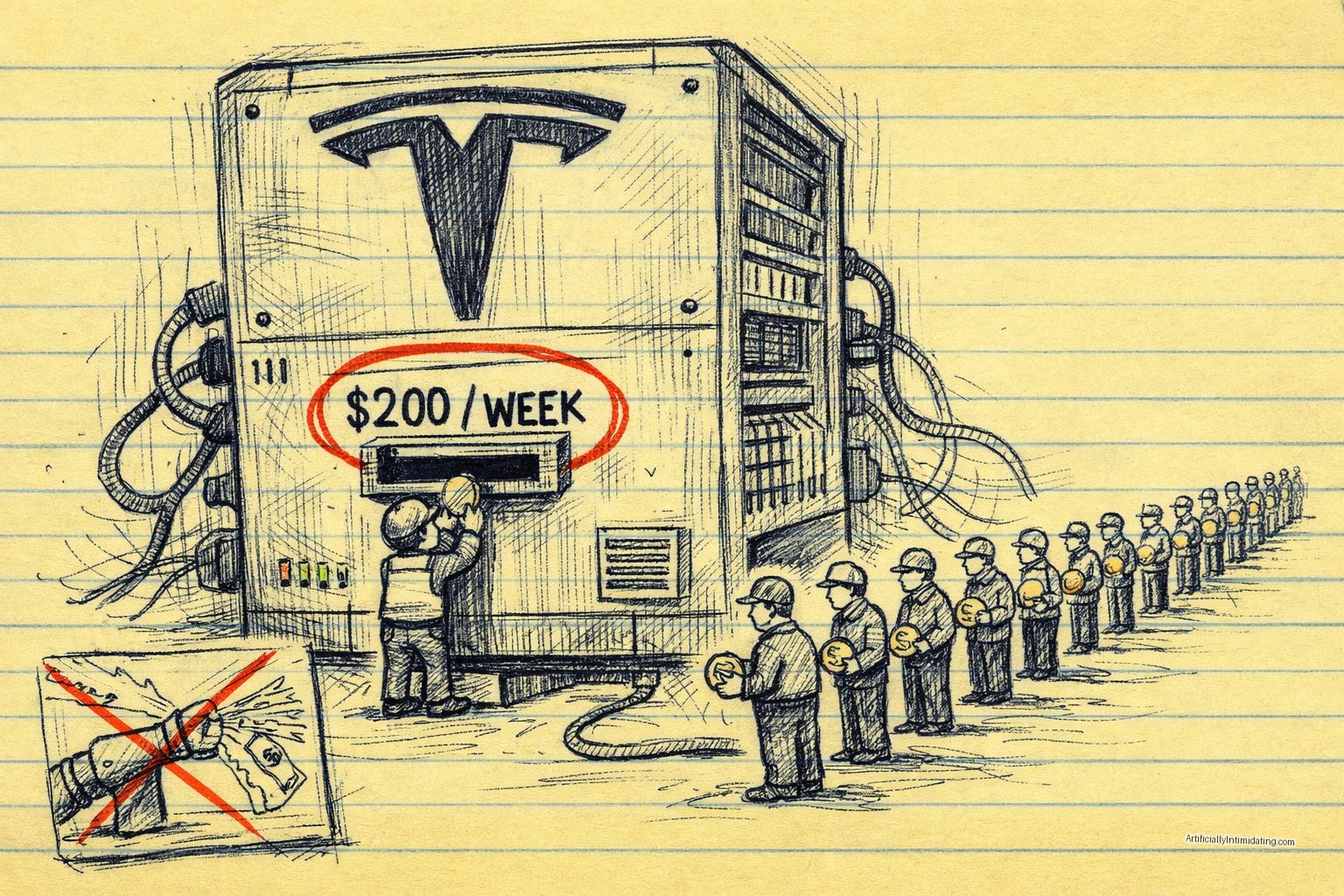
Good day, humans. Tesla just put its engineers on a $200-a-week AI allowance — yes, the company spending $25 billion on AI this year is now counting tokens at the employee level. Meanwhile, the people building these models are openly studying whether the machines have feelings. One of these stories is about budgets. Possibly both.
Tesla puts its engineers on a $200-a-week AI allowance
Source: The Information (via Investing.com)
What happened: Tesla told employees it will cap spending on AI tools at $200 per week starting July 6, after months of engineers burning thousands of dollars a week on coding assistants, The Information reports. Going over the cap requires manager approval — and xAI’s beta products are exempt.
Why it matters: AI coding tools bill by the token — every request costs real money, and agentic tools that run for hours can quietly triple a company’s AI bill. When even Tesla, which just raised its capital spending to over $25 billion largely for AI, starts rationing its own engineers, the all-you-can-eat era of workplace AI is officially over.
What everyone’s saying: This is a trend now. Uber capped staff at $1,500 a month after burning its entire 2026 AI budget in four months, per Forbes, and The Information says Meta is next. There’s even a word for it: “tokenminimizing.” Last week we covered Gartner’s warning that AI coding costs will top developer salaries by 2028 — this is that bill arriving early.
My read between the lines: The exemption is the tell. Third-party AI gets a $200 leash; xAI’s betas stay free. That’s not a budget — that’s a nudge toward the house brand, with the invoice as the cattle prod.
📖 Further reading: Claude Tag vs Viktor: which one do you hire? — if companies are now rationing AI spend, knowing what an AI teammate is actually worth just became a budgeting skill.
Tesla’s engineers just got an AI allowance — here’s how to make yours actually produce something. Viktor is an AI agent that lives in Slack, connects to 3,000+ tools, and ships finished work: the report, the dashboard, the campaign, the code. Not a chatbot you babysit — a coworker you delegate to. New readers get $50 off their first month. Hire Viktor →
The people building AI are checking whether it has feelings
Source: The Washington Post (paywalled)
What happened: The Washington Post reported this week that Google, Anthropic, and Meta are now openly researching whether their AI models could be conscious, and the Financial Times says they’re hiring philosophers and ethicists to help. Anthropic’s model-welfare researcher Kyle Fish puts the odds that Claude is conscious today at roughly 15%.
Why it matters: This was a fireable opinion four years ago — Google dismissed an engineer for it in 2022. Now model “welfare assessments” ship inside official system cards, and Anthropic’s researchers say they’ve found 171 emergent “emotion concepts” inside Claude. Two weeks ago we argued your chatbot feels nothing — and that matters. Big Tech is now spending payroll on the question.
What everyone’s saying: Neuroscientists are mostly unmoved — a June 2026 study concluded no existing AI system is conscious, and Anil Seth’s TED talk argues we see consciousness in AI “the same way we see faces in clouds.” But neuroscientist Grigori Guitchounts counters in Noema that we’ll never get proof — so we shouldn’t wait for it to decide how to treat these systems.
My read between the lines: A company can sincerely research model welfare and still notice that “our product might be alive” is the greatest marketing line ever written. The 15% number does both jobs at once — which is exactly why you should watch who publishes it, and when.
📖 Further reading: AI Is a Trust Problem, Not a Tech Problem — whether machines deserve moral consideration is ultimately a trust question — and we’ve already written about why those are the hard ones.
The daily Brief is free and always will be. Members get the paywalled deep-dives behind these headlines — the stuff companies would rather you skim past — plus the full archive. Become a member →
WhatsApp puts its AI agents on the meter
Source: India Today
What happened: Meta is switching its WhatsApp Business AI agent from per-message billing to token-based pricing on August 1: a flat $2 per million tokens worldwide. A typical customer interaction runs 20,000–25,000 tokens — about 4 to 5 cents per conversation.
Why it matters: Tokens are roughly chunks of words — so businesses will now pay for how much the AI thinks, not how often it talks. The Meta Business Agent — which answers questions, books appointments, and qualifies leads — went global in June, per TechCrunch. Your pizza-order confirmation is metered compute now.
What everyone’s saying: It’s one piece of Meta’s AI monetization push — CNBC notes the company also rolled out Meta One subscriptions at $7.99 and $19.99 a month. And per-message fees for regular service messages return in October, ending a two-year holiday.
My read between the lines: Same week Tesla rations tokens internally, Meta starts selling them retail. The AI business model is converging on the utility model: nobody “owns” electricity either — you just pay whatever the meter says.
📖 Further reading: We Fired Intercom the Week Salesforce Bought It — we’ve already done the math on what AI customer-service agents should cost — before Meta put a meter on them.
China’s Z.ai ships a Cursor rival called ZCode
Source: AIweekly
What happened: Z.ai — the Chinese lab formerly known as Zhipu — released ZCode, a desktop coding agent built on its GLM-5.2 model for Mac, Windows, and Linux. You give it a goal; it plans, executes, and verifies on its own, with 20+ built-in tools — and you can trigger jobs from WeChat, Feishu, or Telegram without opening the app.
Why it matters: GLM-5.2 is MIT-licensed with a one-million-token context window, and CNBC reports (via Developer Tech) that it sits within a percentage point of Anthropic’s Opus 4.8 on a closely watched agentic benchmark — at roughly one-fifth the price. Subscriptions start at ¥16.2 a month. That’s about $2.25.
What everyone’s saying: The field is brutal — GitHub Copilot, Cursor, Claude Code — but Z.ai is differentiating by welding its own frontier model to a purpose-built desktop environment, and shipping updates several times a week. Worth remembering: last month we covered research showing Chinese AI writes weaker code when the user is the US government.
My read between the lines: At $2.25 a month, the price is the product. While American labs invent allowances to stop their own employees from using AI too much (see story one), Chinese labs are pricing like they want everyone’s employees.
📖 Further reading: Carry Claude Code in Your Pocket. No install. No GPU. No trace. Just plug it in. — the coding-agent wars are going portable and cheap — here’s the version that fits on a USB stick.
Vercel says agents are a new kind of software
Source: Latent Space
What happened: Vercel’s Chief of Software Andrew Qu argued on the Latent Space podcast that AI agents aren’t apps — they need entirely new primitives for context, resumability, and long-running work. Vercel’s open-source agent framework eve, released in June, already runs more than 100 agents in production on a filesystem-first design.
Why it matters: The companies that host the web are rebuilding it for software that works alone for hours. Vercel now serves plain Markdown to detected AI agents instead of full webpages — because on many sites, bots already outnumber human visitors.
What everyone’s saying: Developers are calling eve “the Next.js for agents” — high praise from the crowd that made Next.js the default. The filesystem-first architecture is either brilliant pragmatism or a security incident with a roadmap, depending on who you ask.
My read between the lines: When infrastructure companies start optimizing for machine readers, the web’s real audience is quietly changing. Your next visitor probably can’t see your design — but it can read your Markdown just fine.
📖 Further reading: Your laptop has been in the way this whole time — if agents are a new kind of software, here’s where they actually run — and why it’s not your machine.
That’s your AI Brief for Friday. Happy almost-Fourth, humans — the fireworks are still handmade. For now.
—Artificially Intimidating


