

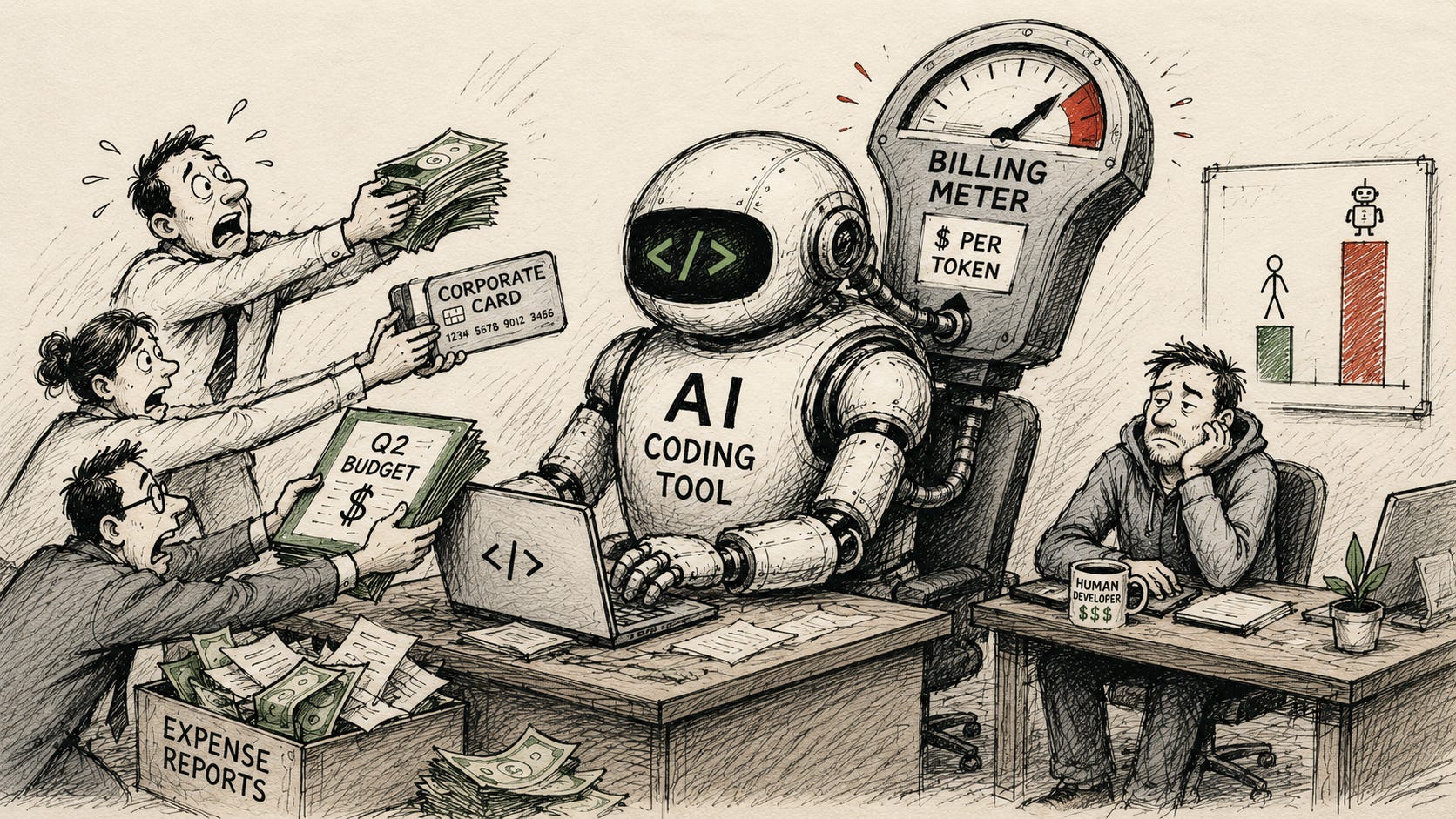
Good day, humans. Today the invoice arrived: Gartner says enterprise AI coding will soon cost more than the developers it's helping. And that's somehow only the third-weirdest thing on the docket — Claude is quietly converting wallets, Gemini learned to read your screen, AI is now writing most of its own code, and Paul Krugman has decided the whole AI backlash is an inside job. Coffee up.
AI Coding Is About to Cost More Than the Coders
What happened: Gartner published a report this week predicting that by 2028, what companies spend on AI coding tools per developer will exceed the average developer's salary, as flat subscriptions give way to per-token billing and usage keeps climbing.
Why it matters: Plain version: AI coding help used to be a flat monthly fee; now you pay per “token” — roughly per chunk of text the AI reads or writes — and the meter runs fast. Uber reportedly burned through its entire 2026 AI budget in four months and now caps employees at $1,500 a month per tool.
What everyone's saying: A budgeting reckoning has arrived — a KPMG report out the same day found only about a quarter of C-suite leaders have real-time visibility into what their AI actually costs to run.
My read between the lines: The detail buried in leaked Accenture audio: it's not the engineers running up the bill, it's non-engineers shoving documents through AI just to reformat them. The “AI will cost more than developers” headline is really a “everyone codes with tokens now, and nobody priced it” problem.
📖 Further reading: Thanks to Apple, Your Favorite AI Tool Is a Dead Tool Walking — if frontier models are becoming cheap commodities, why are the bills exploding? The pricing paradox underneath today's story.
Speaking of runaway AI bills: the fix isn't fewer tools, it's tools that actually finish the job. Viktor is an AI agent that lives in your Slack and plugs into 3,000+ apps — hand it a task and it ships the work back: a built dashboard, a drafted campaign, a pulled report, working code. Not a chatbot you babysit; a coworker who delivers. New readers get $50 off their first month. Hire Viktor →
Claude Is Quietly Winning the Wallet War
What happened: New credit-card transaction data shows Claude's paying consumer base and revenue have grown roughly 75% since January, narrowing the long lead ChatGPT has held in the consumer market.
Why it matters: Anthropic, the maker of Claude, was long pegged as the “enterprise and developers” AI company — this is evidence ordinary people are paying too. DataCamp says “Claude” is now the most-searched term on its platform, beating even “AI,” with Claude course demand outpacing ChatGPT three to one. Earlier this month we covered Anthropic's IPO filing; these consumer numbers are the part of that prospectus investors were waiting for.
What everyone's saying: ChatGPT still dwarfs everyone — it crossed a billion monthly users in May per Sensor Tower — but its share of chatbot apps slipped below 50% for the first time in March, and the gap keeps narrowing.
My read between the lines: A chunk of Claude's spring surge came right after Anthropic publicly refused to let its models be used for mass surveillance. Turns out “the AI company that says no” is a brand — and people will pay a subscription to feel good about which robot they're funding.
📖 Further reading: Claude Tag vs Viktor: Which One Do You Hire? — if you're paying for Claude anyway, here's where it actually earns its keep as a teammate.
Quick housekeeping: this Brief is free, and always will be. But the paywalled deep-dives — like which AI teammate is actually worth hiring, or what Claude's consumer surge means for Anthropic's IPO — are where I do the real digging. Founding members get 20% off the first year, and the launch deal closes Monday. Lock it in before June 30 →
Gemini Can Now Read Your Screen
What happened: Google is rolling out “Select from Screen” for Gemini in Chrome (version 149): you draw a box around any text or image on a webpage and it's instantly attached to your AI prompt — no describing required.
Why it matters: It's the desktop version of the “Circle to Search” gesture phones have had for a while — point at the thing instead of explaining it. In practice you can box two products to compare them, or select part of an image to edit. The browser is becoming the AI's eyes.
What everyone's saying: It's one piece of a bigger Chrome AI push — Skills (saved prompts), auto-browse (multi-step automation), and an experimental WebMCP standard that lets websites expose tools directly to AI agents.
My read between the lines: WebMCP is the sleeper. “Select from Screen” is a nice convenience; a standard that lets every website hand structured commands to your browser's AI is the actual land-grab. Google is quietly laying the plumbing for the agentic web while everyone coos at the new highlighter.
AI Agents Are Going Local, Physical, and Self-Improving
The Economist (paywalled)
What happened: A mid-year roundup of where AI “agents” stand in 2026: increasingly running locally on your own machine, gaining persistent memory and identity, reaching into the physical world via robotics — and, most strikingly, improving themselves. Anthropic now says Claude writes over 80% of the code that gets merged at the company.
Why it matters: Earlier this week we flagged Anthropic's AI writing the bulk of its own code — this is the fuller picture. “Recursive self-improvement,” AI that helps build the next, better AI, used to be a thought experiment. That 80% figure turns it into a payroll line item.
What everyone's saying: Two camps are forming. Tools like OpenClaw bet on user-controlled, file-backed agents you fully own; others, like Hermes Agent, bet on agents that autonomously learn from experience. Local-and-private versus autonomous-and-adaptive.
My read between the lines: “Claude writes 80% of our code” is the flex everyone's repeating, but read it twice: the company building the agent is also the one most exposed if it's wrong. When the AI writes the AI, code review is the only adult in the room — and Anthropic's adults are reviewing at machine speed.
📖 Further reading: OpenAI Shipped a Physical Camera, But That's Not the Story — the same agents leaving the screen and touching the physical world, one $150 prototype at a time.
Krugman: The AI Backlash Is an Inside Job
What happened: Economist Paul Krugman argues the public's growing hostility to AI isn't irrational technophobia — the industry manufactured it, marketing AI as a job-destroying apocalypse to dazzle investors, then acting surprised when people believed them.
Why it matters: The numbers back the mood: a recent Pew survey found 40% of Americans expect AI to harm society, nearly triple the 16% who expect benefit. Former Google CEO Eric Schmidt was literally booed off a commencement stage for praising AI.
What everyone's saying: Krugman isn't alone — a same-day NYT essay by Paul Kedrosky tied AI pessimism to labor-market insecurity, and even Microsoft's Satya Nadella has distanced himself from the doom-marketing: you can't tell people you're coming for their jobs and expect applause.
My read between the lines: The tell is “forced adoption.” People don't just fear AI — they resent being opted in with no switch to turn it off (see: Google Search). The backlash isn't about capability; it's about consent. And consent is the one thing you can't ship in the next model update.
📖 Further reading: AI Is a Trust Problem, Not a Tech Problem — the backlash Krugman is describing, from the ground floor.
That's your AI Brief for Friday. The robots are getting cheaper to build and more expensive to run — make of that what you will.
—Artificially Intimidating