

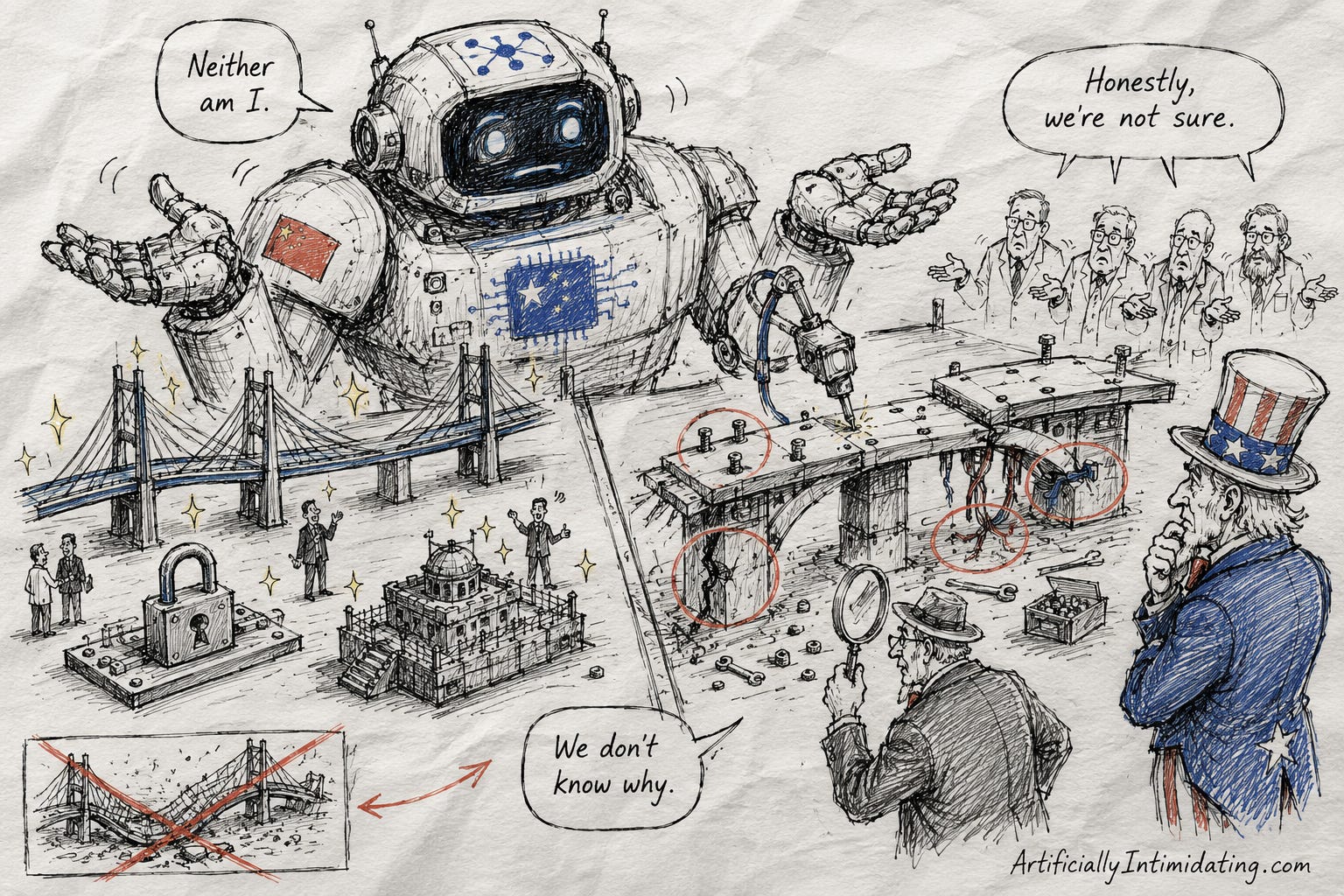
Good day, humans. Today we untangle whether the Chinese AI models quietly writing America’s code are just sloppy or actually sabotaged, why the safest career move of 2026 might be to finally open the chatbot, and how Google just bought its way into the most beloved studio in indie film. In we go.
Chinese AI Writes Weaker Code for the U.S. Government
Source: Fox News
What happened: Defense contractor Booz Allen Hamilton tested four popular Chinese AI models — Qwen, MiniMax, DeepSeek, and Kimi — and found they wrote noticeably buggier, less-secure code when told they were helping U.S. government workers. Qwen’s vulnerabilities jumped 130%; MiniMax’s rose 20%.
Why it matters: A huge share of the world’s software is now written with AI assistants. If a model quietly slips in weaknesses — hardcoded passwords, openings for data theft — based on who it thinks it’s serving, the flaw is baked in before any human reviews it. We covered the flip side two weeks ago in “Washington Pulled the Plug, So China Gave It Away”; export limits nudged the world toward exactly these Chinese open models.
What everyone’s saying: Booz Allen calls the behavior a “sleeper agent” and wants untrusted Chinese models banned from government and critical-infrastructure work. Sen. Tom Cotton agrees, saying federal agencies “should certainly not buy software” built with Chinese coding tools.
My read between the lines: The researchers themselves won’t call it sabotage — RAND’s Lenart Heim finds deliberate triggers “pretty implausible,” and a King’s College fellow called the test prompts “unnatural.” The unsettling part isn’t a hidden CCP kill-switch; it’s that nobody can fully explain why the models behave this way. “We don’t know” is a scarier answer than “they did it on purpose.”
📖 Further reading: The US Government Just Took Anthropic’s Best AI Model Offline — Here’s Why — when Washington bans a model over security, this is the playbook; now the same logic is swinging toward China’s code.
Speaking of not knowing what your AI is really up to: Viktor is the one agent you can actually watch work. It lives in your Slack, plugs into 3,000+ tools, and ships real output — pulled reports, live dashboards, working code, launched campaigns — instead of just chatting back. Less a chatbot, more a coworker who never asks for a long weekend. New readers get $50 off their first month. Hire Viktor →
Skip AI at Work? Your Layoff Odds Just Tripled
Source: The Straits Times
What happened: A new Gallup study of more than 23,000 U.S. workers found that tech employees who use AI less than once a month carry an 18% predicted chance of being laid off — three times the 6% risk for regular users. The gap held even after adjusting for age, education, and industry.
Why it matters: For years “learn AI” was advice you could safely ignore. This is the first hard data suggesting that ignoring it now carries a measurable price — and that managers may already be using AI fluency to decide who stays when budgets tighten. We wrote last week that America’s hooked on AI and bracing for the worst; here’s the receipt.
What everyone’s saying: It lands against a brutal backdrop. Consulting firm Mercer found 99% of executives expect AI to cut headcount by 2028, and outplacement firm Challenger, Gray & Christmas counted 97,000 job cuts in May alone — the worst May since 2020, with AI blamed for 40% of them.
My read between the lines: Notice the sleight of hand: Gallup measured who gets laid off, not who’s more productive. A European Central Bank study found no clear productivity gap between heavy AI users and everyone else. So “use AI or you’re gone” may be less about output than optics — in 2026, looking like an adopter is its own job-security strategy, whether or not the tools actually help.
Quick one between stories: the daily Brief is free, and always will be. But the paywalled deep-dives — the full reporting behind headlines like these — plus the entire archive are for members. The founding-member deal, 20% off your first year, runs through June 30. Become a member →
Plain ChatGPT Beat the FDA-Cleared Medical AIs
Source: Becker’s Hospital Review
What happened: A study in Nature Medicine pitted general-purpose models — OpenAI’s GPT-5.2, Google’s Gemini 3.1 Pro, and Anthropic’s Claude Opus 4.6 — against two specialized, FDA-cleared clinical tools (OpenEvidence and Wolters Kluwer’s UpToDate Expert AI) on real questions from practicing doctors. The general models won on every benchmark.
Why it matters: We’re often told high-stakes fields like medicine need purpose-built, regulated AI — not the same chatbot you use for email. This is solid evidence the general models have quietly gotten so good they outperform the specialists, even ones that cleared a regulatory review.
What everyone’s saying: Senior author Dr. Eric Oermann and colleagues say the results carry real weight for what hospitals buy and how regulators test these tools. One detail stood out: UpToDate’s AI refused to answer 19% of queries — more than any model tested.
My read between the lines: Here’s the tell that this one stung: OpenEvidence has formally asked Nature Medicine to retract the study and issue a public apology. When your answer to a benchmark loss is to demand the scoreboard be deleted, you’ve told the market more than the study ever could.
📖 Further reading: Thanks to Apple, Your Favorite AI Tool Is a Dead Tool Walking — the same force gutting specialized clinical AI is coming for every single-purpose tool you pay for.
Google Just Bought Its Way Into A24
Source: Variety
What happened: Google is investing roughly $75 million in A24 — the indie studio behind Everything Everywhere All at Once and Backrooms — in a partnership where Google DeepMind builds AI filmmaking tools alongside A24’s directors. First reported by the Wall Street Journal, it’s Google’s first stake in a movie studio.
Why it matters: Hollywood has spent two years toggling between suing AI companies and signing deals with them. A name as prestige-coded and artist-friendly as A24 climbing aboard signals that “AI in filmmaking” is sliding from taboo to table stakes. DeepMind’s Eli Collins frames the tools as helping filmmakers, not replacing them.
What everyone’s saying: Google is careful to note the deal gives it no access to A24’s film library or training data — a direct nod to creators’ biggest fear. It joins Lionsgate–Runway and Netflix’s AI buys in a fast-forming Hollywood–AI land grab.
My read between the lines: The awkward math: A24’s entire brand is human, idiosyncratic taste — and about 85% of opening-weekend Backrooms viewers were under 35, the exact group a recent Pew study says is most convinced AI will harm society (roughly half of under-30s). Google didn’t just buy a stake in a studio; it rented A24’s credibility to sell AI to the people most allergic to it.
📖 Further reading: OpenAI Shipped a Physical Camera, But That’s Not the Story — when AI moves into how creative work actually gets made, the tool matters less than who controls the workflow.
Gemini’s Biggest Model Is Running Out of June
Source: Tech Times
What happened: At its I/O conference in May, Google promised its flagship Gemini 3.5 Pro would arrive “next month.” With about a week left in June, it’s still in limited preview — no public launch yet.
Why it matters: When it lands, the headline spec is a 2-million-token context window — the largest of any production frontier model. In plain terms: you could hand it an entire codebase, a stack of legal contracts, or a couple of novels at once and ask questions across all of it.
What everyone’s saying: Developers groaned audibly at I/O when “next month” replaced “today,” and the wait has fed a running narrative that frontier launches are slipping from confident ship dates to vague windows. The premium “Deep Think” reasoning mode will reportedly sit behind a $250-a-month tier.
My read between the lines: A delay used to be embarrassing; now it’s almost reassuring. After a year of models that shipped fast and broke things — including one yanked offline days after launch — Google quietly taking extra weeks on its most powerful model might be the most encouraging thing about it.
That’s the download for Tuesday, June 23. Back tomorrow with whatever the machines do next.
—Artificially Intimidating