

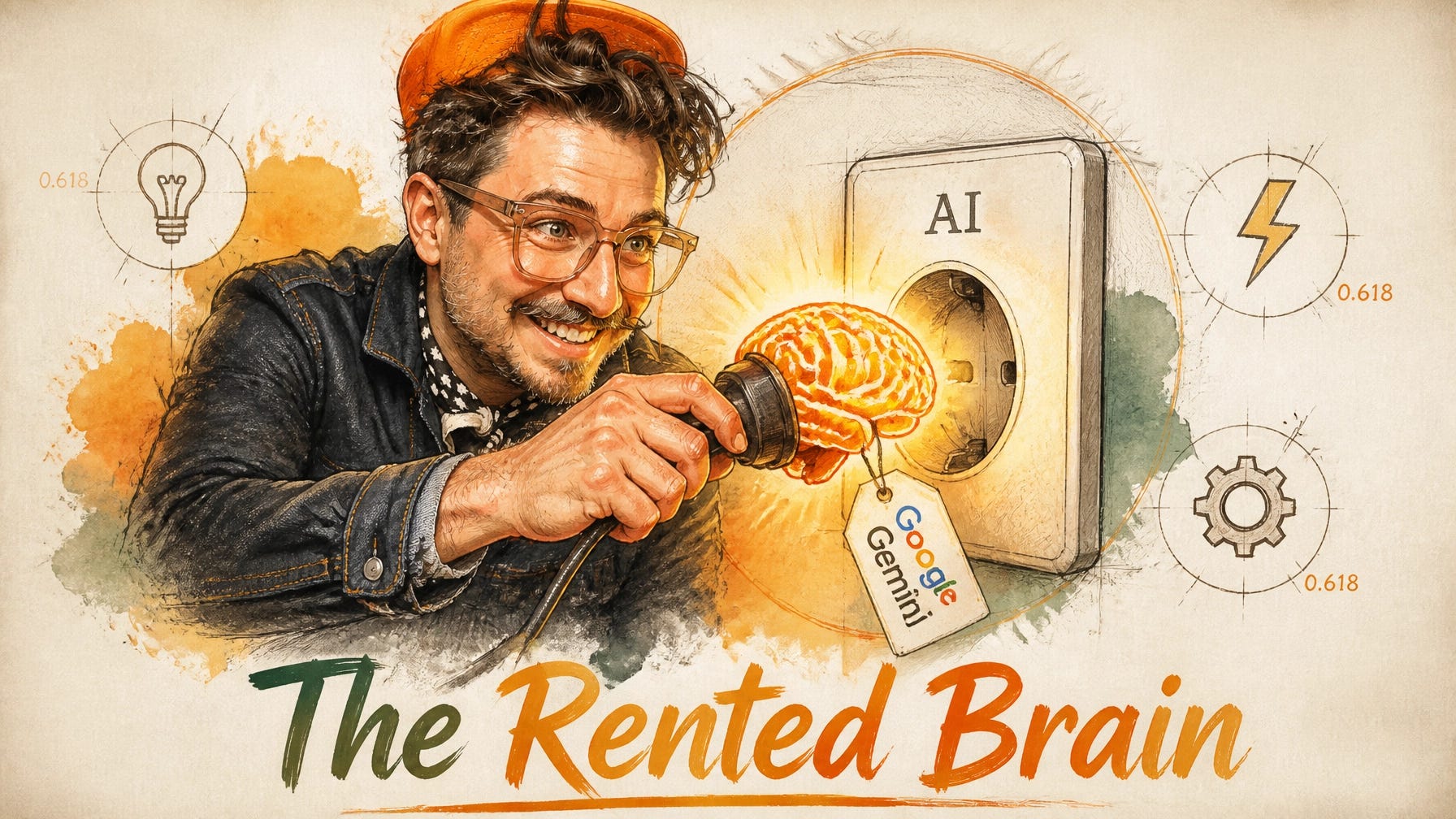
Three weeks ago, in the May 18 brief, I said Apple was quietly trying to “own the trust layer” — routing your Siri requests through its own Private Cloud Compute before they ever touch Google’s Gemini.
I wrote it as a throwaway line. After watching WWDC, I think it was the whole ballgame.
Because here’s what Apple actually announced on Monday, underneath the Liquid Glass sliders and the 80%-faster AirDrop and a macOS named, I’m not kidding, “Golden Gate”:
Apple gave up on building the AI. And it might be the smartest move they’ve made in a decade.
They rented the brain
The new Siri AI — the one Apple first promised in 2024, the one they got sued over and settled for $250 million when it didn’t ship — doesn’t run on Apple’s own frontier model.
It runs on Google’s Gemini.
Apple adapted Gemini to run on its devices and servers, slapped an “Apple Foundation Models” label on it, and shipped it. Even the watermark on AI-generated images is Google’s tech (SynthID). The dependency runs deep, and Apple barely tried to hide it.
Now — the easy take is “Apple fell behind and had to go begging to Google.” And sure, there’s some truth there. You don’t pay a quarter-billion-dollar settlement from a position of strength.
But that’s not the interesting part. The interesting part is what Apple built around the rented brain.
The Tell: A Socket
Look at what Apple kept for itself and what it outsourced.
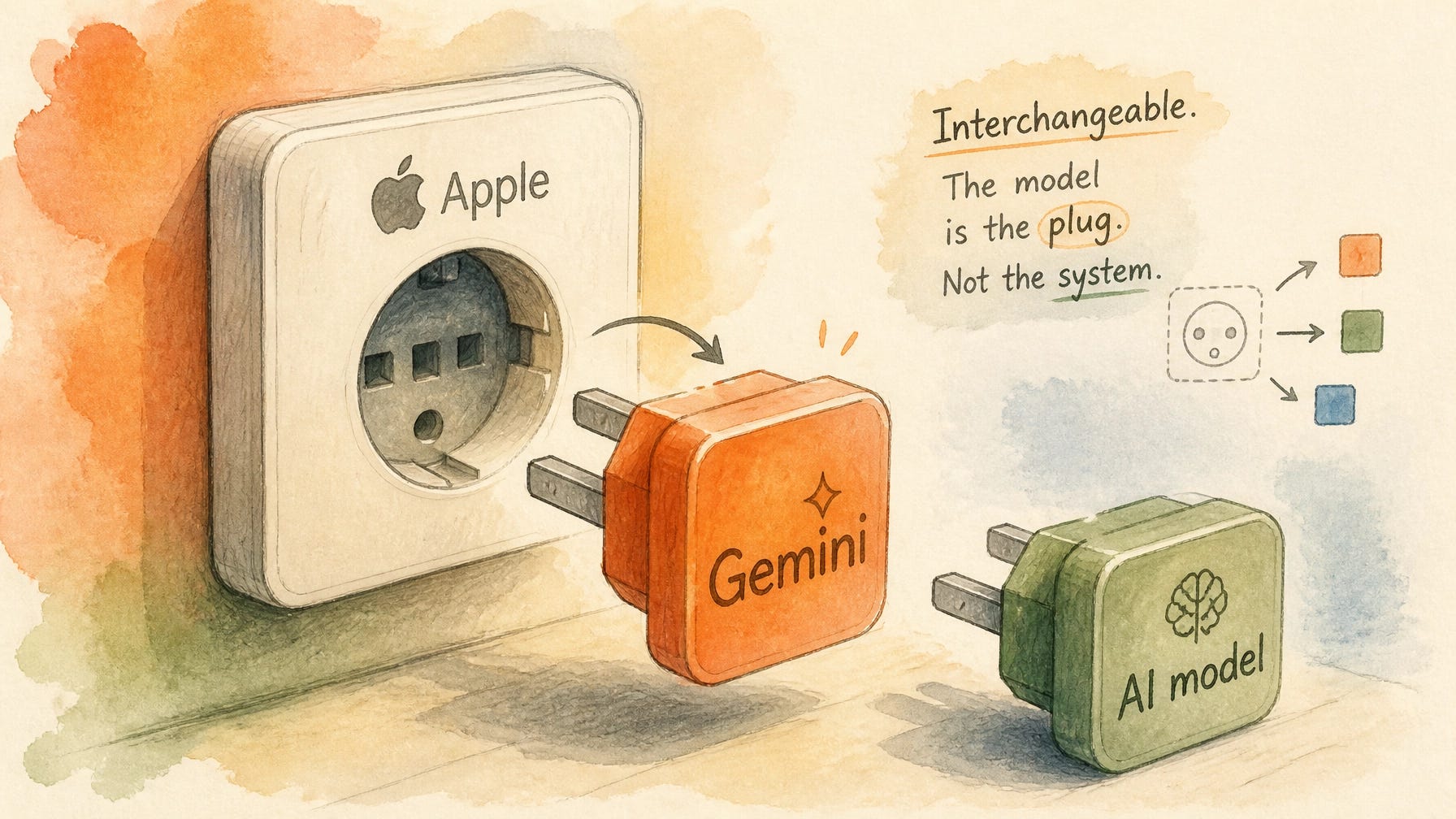
It outsourced the model. But it kept every piece of the layer that wraps around the model: the system orchestrator, the semantic index in Spotlight that knows your photos and your messages, App Intents that let Siri reach into your apps, on-screen awareness, the personal-context plumbing. That’s the hard part. That’s the part nobody can copy, because it’s welded into the OS and your data.
And then there’s the detail that gives away the entire strategy: Apple is building Apple Intelligence so you can swap the underlying model out. Gemini today. Something else tomorrow. A socket on the wall.
You do not design a slot to swap the engine if you think the engine is your advantage.
Apple just told the entire industry, in its own product architecture, that it believes the frontier model is a commodity — a part you buy, like a screen or a battery or a chip from TSMC. The intelligence is interchangeable. The integration is the product.
That is a wildly different bet from OpenAI and Anthropic, who are betting their entire valuations that the model itself stays the moat.
So who’s right?
The squeeze nobody’s talking about
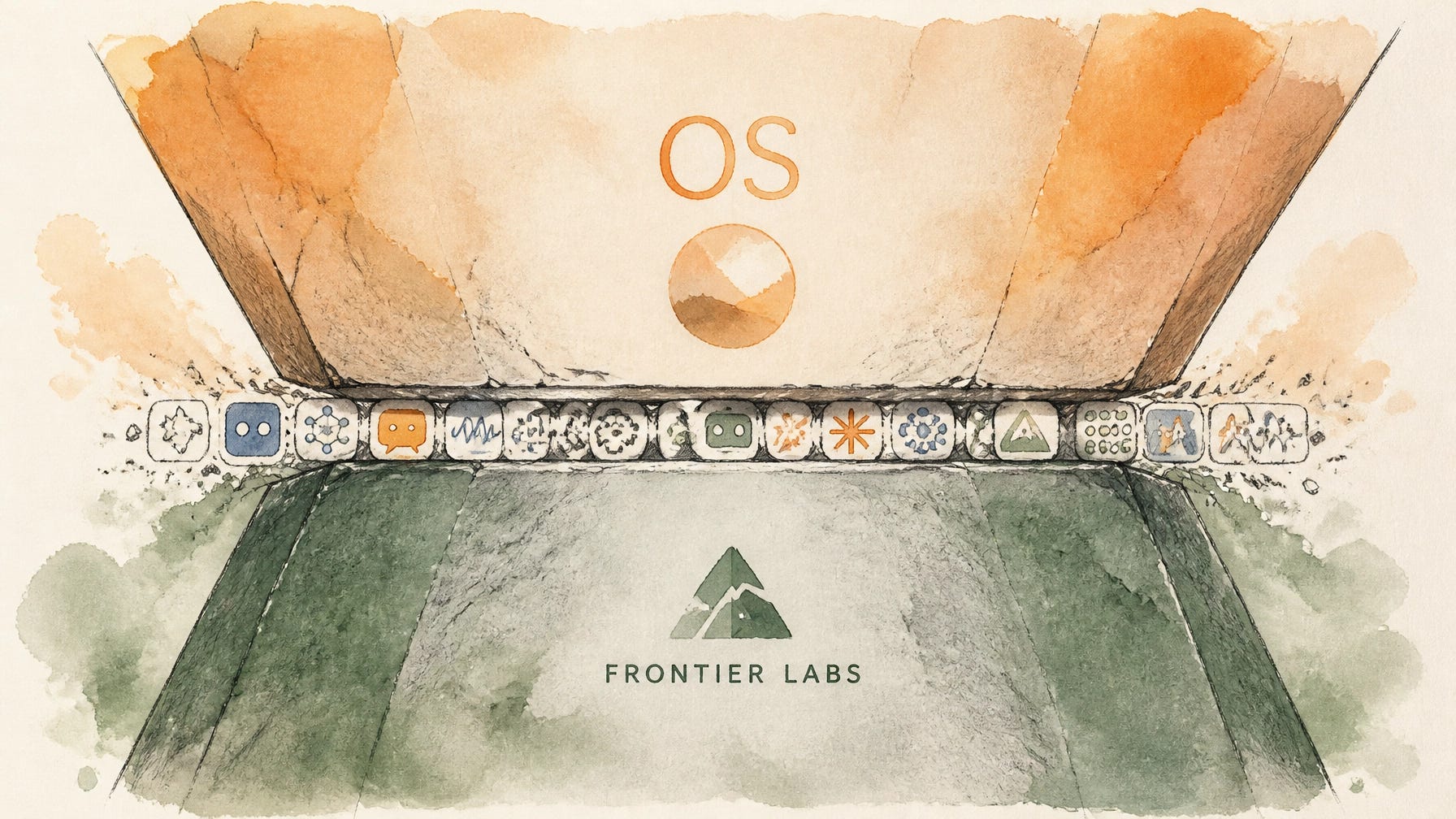
Here’s the thing that makes Apple’s bet so sharp: “the model is a commodity” crushes the middle from both directions at once.
From above, value floats up to whoever owns distribution, data, and trust. That’s Apple. A billion devices. Your photos. Your messages. Fifteen years of “I’ll hand Apple my data and they won’t sell it.” Gemini is just the engine they dropped into a car everyone already owns and already trusts.
From below, the labs don’t sit still. OpenAI and Anthropic spent the last three years watching people build on their APIs, cherry-picking the workflows that got traction, and absorbing them in-house. ChatGPT Search is Perplexity. Projects, memory, Canvas, computer use — every one of those was somebody’s startup first.
So the thin middle gets flattened. And I’ll say the quiet part out loud, even though one of these is a tool I’ve recommended to you:
Perplexity, Jasper, Wispr Flow, the other dictation apps, the standalone “chat with AI” wrappers — I think most of them are dead tools walking. Not because they’re bad. I love many of these and they supported our business and entry into this space …. but because they built their whole business inside the labs’ roadmap, with no distribution the labs can’t match and no data the labs can’t get.
Perplexity is a gorgeous interface sitting directly on top of the one feature OpenAI most obviously wanted. Brand alone doesn’t stop OpenAI. It barely slows it down.
And the agents are next
Here’s where I lose half of you, because this is the part nobody funding the current hype cycle wants to hear.
It’s not just the chatbot wrappers that are dead tools walking. It’s most of the agents everybody’s so excited about right now.
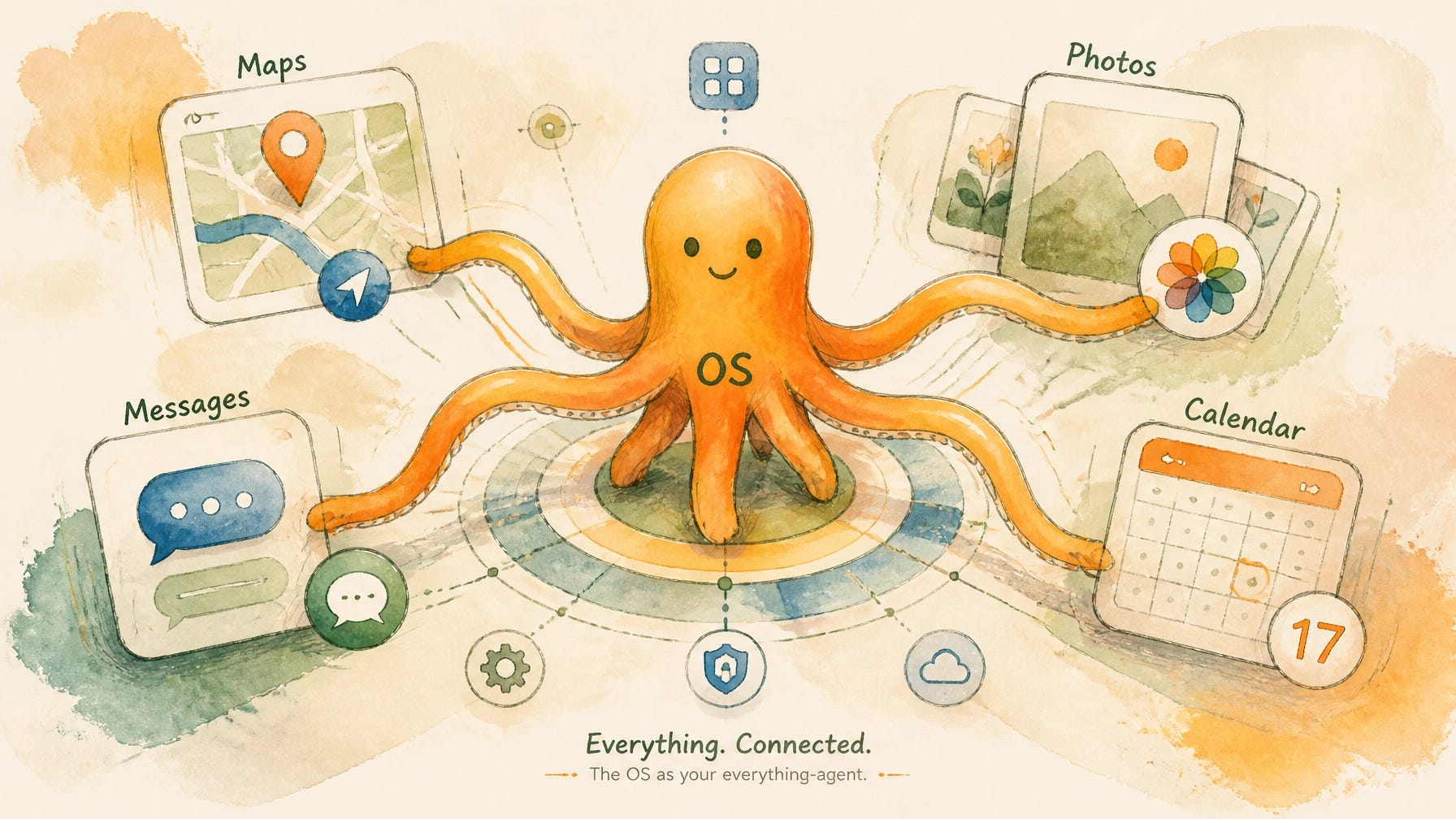
Watch what Siri actually did in the demos. “Give me directions to the arch with a stop at Jeff’s.” “Add just the photos with Bryce to the shared album.” “Send the menu to the Goal Chasers group chat.” That’s not search. That’s an agent orchestrating across Maps, Photos, Contacts, and Messages from one plain-English sentence.
Apple is building the everything-app. Except it’s not an app — it’s the operating system becoming the agent. They don’t need you to download it. It’s already on the phone in your pocket, wired into your data, with App Intents reaching into every app on the thing.
And the second the OS is the agent, every standalone agent startup gets caught in the exact same squeeze as the wrappers — from both sides. The OS owns it from above: Siri has your personal context, your apps, and a billion-device head start no startup will ever match. The labs own it from below: ChatGPT, Claude’s computer use, Gemini’s agents, all racing to do your tasks natively. The standalone “AI agent that runs your life” is a wrapper with extra steps.
That’s the growth plan, by the way. The App Store taxed apps. The everything-agent taxes every action — Apple sitting in the middle of every booking, every purchase, every transaction, taking its cut, privacy as the cover story. It’s the App Store land-grab an order of magnitude bigger.
Now — does Siri actually pull this off out of the box? Honestly, no. It ships in beta later this year, English-only, blocked in the EU, newest-silicon-only, from the company that promised this exact Siri in 2024 and paid $250 million for missing. The ambition is real. The day-one delivery will lag, like it always does. So there’s a window.
But a window is not a moat.
There will be survivors. They’ll just be few and far between. The agents that live are the ones with — say it with me — the moats. Proprietary data the OS can’t get. A real customer relationship the OS won’t bother to win. Or a vertical so specific, so cross-platform, so far outside Apple’s walls that Siri will never show up to compete. (Apple’s agent only works inside Apple’s world. The web, Windows, Android, the messy regulated verticals — that’s open ground.)
Everything in the fat middle — the horizontal consumer agent with a nice UI and someone else’s model underneath — has a clock on it. Run the test one more time: if Siri can do this natively next fall, what do I have left? If the answer is nothing, you didn’t build a company. You built a feature Apple hadn’t shipped yet.
The only moats left
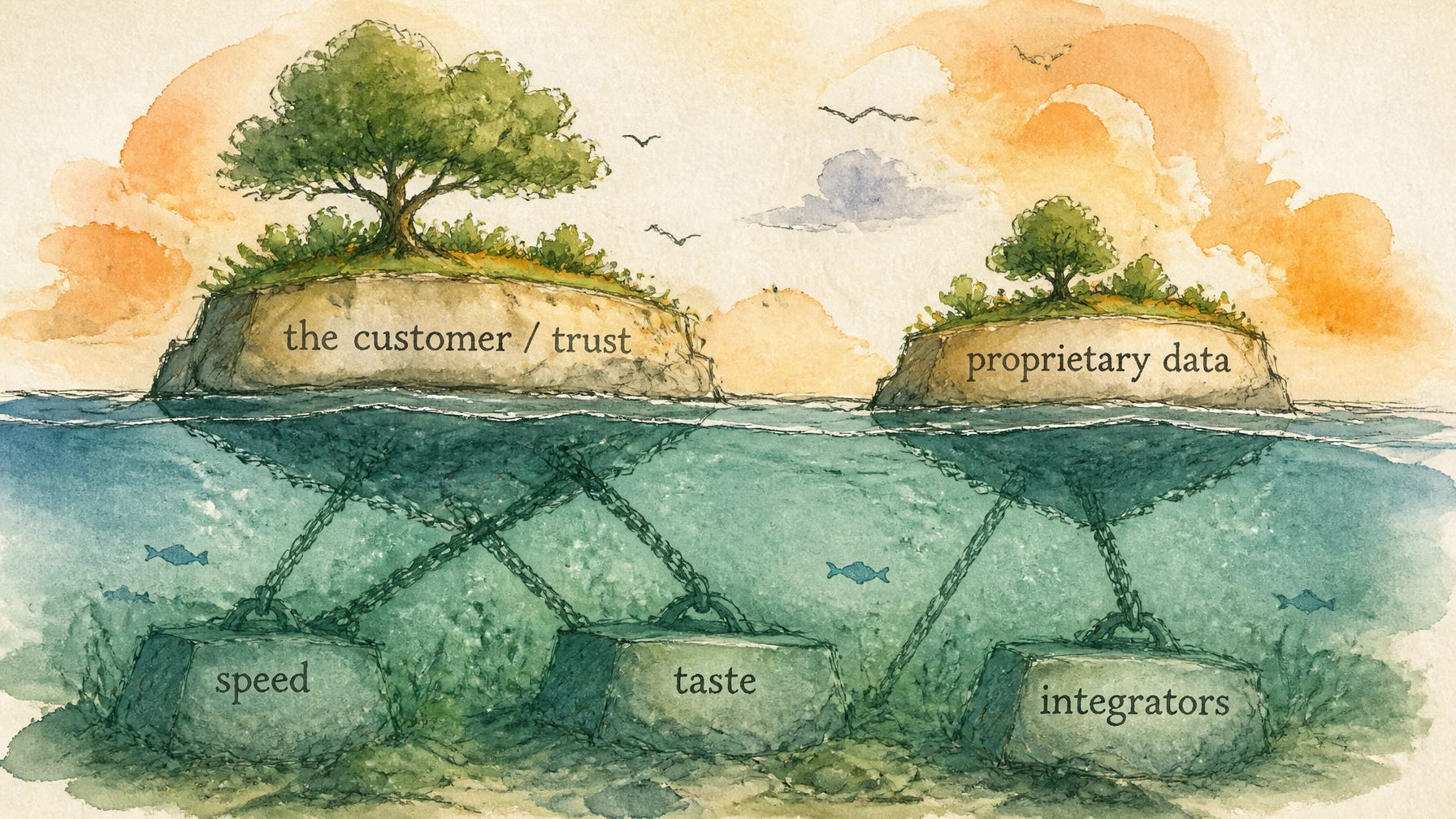
Strip the jargon off everything above and you’re left with a brutally simple map. When intelligence is a cheap utility you rent by the token, exactly three things still defend you — and nothing else does.
Own the customer. The relationship. The audience. The fact that they come to you on purpose. The labs can clone any tool you use, but they can’t clone the ten thousand people who open your email because it’s yours.
Own the data. Something you generate or collect that no lab has and can’t buy — your transactions, your niche, your operational history. The AI is rented. The data is yours.
Own the trust. This is the one nobody puts on the list, and it’s the whole game. An audience isn’t enough — there are huge lists nobody believes. Trust is what lets you stand in the middle: the one they’ll let broker their tools, hold their data, point them at the rented intelligence. Trust is what turns an audience into a position.
That’s it. That’s the list. Everything else — speed, taste, being a clever integrator — is a head start, not a wall. Real ways to make money. Not moats.
And here’s the part that should reorganize your whole week: Apple’s moats and yours are the same three, just at different scale. A billion customers. Their photos and messages as the data. And fifteen years of trust — which is the one Apple just quietly turned into a cash register.
Which means the model going commodity is the best news an audience-owner has ever gotten. For years the moat was the technology, and you couldn’t compete on that — you don’t have a research lab. Now the tech is a socket on the wall, and the three things that are left are the three things a small operator can actually build.
So the strategy writes itself. Stop chasing the best tool. Start building the three things the labs can never take — and steal the one move Apple just used to monetize all three.
Own the three — and steal Apple’s trust trick
Let me get specific, because “build a moat” is useless without a Monday-morning to-do. And to be clear up front: I’m not torching my stack over one keynote. None of this is “cancel your subscriptions today.” It’s where the time and the money go from here.
The filter
Every tool now has to answer one question before it gets another dollar:
