

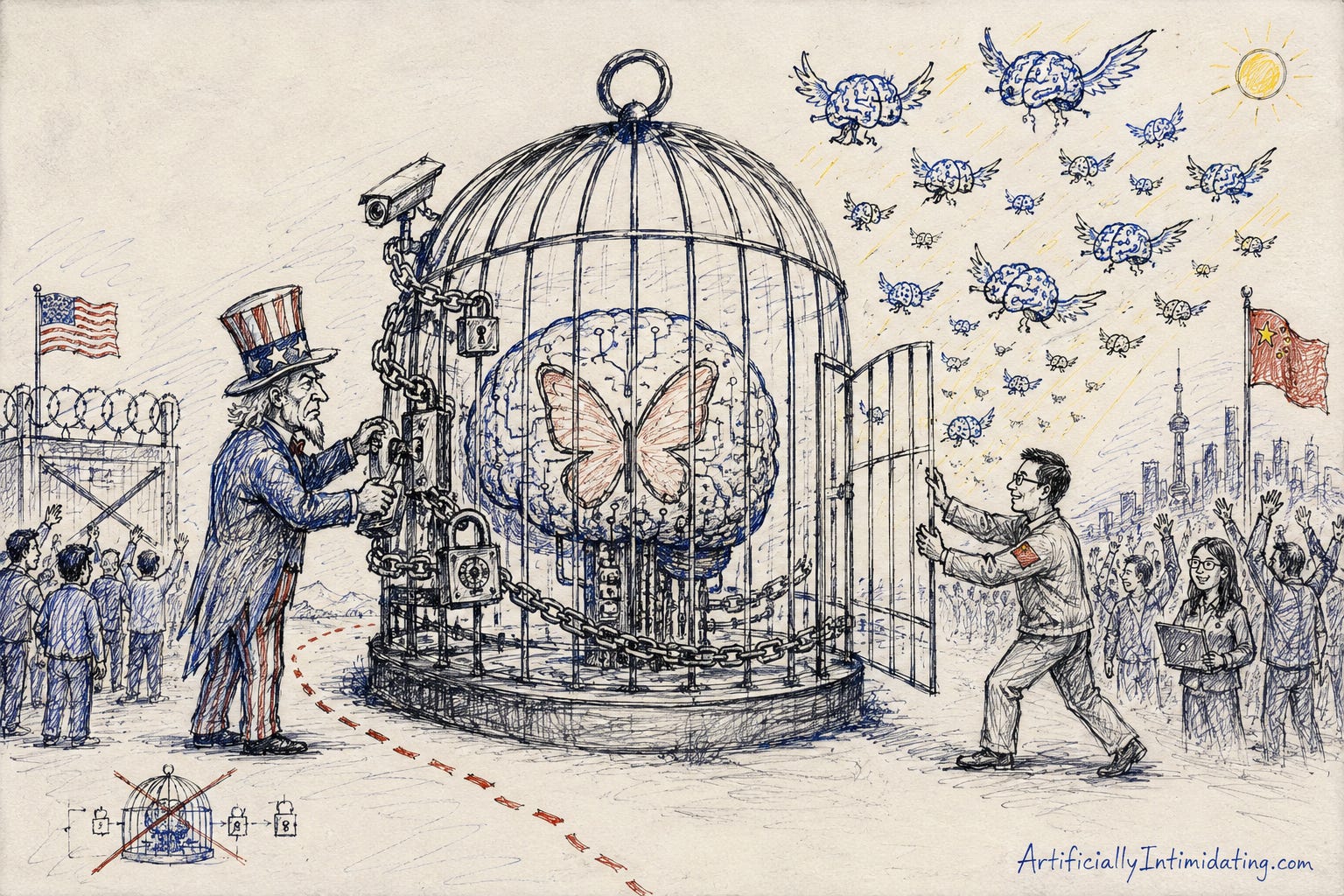
Good day, humans. Yesterday Washington reached into Anthropic’s servers and switched off its two best models — Fable 5 and Mythos 5 — for everyone outside the US. The rest of the AI world spent the next 24 hours answering back, and the answers tell you everything about where this is going: China open-sourced its flagship out of apparent spite, a decentralized-AI token pumped on the principle of the thing, and a German court reminded Google that whatever its AI says out loud, Google owns. Let’s get into it.
📬 Before we dive in: The sharpest AI Brief tips come from readers who are actually in the weeds. If you spot a story worth covering, drop it in the community Discord. The best tips make tomorrow’s edition.
China Just Gave Away Its Best Model
What happened: Zhipu AI released GLM-5.2 on June 13 — its new flagship, a 744-billion-parameter mixture-of-experts model with a usable 1-million-token context window, rolled out to every GLM Coding Plan tier with open weights under the MIT license promised within the week. It landed the same day the US ordered Anthropic to pull Fable 5 and Mythos 5 offline.
Why it matters: While one government was switching off the West’s most capable models, a Chinese lab was giving its flagship away for free — and said so explicitly, framing the release as a rebuttal to the idea that frontier AI can be "withdrawn at any time by a few rules." We covered the shutdown itself yesterday; this is the other side of the same coin.
What everyone’s saying: GLM-5.1 already beat every closed model on SWE-Bench Pro, and GLM-5 was trained entirely on Huawei chips with zero Nvidia. The consensus is hardening: China’s open coding models are now genuinely frontier-class, not fast-followers.
My read between the lines: The "open" framing has an asterisk. At launch GLM-5.2 is paywalled behind paid Coding Plans, with the actual weights and any independent benchmarks both "coming next week." Developers in the launch thread noticed. It’s open source as a press release — the weights ship when they ship.
📖 Further reading: The US Government Just Took Anthropic’s Best AI Model Offline — Here’s Why — GLM-5.2’s whole pitch only makes sense once you understand exactly what got switched off.
Your readers spend all week reading about AI agents. Viktor IS an AI agent — it lives in Slack, connects to 3,000+ tools, and does real work: reports, dashboards, code, campaigns. Not a chatbot. A coworker. New users get $50 off their first month. Hire Viktor →
Bittensor Pumps 15% on Anthropic’s Shutdown
What happened: Bittensor’s TAO token jumped about 15% on June 13, to roughly $245, after the network’s official account tied the rally directly to the US forcing Anthropic to suspend its top models worldwide. "If AI is going to run the economy, you cannot have it gated behind one API, one vendor, one jurisdiction, or one policy mood," it posted.
Why it matters: It’s the clearest market verdict yet on a real question: when a government can switch off the best models overnight, what’s the premium on AI infrastructure no single government controls? Yesterday we covered the shutdown; today is the market’s reaction to it.
What everyone’s saying: Decentralized-AI bulls are calling it proof of concept. Stocktwits sentiment flipped to "extremely bullish," reviving Jensen Huang’s old line comparing Bittensor to a Folding@home for AI.
My read between the lines: The math doesn’t survive five minutes. TAO’s external revenue is reportedly under $2.4M a year against a ~$2.7B market cap, and there’s no evidence anyone actually migrated from Claude to a subnet. This is a narrative trade wearing an infrastructure costume.
📖 Further reading: Claude and Gemini quietly run on Elon’s GPUs — before betting on "decentralized," it helps to see how centralized today’s AI compute actually is.
Google Will Appeal Germany’s AI Overviews Ruling
What happened: A Munich regional court ruled that Google is directly liable for false statements its AI Overviews generate — the feature writes "in its own words," so the words are Google’s, not the publishers’ it links to. On Friday, Google confirmed it will appeal.
Why it matters: For years the "we just link, we’re not the publisher" defense protected search engines. The court said an AI summary asserting a company "is known for dubious business practices" is an original statement Google owns — and that the source links beneath it are, in effect, decoration.
What everyone’s saying: Legal and insurance analysts say it’s the first time a court has told a generative-AI operator that the disclaimers don’t work — and that the logic travels well beyond Germany if other courts follow.
My read between the lines: Google is appealing the liability, not fixing the hallucination — because it can’t, reliably. Every company shipping a confident AI summarizer just learned its legal exposure scales with its confidence. The glue-on-pizza era now has a courtroom.
AI Startups Never Needed an RTO Memo
What happened: Post-pandemic AI startups simply never adopted return-to-office mandates, Business Insider reports — because employees show up voluntarily, often on weekends. Together AI’s CEO didn’t even recognize the acronym "RTO."
Why it matters: While big companies fight bitter RTO battles, a whole cohort of AI startups skipped the fight entirely. Stanford economist Nick Bloom describes the mode as "almost entirely in-person" and "100% work focused."
What everyone’s saying: Founders and workplace experts chalk it up to tight-knit cultures, heavy equity stakes, and the belief that AI innovation requires being physically close to your users and to each other.
My read between the lines: "People like to come in" is a generous way to describe a workforce that’s young, equity-loaded, and terrified of missing the last train to wealth. Voluntary, sure — the way breathing is voluntary.
📖 Further reading: AI Wants $12 Billion and 6.4 Hours of Your Week — the hours these "voluntary" workers pour in have a price tag, and it’s climbing.
The "Product Engineer" Is Eating the PM Role
What happened: On Lenny’s Podcast, Anthropic’s head of growth Amol Avasare argued that AI coding tools have made engineers 2–3x more productive while team sizes stayed flat — so PMs and designers are "just squeezed," and a hybrid "product engineer" role is emerging.
Why it matters: If one engineer with Claude Code ships what used to take three, the bottleneck moves to deciding what to build — and the org chart starts to bend around whoever can do both the building and the deciding.
What everyone’s saying: It’s not a fringe take — Zencoder’s CEO floated the same "product engineer" hybrid at HumanX last year, and Lenny’s community has been chewing on whether the classic PM is being automated or just reshaped.
My read between the lines: Notice who’s pronouncing the PM role obsolete: the head of growth at the company selling the coding tool doing the squeezing. "Your job is changing" is the most reliable thing a vendor says right before "…so buy our product." The PM isn’t dead; it’s being rebranded by people with inventory to move.
📖 Further reading: What OpenAI’s "everything app" means for your workflow — the same forces reshaping the PM are quietly redrawing everyone’s workflow.
That’s your AI Brief for Sunday. Join the conversation in the Artificially Intimidating community chat.
—Artificially Intimidating