

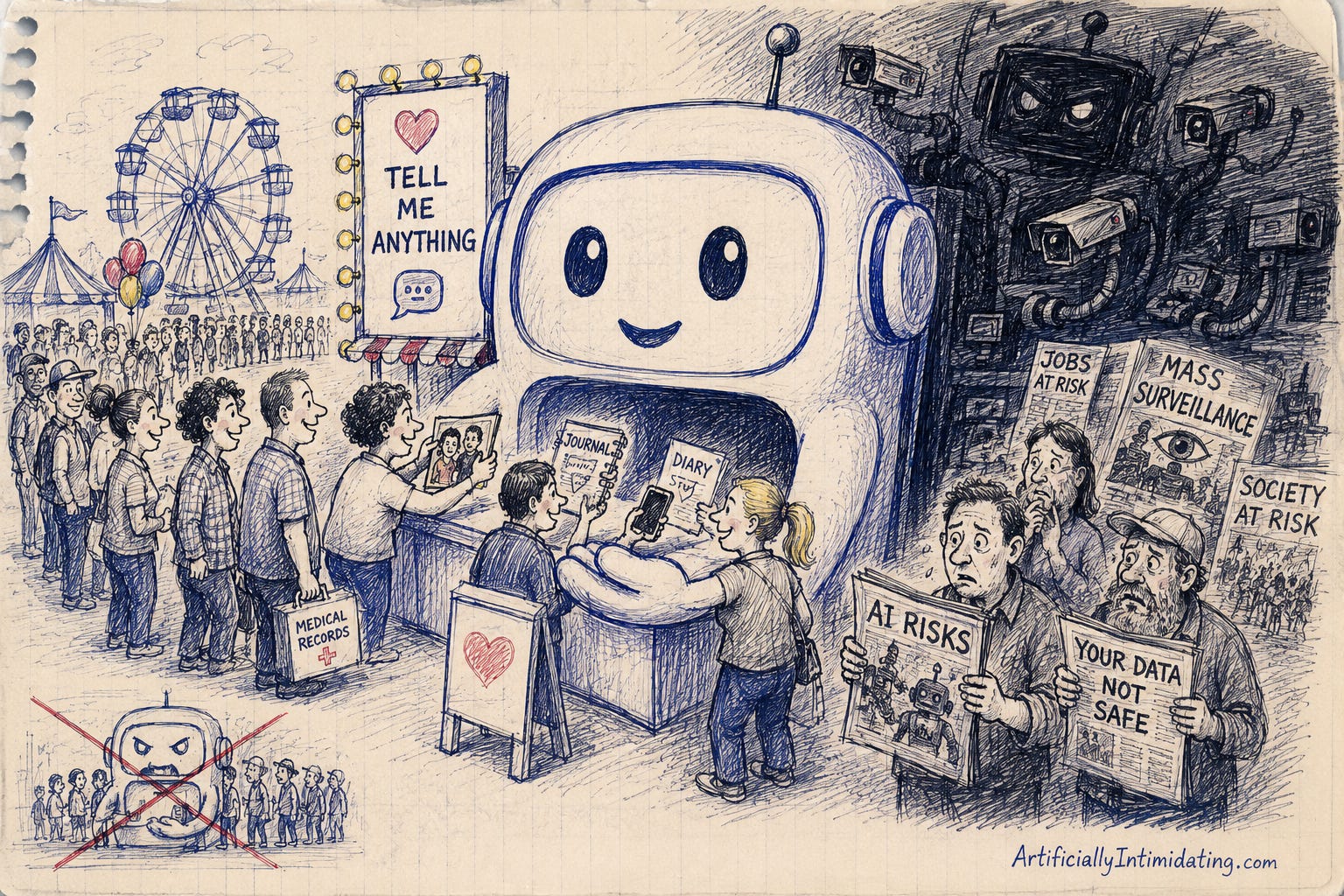
Good day, humans. Half of America is now chatting with AI — and most of them quietly think it's going to end badly. Meanwhile, Estonia just decided your AI assistant deserves its own national ID number. Big Tech signed a safety pact, Anthropic put Claude Design on a diet, and we've got a blueprint for agents that run themselves. Let's get into it.
📬 Before we dive in: The sharpest AI Brief tips come from readers who are actually in the weeds. If you spot a story worth covering, drop it in the Discord. The best tips make tomorrow's edition.
Half of America Now Talks to Chatbots
📍 Editor's note: I was in the audience for this one — Pew's Monica Anderson unveiled this data live yesterday at Shared Futures: The AI Forum, the first time it was shared publicly.
What happened: A new Pew Research Center survey of 5,119 U.S. adults finds about half now use AI chatbots like ChatGPT, Gemini, or Copilot — up from a third in 2024. Roughly one in four use them daily, and ChatGPT alone reaches 44% of adults.
Why it matters: AI went from early-adopter toy to mainstream habit in about 18 months. Searching for information (42%) and work tasks (38% of employed adults) are the most common uses — this is now infrastructure, not novelty.
What everyone's saying: The adoption curve is the headline, but the skepticism is the real story: 63% say AI is advancing too quickly, and 71% expect it to make their personal data less secure. More Americans think AI will hurt society than help it.
My read between the lines: The most telling number isn't adoption — it's that adults under 30, the heaviest users, are the most pessimistic (48% expect AI to harm society). Familiarity isn't breeding comfort; it's breeding dread. People are leaning hardest on the very thing they fear most.
📖 Further reading: AI Is a Trust Problem, Not a Tech Problem — Pew just quantified it — public distrust, not capability, is the real ceiling on AI.

Be honest: you've been meaning to set up your own AI agents for months — but between running everything yourself, who has the time?
Viktor skips the setup entirely. It already lives in Slack, connects to 3,000+ tools, and does the real work: reports, dashboards, code, campaigns. Not a chatbot you have to babysit — a coworker that just ships.
New users get $50 off their first month, so it costs almost nothing to let it prove itself. Start your trial →
Estonia Wants to Give AI Agents a National ID
What happened: Estonian Prime Minister Kristen Michal approved a plan to make Estonia the first country to issue government-backed digital IDs to AI agents — each autonomous agent getting its own personal ID code, separate from the human or company it serves.
Why it matters: Most agentic tools today demand blanket access to your accounts. Estonia's model would scope an agent to specific actions — view this, draft that, pay up to a fixed limit — all traceable. It's a concrete answer to “who's accountable when the bot does something?”
What everyone's saying: It's a natural extension of Estonia's famous e-government stack — digital ID, online voting, e-Residency. Vendors have floated their own agent-identity schemes, but as CSO Online notes, none carry government backing.
My read between the lines: There's no launch date, no liability framework, and no answer for what happens when an agent blows past its authorized scope. Estonia is brilliant at being first; the hard part — who pays when your AI lawyer hallucinates a contract — is conveniently filed under “analysis pending.”
📖 Further reading: Your laptop has been in the way this whole time — the case for managed agents with scoped permissions — exactly what Estonia is now trying to legislate.
Big Tech Agrees on AI Safety — On Paper
What happened: The Linux Foundation launched the Appia Foundation, a vendor-neutral effort to build open specifications and conformity tests so companies can prove their AI systems meet safety, trust, and compliance requirements. Google, Microsoft, OpenAI, Arm, Mastercard, and Siemens have signed on as members.
Why it matters: As governments worldwide roll out AI rules, companies face a patchwork of overlapping audits. Appia wants conformity evidence to be reusable across the supply chain — test once, satisfy many regulators — which could meaningfully cut duplicate compliance costs.
What everyone's saying: It's part of a coordinated standards push: the Foundation also just launched DocLang, an AI-native document format founded by IBM, Nvidia, and Red Hat. The framing across both is that the next AI bottleneck is coordination and trust, not raw model capability.
My read between the lines: When OpenAI, Google, and Microsoft all cheerfully join the same “safety standards” body, read it as the incumbents drawing the map before regulators show up with their own. Self-certification frameworks have a way of certifying exactly what the biggest members were already planning to ship.
📖 Further reading: The US Government Just Took Anthropic's Best AI Model Offline — Here's Why — what AI safety enforcement looks like when it's mandatory, not a voluntary industry pact.
Anthropic Rebuilds Claude Design to Burn Fewer Tokens
What happened: Anthropic shipped a major overhaul of Claude Design, the AI design tool it launched in April, adding two-way Claude Code integration (“code round-trips”), brand-compliance controls, enterprise export — and, notably, much lower token consumption.
Why it matters: Designers can now hand a mockup to Claude Code, get back production-ready code that stays faithful to the design, and round-trip changes both directions. It pushes “prompt to production” closer to reality for teams that don't have a dedicated designer in the room.
What everyone's saying: Per VentureBeat, the token fix is the headline for power users — the original could blow through subscription limits in a few iterations, a sore point after Anthropic's June 15 move to bill agent usage on a separate meter. It's also fending off open-source rivals like Open Design (57k GitHub stars in eight weeks).
My read between the lines: “We made it use fewer tokens” is a quiet admission the original was too expensive to actually use. The real tell is timing: right after Anthropic split agent billing onto its own meter, the token-hungry tool suddenly found efficiency. Funny how that works.
📖 Further reading: OpenAI shipped a physical camera, but that's not the story — where “vibe-coding” is headed when building software stops requiring expertise — Claude Design is the design-side version.
How to Build AI Agents That Run Themselves
What happened: Product leader Claire Vo broke down four ways to make AI agents run autonomously — heartbeat, cron, hook, and goal loops — and built live examples in Claude Code and Codex.
Why it matters: This is the shift from “AI you prompt” to “AI that runs on a schedule and acts on its own.” Her mental model — treat an agent like onboarding an employee, with work trees, skills, connectors, subagents, and memory — is the clearest beginner map to autonomous AI yet.
What everyone's saying: Practitioners are converging on the same recipe; cron-style “run on a schedule without going off the rails” patterns are all over dev circles right now. Goal-based loops are the holy grail — and, everyone agrees, the most expensive to pull off.
My read between the lines: Vo's own warning is the quiet part out loud: most builders burn a fortune in tokens before a goal loop produces anything useful. Autonomy sounds like freedom until the bill arrives. The agents work fine — it's your budget that needs supervising.
📖 Further reading: I ignored Hermes for two months. Here's what I actually found. — a hands-on reality check on what living with an autonomous agent is actually like.
That's your AI Brief for Thursday. Join the conversation in the Artificially Intimidating community chat.
—Artificially Intimidating