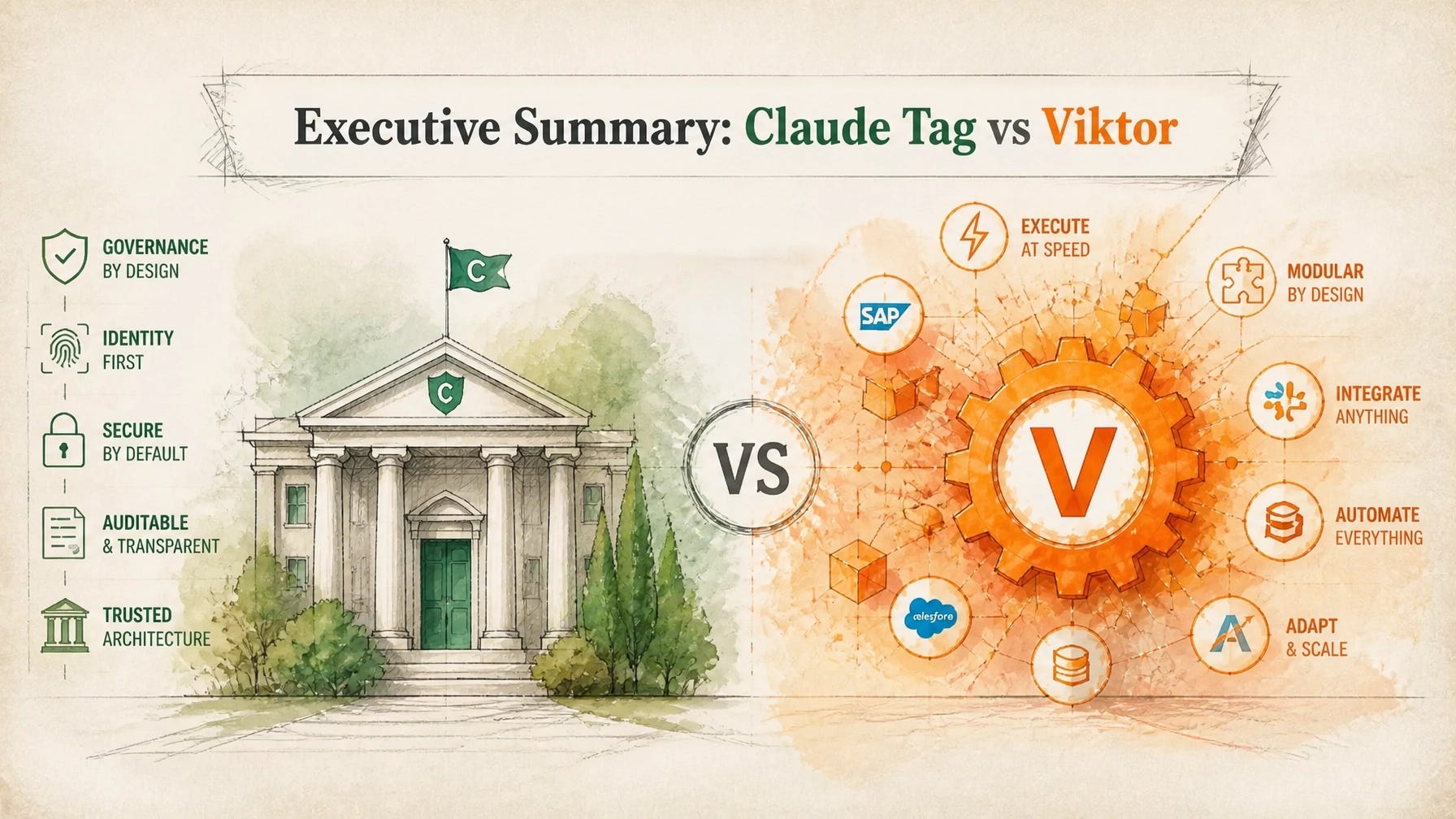
Anthropic just dropped an AI coworker into Slack. There's one catch: you probably can't get it yet. Here's the honest head-to-head -- and the teammate you can hire today.
On June 23, Anthropic launched Claude Tag -- type @Claude in a Slack thread and an AI agent reads the conversation, breaks down the task, and even jumps in on its own to flag things you forgot. It remembers. It works while you're logged off. Anthropic's own framing is that it feels like "working with a real colleague."
If that pitch sounds familiar, it's because there's already a company built entirely around it. Viktor's tagline is literally "Not a tool. A hire." -- an AI employee that lives in Slack and Microsoft Teams, plugs into 3,200+ apps, and ships actual work: reports, dashboards, code, campaigns.
So, as the "AI teammate" category heats up: which one do you actually put in your workspace? Here's the read between the lines.
Claude Tag vs Viktor: Head-to-Head Comparison
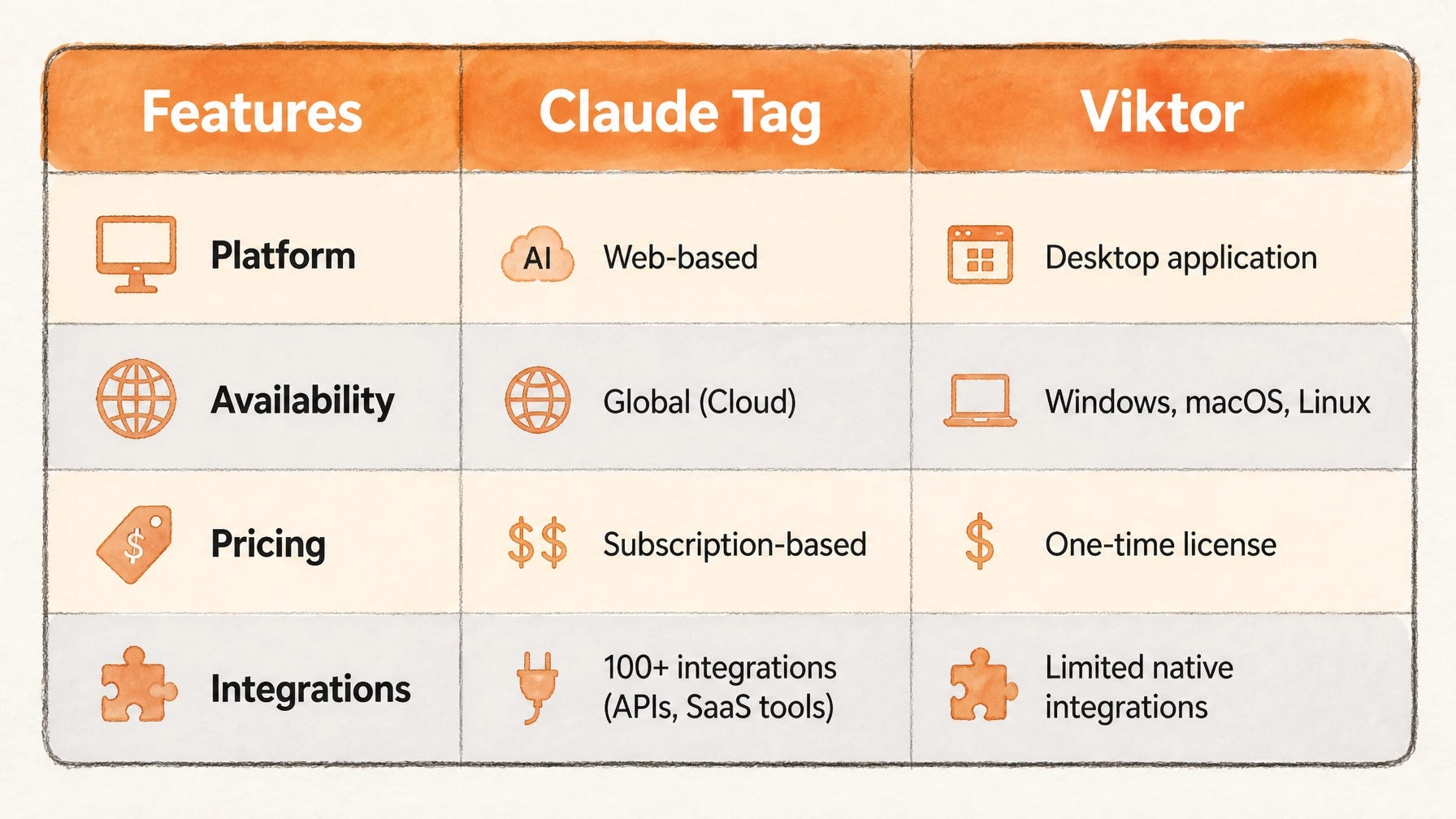
WHAT IT IS:
Claude Tag: @Claude agent inside Slack threads
Viktor: an AI "employee" in Slack + TeamsWHERE IT RUNS:
Claude Tag: Slack only (more platforms "in coming weeks")
Viktor: Slack AND Microsoft Teams, todayWHO CAN GET IT:
Claude Tag: Claude Enterprise & Team customers, in beta
Viktor: anyone -- free $100 in credits, no cardPRICING:
Claude Tag: per-seat, ~$20--30/user/mo with a 5-seat minimum (Team), or custom (Enterprise)
Viktor: a flat $50/mo shared workspace, no per-seat chargeINTEGRATIONS:
Claude Tag: Anthropic connectors (Slack, GitHub, Drive, warehouses via admin)
Viktor: 3,200+ toolsMODEL:
Claude Tag: Claude (Opus 4.8)
Viktor: Claude, OpenAI, and othersSECURITY:
Claude Tag: admin-controlled access, per-channel scoping, full audit trail
Viktor: SOC 2 compliant, DPA on Enterprise
Where Claude Tag Wins: Agent Identity, Security, and Ambient Mode
Let's be fair -- the credible answer matters more than the convenient one.
Claude Tag's agent identity model is legitimately clever, and the part nobody else has cleanly solved. Instead of the AI borrowing your permissions (and quietly turning a shared channel into a side door to your private docs), Claude gets its own scoped account per channel. The legal channel's Claude can't read the engineering repo. Admins control exactly what it touches, and every action lands in an audit log. If you're a large org with a security team that asks hard questions, that architecture is a real advantage.
It's also pure Claude -- if your team is already all-in on Anthropic's models and you're on Enterprise, Tag is the native, no-new-vendor option.
Where Viktor Wins: Microsoft Teams, Flat Pricing, and Day-One Access
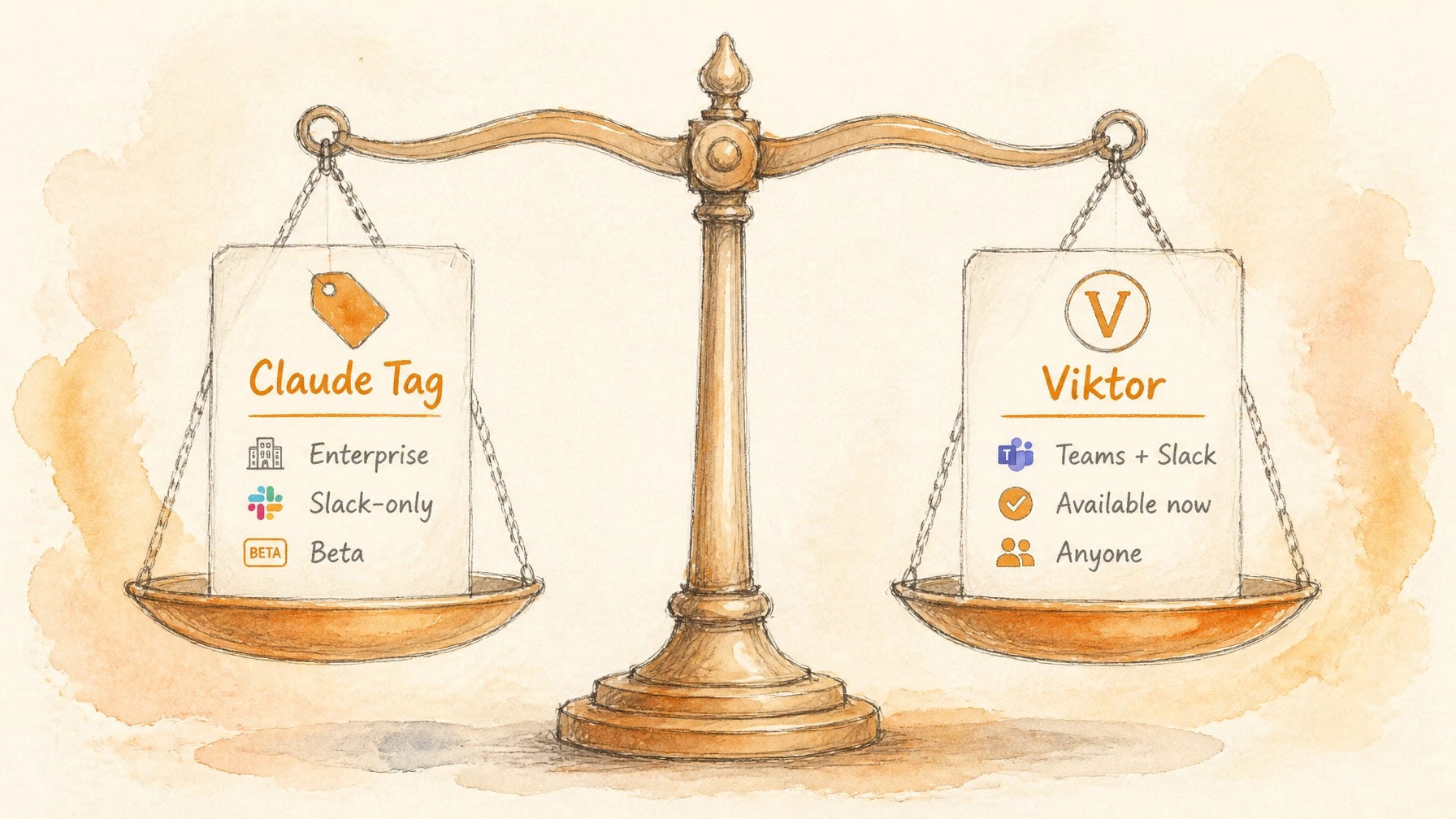
Here's the thing the launch coverage buried: Claude Tag is beta, Slack-only, and locked to Enterprise and Team plans. A huge share of the people reading about it this week -- solo operators, small teams, anyone on Microsoft Teams, anyone without an Enterprise contract -- literally cannot use it yet.
Viktor fills exactly that gap:
You can actually start. $100 in free credits, no credit card, no sales call. Claude Tag wants you on a qualifying plan first.
It runs on Teams, not just Slack. If your company lives in Microsoft 365, Tag isn't an option today. Viktor is.
The math favors small teams. Claude Team is per-seat with a 5-person minimum -- call it $125+/month before you've done anything. Viktor is a flat $50/month shared workspace.
It's model-agnostic. Viktor routes across Claude, OpenAI, and others, so you're not betting the whole workflow on one lab.
My Two Cents: What It's Actually Like Using Viktor Every Day
I'm not neutral, so let me say it plainly: my company, Pictor.pro, runs Viktor every day -- across our dev team, me on product, our C-suite, even alongside customers -- and the link in this post is an affiliate link. I'd still point a friend to it. Here's the honest version of why.
The thing nobody tells you about a tool like this is how it arrives. Viktor didn't get "rolled out." It took root. It earned its way in, one skeptic at a time.
Exhibit A: one of our devs flat-out doubted it could tell an actual bug from human error on a support ticket. Viktor found the relevant line number in the code, explained the likely cause, suggested the fix -- and offered to make the change itself. (We haven't handed it that key yet.) It didn't close the ticket; it gave the team a running start on triage in seconds.
Exhibit B: I needed to understand a very specific corner of how our product worked, and I didn't know the answer. I told Viktor. Instead of guessing, it went and found the teammate who'd actually written that part of the code, asked him pointed, specific questions, and handed me back exactly what I needed to update our support docs. That teammate -- who started out treating Viktor like an alien in the building -- now talks to it like a colleague.
That's the part that's hard to describe without sounding like I'm overselling. Viktor behaves like the teammate who's almost annoyingly good -- relentlessly proactive, weirdly eager, always connecting dots you didn't ask it to connect -- except it has zero interest in the credit. It's not angling for your job. It wants you to win. You end up liking it despite yourself.
Can Viktor Survive Anthropic? Why the Real Moat Is Temperament, Not the Model
Here's the uncomfortable truth underneath this whole comparison: almost every breakout AI startup of the last few years is renting someone else's brain. They're built on top of OpenAI's or Anthropic's models. And those labs are watching their ecosystems find product-market fit and then -- politely or not -- walking into the very same category. Claude Tag is exactly that: Anthropic stepping into the "AI teammate in Slack" space that companies like Viktor mapped out first. If the labs are feeling generous, they acquire you. They usually don't have to. It was their brain you were borrowing.
So what's actually defensible? From where I sit, it isn't the model -- it's the temperament. Viktor's moat is that it nails the feel of a great proactive teammate in a way I haven't seen anyone else, the labs included, reproduce yet. That's a product-and-taste problem, not a model problem, which is exactly why it's hard to copy.
The one place this bites me: my other team, Outsnapped, lives in Google Workspace and Google Chat -- not Slack. So I can't drop Viktor in the way I have at Pictor. I've been hand-tuning a Hermes agent to get somewhere in the neighborhood, and I'll be honest: it's been nearly impossible to come close to the magic Viktor has harnessed -- the proactivity, the eagerness, the dot-connecting. Whoever ships a real Google Chat version of this first is getting my money. Viktor, Claude Tag, anyone -- that's a wide-open door.
The Verdict: Should You Choose Claude Tag or Viktor?
If you're an enterprise already standardized on Claude, with an admin team that cares about per-channel permission scoping, Claude Tag is the elegant native answer -- once you're off the beta waitlist.
For everyone else -- small teams, Teams-first shops, anyone who wants an AI coworker doing real work this afternoon instead of in coming weeks -- the practical pick is the one you can hire right now.
Hire Viktor -- new readers get $50 off ->
The "AI teammate" era didn't start this week. Anthropic just made everyone notice it. The good news: you don't have to wait for a beta invite to live in it.
Disclosure: Pictor.pro is a paying Viktor customer, and the Viktor link above is an affiliate link -- if you sign up through it, Artificially Intimidating earns a commission, at no extra cost to you, and you still get the $50 off. I only run affiliate offers for tools I'd actually point a friend to. Claude Tag details are from Anthropic, Reuters, and TechCrunch reporting (June 23--24, 2026); pricing is current as of publication and may change.
Go Deeper: The Full Claude Tag vs Viktor Research Report
If you want the ground-level version of this matchup, I packaged it into a Deep Research Report -- and it goes well past what's above:
What practitioners are actually saying on Reddit, Hacker News, Product Hunt, and YouTube (including the "The end of Viktor?" thread and the HN debate).
The full pros and cons for both tools -- token-cost anxiety, governance gaps, the Teams lockout, credit-burn opacity, and more.
An 18-row head-to-head feature matrix covering memory model, eligibility, audit logs, pricing, traction, and SOC 2.
The real-money numbers: Viktor's $20M ARR and $75M Series A, and how Anthropic's launch reframes the whole category.
Paid subscribers get the full report below. It's the kind of thing I'd otherwise keep to myself -- consider it the upgrade.