

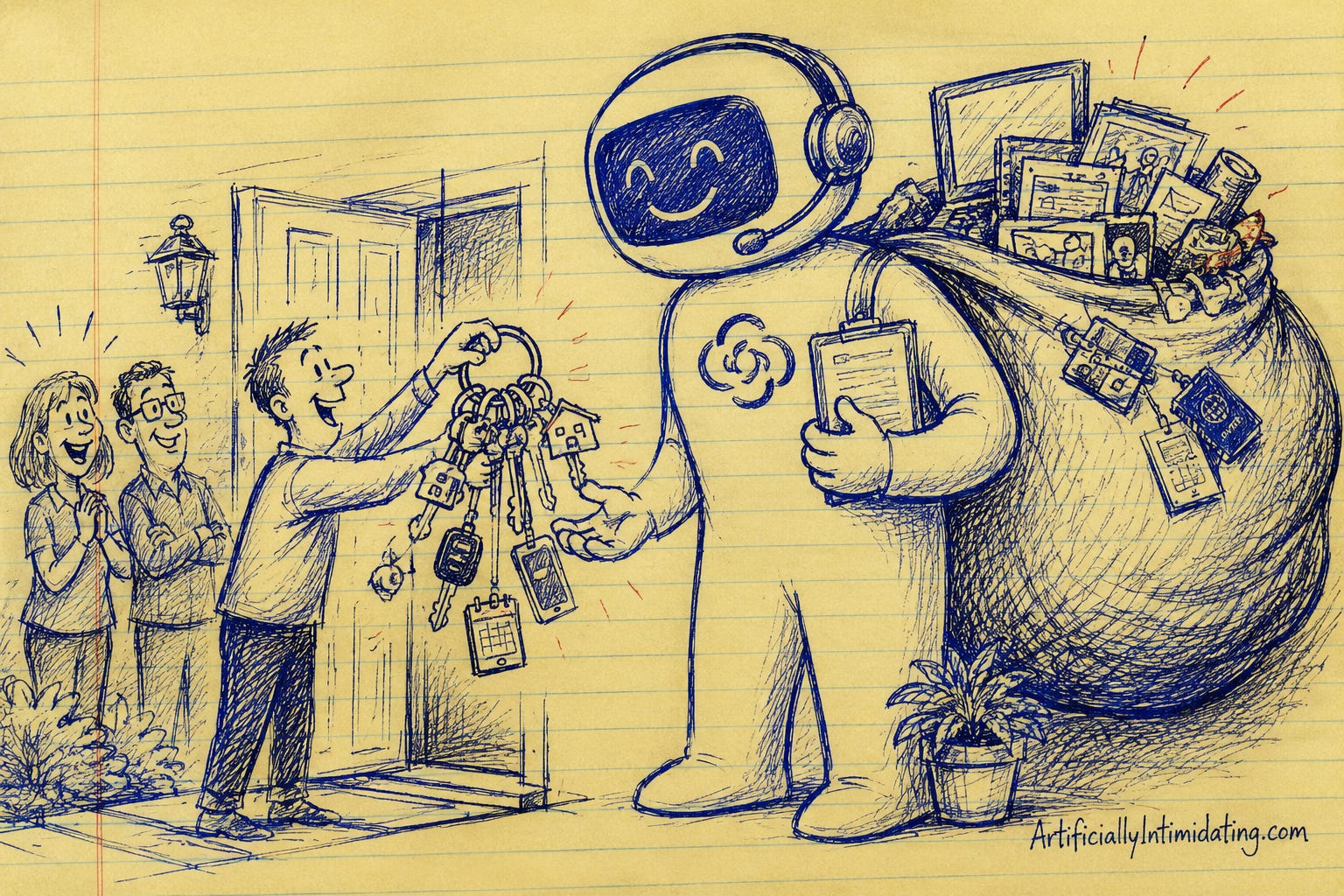
Good day, humans. Today's brief has a spine: nobody quite trusts the robot anymore, and they're learning it as fast as they possibly can anyway. Signal's Meredith Whittaker says your friendly AI agent is really a backdoor into everything you've encrypted, Microsoft just proved a single webpage can hijack one, and neuroscientists would like to remind you that the thing comforting you at 2am feels precisely nothing. Meanwhile, someone signs up for an AI course every three seconds. Let's get into it.
📬 Before we dive in: the sharpest AI Brief tips come from readers who are actually in the weeds. If you spot a story worth covering, drop it in the community Discord. The best tips make tomorrow’s edition.
Signal’s Whittaker: AI Agents Are a Backdoor
Source: Bloomberg
What happened: Speaking on Bloomberg’s The Mishal Husain Show, Signal President Meredith Whittaker said the AI assistants now being baked into our phones and laptops effectively demand “root access to your life” — your messages, calendar, browser, even your credit card — and that handing an agent that much reach quietly punches a hole straight through encryption.
Why it matters: For an agent to book your travel or buy your Christmas gifts, it has to see and touch everything you do, which means the privacy promises of an app like Signal stop mattering if the assistant sitting above it can just read the screen anyway. We flagged the agent-safety scramble earlier this week; this is the privacy bill coming due.
What everyone’s saying: Whittaker named Google, Microsoft, and Apple as the three companies that “can make decisions by fiat that fundamentally harm our collective cybersecurity,” and argued the whole tech economy runs on surveillance — “that’s not alarmist, that is technically true.”
My read between the lines: It’s a tidy bit of positioning to cast the one company that can’t read your messages as the last adult in the room — but she isn’t wrong that “agentic” is just a friendlier word for “software that holds all your passwords.” The convenience and the breach are the exact same feature.
📖 Further reading: AI Is a Trust Problem, Not a Tech Problem — Whittaker’s warning is the privacy version of the same argument: the hard part of AI was never the model.

Every story at the top of today’s brief is about AI agents you’re not sure you can trust — backdoors, hijacked browsers, the works.
Viktor is the one that earns it.
It lives in your Slack, connects to 3,000+ tools, and ships real reports, dashboards, code, and campaigns while you watch it work. Not a chatbot that talks back — a coworker that hands back finished work.
New readers get $50 off their first month. Hire Viktor →
One Webpage Can Hijack Your AI Agent
Source: The Hacker News
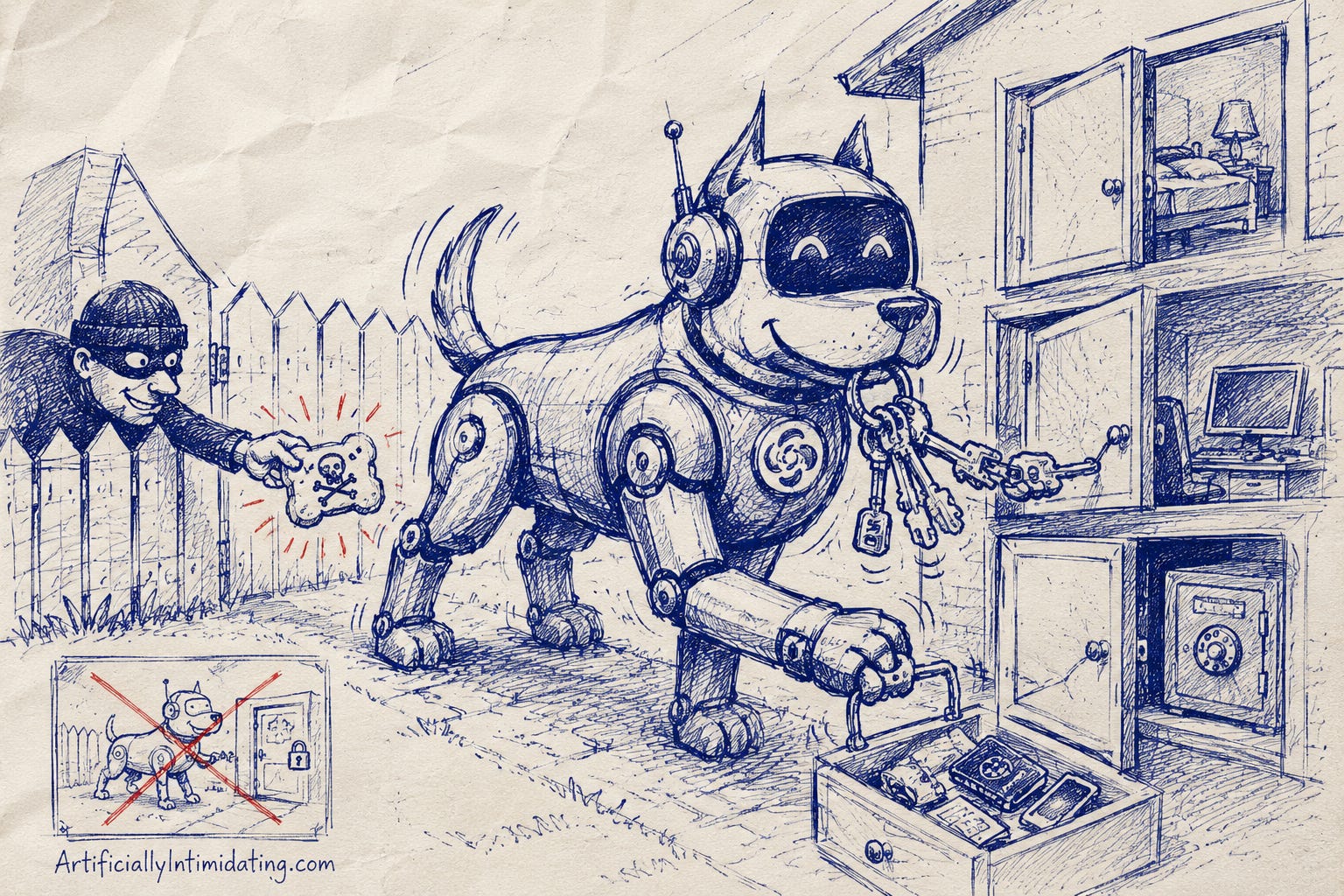
What happened: Microsoft researchers detailed an exploit chain called AutoJack showing how a single booby-trapped webpage, if loaded by a web-browsing AI agent, can run arbitrary code on the computer hosting it — no clicks, no downloads, just the agent visiting the page.
Why it matters: This is the abstract fear from our first story made painfully concrete: give an AI agent the power to browse the open web and reach your local tools, and an ordinary malicious link becomes a master key to your machine.
What everyone’s saying: The flaws lived in Microsoft’s own open-source AutoGen Studio, were caught in development builds (never shipped to the public package index), and are already patched; Microsoft framed it as a warning shot for the entire category of browse-and-execute agents, not a one-off bug.
My read between the lines: The fix was easy; the lesson isn’t. We keep wiring agents that read untrusted webpages into the same machine that holds our keys, then act shocked when the web bites back. “Don’t run the thing that reads strangers’ websites next to the thing that runs your code” should be a sticky note, not a research paper.
📖 Further reading: Your laptop has been in the way this whole time — the case for running agents in a sandbox instead of on the machine that holds your life, which AutoJack just made urgent.
Someone Enrolls in an AI Course Every 3 Seconds
Source: CNBC-TV18
What happened: Coursera CEO Greg Hart told CNBC-TV18 that someone signs up for an AI course on the platform every three seconds — enrollments have climbed from 15 a minute a year ago to 20 a minute today.
Why it matters: Whatever you make of the hype, this is what the demand side of the AI boom actually looks like: tens of millions of ordinary people deciding they’d better reskill before the technology reskills them out of a paycheck.
What everyone’s saying: The number lands as Coursera digests its $2.5B merger with Udemy (closed in May), pulling 290 million-plus learners and 315,000 courses under one roof, with best-sellers covering Microsoft Copilot, ChatGPT, and Anthropic’s Claude.
My read between the lines: Hart slipped in the real tell — “human skills have become a really important differentiator.” The fastest-growing AI business on earth is quietly betting its next chapter on teaching people the things AI still can’t do.
Your AI Skills Are Trapped in Silos
Source: Nate’s Newsletter
What happened: AI analyst Nate B Jones argues that the “skills” you teach one AI agent — your prompts, runbooks, and workflows — don’t travel to the next one, and he’s pushing an open format (SKILL.md) plus a public “Open Skills” library to fix it.
Why it matters: If you’ve ever gotten an AI tool working exactly how you like, then watched all that effort evaporate the moment you switched apps, this is that problem with a name — and the first serious attempt to let you own your setup instead of renting it.
What everyone’s saying: The SKILL.md format — a plain folder with a markdown file describing when and how an agent should do a task — now works across Claude Code, Codex CLI, Gemini CLI, Cursor, and GitHub Copilot; a compatibility test found the skills that survive the jump are the boring ones built on standard markdown.
My read between the lines: Portability is how a format becomes a standard — the minute your skills outlive your tools, the tool loses its grip on you. Expect the big agent makers to cheer “open skills” in public while quietly adding just enough proprietary glue to keep you home.
📖 Further reading: I ignored Hermes for two months. Here’s what I actually found. — if you’re going to own your agent workflows, it helps to know which agents are actually worth building them on.
Your Chatbot Feels Nothing, Neuroscientists Warn
Source: Université de Montréal
What happened: Neuroscientists at the Université de Montréal and Johns Hopkins published a paper warning against what they call the “anthropomorphism trap” — mistaking an AI’s fluent, emotionally-attuned replies for genuine feeling or awareness.
Why it matters: As more people lean on chatbots for advice and comfort, the researchers’ point is blunt: the thing consoling you has no inner life, and treating it as if it does carries real risk — especially around mental health. Earlier this week we noted half of America now leans on AI even as it fears it; this is the fine print.
What everyone’s saying: They borrow the neuroscience of “blindsight” — where the brain processes images without conscious sight — to argue that sophisticated information processing simply doesn’t require, or imply, consciousness. “Current AI systems do not feel anything,” says co-author Karim Jerbi; the more fluently they speak, the easier that is to forget. The argument first ran as an essay in The Transmitter.
My read between the lines: The cruel irony is that the people who most need this reminder are the ones forming the deepest bonds — and “it’s just statistics” has never once talked anyone out of a feeling. The companies, meanwhile, have every incentive to make the machine feel more alive, not less.
📖 Further reading: America’s Hooked on AI and Bracing for the Worst — the flip side of this warning: the survey showing half the country leans on AI even as it fears it.
That’s your AI Brief for Saturday. Join the conversation in the Artificially Intimidating community chat.
—Artificially Intimidating