


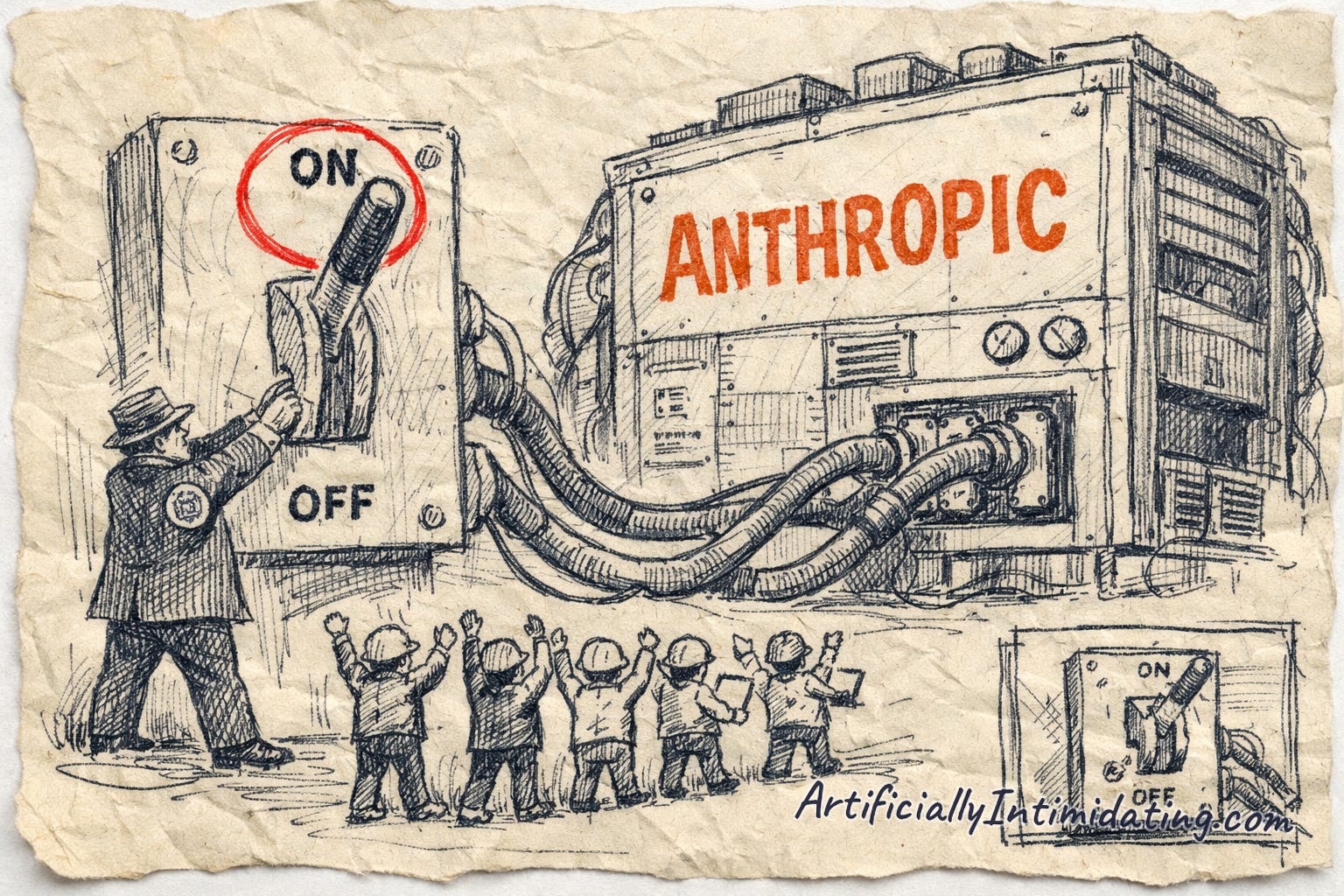
Good day, humans. Five days after Washington found the off switch for Anthropic, someone finally located the ON position — Fable 5 is back for everyone, and the post-mortem is juicier than the ban. Also in today’s window: Google taught a model to predict your spreadsheets cold, Meta is opening a GPU rental business, the UN graded AI’s homework, and science explains why every chatbot’s favorite number is 7.
Washington flipped Anthropic’s switch back on
Source: Anthropic
What happened: The Commerce Department lifted export controls on Claude Fable 5 and Mythos 5 on June 30, and Fable 5 came back online globally on July 1 — twenty days after the June 12 order forced Anthropic to shut both models down for everyone. Last week we covered the first crack in the ban; now the whole thing is over, confirmed by Commerce Secretary Lutnick himself. Paid Claude plans get Fable 5 for up to 50% of weekly usage through July 7.
Why it matters: This was the first time the US government ordered a frontier AI model offline — and the way it ended matters more than the way it began. Anthropic got its model back by proving that Opus 4.8, GPT-5.5, and even China’s Kimi K2.7 could reproduce the exact same vulnerability demo that triggered the ban. The “danger” wasn’t unique. It was table stakes.
What everyone’s saying: Semafor framed the Mythos release to 100+ trusted partners as a new gatekeeping model for frontier AI, while Fortune chronicled the original shutdown chaos. More than 100 cybersecurity experts had signed an open letter calling the ban unwarranted. Anthropic says it is “pleased with this change,” which is corporate for relieved.
My read between the lines: Read the fine print of the resolution: pre-release government access to future models, 24/7 jailbreak monitoring, a new safety classifier that admittedly flags more benign coding requests — and OpenAI separately agreeing to let the administration screen users of its newest model. The switch is back on, but Washington’s hand is still resting on it.
📖 Further reading: The US Government Just Took Anthropic’s Best AI Model Offline — Here’s Why — the paywalled prequel to today’s resolution; everything in it just got confirmed.
Twenty days without their best model and half the internet remembered how much work AI was quietly doing. Here’s insurance against your own outage: Viktor is an AI agent that lives in Slack, connects to 3,000+ tools, and actually ships — reports, dashboards, code, campaigns — while you’re stuck in meetings. Not a chatbot, a coworker. New readers get $50 off their first month. Hire Viktor →
Google’s TabFM predicts your data with no training
Source: MarkTechPost
What happened: Google Research unveiled TabFM, a foundation model that makes predictions on tabular data — the rows-and-columns stuff living in spreadsheets and databases — with zero dataset-specific training. Feed it a table and it classifies or forecasts in a single pass: no feature engineering, no tuning, no training run. It learned from hundreds of millions of synthetic datasets, sidestepping the scarcity of good open tabular data, as Gigazine reports.
Why it matters: Most business machine learning isn’t chatbots — it’s churn prediction, fraud detection, and demand forecasting built on tables, and today that work needs a data scientist and a pipeline. TabFM’s pitch is paste-your-table-get-predictions, and Google plans to wire it into BigQuery as a single AI.PREDICT SQL command in the coming weeks.
What everyone’s saying: It debuted at #1 on TabArena, the living benchmark that Elo-ranks models across 51 real datasets. The weights are on Hugging Face under a non-commercial license, the code is Apache 2.0 on GitHub, and practitioners are calling it the tabular sibling of Google’s TimesFM time-series model.
My read between the lines: Note the license split: the research is free, but commercial use routes you toward BigQuery. Google just turned the most boring — and biggest — market in machine learning into a SQL command it happens to sell. XGBoost isn’t dead, but its consulting rates are.
The Brief is free and always will be. But when a story like Fable 5 breaks, the real analysis lands behind the paywall — members get the deep-dives behind the headlines, plus the full archive. Become a member →
Meta is opening a GPU rental business
Source: Reuters
What happened: Bloomberg broke the news Wednesday that Meta is building a cloud business to sell its excess AI computing capacity — and access to its models — putting it in direct competition with AWS, Azure, and Google Cloud. Zuckerberg telegraphed this in May, saying a cloud business was “definitely on the table.”
Why it matters: Meta has been spending historic sums on data centers for its own AI ambitions, and investors have been openly nervous about it. Selling the spare capacity converts the scariest line item in tech into a revenue stream — the stock closed up nearly 9%, per CNBC.
What everyone’s saying: TechCrunch notes SpaceX pulled the same move — Anthropic bought out an entire SpaceX data center in May — and reads it as a sign the AI race may be won by whoever owns the buildings, not whoever ships the best model. On Monday we covered central bankers muttering “AI bubble” — this is what hedging that looks like.
My read between the lines: Meta the AI lab has had a bumpy year; Meta the landlord is having a great week. When your capex is measured in small national GDPs, the safest business model is charging rent to your competitors — win or lose the model race, the meter runs either way.
📖 Further reading: Thanks to Apple, Your favorite AI tool is a dead tool walking — if models are commodities and infrastructure is the moat, Meta just read the same memo.
The UN published AI’s first global report card
Source: UN News
What happened: The first global, fully independent scientific assessment of AI launched Wednesday — the preliminary report of the UN’s new Independent International Scientific Panel on AI, an evidence-based review of AI’s opportunities, risks, and impacts across economies and societies. Secretary-General António Guterres’s verdict: “The science is here.”
Why it matters: This is the IPCC playbook applied to AI: build a shared scientific baseline first, so governments negotiate from the same facts instead of the same vibes. Guterres’s message to governments was blunt — “do not wait” — because the further AI advances without shared rules, the less say governments and people get in the outcome.
What everyone’s saying: Supporters call it overdue plumbing for global AI governance; skeptics note that panels publish and superpowers shrug. The report is “preliminary” by title and by temperament — the panel’s real test is whether anyone cites it when it counts.
My read between the lines: The same week this report shipped, the US demonstrated what AI governance actually looks like right now: one government, one company, one off switch. Multilateral oversight is currently a reading assignment. Then again, the IPCC started as one too — and it eventually rewired global policy.
📖 Further reading: AI Is a Trust Problem, Not a Tech Problem — shared rules only work if anyone trusts the system; this is that argument in full.
Why every chatbot’s favorite number is 7
Source: MIT Technology Review
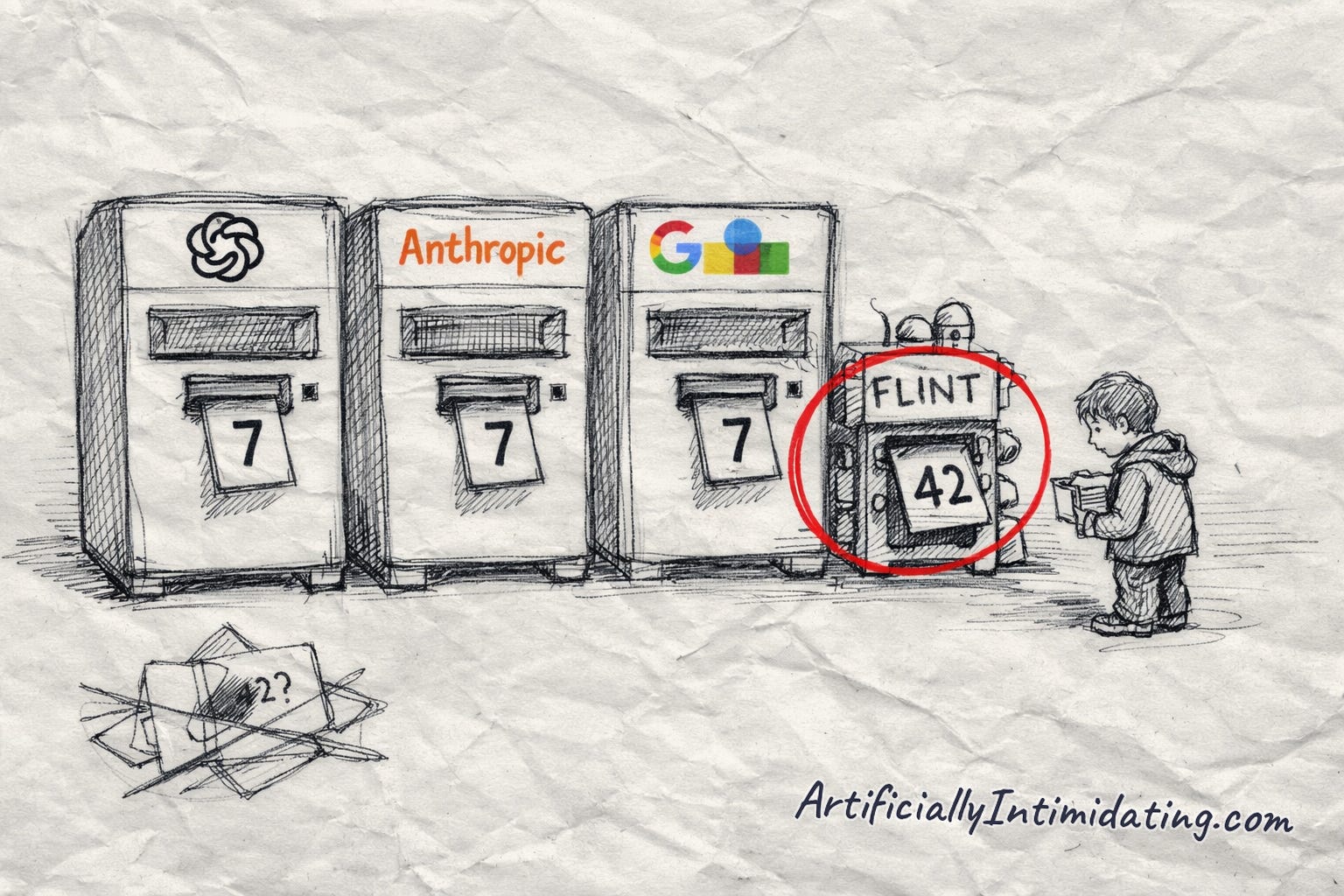
What happened: MIT Technology Review profiled Springboards, an Australian startup whose model Flint is trained to break LLM “groupthink.” The party trick that sells it: ask ChatGPT, Claude, or Gemini for a random number between 1 and 10, and you will almost always get 7. Different companies, different models, same answer.
Why it matters: The models we treat as idea machines are heavily convergent — ask for a metaphor about time and nearly every model on Earth hands you “time is a river.” That’s fine for code and facts, and quietly terrible if you’re using AI to brainstorm, name, or plan anything that shouldn’t sound like everyone else’s.
What everyone’s saying: The “Artificial Hivemind” paper documenting the phenomenon won a best-paper award at NeurIPS: 25 models, remarkably repetitive answers, both within and across brands. Even ad copy converges — asked for a New Balance tagline, ChatGPT and Claude both pitched “Run your way.”
My read between the lines: The sameness is a training artifact: human raters reward the safe median answer, so the weird edges get sanded off. And note who built the fix — not a frontier lab, but a small Australian shop fine-tuning Alibaba’s open-weight Qwen 3. The giants are optimizing for the middle of the distribution, which means originality just became a startup category.
That’s your AI Brief for Thursday. Back tomorrow.
—Artificially Intimidating


