


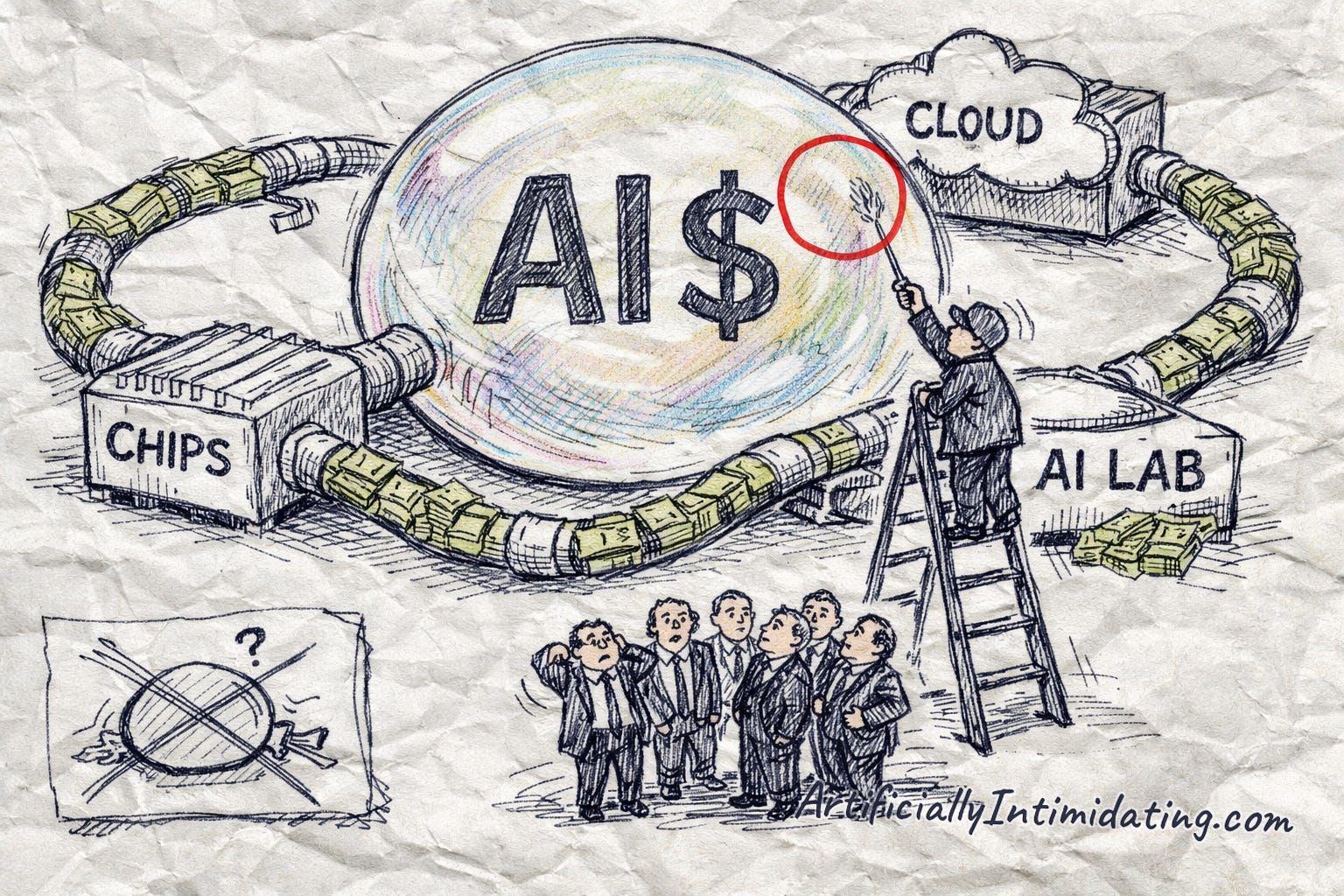
The BIS just said the quiet part out loud: “bubble.” · Illustration: Artificially Intimidating
Good day, humans. The grown-ups are getting nervous. The Bank for International Settlements — the central bank for central banks, the institution so cautious it makes your accountant look reckless — looked at the AI spending boom and reached for the word “bubble.” Meanwhile a U.S. senator wants your future AI agent to legally work for you instead of the highest bidder, Groq clawed back $650 million after Nvidia gutted it, and A24 took Google’s money. Let’s get into it.
The AI Boom Just Got a Bubble Warning
BIS Annual Economic Report 2026
What happened: The Bank for International Settlements — the Basel-based “central bank for central banks” — used its Annual Economic Report (out June 28) to warn that the AI investment boom carries real systemic risk, flagging a possible “investment bust” if returns disappoint and singling out the opaque “circular financing” deals knitting together chipmakers, cloud providers and AI labs.
Why it matters: When the world’s most conservative financial body says the quiet part out loud, it’s worth a pause. The BIS isn’t predicting a crash tomorrow; it’s saying the plumbing connecting Nvidia, the hyperscalers and the labs is murky enough that a stumble in one corner could ripple into the wider economy.
What everyone’s saying: Bloomberg and the Wall Street Journal framed it as the establishment finally pricing in AI downside (a free write-up ran at PYMNTS). Everyone seized on “circular financing” — the merry-go-round where a chipmaker funds a lab that buys its chips and rents them from a cloud it also backs.
My read between the lines: The BIS didn’t say “bubble” because it thinks AI is fake. It said it because the financing looks like a row of giants holding each other up by the collar — impressive until someone lets go. Earlier this week we covered how GLM 5.2 gutted AI pricing; that’s the demand side. This is the supply side quietly asking who actually pays for all this compute.
📖 Further reading: Thanks to Apple, Your Favorite AI Tool Is a Dead Tool Walking — if the BIS is worried about the money, this is the case that the product economics were never going to justify the valuations.
Whatever the BIS makes of AI’s balance sheets, the work on your desk is still real — and still piling up. Viktor is an AI agent that lives in your Slack and plugs into 3,000+ tools, so it actually does the job: pulls the weekly report, builds the dashboard, ships the campaign draft, even writes the code. Not a chatbot you babysit — a coworker who delivers. New readers get $50 off their first month. Hire Viktor →
A Senator Wants Your AI Agent to Actually Work for You
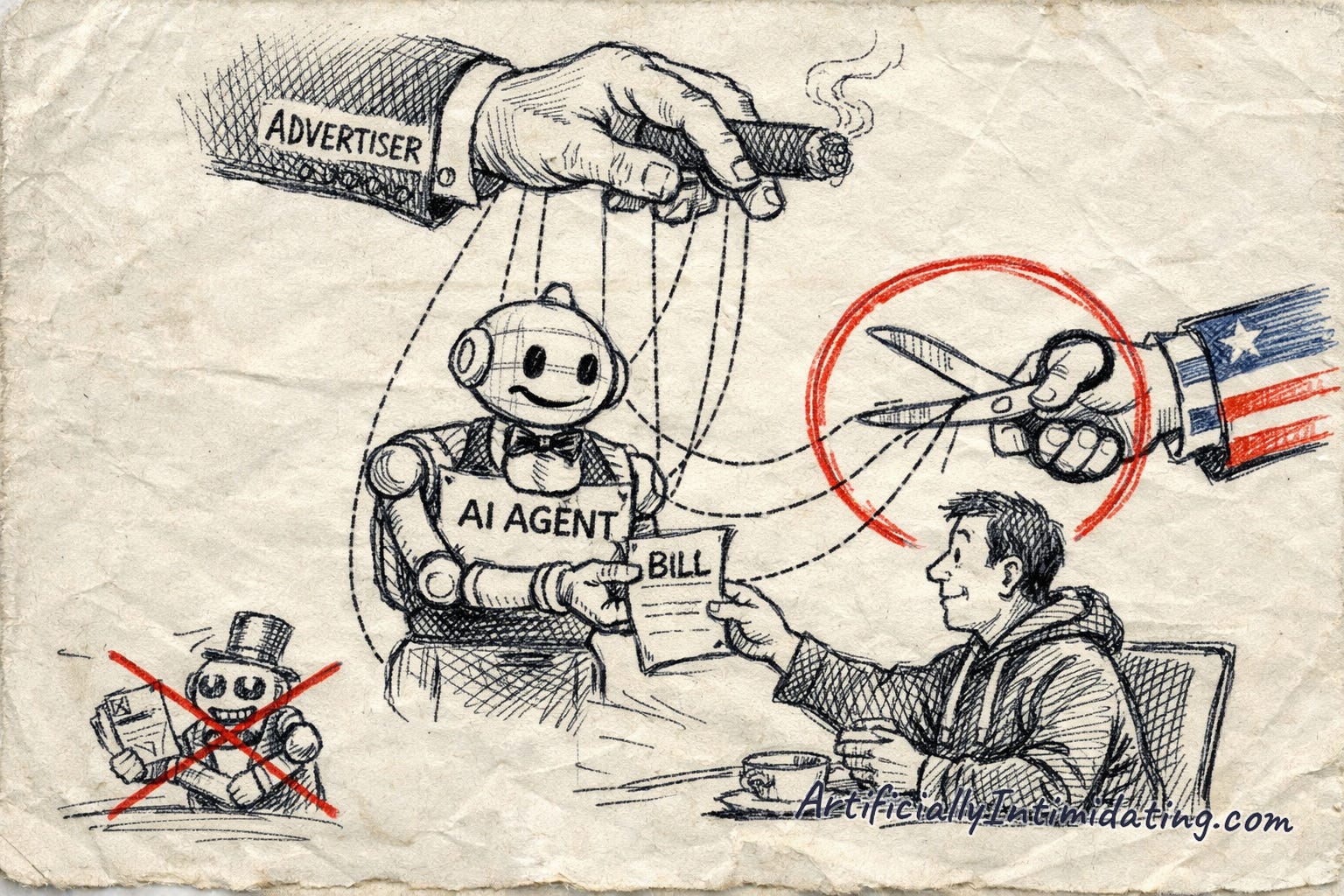
Whose side is your agent really on? · Illustration: Artificially Intimidating
What happened: Senator Mark Warner (D-VA) released a discussion draft on June 29 of the AI AGENT Act, which would impose a “duty of loyalty” on consumer AI agents — legally barring an agent acting on your behalf from quietly favoring the developer, platform or advertiser paying it kickbacks.
Why it matters: Picture an AI travel agent that books you a pricier hotel because the chain pays its maker a referral fee. Warner’s bill says that’s not allowed — your agent has to put you first. It also adds interoperability rules to stop giants like Google or Meta from blocking rival agents on their platforms.
What everyone’s saying: It’s being called the first real federal framework aimed specifically at AI agents (most prior bills targeted deepfakes or model safety). Observers note the timing — agents are where the money and growth are now — but warn a crowded calendar and midterm elections make passage a long shot.
My read between the lines: “Duty of loyalty” is borrowed from how the law treats your doctor and your lawyer, and applying it to software is a quietly radical idea. Earlier this week we covered “agentjacking” — agents hijacked by bad inputs. This is the policy cousin: agents quietly bought off by their own makers. Same threat model, an agent serving someone who isn’t you.
📖 Further reading: Claude Tag vs Viktor: Which One Do You Hire? — Warner’s bill is about who your agent answers to; this is the practical version of that question when you actually pick one.
Quick one: the Brief is free and always will be. But the paywalled deep-dives — where I take a headline like Warner’s bill apart and tell you what it means for your stack — plus the full archive are for members. The founding 20%-off-your-first-year offer ends today, June 30. Lock it in →
Groq Raises $650M and Becomes a Cloud Landlord
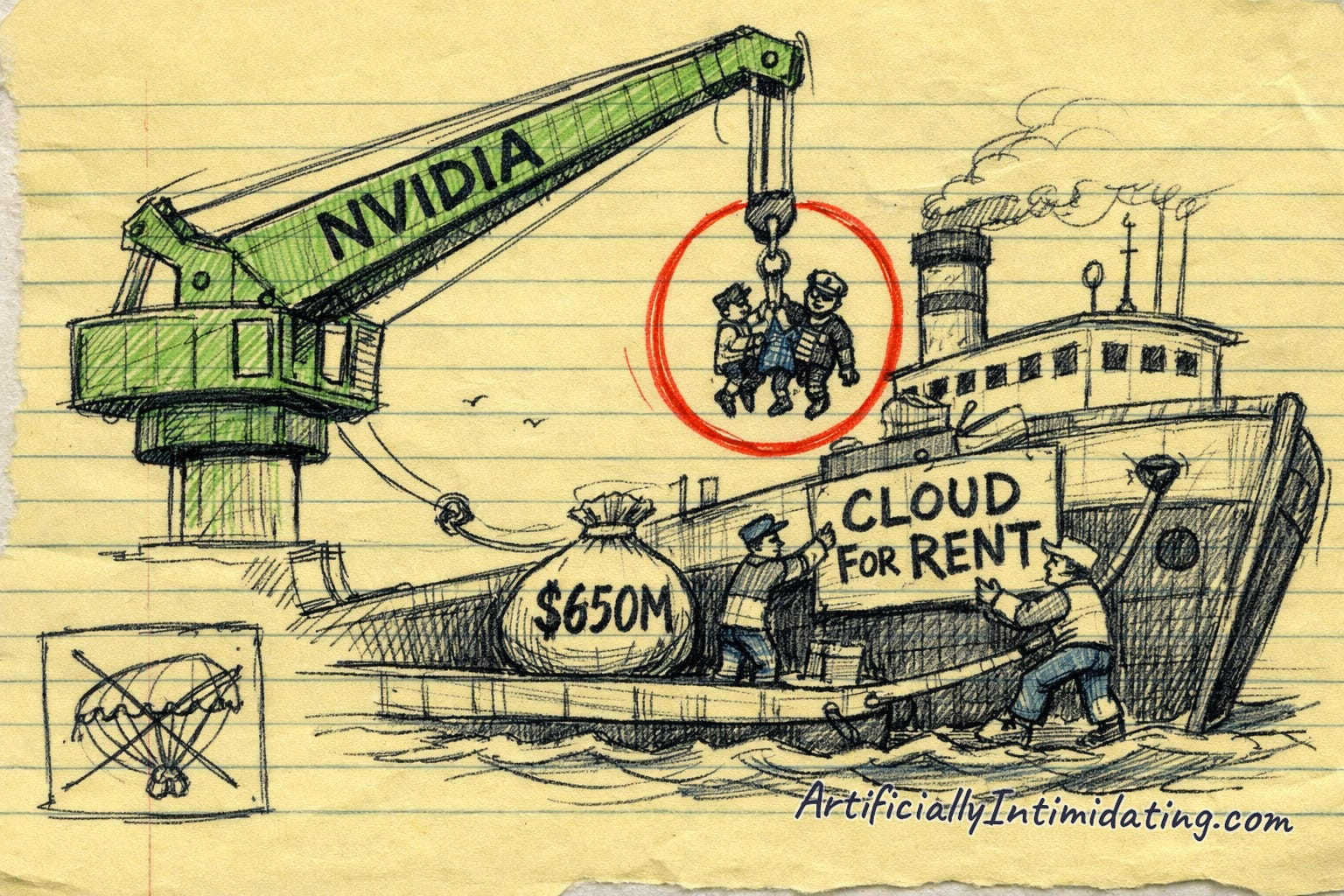
Nvidia took the crew; Groq kept the keys. · Illustration: Artificially Intimidating
What happened: AI chip startup Groq confirmed a $650 million funding round — led by Disruptive and hedge fund Infinitum — and is rebuilding its leadership six months after Nvidia struck a roughly $20 billion non-exclusive licensing deal that scooped up Groq’s tech and its founder-CEO. Groq is pivoting from selling chips to running an AI “inference cloud.”
Why it matters: Inference — actually running a trained model to answer your prompt — is becoming the real cost center of AI, and Groq wants to be the landlord you rent that speed from rather than the company that sells you the hardware. It’s a bet that the money is in operating the compute, not shipping it.
What everyone’s saying: Analysts are calling Nvidia’s $20B “not-acqui-hire” the new playbook — neutralize a rival by licensing its tech and hiring its people, all without an acquisition regulators would scrutinize. The $650M says investors still think there’s a business left in the shell.
My read between the lines: Nvidia took Groq’s leadership and a license to its designs, then Groq raised two-thirds of a billion to compete using… the same designs Nvidia now also ships. That’s either a remarkable second act or paying rent to live in your old house. The tell will be whether “neocloud” margins survive contact with Nvidia’s own LPX hardware.
Now There’s a Standard for AI Agents to Find Each Other
What happened: Google introduced the Agentic Resource Discovery (ARD) specification — an open standard, backed by Microsoft, GitHub, GoDaddy, Hugging Face, Nvidia and others, that lets AI agents automatically find, verify and connect to the tools, APIs and other agents they need for a task, instead of a human wiring each one up by hand.
Why it matters: Today, hooking an AI assistant to a new tool is manual plumbing — you find it, judge whether it’s trustworthy, connect it, and maintain the wiring. ARD aims to be the “missing layer of the agentic web,” a phone book plus trust check so agents can discover capabilities on their own. GitHub is already shipping an “agent finder” built on it.
What everyone’s saying: It’s read as the natural next layer on top of MCP — if MCP gave agents a universal plug, ARD gives them a directory to find the outlets. The unusually broad coalition (rare to see Google and Microsoft on one spec) signals everyone wants the agentic web interoperable rather than locked to a single store.
My read between the lines: A standard that lets agents autonomously discover and connect to other services is exactly what makes Warner’s “who is this agent loyal to” question urgent. The more freely agents wire themselves together, the more it matters whose interests are baked into the wiring. Convenience and control, pulling opposite directions, as ever.
📖 Further reading: I Ignored Hermes for Two Months. Here’s What I Actually Found. — ARD is about agents discovering tools; this is what living with an agent that reaches across your tools actually feels like.
A24 Took Google’s $75M to Build AI Film Tools
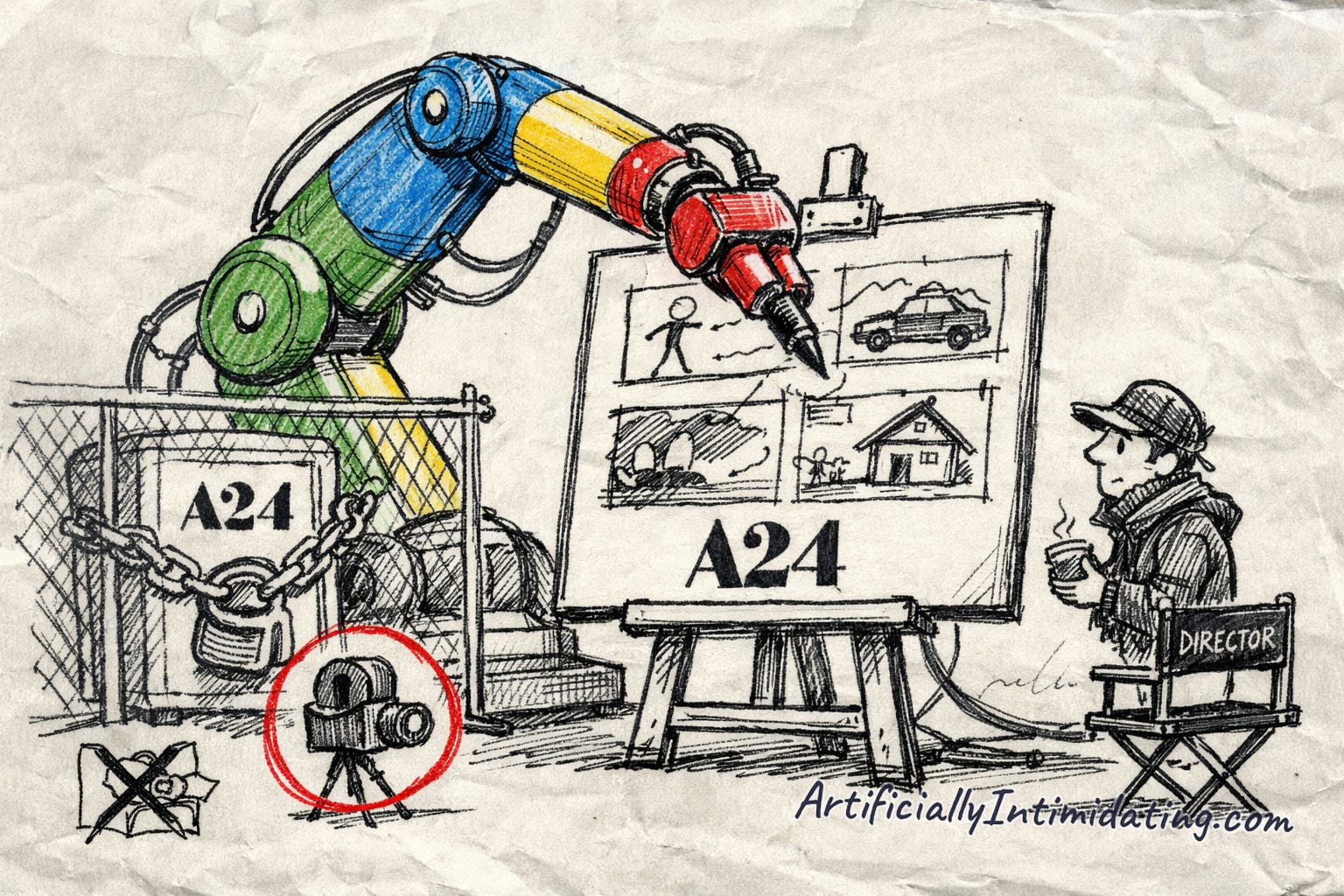
Google draws the storyboards; A24 keeps the vault. · Illustration: Artificially Intimidating
What happened: Indie studio A24 (Marty Supreme, Backrooms) struck a multi-year, non-exclusive research partnership with Google DeepMind, with Google investing roughly $75 million to fund an AI lab inside A24. The first tool reportedly isn’t a text-to-video engine but an AI storyboard generator — and the deal pointedly does not hand Google A24’s films, IP or training data.
Why it matters: A24 is the most filmmaker-revered studio in the business, so its embrace of AI tools — even carefully fenced ones — is a cultural signal that generative AI is sliding from “threat to Hollywood” toward “instrument in the room.” For DeepMind, access to real auteurs is street cred money usually can’t buy.
What everyone’s saying: A24 Labs’ Scott Belsky told the Wall Street Journal the tools “won’t look anything like the prompted generation type of AI that people feel uncomfortable with.” Fans, predictably, were less convinced — the A24 subreddit lit up with “A24 is now dead” and calls to “create A25.”
My read between the lines: The firewall is the whole story. A24 negotiated AI tooling without surrendering its library or its data — the deal every creative company wishes it had the leverage to demand. Whether storyboards stay storyboards, or quietly become the first draft of the entire film, is the line nobody has actually agreed to hold yet.
📖 Further reading: OpenAI Shipped a Physical Camera, But That’s Not the Story — A24’s bet is the other side of the same coin: AI quietly moving into how creative work actually gets made.
That’s your AI Brief for Tuesday, June 30. The bankers are nervous, the senators are drafting, and the studios are signing — same as it ever was, just faster. See you tomorrow.
—Artificially Intimidating


