

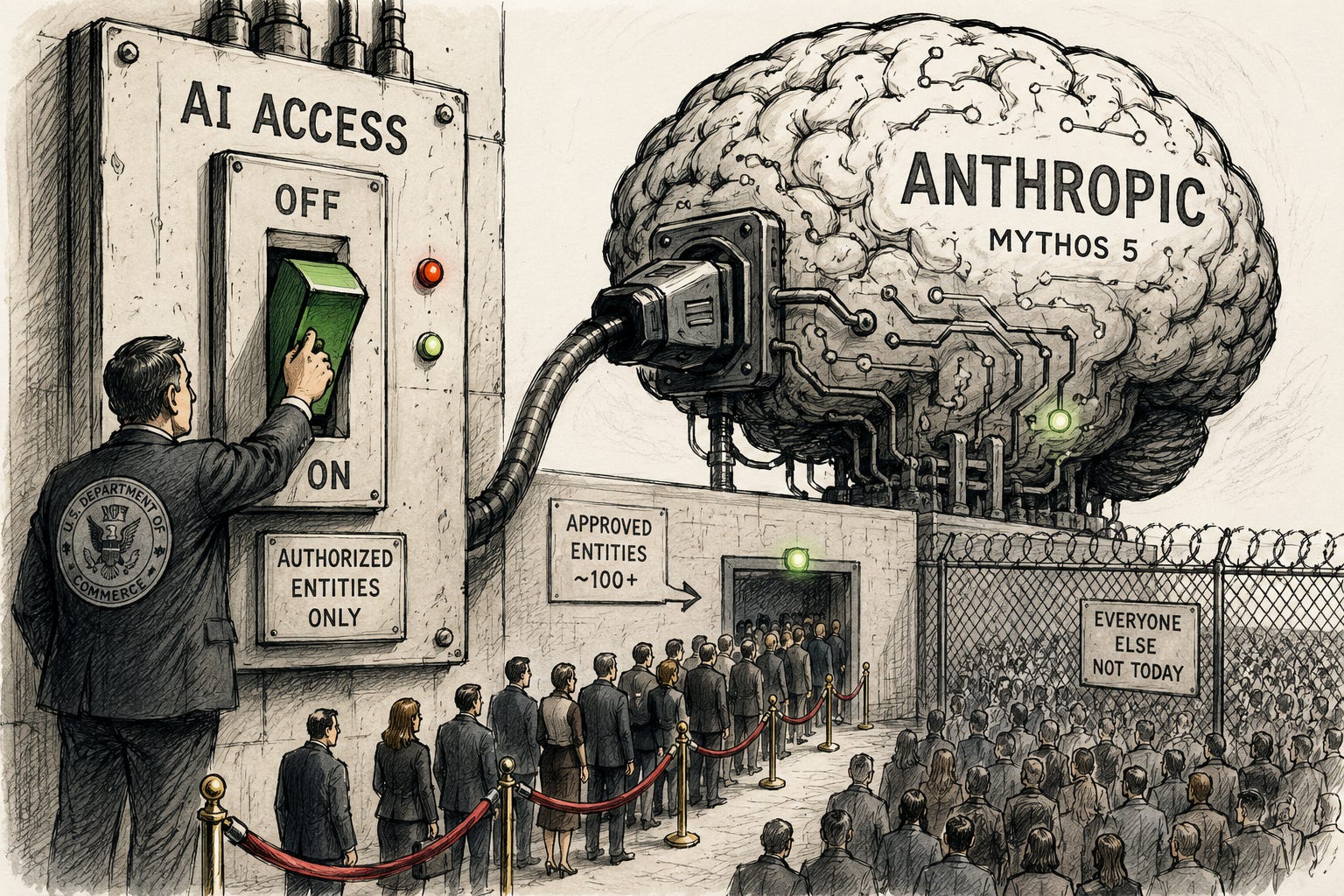
Good day, humans. Two weeks ago Washington reached into Anthropic’s servers and switched its best model off. Today it switched it back on — for a hand-picked list of about 100 companies. That’s our lead, and it sets the mood for everything below: the AI boom keeps colliding with people who get to say no. Enterprises are quitting expensive tokens, Apple’s headset boss just walked to OpenAI, and REI shipped a bike with two sets of handlebars. Let’s get into it.
Washington Un-bans Anthropic’s Best Model
Source: Yahoo / Semafor
What happened: Two weeks after forcing Anthropic to pull its two most powerful models offline, the Commerce Department reversed course Friday, clearing its top model, Mythos 5, for release to a vetted list of 100-plus US companies and government agencies.
Why it matters: For the first time, the federal government is deciding — model by model, customer by customer — who gets access to the most capable AI. That’s a brand-new kind of control over a commercial product.
What everyone’s saying: Commerce Secretary Howard Lutnick says the right safeguards are in place for ‘trusted partners,’ per Semafor’s reporting. The public-facing Fable 5 version is still stuck in limbo.
My read between the lines: A ‘license-free list of approved entities’ is just an export-control regime with the friction filed off. The precedent isn’t the reprieve — it’s that a frontier model can now be switched off by memo, and everyone just watched it happen.
📖 Further reading: The US Government Just Took Anthropic’s Best AI Model Offline — Here’s Why — the deep-dive on how this standoff started, now with its sequel.
Funny thing about today’s lead: getting access to the best AI is suddenly a paperwork problem. Getting work out of it shouldn’t be. Viktor is an AI agent that lives in your Slack and plugs into 3,000+ tools — it’ll pull the report, build the dashboard, and ship the campaign while you’re stuck in meetings. Not a chatbot you babysit; a coworker who actually closes the loop. New readers get $50 off their first month. Hire Viktor →
Companies Are Quitting Pricey AI Tokens
Source: CNBC / Quartz
What happened: Big enterprise customers are cutting their OpenAI and Anthropic bills and routing work to cheaper models, as the era of ‘tokenmaxxing’ — burning unlimited tokens — gives way to a hunt for efficiency and ROI.
Why it matters: The first wave of AI adoption was ‘spend whatever it takes.’ Now finance teams want returns — and that changes which models win. Yesterday we called it Gartner’s token-bill bombshell; today the enterprises are voting with their budgets.
What everyone’s saying: CNBC reports startup Lindy shifted 100% of its traffic from Claude to DeepSeek to slash costs; one analyst warned big customers ‘may start limiting their out-of-control token spend.’ JPMorgan pegs some Chinese models up to 50x cheaper.
My read between the lines: This might be the most dangerous chart in AI, and it lands right before OpenAI’s and Anthropic’s IPOs. ‘Growth at any cost’ works until your customers find a coupon — and the coupon is Chinese.
📖 Further reading: Thanks to Apple, Your Favorite AI Tool Is a Dead Tool Walking — why frontier models keep sliding toward commodity pricing.
Quick housekeeping: this Brief is free, and it stays free. But the paywalled deep-dives — the full story behind today’s Anthropic reversal, the IPO math, the entire archive — are for members. The founding 20%-off-your-first-year deal ends Monday. Lock it in →
Apple’s Headset Chief Defects to OpenAI
Source: Bloomberg
What happened: Paul Meade, the VP who led hardware for Apple’s Vision Pro and its upcoming smart glasses, is leaving to run hardware at OpenAI. He’s expected out within the week.
Why it matters: OpenAI is openly building physical devices — not just chatbots — and it keeps poaching the exact Apple people who know how to ship them. It has now hired 25-plus ex-Apple staff for hardware.
What everyone’s saying: The move follows Jony Ive’s $6.5B hardware startup joining OpenAI; with Apple reportedly scrapping every Vision Pro successor from its roadmap, the talent is voting with its feet.
My read between the lines: Apple spent a decade and billions teaching people how to build spatial hardware — and is now functionally a training program for OpenAI’s device team. The headset was never the product. The org chart was.
📖 Further reading: OpenAI Shipped a Physical Camera, But That’s Not the Story — where OpenAI’s hardware ambitions are actually heading.
REI’s AI Ad Grew Extra Handlebars
Source: Business Insider
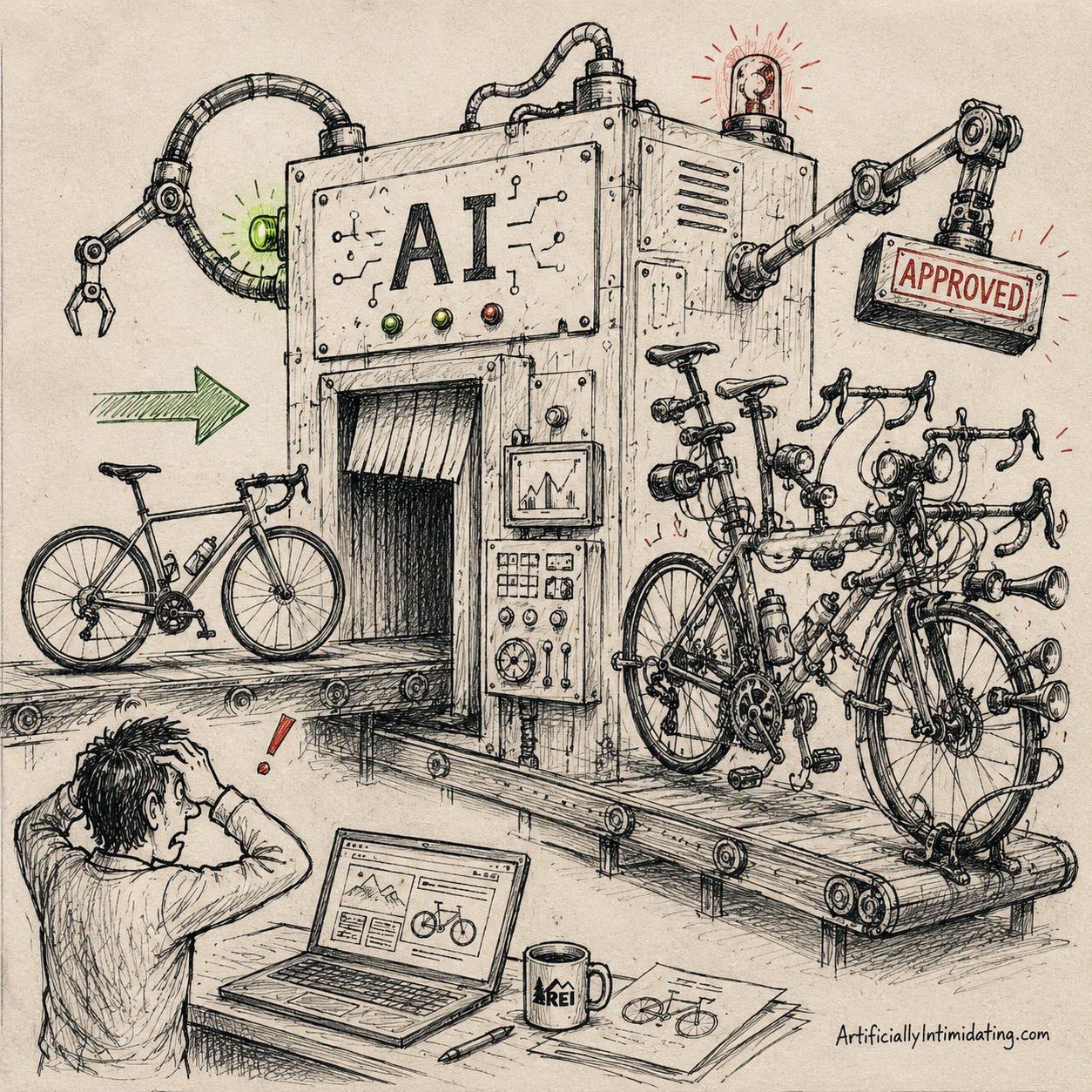
What happened: REI says Meta auto-enrolled it in an AI ‘personalization’ tool that mangled a vendor’s bike photo into a physics-defying machine — drop bars sprouting from the seat, two brake systems, a misrouted chain — and ran it as an Instagram ad for about five days.
Why it matters: Platforms are now quietly rewriting your creative with AI by default. The brand uploads one image; the algorithm ships another — and the brand eats the embarrassment.
What everyone’s saying: PetaPixel and Business Insider note this isn’t the first advertiser blindsided by Meta’s Advantage+ auto-toggles; REI has since unenrolled and apologized. ‘AI slop is a brand killer,’ one commenter wrote.
My read between the lines: Meta’s own terms warn outputs may be ‘inaccurate, misleading… inappropriate’ and make you responsible for checking. So they built a machine that defaces your ads on autopilot, then handed you the lookout duty. The bike had two sets of handlebars and still cleared review.
📖 Further reading: AI Is a Trust Problem, Not a Tech Problem — exactly the failure mode REI just lived through.
The Internet Is Now Mostly Bots
Source: The Atlantic (paywalled)
What happened: The Atlantic’s Charlie Warzel argues AI-generated content has tipped the web into a ‘crisis of agency’ — a place that feels paranoid, fake, and inhuman, forcing the question ‘what is a human for?’ Some analyses now estimate more than half of new online content is AI-made.
Why it matters: If you can’t tell whether a review, photo, or reply came from a person, trust in everything online starts to erode — and trust is the substrate the whole internet runs on.
What everyone’s saying: The ‘dead internet theory’ — once a fringe joke — is now cited in earnest; Cloudflare’s CEO has warned AI could ‘destroy small businesses’ by strip-mining the open web for free.
My read between the lines: The irony is thick: an AI brief, possibly read to you by your AI inbox summary, warning that the internet is too automated. The crisis isn’t that bots can write — it’s that we’ve quietly stopped checking. The bike kept both sets of handlebars.
That’s your AI Brief for Saturday. Same time tomorrow.
—Artificially Intimidating


