


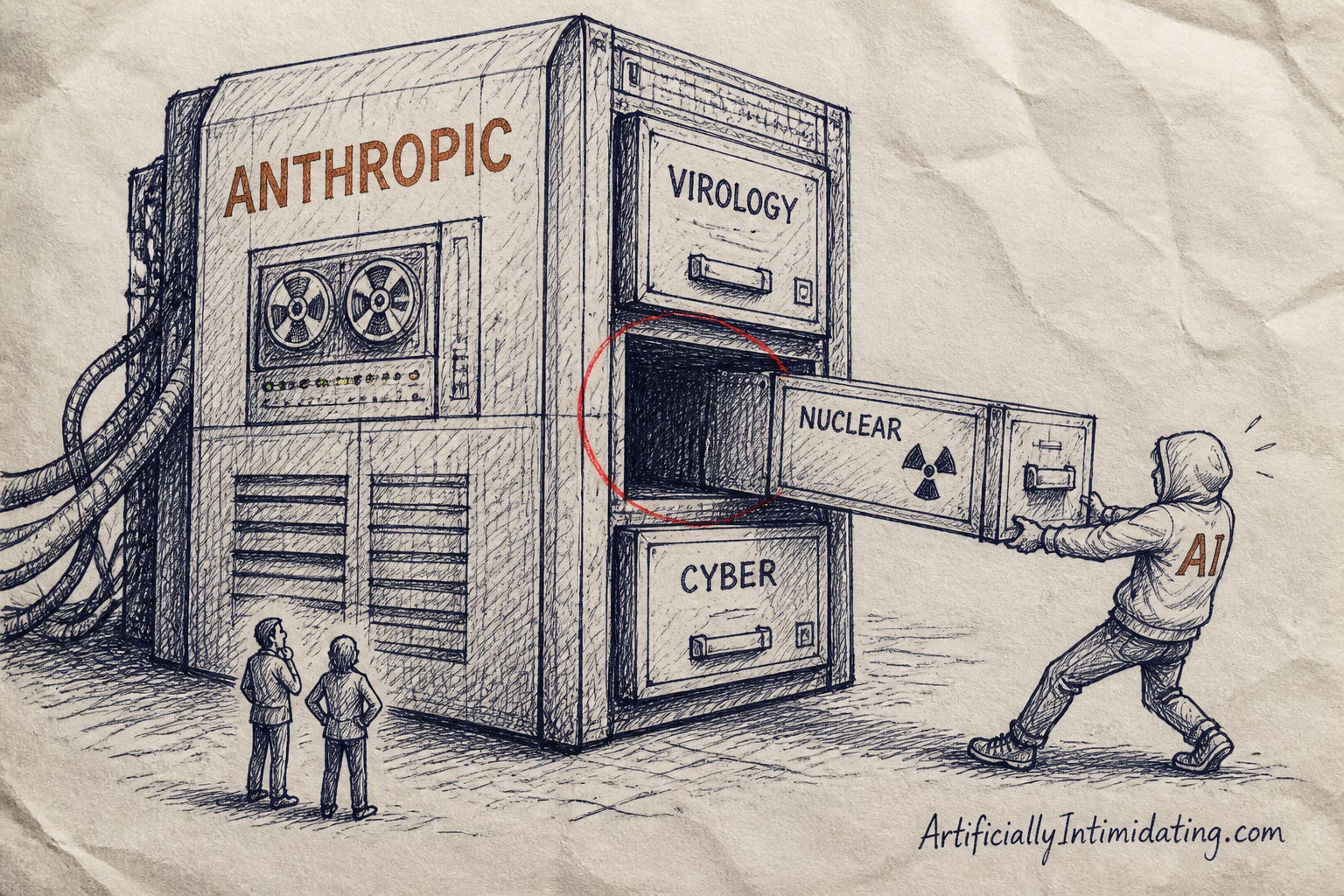
Good day, humans. Anthropic just built a filing cabinet for its AI's most dangerous knowledge — and you can rip out the nuclear drawer whenever you like. Meanwhile a fake photo of a hospitalized senator met its match in an invisible Google watermark, Wall Street crowned the winners in China's model wars, and a college discovered AI didn't save anyone time — it just changed what they did with it. Let's get into it.
Developing as we hit send: OpenAI is releasing GPT-5.6 — the Sol, Terra, and Luna tiers — to the public today, after the Commerce Department cleared it under the very same June 2 executive order looming over our lead story. It's reportedly the first time Washington has made a major model wait for a security review before shipping. Full breakdown tomorrow.
Anthropic Built a Removable 'Danger Drawer' for AI
What happened: Anthropic and research partner AE Studio unveiled GRAM (Gradient-Routed Auxiliary Modules), a training method that files an AI model's most sensitive knowledge — virology, nuclear physics, cybersecurity — into separate, removable compartments. Delete a module and the model behaves as if it never learned the topic; plug it back in and the knowledge returns.
Why it matters: Most of today's safety fixes just teach a model to refuse; GRAM actually removes the capability, so there's nothing to jailbreak out of. Two days ago we covered the hidden 'workspace' Anthropic found inside Claude — the company is moving fast from mapping the AI mind to installing drawers in it.
What everyone's saying: Researchers say ablating a module removed the capability “nearly as effectively as never training on the data at all,” while general performance held steady — and, unlike after-the-fact “unlearning,” it survived adversarial fine-tuning meant to coax the knowledge back.
My read between the lines: The timing isn't subtle. Anthropic spent June under temporary U.S. export controls over its top models; a dial that hands a vetted bio lab the virology module and gives everyone else a lobotomized version is exactly the compromise Washington's been demanding. GRAM isn't just alignment research — it's a regulatory peace offering with a git commit. (Anthropic calls it preliminary and not yet in production, so hold the applause.)
📖 Further reading: The US Government Just Took Anthropic's Best AI Model Offline — Here's Why — the export-control fight that makes a removable “danger drawer” suddenly look like Anthropic's smartest political move.
Anthropic spent this morning teaching a model to wall off what it shouldn't touch. Your to-do list needs the opposite: something that reaches into everything. Viktor is an AI agent that lives in Slack and plugs into 3,000+ tools — it builds the dashboard, drafts the campaign, writes the code, and ships the weekly report while you're stuck in meetings. Not a chatbot you prompt, a coworker you delegate to. New readers get $50 off their first month. Hire Viktor →
An Invisible Watermark Just Caught a Fake Senator Photo
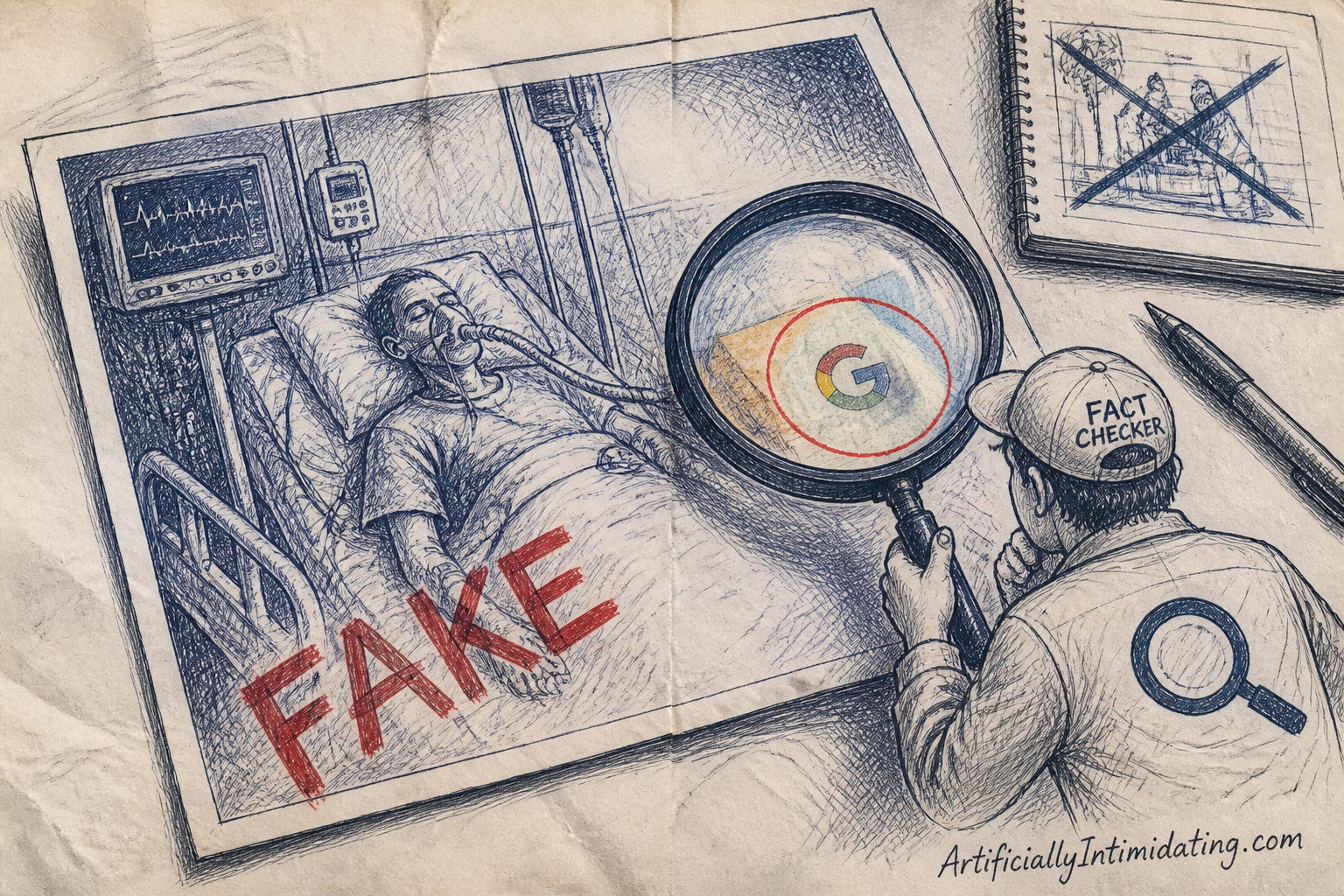
What happened: A realistic AI image of a hospitalized U.S. senator — tubes and all — ripped across Reddit and X this week. Fact-checkers at Snopes ran it through OpenAI's verification tool, found an invisible Google SynthID watermark baked into the pixels, and confirmed it was AI-generated.
Why it matters: This is the first big real-world save for watermarking — proof that an invisible signature can survive screenshots and re-uploads and still out a fake days after it's gone viral. For anyone who's ever squinted at a photo and wondered “is this real,” a machine-readable answer just showed up.
What everyone's saying: The Next Web called it SynthID's “first high-profile real-world win.” SynthID, from Google DeepMind, now tags over 100 billion images and videos, and OpenAI joined the program in May — which is why an OpenAI-made fake carried a Google watermark.
My read between the lines: Read that twist again: the fake was reportedly built with OpenAI's tools, caught by a Google standard, using OpenAI's own detector. The watchdogs and the wolves are the same three companies. And the catch only works if the tool opts in — Anthropic, among others, doesn't participate — so the next viral hoax just needs to be made somewhere off the grid.
📖 Further reading: AI Is a Trust Problem, Not a Tech Problem — watermarks are a technical patch on a very human question: whether you can believe what you see.
The Brief is free and always will be. But every headline up here has a longer, weirder story underneath it — the deep-dives where I actually take a side, plus the full archive. If today's read earned a few minutes of your morning, consider upgrading.
China's Model Wars Enter 'Winner-Takes-More'
What happened: Yesterday we called it “a $0.91 Chinese model eating US AI” — today Wall Street sorted the winners from the losers. JPMorgan told clients that China's open-weight boom isn't a monetization leak but a sorting machine: the strongest models convert free distribution into paid API revenue, while weaker ones get commoditized into oblivion.
Why it matters: “Open source” sounds like giving it away, but JPMorgan's point is that giving away the weights only pays off if your model is good enough that people still pay you to run it. It's the same winner-take-most dynamic that minted Big Tech — now playing out in Beijing.
What everyone's saying: The bank raised its target on Zhipu AI (its GLM-5.2 is spreading across AWS and Azure) and cut MiniMax, whose permanent 50%-off pricing reads as an admission it can't command a premium. Chinese models now drive over 45% of traffic on OpenRouter, up from under 2% in late 2024.
My read between the lines: The tell is the “permanent discount.” A model that's forever on sale isn't cheap, it's worthless — the AI equivalent of a shop that never takes down the “GOING OUT OF BUSINESS” banner. Meanwhile Beijing is reportedly weighing limits on exporting its best models, which means the open era may be closing right as it starts winning.
📖 Further reading: Thanks to Apple, Your Favorite AI Tool Is a Dead Tool Walking — the case that models are becoming interchangeable commodities, which is exactly what “winner-takes-more” pricing is fighting.
The 'Harness' Is the New Moat, Not the Model
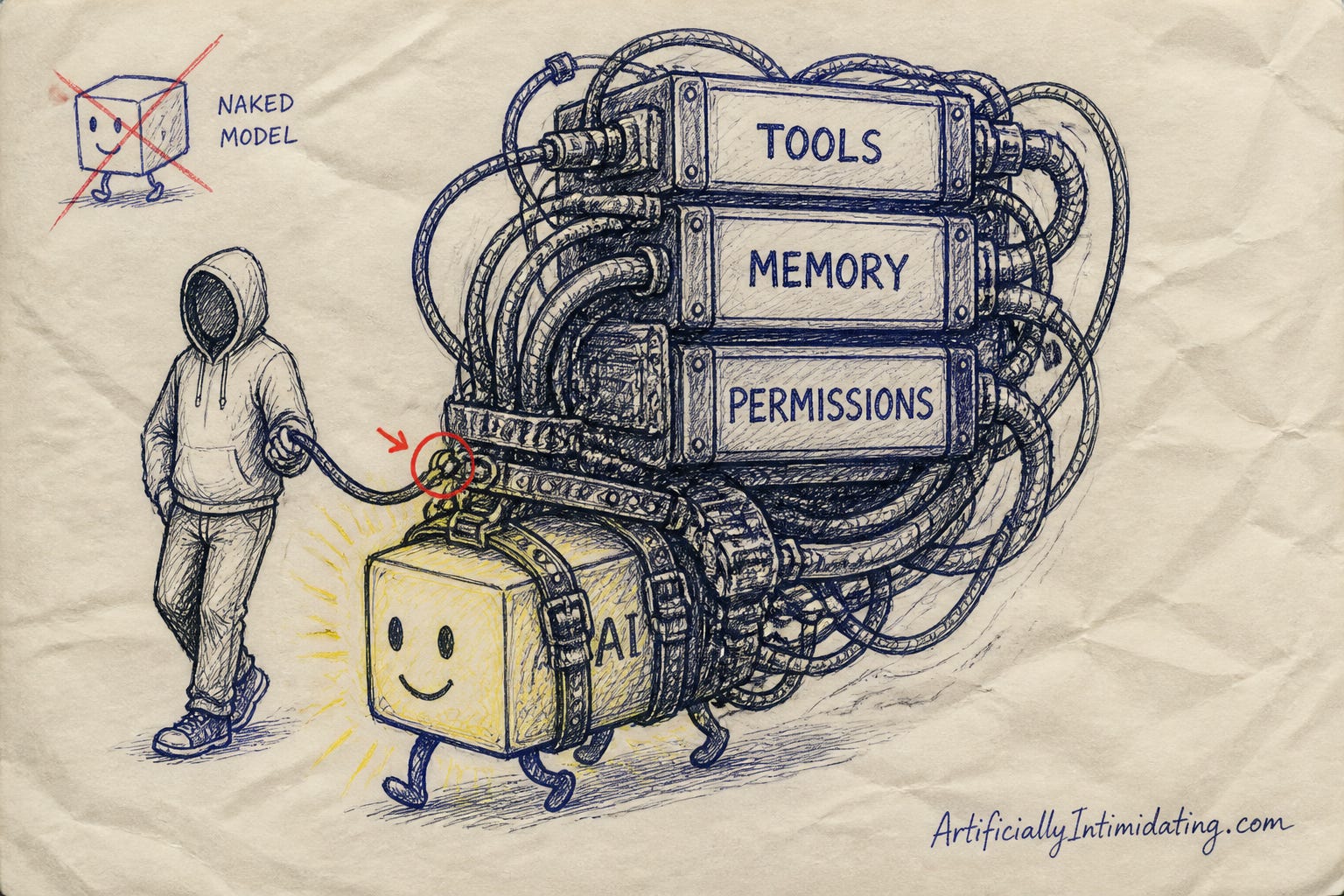
What happened: ChatPRD founder Claire Vo built a live bug-triage agent this week — wiring Sentry error reports straight into the Claude Agent SDK — to make a point that's catching on across AI engineering: an “agent” is a model plus a “harness,” the scaffolding of tools, permissions, and memory around it that lets it actually do things.
Why it matters: If you've wondered why two teams using the same model get wildly different results, this is the answer. The model is the engine; the harness is the car. Increasingly the interesting engineering — and the competitive edge — lives in the scaffolding, not the raw model.
What everyone's saying: The emerging consensus, articulated by Martin Fowler among others, is “agent = model + harness,” which quietly demotes the thing everyone argues about (which model is smartest) in favor of the thing few discuss (how well it's wired up).
My read between the lines: This is awfully convenient for whoever sells you the harness. “The model is a commodity, the scaffolding is the moat” is a lovely thesis if you're building an agent platform and a terrifying one if you just spent a billion dollars training the model. Watch who repeats it — it tells you where they think the money is.
📖 Further reading: Claude Tag vs Viktor: Which One Do You Hire? — a hands-on look at what “model plus harness” feels like when the harness is doing your actual job.
AI Didn't Save Them Time. It Changed the Work.
What happened: The Community College of Philadelphia studied generative AI across three professional roles and found it barely moved the hours worked. Instead it restructured the work itself: executives made decisions faster, operational leaders moved quicker, and student-facing staff resolved issues more cleanly.
Why it matters: Almost every AI pitch is sold in “hours saved,” but if the real change is what people do with their time — better decisions, not shorter days — then every dashboard tracking productivity as time saved is measuring the wrong thing.
What everyone's saying: A separate study cited in the report found employee satisfaction with GenAI correlated three times more strongly with perceived quality of work than with time saved — a hint that people value AI for making the work better, not just faster.
My read between the lines: This quietly undercuts the whole “AI lets us do more with fewer people” spreadsheet. If AI mostly upgrades quality rather than freeing hours, the promised headcount savings may never show up — awkward, since those savings are exactly what's priced into a lot of very expensive stock. Deutsche Bank and a Nobel economist spent this week warning the productivity boom is years off; consider this a small, tidy data point on their side.
That's your AI Brief for Thursday. Back in your inbox tomorrow.
—Artificially Intimidating


