


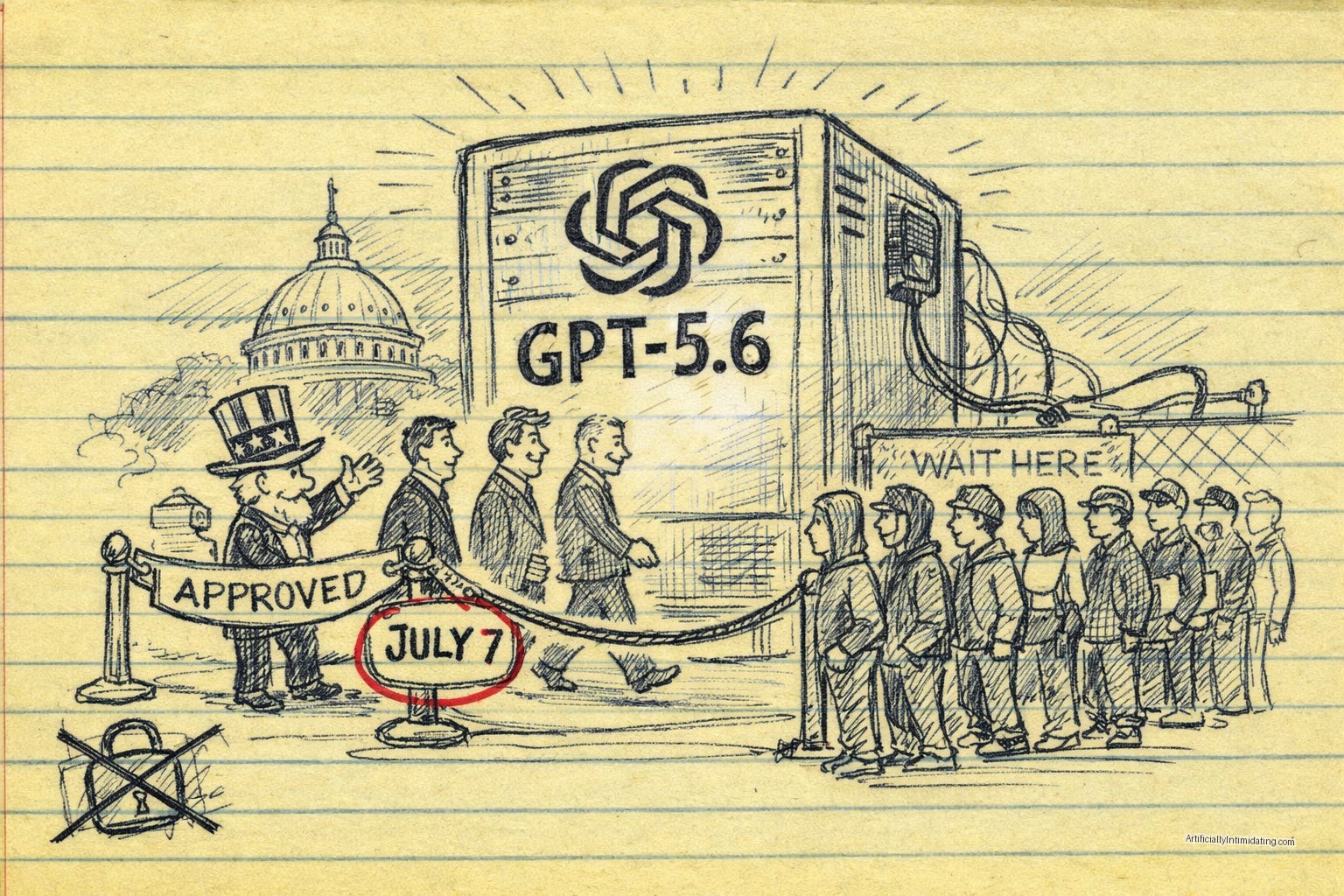
The U.S. government is now standing between developers and OpenAI’s GPT-5.6. (Illustration: Artificially Intimidating)
Good day, humans. For the first time in the AI era, the U.S. government is standing between you and a frontier model — OpenAI’s GPT-5.6 is stuck behind a White House velvet rope until at least July 7. Meanwhile your Robinhood account can now trade itself, Washington’s departing AI czar says no referee is coming, and a scholar just caught ChatGPT mangling one of South Asia’s greatest poets. Let’s get into it.
Washington Won’t Let You Have GPT-5.6 Yet
Source: Reuters
What happened: OpenAI previewed GPT-5.6 — a three-model family (Sol, Terra, and Luna) with a new “ultra” mode that spins up sub-agents to work in parallel — on June 26, then, at the White House’s request, kept it limited to roughly 20 vetted, government-approved organizations. Broad public access now hinges on a federal AI framework expected around July 7.
Why it matters: It’s the first time a U.S. administration has gated the release of a frontier AI model, reportedly approving customers one at a time. Earlier we covered how Washington took Anthropic’s Fable 5 offline — this is the same lever, now pointed at OpenAI. When the government decides who gets the newest model first, “launch day” stops being the lab’s call.
What everyone’s saying: Sam Altman told staff the setup is “not our preferred long-term” approach — a memo confirmed by CNN — and OpenAI framed its compliance as a tactical concession, “the strongest path to broader availability in the coming weeks.” Prediction markets have converged on July 7 as the likely unlock.
My read between the lines: Both OpenAI and Anthropic have confidentially filed for IPOs at valuations near $1 trillion, which makes every week of “national security” delay a very real line on a financial statement. Nothing concentrates a company’s cooperative spirit quite like a locked-up product it’s about to sell to public markets.
📖 Further reading: The US Government Just Took Anthropic’s Best AI Model Offline — Here’s Why — the OpenAI gate is the sequel to the Anthropic ban we broke down here.
While Washington decides who’s allowed to touch GPT-5.6, there’s one AI coworker you can hire today with no waitlist. Viktor is an AI agent that lives in Slack, connects to 3,000+ tools, and actually does the work — shipping reports, building dashboards, and running campaigns while you sleep. Not a chatbot you pepper with questions; a coworker who closes the loop. New readers get $50 off their first month. Hire Viktor →
Your Robinhood Account Can Now Trade Itself
Source: TechCrunch
What happened: Alphio AI announced on July 3 that it has plugged into Robinhood’s new agentic-trading system, letting retail investors place real equity trades by typing plain-English commands to a chatbot. It builds on the “agentic” accounts Robinhood opened to AI agents in late May.
Why it matters: For the first time, an everyday investor can hand a bounded, pre-funded account to an AI agent and say “trim my tech exposure” in actual English — no order tickets, no ticker symbols. Robinhood bakes in trade previews, spending caps, and an instant kill switch, but you’re the one setting the guardrails.
What everyone’s saying: Robinhood isn’t alone — TechCrunch notes Stripe, Amazon, and Google are all racing to give AI agents real spending power, and third-party specialists like Alphio are now stacking trading strategies on top of Robinhood’s open protocol.
My read between the lines: Every one of these launches tiptoes past the same question: when an autonomous agent fat-fingers your savings at 3 a.m., who’s liable — you, Robinhood, or Alphio? “Instant kill switch” is a wonderful feature, assuming you’re awake to press it.
📖 Further reading: Claude Tag vs Viktor: which one do you hire? — a field guide to trusting AI agents with real work, before you trust one with your brokerage.
The Brief you’re reading is free, and it’s staying that way. But the headlines are only half the story — members get the paywalled deep-dives where I actually take things apart, like exactly how Washington’s model bans work, plus the full archive. If today made you think, come inside.
Trump’s AI Adviser: No Referee Is Coming
Source: Financial Times (via aiweekly.co)
What happened: Sriram Krishnan, who just stepped down as the White House’s senior AI policy adviser, told the Financial Times there “will not be an FDA for AI” under President Trump — ruling out any centralized federal regulator for frontier models.
Why it matters: It confirms the U.S. is betting on a light-touch, voluntary framework: labs submit their most powerful models for up to 30 days of government testing before release, but there’s no licensing and no pre-clearance. It’s the same voluntary door that let Washington gate GPT-5.6 and, weeks earlier, flip Anthropic’s off switch — leverage without a rulebook.
What everyone’s saying: Krishnan pinned the public backlash on the industry’s own “doomer” messaging. Europe sees it differently — at the ECB’s Sintra forum this week, the Bank of England’s deputy governor floated market “circuit breakers” for rogue AI, and the UK’s FCA chief warned AI is “evolving too quickly” for traditional rules.
My read between the lines: “No FDA” sounds like freedom until you notice the same administration is already hand-approving GPT-5.6 customers one by one. No agency, no statute, no appeals — just a phone call from Washington. That’s not deregulation; it’s discretion, which is a far less predictable thing to build a company on.
📖 Further reading: Fable 5 Is Back After 18 Days. The Precedent It Set Isn’t Going Anywhere. — what “voluntary” oversight looks like in practice, once the government has your model.
ChatGPT Still Can’t Translate a Poem
Source: Delos (University of Florida Press)
What happened: Amherst College scholar Krupa Shandilya pitted ChatGPT against human translators on the work of celebrated Urdu poet Faiz Ahmed Faiz. In a study published in the journal Delos, the AI produced nonsensical grammar and invented imagery that appears nowhere in the original.
Why it matters: Translation is supposed to be one of AI’s easy wins, but poetry lives in metaphor, rhythm, and cultural weight — the exact layers a fluent-sounding model quietly flattens. It’s a clean, concrete illustration of the gap between “reads smoothly” and “means what the author meant.”
What everyone’s saying: Researchers keep hitting the same pattern: experts initially prefer the AI translation for its fluency, then switch to the human version the instant they compare it against the source text. Fluency, it turns out, makes a convincing disguise.
My read between the lines: The unsettling part isn’t that ChatGPT gets poetry wrong — it’s that it gets it wrong beautifully, in confident, publishable-looking prose. If you don’t read Urdu, you’d never catch it. Now multiply that by every “good enough” AI translation shipping silently around the world today.
📖 Further reading: Krugman Says AI Is Eating Our Brains — another angle on what gets lost when we let the fluent machine do the thinking.
The “AI Confidence Theater” Wrecking Adoption
Source: Elena Verna
What happened: Growth leader Elena Verna published a widely shared essay arguing that most people posting “life-changing” AI breakthroughs are really just running basic workflows — and that the performance is doing real harm.
Why it matters: Verna’s argument is that inflated claims manufacture toxic FOMO: people feel hopelessly behind, lose trust in the tech, and tune out the tools that genuinely help. It’s the adoption paradox — overselling AI is one of the fastest ways to make people stop believing in it.
What everyone’s saying: She’s clearly hit a nerve. A recent Forbes analysis blamed “AI fatigue” on exactly this — repeated exposure to hype with too little measurable proof. Her fix is refreshingly boring: spend a couple of hours a week actually experimenting instead of performing mastery.
My read between the lines: The irony is delicious — “AI confidence theater” is itself a viral post about how viral AI posts are bad. But she’s right, and here’s the tell: the people doing the most impressive work with AI are almost always the quietest about it. The loudest “prompt gurus” are usually selling the ladder, not climbing it.
📖 Further reading: AI Is a Trust Problem, Not a Tech Problem — why the hype cycle, not the technology, is the real barrier to adoption.
That’s your Brief for Sunday. Back tomorrow with more.
—Artificially Intimidating


