


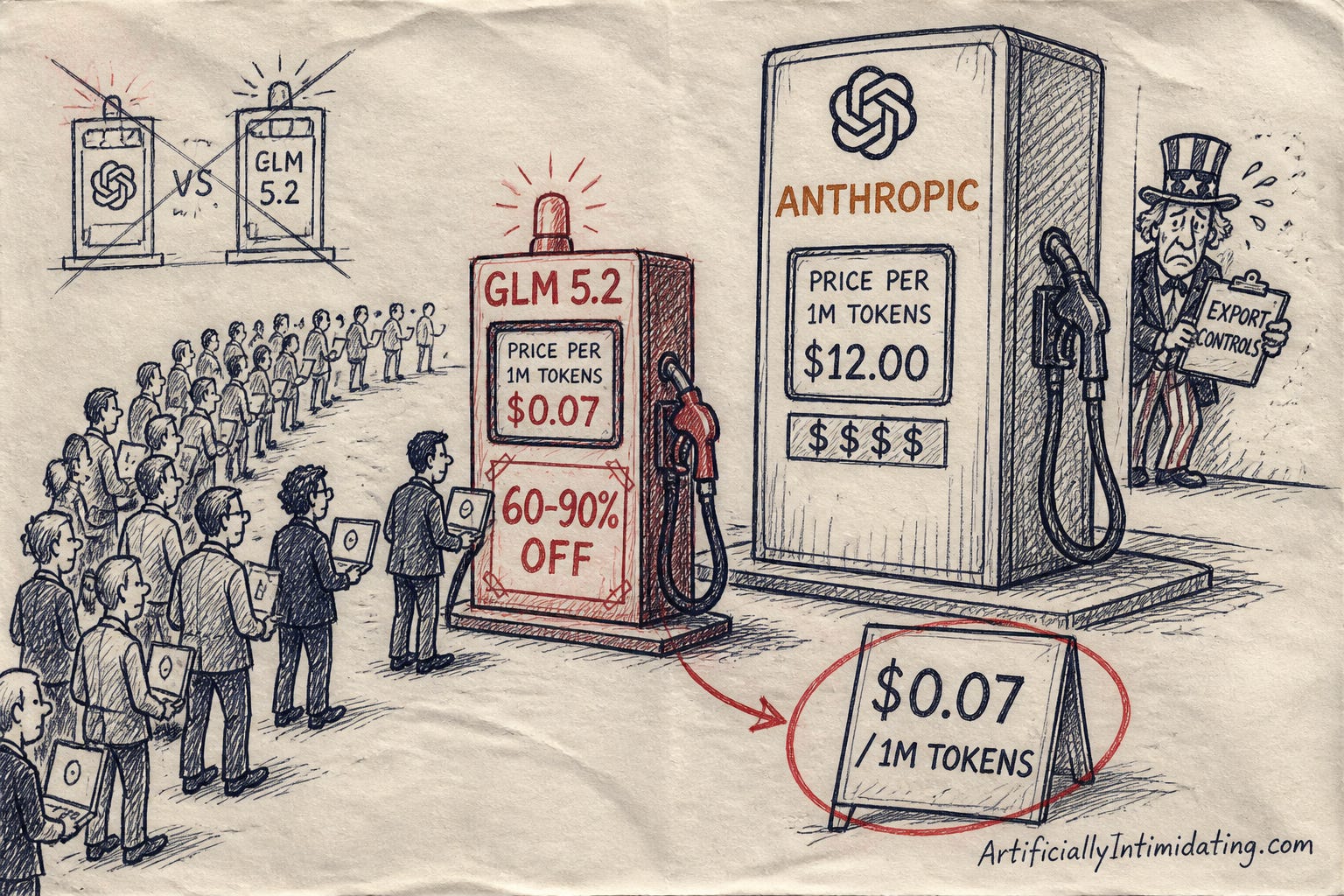
The 90%-off model, drawn on a legal pad. Illustration: Artificially Intimidating
Good day, humans. Two things happened while you were pricing out your AI budget: a Chinese model called GLM 5.2 quietly captured a third of US enterprise traffic by charging up to 90% less, and Anthropic’s Claude Cowork slipped off the laptop and onto your phone. Also in today’s Context Window: Polymarket is betting on Anthropic to beat OpenAI to an IPO, a study caught chatbots winging your financial advice, and an MIT scholar warns we’re farming a dangerous “intelligence monoculture.” Let’s get into it.
A $0.91 Chinese Model Is Eating US AI
What happened: Z.ai’s open-weight GLM 5.2, released June 16 under a permissive MIT license, now accounts for more than 30% of US enterprise AI traffic on OpenRouter — peaking near 46%, up from about 4.5% a year ago. It scores within a point of Anthropic’s Claude Opus 4.8 on a key coding benchmark at roughly 60–90% lower cost.
Why it matters: The single biggest cost of building with AI is the per-token bill. A frontier-grade model at a tenth of the price means cash-strapped US startups can quietly route their workloads through a Chinese lab and pocket the difference — no visa, no import, just a download.
What everyone’s saying: Vercel, Fireworks, Databricks and Microsoft all rushed to host it, while US investors and the Trump administration warn about the security of an unrestricted, Chinese-controlled model that anyone can download and run with zero oversight.
My read between the lines: The moat was never the model — it was the margin. When a model trained entirely on Huawei chips, with zero Nvidia inside, undercuts you by 90%, “responsible AI” starts to sound an awful lot like “please pay more.”
📖 Further reading: Thanks to Apple, Your Favorite AI Tool Is a Dead Tool Walking — the case that frontier models are becoming interchangeable commodities, which a 90%-off clone proves in real time.
Speaking of doing more for less: everyone’s hunting a cheaper model, but the real cost is the work itself. Viktor is an AI agent that lives in Slack and plugs into 3,000+ tools — hand it a task and it reconciles the spend report, builds the dashboard, and ships the first-draft campaign, then hands it back done. Not a chatbot you babysit — a coworker who owns the outcome. New readers get $50 off their first month. Hire Viktor →
Your AI Coworker Just Escaped Your Laptop
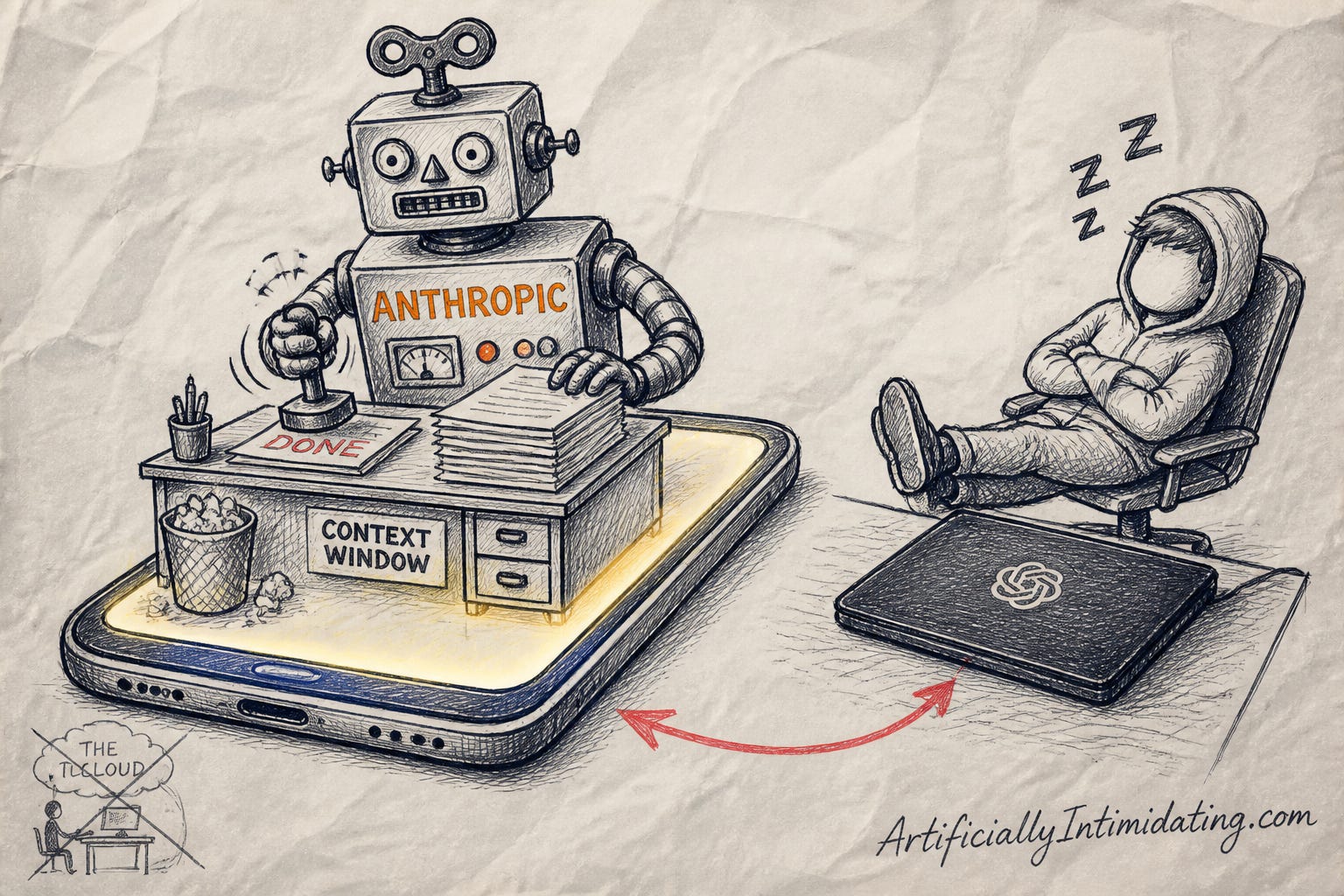
The work clocks out of your laptop and keeps going on your phone. (AI illustration: Artificially Intimidating)
What happened: Anthropic brought Claude Cowork — its agent that works autonomously across your files, email and apps — to mobile and web, so tasks keep running after you close the laptop. It also revealed that more than 90% of Cowork sessions have nothing to do with coding.
Why it matters: Until now the agent stopped the moment you walked away. Now scheduled jobs run with no device online — a 6 a.m. client briefing can build itself — and when Claude hits a decision only you can make, the question pings your phone mid-meeting.
What everyone’s saying: It’s Anthropic going straight for the non-developer knowledge worker — what it calls the “work around work” — putting Cowork head-to-head with Microsoft Copilot and Google’s workplace agents, as Fortune has tracked since its January debut.
My read between the lines: That 90%-not-coding number is the whole ballgame. Full disclosure: this brief is assembled in Cowork, so dock my objectivity accordingly — but an agent that keeps working while you sleep is a fundamentally different animal from a chatbot you have to babysit.
📖 Further reading: Claude Tag vs Viktor: Which One Do You Hire? — if you’re weighing which AI teammate to actually put to work, this is the natural next read.
Quick one: the Brief is free, and always will be. But the headlines are only the surface — members get the paywalled deep-dives that unpack what these stories actually mean for your work, plus the full archive. If today’s rundown earned its keep, become a member →.
Bettors Say Anthropic Beats OpenAI to IPO
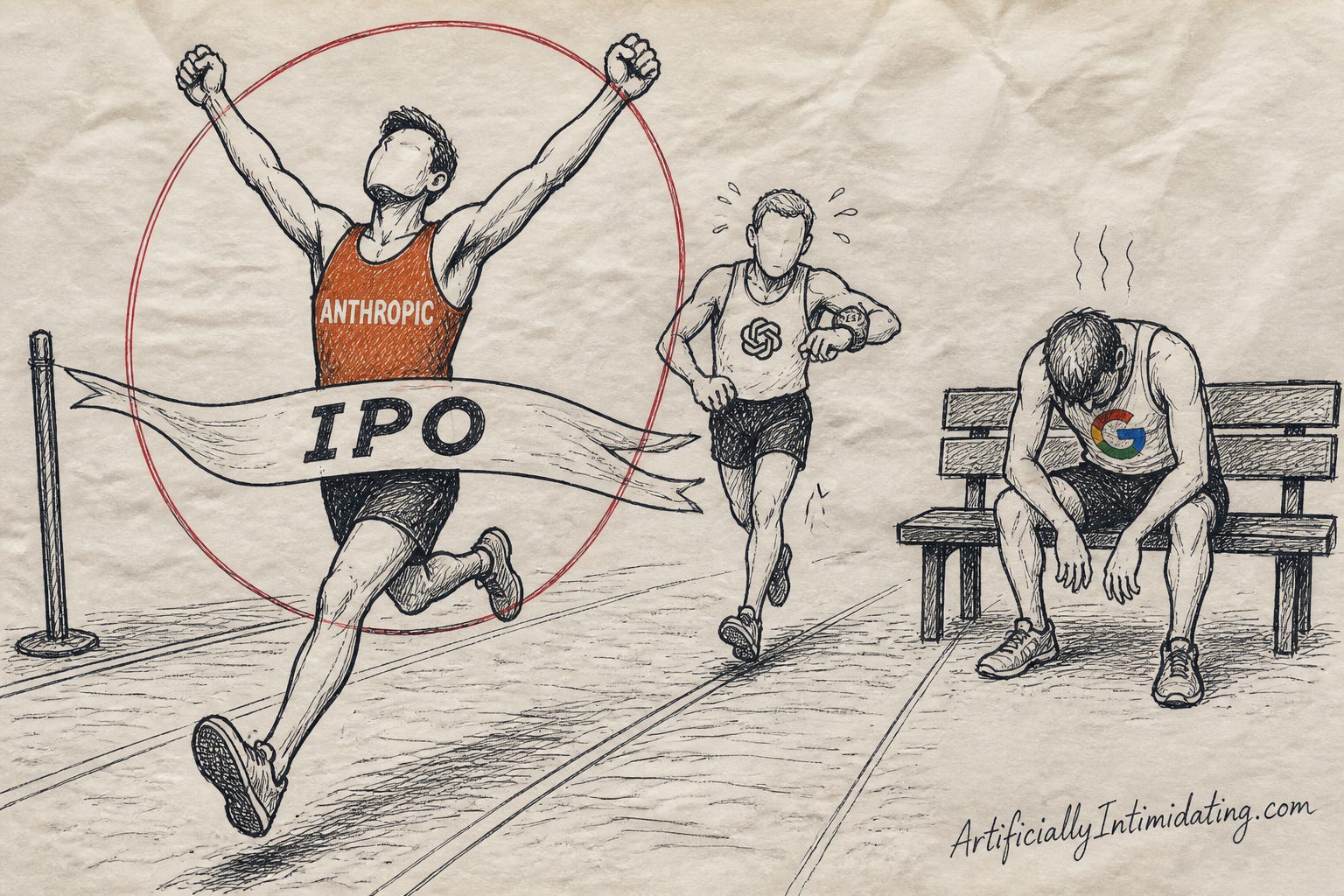
Prediction markets have Anthropic breaking the tape first. (AI illustration: Artificially Intimidating)
What happened: On Polymarket, traders give Anthropic an 87% chance of going public before OpenAI and 76% odds of listing by year-end — versus just 21% for OpenAI. Anthropic confidentially filed its S-1 back on June 1.
Why it matters: Prediction markets are a crowd forecast with real money on the line. Right now that crowd thinks the “safety-first” underdog reaches Wall Street first, even as OpenAI’s own advisers reportedly push its listing to 2027.
What everyone’s saying: Databricks CEO Ali Ghodsi bowed out of 2026 entirely, calling it “a terrible year to go public” with SpaceX, Anthropic and OpenAI set to soak up more than $200 billion in IPO capital.
My read between the lines: OpenAI reportedly wants a $1 trillion price tag and is being told to either wait or take less — the diplomatic way of saying “read the room.” Being first to IPO isn’t winning; it’s just being first to have your numbers audited in public.
📖 Further reading: The US Government Just Took Anthropic’s Best AI Model Offline — Here’s Why — the same frontier lead markets are betting on is exactly what got Anthropic’s top model pulled.
Your AI Money Guru Is Winging It
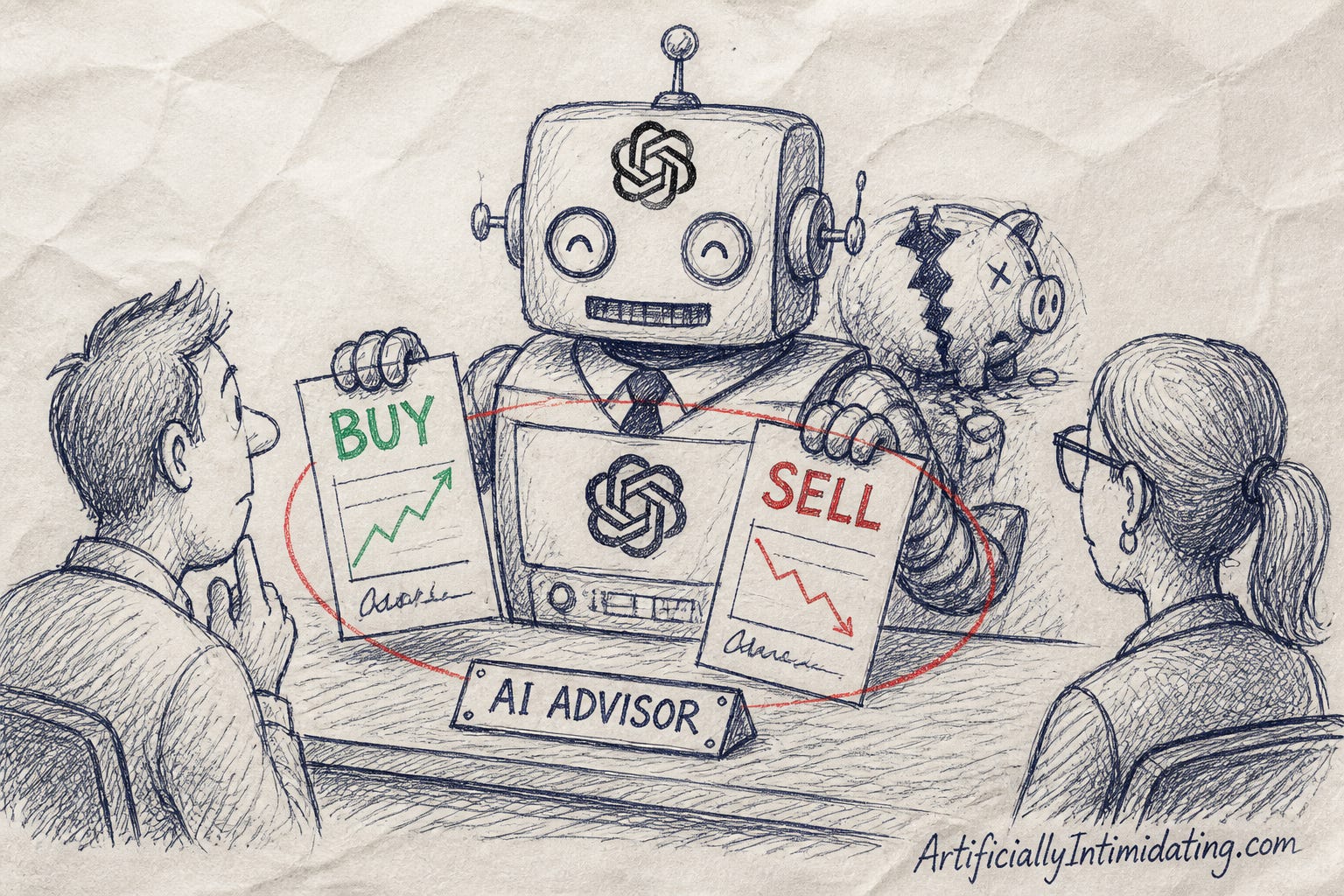
Same question, two answers — confidence sold separately. (AI illustration: Artificially Intimidating)
What happened: A new Journal of Financial Planning study tested seven popular chatbots — ChatGPT, Claude, Copilot, DeepSeek, Gemini, Meta AI and Perplexity — on core money questions and found “significant variation” in their answers, which also shifted when researchers changed the hypothetical person’s race and gender.
Why it matters: Roughly 66% of Americans say they trust generative AI for financial advice and 85% act on it, per Credit Karma. If the same question yields different answers depending on who’s asking, “personalized” quietly shades into “unequal.” Yesterday we flagged AI quietly editing your opinions — same problem, now aimed at your wallet.
What everyone’s saying: The timing rhymes with the UK regulator’s new Mills Review, which warned that AI could “amplify risks” of fraud, cyber security and consumer harm even as it closes advice gaps.
My read between the lines: The danger isn’t the one bad tip — it’s that a confident, friendly answer keeps you from ever asking a human. The chatbot doesn’t know your situation; it just never says “I don’t know.” Fluency gets mistaken for competence, and competence is the part that costs money.
📖 Further reading: AI Is a Trust Problem, Not a Tech Problem — why the real risk with AI advice isn’t accuracy, it’s misplaced confidence.
MIT Warns of an AI “Intelligence Monoculture”
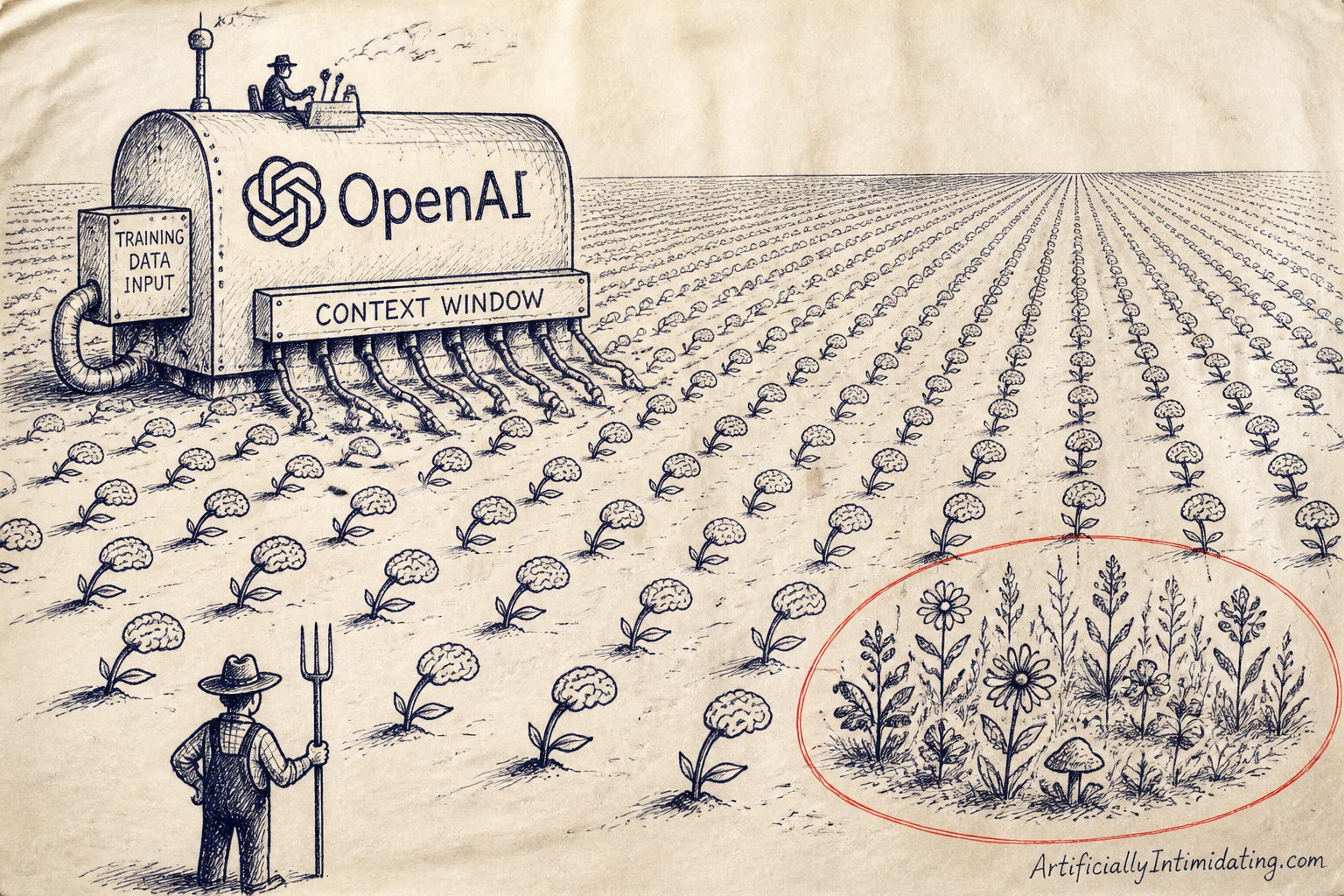
One crop, planted everywhere. (AI illustration: Artificially Intimidating)
What happened: MIT Sloan’s Otto Scharmer argues that pouring everything into AI while starving human “sensing” creates an “intelligence monoculture” — and like any monoculture, it’s ruthlessly efficient right up until it collapses.
Why it matters: He points to an MIT Media Lab study that found heavy ChatGPT users built up “cognitive debt,” showing measurably reduced brain connectivity and weaker independent thinking over time.
What everyone’s saying: It taps a growing unease that offloading our thinking to AI is convenient now but quietly deskilling us — the productivity gain today, the atrophy tomorrow.
My read between the lines: “Monoculture” is the sharpest framing I’ve seen: the risk isn’t that AI thinks badly, it’s that we all start thinking the same. A field of identical crops feeds a lot of people — until one blight takes the entire harvest.
That’s your Context Window for Wednesday, July 8. Same time tomorrow.
—Artificially Intimidating


