


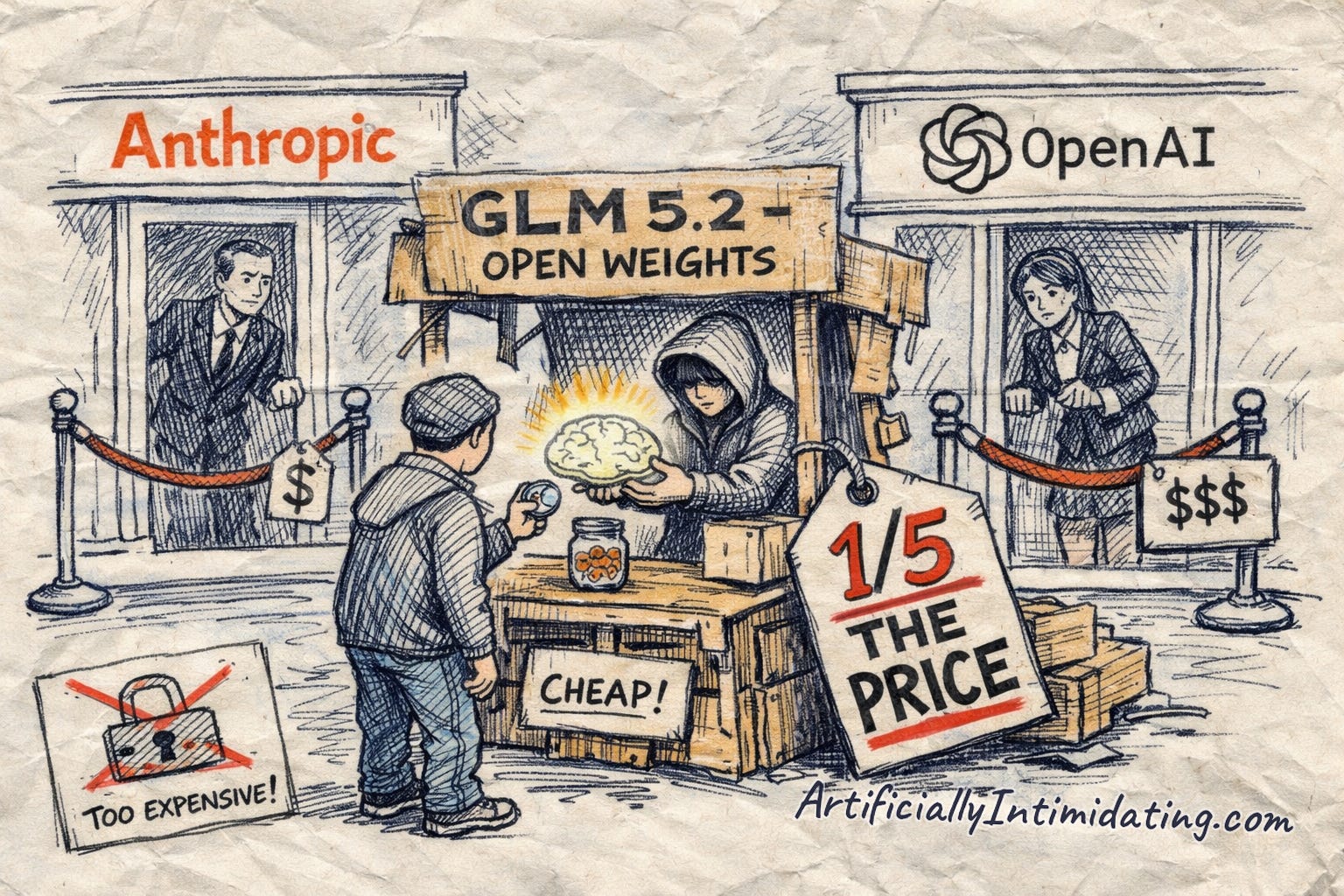
Good day, humans. The theme writes itself today: the best coding model of the weekend is free and Chinese, the most powerful American one is locked behind a government velvet rope, and somewhere in the middle a philosopher is calling your chatbot Satan. On deck — Zhipu's GLM 5.2 gutting frontier pricing, OpenAI's crypto-coded model names, a nasty new attack on coding agents, what Georgia's teachers really think of AI, and Žižek's prog-rock theology. Let's get into it.
China's Open Model Just Undercut the Frontier by 80%
What happened: Chinese lab Zhipu AI (a.k.a. Z.ai) dropped GLM 5.2, a 744-billion-parameter open-weight model under the permissive MIT license that lands within a few points of Anthropic's Claude Opus 4.8 on agentic coding benchmarks — at roughly one-fifth the cost to run. It posts 81.0 on Terminal-Bench 2.1 to Opus's 85.0, and ships a one-million-token context window big enough to swallow an entire codebase at once.
Why it matters: Earlier this week we covered enterprises dumping pricey tokens for DeepSeek — this is the next chapter, and a louder one. “Open weight” means anyone can download GLM 5.2, run it on their own servers, and pay the lab that built it nothing. When a free model gets within arm's reach of the most expensive one on the market, frontier-grade AI stops being a moat and starts being a commodity.
What everyone's saying: Comparisons to early-2025's “DeepSeek shock” are everywhere, but practitioners argue this one sticks: unlike DeepSeek, GLM 5.2 is genuinely strong at agentic work — planning, coding, testing, looping — the autonomous tasks enterprises actually want to automate. Harvey co-founder Gabe Pereyra and a chorus of developers have called it the first open model that feels competitive in daily use.
My read between the lines: The quiet kicker is regulatory. A June executive order now grants Washington up to 30 days of pre-release access to “covered frontier models” — which is exactly why OpenAI's newest model is trickling out to a handful of approved partners (more on that below). Zhipu, sitting outside that framework, simply gets to ship. We may have built a world where the safest models are the hardest to obtain and the Chinese one is a free download.
📖 Further reading: Thanks to Apple, Your Favorite AI Tool Is a Dead Tool Walking — our case that frontier models are sliding into interchangeable commodities just got a 744-billion-parameter exhibit.
A frontier-grade model for a fifth of the price is great — but a cheaper brain still doesn't do the work for you. Viktor does. It's an AI agent that lives in your Slack and plugs into 3,000+ tools, shipping real output: research reports, live dashboards, working code, entire campaigns. Not a chatbot you babysit all day — a coworker you hand things to. New readers get $50 off their first month. Hire Viktor →
OpenAI Named Its New Models After a Crypto Crash
What happened: OpenAI launched a limited preview of its GPT-5.6 family on Friday, splitting it into three permanent tiers — Sol (flagship reasoning and coding), Terra (an everyday model at about half the cost of GPT-5.5), and Luna (the fastest and cheapest). The structure mirrors Anthropic's Opus / Sonnet / Haiku; the names, less intentionally, mirror three of crypto's most infamous tickers.
Why it matters: Naming is more than branding. A clean, durable tier system tells developers which model to reach for without re-reading a changelog every month. But “Sol, Terra, Luna” also evokes Solana and the Terra/Luna ecosystem, whose 2022 implosion vaporized tens of billions of dollars — so the launch doubled as an unintentional test of how online your audience is.
What everyone's saying: Crypto X had a field day: Solana's official account replied “Sam Altcoinman,” and others posted about “crypto PTSD” at seeing Terra and Luna reunited on a product page. OpenAI insists the celestial theme — sun, earth, moon — has no connection to digital assets, which is precisely the kind of denial that guarantees the joke outlives the launch.
My read between the lines: Yesterday we said Washington found the off switch for Anthropic — today it's holding OpenAI's door. The genuinely strange part isn't the names; it's that GPT-5.6 is going to roughly 20 government-approved partners first, not to ChatGPT, at the U.S. government's request. The most powerful American model debuts behind a velvet rope while a free Chinese one ships to anyone. Stories one and two are the same story.
📖 Further reading: The US Government Just Took Anthropic's Best AI Model Offline — Here's Why — the gatekeeping playbook that explains GPT-5.6's strange, partners-only debut.
Quick housekeeping: the Brief is free, and always will be. The deeper dives — like why the cheap Chinese model and the gated American one are really the same story — live behind the paywall, along with the full archive. Founding members get 20% off the first year, but only through June 30. Become a member →
‘Agentjacking’ Turns Your Coding Bot Against You
What happened: Security researchers detailed an attack they call “agentjacking” that tricks AI coding agents into running malicious code on a developer's machine. The method: poison the data an agent reads — say, a booby-trapped Sentry error report — so the agent “helpfully” executes the attacker's instructions while believing it's fixing a bug.
Why it matters: AI coding agents are built to read your tools, logs, and error trackers and then act on them automatically — that's the entire pitch. Agentjacking weaponizes that trust: anything an agent ingests becomes a potential command. As more teams hand agents the keys to their codebase, the attack surface stops being “your code” and becomes “everything your code touches.”
What everyone's saying: This slots into the fast-growing family of prompt-injection attacks, and the security consensus is blunt: an agent that acts on untrusted input is a confused deputy waiting to happen. The standard advice — sandbox aggressively, require human approval for shell commands, treat every external string as hostile — is easy to say and routinely ignored.
My read between the lines: We spent the back half of last year marveling at agents that can “just do things.” Agentjacking is the invoice arriving: the same autonomy that makes an agent useful is the autonomy that makes it dangerous, and you can't bolt safety on after you've already told it to run whatever it finds. The productivity demo and the security nightmare are, annoyingly, the exact same feature.
📖 Further reading: I Ignored Hermes for Two Months. Here's What I Actually Found. — what handing real autonomy to an AI agent feels like, before attackers got this creative.
Georgia's Teachers Use AI — Just Not for Grading
What happened: A state audit of roughly 13,000 Georgia public-school teachers found that about 59% now use AI to prepare for class — 95% of those for lesson planning, and nearly 90% saying it's had a positive impact. But 62% said they never use AI to grade student work.
Why it matters: This is one of the largest state-level snapshots of how teachers actually use AI, and the split is the story. Educators happily let AI handle the prep — worksheets, outlines, the grind — but draw a hard line at judgment calls about a child's learning. That instinct — automate the busywork, keep the human in the decisions — is the most sensible AI policy a lot of industries still haven't landed on.
What everyone's saying: It tracks with national data showing most teachers get no formal guidance on AI at all, with a sizable share reporting zero policies to follow. Georgia is now scrambling to catch up: a new AI-for-educators endorsement launches in 2026, and computer science — including AI — becomes a high-school graduation requirement by 2031.
My read between the lines: The number nobody's framing yet: teachers trust AI to design the learning but not to evaluate it — a quiet vote of no confidence in the technology's judgment, dressed up as enthusiastic adoption. Meanwhile a separate study found AI-aided homework can drag exam scores down by around 20%. The grown-ups automating their prep and the kids automating their thinking are on a slow-motion collision course.
Žižek Says Your AI Agent Is Literally Satan
What happened: Philosopher Slavoj Žižek published an essay arguing that the 1969 cover of King Crimson's In the Court of the Crimson King — a screaming face on the front, a serene smiling king with sharp canines inside — perfectly captures life under AI agents. The scream is the user realizing how thoroughly he's manipulated; the smiling king, Žižek says, is Satan.
Why it matters: Strip away the theology and there's a real point. Žižek is naming the gap between how AI feels — helpful, friendly, deferential — and what it does: steer, nudge, and optimize you toward someone else's goal. “A benevolent smile covering sharp canines” is as sharp a description of a recommendation engine, or a chipper chatbot upselling you, as anything in a product review.
What everyone's saying: Žižek has banged this drum for years — his 2023 Post-Human Desert warned AI would deepen human divisions rather than enslave us — and reactions split predictably: some find it a bracing antidote to techno-optimism, others a continental-philosophy word salad draped over a prog-rock sleeve. Both camps clicked.
My read between the lines: It's easy to roll your eyes at “AI is Satan” — until you notice the album art was drawn in 1969 by Barry Godber, a computer programmer. The people closest to the machines have been sketching their menace for half a century; we just kept it on record sleeves instead of in policy memos. The most unsettling AI criticism this week came not from a lab or a regulator, but from a 57-year-old painting and a Slovenian Marxist.
📖 Further reading: AI Is a Trust Problem, Not a Tech Problem — the case that the scariest thing about AI isn't capability, it's how readily we hand it our trust.
That's your AI Brief for Sunday. Back in your inbox tomorrow.
—Artificially Intimidating


