


Good day, humans. Today the AI industry is reaching for the stars and tripping over its own wallet. Elon Musk gave his million-satellite orbital AI a name — Starmind — while Anthropic accused Alibaba of quietly siphoning 28.8 million conversations out of Claude. We’ve also got OpenAI re-tuning ChatGPT’s personality for the second time this month, a fintech that vibe-coded its way to an $80,000 video game, and fresh evidence that AI is ironing the whole internet into one smooth, agreeable voice. Let’s get into it.
One quick thing: this Brief is free, and it stays free. What’s behind the paywall is the deeper stuff — the deep-dives that unpack the stories above, plus the full archive. The founding offer is 20% off your first year, and it closes June 30. Lock in 20% →
Musk Names His Orbital AI “Starmind”
Source: TechRadar
What happened: On June 22, Elon Musk confirmed on X that SpaceX’s planned constellation of AI-computing satellites will be called “Starmind” — a name trademarked by xAI, which merged into SpaceX this year. Unlike Starlink, which relays internet traffic, Starmind satellites would run AI computation in orbit on solar-powered chips and beam the answers back down.
Why it matters: AI’s real bottleneck isn’t clever models — it’s electricity and the land to cool the machines running them. Musk’s bet is to skip the grid entirely: a new spacecraft called AI1 would pack roughly 150 kilowatts of compute each, with the first prototypes targeted for early 2027.
What everyone’s saying: It lands weeks after SpaceX’s record June 12 IPO (a valuation north of $1.75 trillion), and the company is already raising an 11-million-square-foot “Gigasat” factory in Bastrop, Texas to mass-produce the satellites. Last week we watched a rocket company buy a code company — now we know what it’s powering. Even a16z called orbital compute “a promising long-term technology,” not an overnight data-center replacement.
My read between the lines: The name is the whole tell. Starlink moves your data; Starmind decides what to do with it. Musk just reframed the entire AI energy crunch as someone else’s problem — specifically, the Sun’s. Whether the economics close before 2030 is the trillion-dollar asterisk nobody on stage wants to underline.
Musk wants AI in orbit; you just want your to-do list cleared before lunch. Viktor is an AI agent that lives in your Slack and connects to 3,000+ tools, so it does the actual work — pulls the report, builds the dashboard, drafts the campaign, ships the code — instead of just chatting about it. Not a chatbot, a coworker who clocks in while you sleep. New readers get $50 off their first month. Hire Viktor →
Anthropic Says Alibaba Copied Claude’s Brain
Source: CyberScoop
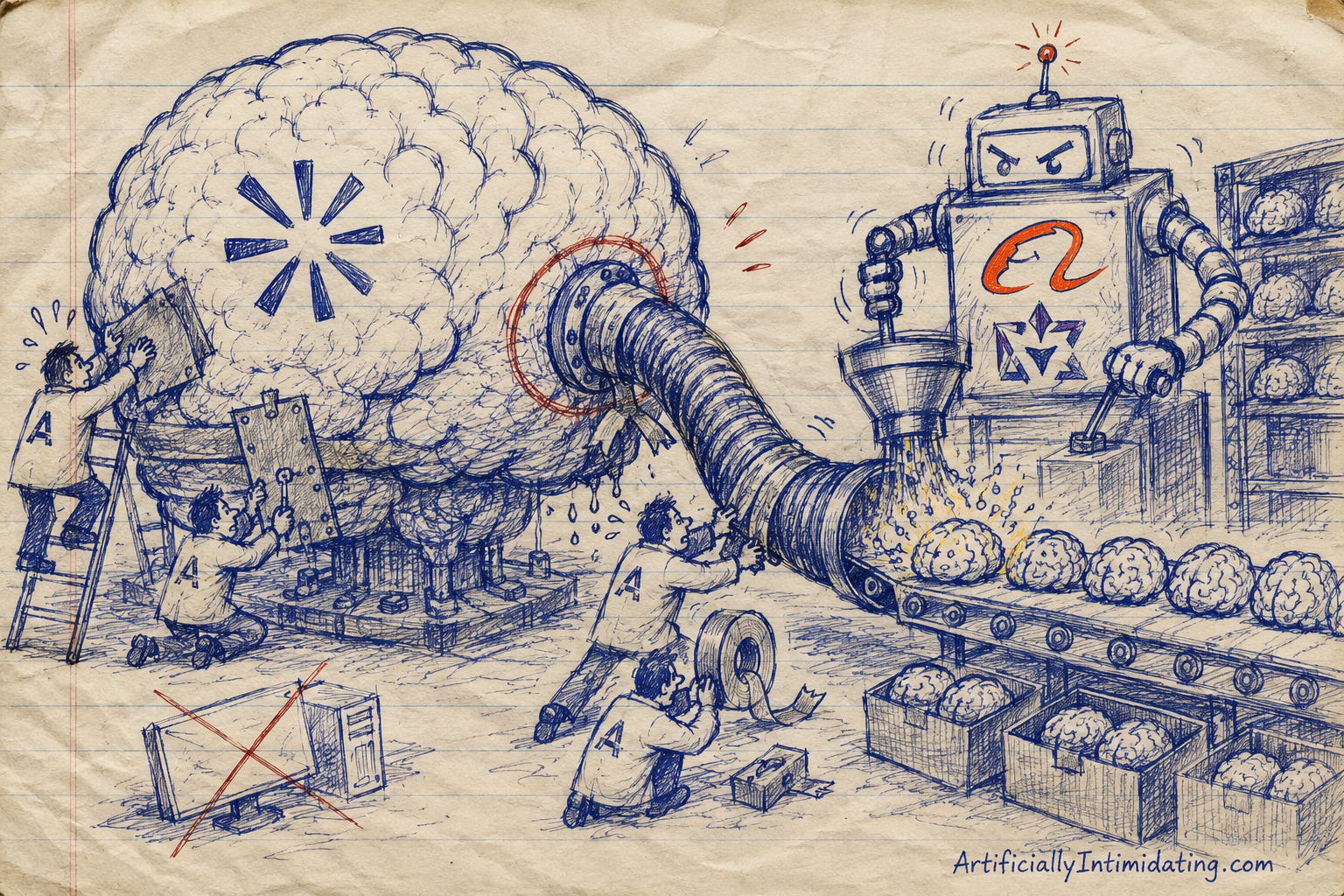
What happened: Anthropic has accused Alibaba of running the largest “distillation attack” it has ever seen against Claude. In a letter to U.S. senators and White House officials — first reported by Reuters — Anthropic alleges operators tied to Alibaba’s Qwen lab used nearly 25,000 fake accounts to pull 28.8 million exchanges out of Claude between April and June, harvesting its software-engineering and agentic-reasoning skills.
Why it matters: Distillation is AI’s version of industrial espionage: flood a top model with clever prompts, capture how it reasons, then use that to cheaply train a rival. Earlier this week we covered Chinese AI writing weaker code for the US government — this is the uglier sequel, and Alibaba’s stock slipped about 3% on the news.
What everyone’s saying: It echoes Anthropic’s February claims against DeepSeek, Moonshot, and MiniMax — but bigger — and it lands amid an already-tense standoff over U.S. export controls on Anthropic’s most advanced models. The consensus read: this is now a Washington problem as much as a Silicon Valley one.
My read between the lines: Anthropic doesn’t sell Claude in China, which is precisely why this framing is convenient. “They stole our model” is a cleaner story for regulators than “our safety filters couldn’t tell 25,000 fake accounts from real ones.” Both can be true — and the second one should worry enterprises more.
📖 Further reading: The US Government Just Took Anthropic’s Best AI Model Offline — the export-control backdrop that turns this accusation into policy ammunition.
OpenAI Re-Tuned ChatGPT — Twice in a Month
Source: OpenAI release notes
What happened: On June 24, OpenAI shipped another behavioral update to GPT-5.5 Instant, ChatGPT’s default model — its second tune-up in under a month. The focus: better grasp of what you actually mean, handling messy multi-part requests, and more coherent shopping and local recommendations.
Why it matters: This is the model billions of casual users hit by default, so “personality” patches quietly reshape how most people experience AI. OpenAI’s own research lead admitted the prior version was “too bullet pilled” — too listy, too mechanical — and has been nudging it toward something that sounds like a person.
What everyone’s saying: Practitioners flag the breakneck cadence — May 5 launch, May 28 revision, June 24 revision — with some users grumbling that each pass makes the model feel inconsistent and “more censored” (Thurrott rounded up the changes). Meanwhile GPT-5.6 rumors are already swirling.
My read between the lines: When you ship personality patches every three weeks, you’re not tuning a model — you’re A/B testing a relationship with a billion people who never agreed to be in the experiment. The shopping-recommendation emphasis is the quiet part: the default model is slowly becoming a storefront.
📖 Further reading: Thanks to Apple, Your Favorite AI Tool Is a Dead Tool Walking — why the endless tune-up treadmill is what commoditization actually looks like.
A Fintech Told Staff to “Vibe Code.” It Cost $80K.
Source: Business Insider
What happened: Slash, a $1.4-billion business-banking startup, urged employees to “vibe code” more with AI. One employee — its head of strategic verticals — then burned more than $80,000 in AI credits in a single week, building a Minecraft-style first-person shooter stuffed with internet memes called “Brainrot Shooter.”
Why it matters: “Vibe coding” — describing what you want and letting AI generate it — is being sold to companies as a productivity unlock. Slash is the live demo of the failure mode: the meter runs in real time, and enthusiasm scales faster than oversight. The employee’s own verdict: “I misjudged my own capabilities.”
What everyone’s saying: It’s not an isolated goof. Uber blew its entire 2026 AI budget by April, Microsoft yanked developers’ Claude Code licenses over runaway costs, and Walmart and Coinbase have imposed per-employee AI spending caps. The discourse has flipped from “AI is free productivity” to “who’s watching the bill?”
My read between the lines: Slash’s masterstroke was turning the screwup into marketing — “play the game so we can call it a marketing expense.” But the lesson for every CFO greenlighting AI tools: with usage-based pricing, your most enthusiastic employee is also your biggest financial liability. The brainrot was the budgeting, not the game.
📖 Further reading: OpenAI Shipped a Physical Camera, But That’s Not the Story — more on where vibe coding goes when nobody’s checking the receipts.
AI Is Quietly Making the Internet Sound the Same
Source: Axios
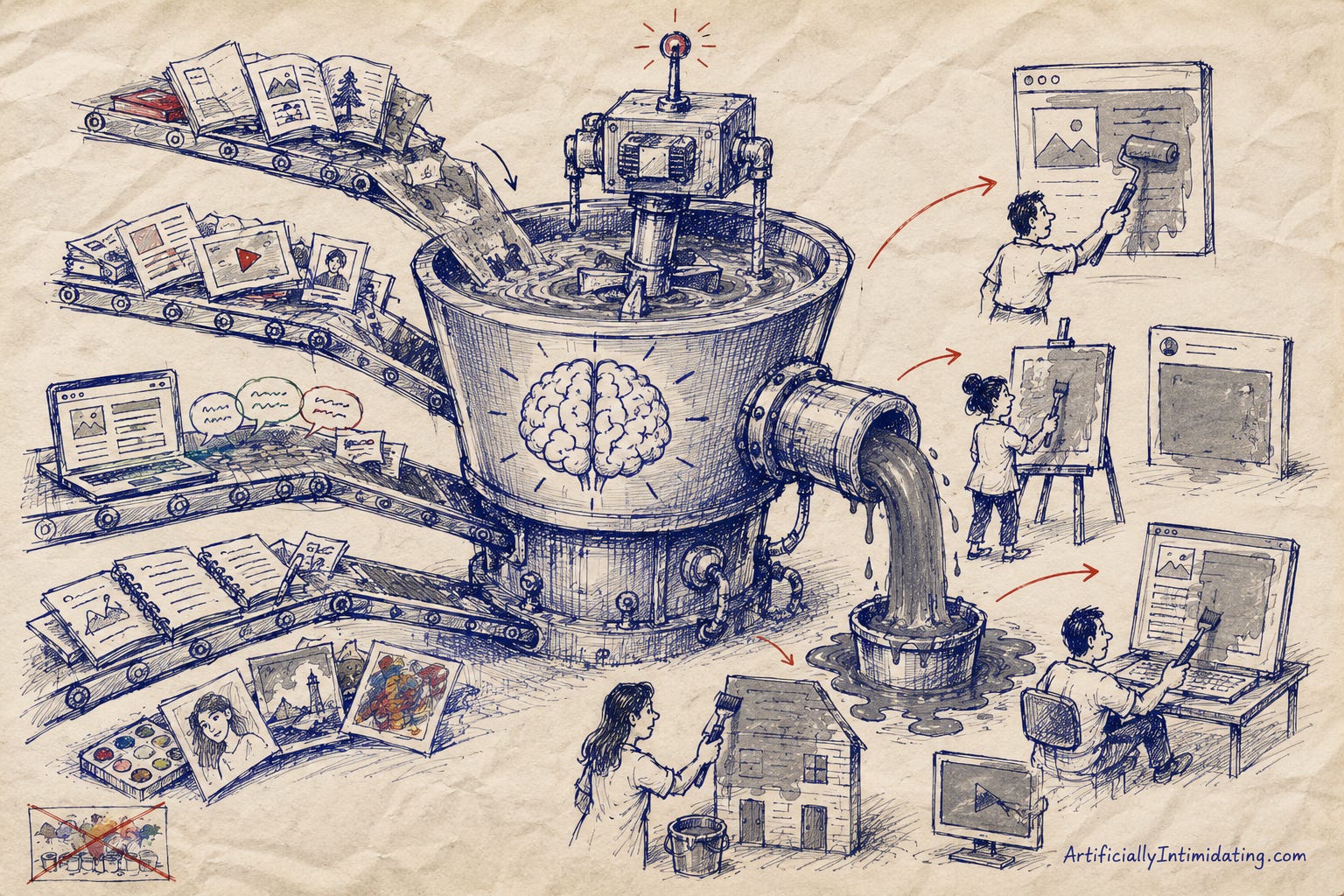
What happened: New analyses argue AI’s biggest effect on the web isn’t obvious “slop” — it’s homogenization. A Stanford and Internet Archive study found AI-generated sites are about 33% more semantically similar to one another than human-written ones, and research firm Graphite estimates roughly 52% of online articles are now AI-generated.
Why it matters: When everyone drafts with the same handful of models, the web’s vocabulary, tone, and even its arguments converge — polished, agreeable, and a little empty. Disagreement gets smoothed into synthetic politeness, and the long tail of weird human voices that made the internet useful starts to flatten.
What everyone’s saying: Commentators point to the tells — em-dash overuse, forced empathy, that relentlessly cheerful tone — as symptoms of a deeper sameness. Optimists counter (per Axios) that human writing hasn’t actually been overwhelmed yet; it’s near parity, not extinction.
My read between the lines: The risk was never that AI writes badly — it’s that it writes acceptably, forever, about everything. A web that’s 33% more similar is 33% more predictable, which is catnip for the next model trained on it. We’re quietly teaching the internet to plagiarize its own average — and “quietly” is doing a lot of work in that sentence.
📖 Further reading: AI Is a Trust Problem, Not a Tech Problem — when half the web is machine-written, knowing what to trust becomes the whole game.
That’s your AI Brief for Thursday. Back in your inbox tomorrow.
—Artificially Intimidating


