


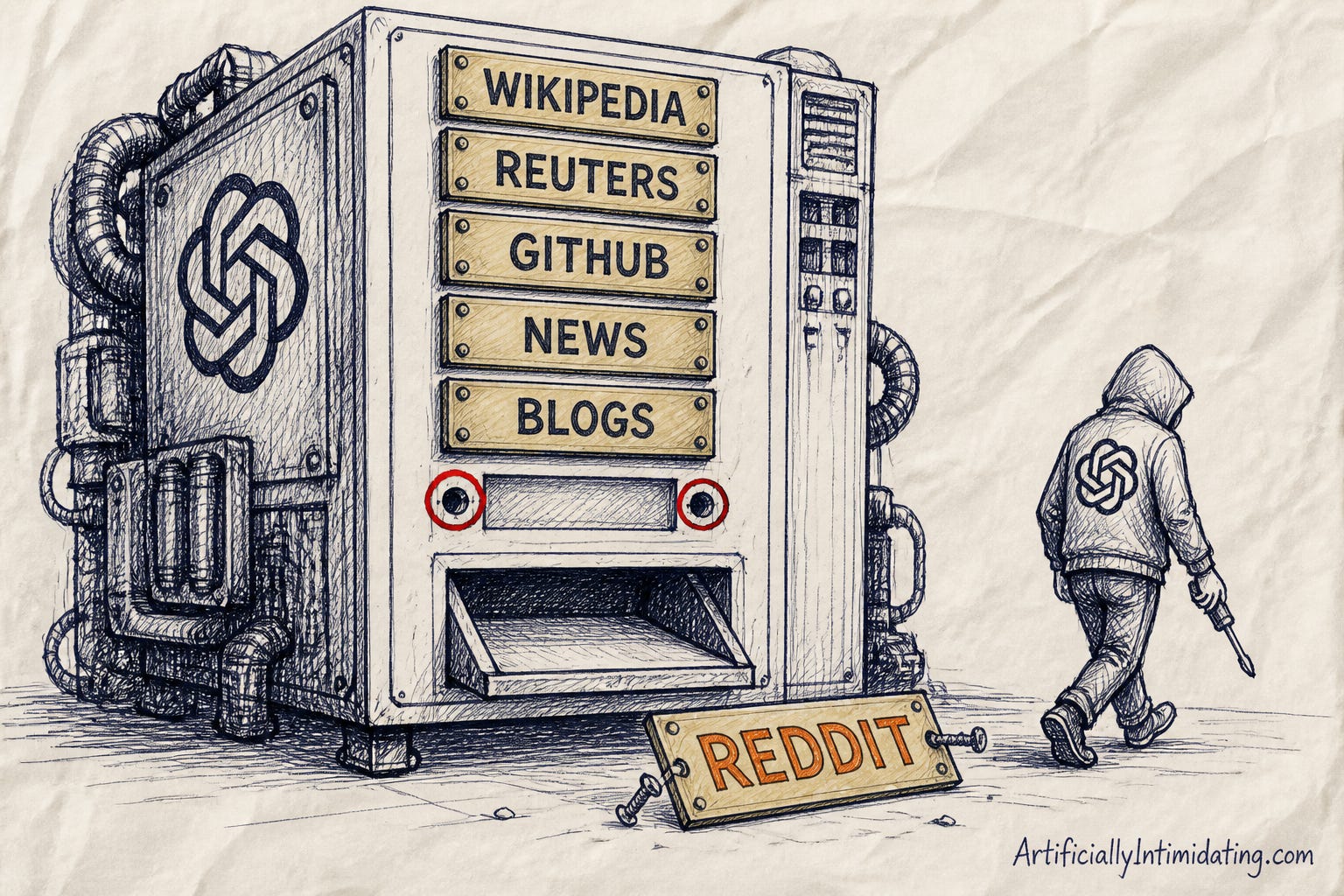
Good day, humans. Today's stories are all about things disappearing without anyone announcing it. Reddit fell off ChatGPT's citation list in four days. Stripe spent seven billion dollars to own the meter that every AI model runs through. Goldman Sachs went looking for the bottom rungs of the career ladder and could not find them. And two separate research threads landed on the same uncomfortable idea: we are losing the ability to prove where anything came from. Let's get into it.
Reddit Fell Out of ChatGPT and Nobody Said Why
Source: Search Engine Land
What happened: Reddit made up an average of 3.83% of all the sources ChatGPT Search cited between July 18 and August 7. Starting August 14 that fell below 1%, and averaged 0.52% through August 17 — an 86% drop in four days, according to Promptwatch data reported by Search Engine Land. There was an earlier, smaller dip on August 8, the same day Promptwatch says ChatGPT changed how it fans a question out into multiple searches.
Why it matters: When an AI assistant answers a question, it picks a handful of websites to read and credit. Being on that list is now a real traffic channel for anyone who publishes anything. Reddit has been the single most-cited site on the internet for AI answers, and it lost roughly six sevenths of that position in under a week without being told in advance. If it can happen to the biggest source, the smaller ones have no floor at all.
What everyone's saying: The SEO and AI-visibility world jumped straight to mechanism — the leading theory is that ChatGPT started aiming searches at specific domains instead of casting wide, which structurally starves a general forum. Worth being careful here: Promptwatch itself says the data shows when the shift happened, not why, calls the findings provisional, and says it cannot rule out a collection issue on its own end. Google's AI Overviews showed no comparable one-day cliff.
My read between the lines: Reddit spent the last two years selling its content to AI companies as a data licensing business. The lesson of this week is that licensing your words to a platform and being cited by that platform are unrelated transactions, and only one of them has a contract. I have some feeling about this: Google unlisted a business of ours with no notice and no appeal, and the worst part was never the traffic. It was the four days spent guessing at a mechanism nobody would confirm. Reddit is now doing that guessing at scale.
📖 Further reading: Google's Invisible Axe: The Silent Killer of Small Businesses — I wrote this after a platform switched us off without warning. The playbook for what to do next has not changed, only the platform has.
Reddit found out about its own bad week by watching a chart move. Most of the work that would have caught it earlier — pulling the numbers daily, noticing the break, writing it up before anyone asks — is work nobody has time to do by hand. That is the job Viktor takes. It is an AI agent that lives in your Slack or Teams, connects to over 3,000 tools, and comes back with finished reports, live dashboards, working code and running campaigns. Not a chatbot you have to prompt — a coworker you hand things to. New readers get $50 off their first month. Hire Viktor →
Stripe Just Bought the Meter Every AI Model Runs Through
Source: Stripe
What happened: Stripe agreed to acquire OpenRouter for more than $7 billion, CNBC reports. OpenRouter is a single API that lets a developer reach 400-plus AI models — OpenAI, Anthropic, DeepSeek, Qwen — through one connection, and swap between them without rewriting anything. The price is roughly 5.4 times the $1.3 billion valuation it carried at its Series B in May, three months ago.
Why it matters: Every AI feature you use is billed by the token, which is a unit of text about three quarters of a word long. Somebody has to count those, price them, and settle up across a dozen vendors. That is metering, and metering is just payments with extra steps — which is precisely Stripe's business. Buying OpenRouter buys the pipe that an enormous amount of AI spending already flows through.
What everyone's saying: The framing everywhere is that OpenRouter's own pitch — CEO Alex Atallah has called it "the Stripe for AI" — turned out to be a sales document. The consensus read is that the fight in AI has moved off the models themselves and onto the boring layer underneath them: routing, billing, and not being locked into one vendor.
My read between the lines: A 5.4x markup in ninety days is not a bet on OpenRouter's revenue. It is a bet that AI agents will soon be spending money on their own, constantly, in tiny amounts, and that whoever sits between the agent and the model gets to watch every transaction. Stripe did not buy a router. It bought a vantage point.
📖 Further reading: Fable 5 Costs 2x Opus — and Using It Wrong Costs You More Than That — Routing between models is the entire product Stripe just paid $7B for. This is how to do it yourself on the two models you actually use.
Quick note before story three. The Brief is free and stays free — five stories, every morning, no gate. What sits behind the paywall is the other half: the deep-dives where I take one of these stories apart over a few thousand words, plus the full archive going back to the beginning. If the daily has been useful, that is the part worth paying for. Become a member →
Goldman Sachs Went Looking for Entry-Level Jobs
Source: CNBC
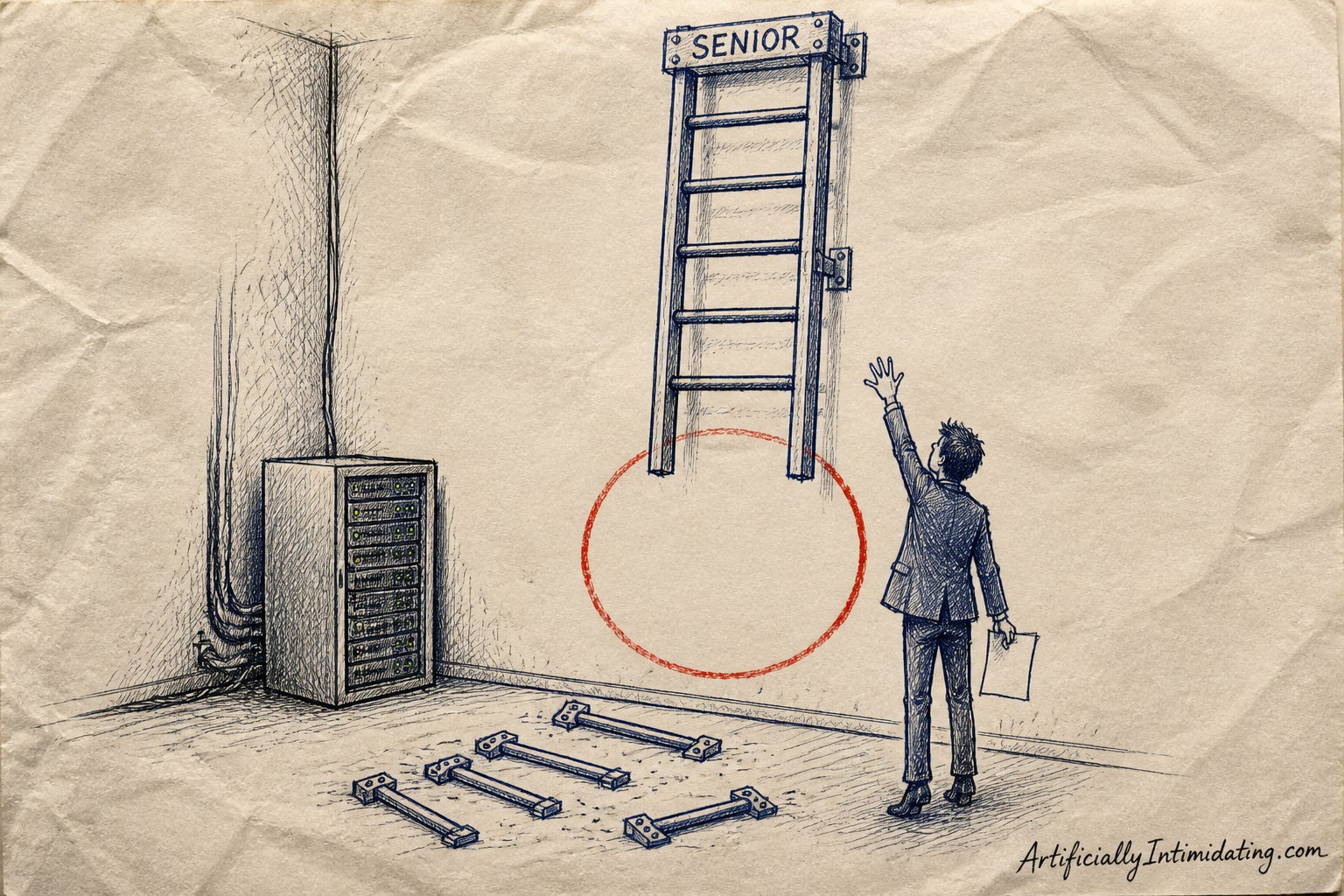
What happened: Goldman Sachs research found AI is already slowing hiring across developed economies, with the clearest signal in the US, Germany and Australia. Call centre employment is the sharpest case: running 39% below its long-run trend in the US, 33% below in Canada and 27% below in Germany. The effect concentrates on entry-level workers.
Why it matters: "Below trend" does not mean mass layoffs. It means the job was never posted. That is a much quieter kind of loss — there is no announcement, no severance, no news story, just a hiring page that gets shorter each quarter. And it lands hardest on the roles people use to get into an industry at all.
What everyone's saying: This lands next to a second Goldman finding that cuts against the hype: only about 2% of S&P 500 companies put any number on AI's effect in their Q2 earnings, and those that did reported no meaningfully better growth than everyone else. So the labour effect is showing up in the data before the profit effect does.
My read between the lines: Those two findings together are the whole story, and they are worse than either one alone. Companies are cutting the bottom of the ladder on the promise of a productivity gain they cannot yet measure on their own income statements. That is not automation paying for itself. That is a bet being placed with somebody else's career.
📖 Further reading: The Tools That Just Replaced 40% of Block's Workforce Are Free in Your Browser — If the entry-level rung is gone, the tools that removed it are the ones worth learning first. They are cheaper than you think.
MIT Says a Lot of AI Art Has No Author at All
Source: MIT Schwarzman College of Computing
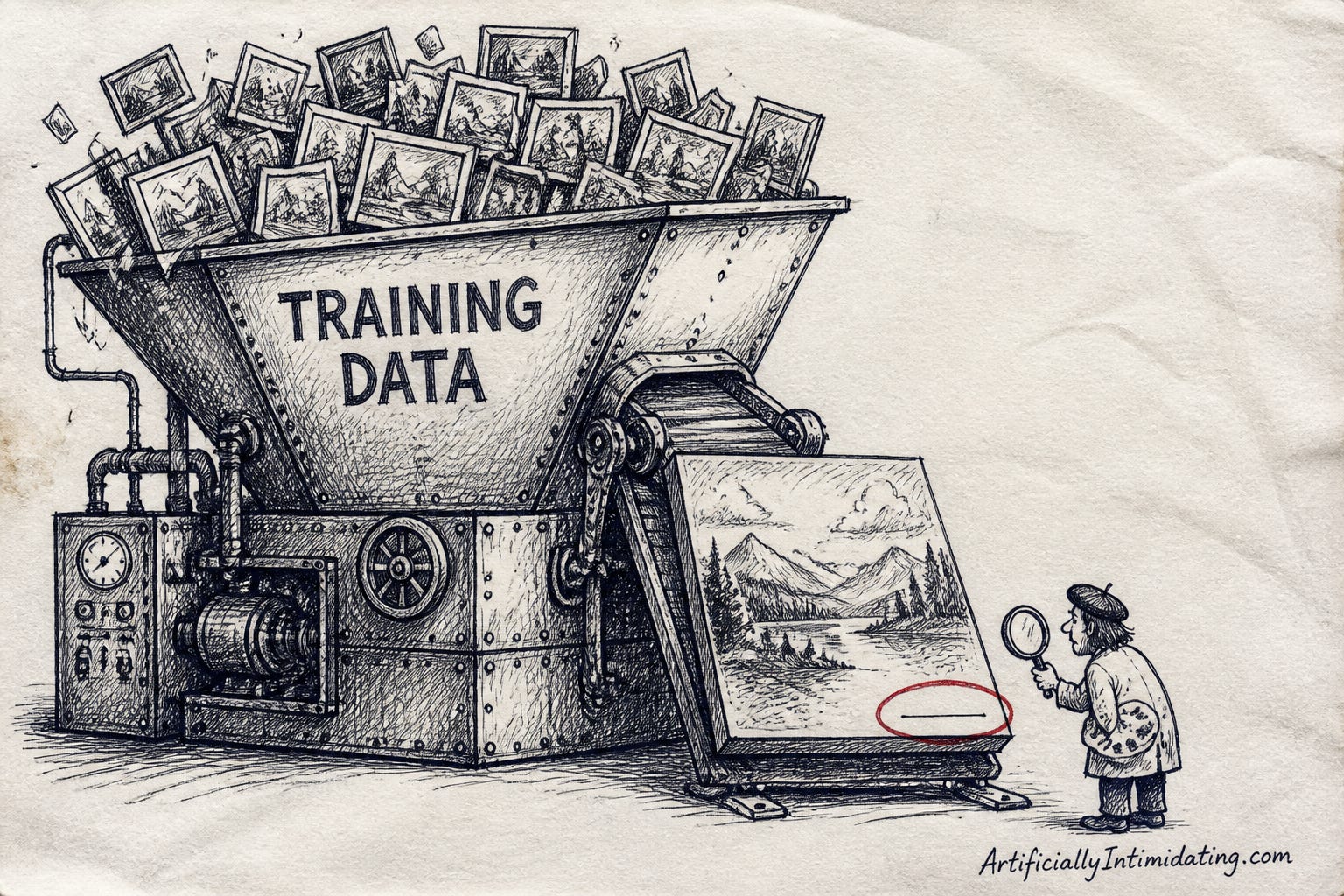
What happened: MIT CSAIL researchers published work on what they call attribution decay. At large training scales, they found you can pull any single image out of the training data — or every image by one artist, or every photograph of one person — and the model's output barely changes. The link between a specific source work and a specific generated image effectively stops existing.
Why it matters: Nearly every argument about AI and creative work assumes the question "which artists made this possible?" has an answer, even a hard one. Licensing schemes, royalty pools, opt-out registries and most copyright suits are all built on that assumption. This research suggests that past a certain scale the answer is not hidden. It is absent.
What everyone's saying: Reaction splits cleanly along the lines you would expect. Technical readers treat it as a clean result about how diffusion models actually behave. Artists and their advocates read it as a finding that arrives suspiciously well-timed for the defence, and point out that "we mixed it too thoroughly to tell" has never been a defence in any other industry.
My read between the lines: Both sides are right, which is the problem. The science looks sound and the convenience is real. But notice what the finding actually describes: not that nobody was taken from, but that the taking was done at a scale that destroyed the receipt. Diluting the evidence until it fails a test is a well-worn move, and it happening as a side effect rather than a plan does not change who ends up unable to prove anything.
📖 Further reading: I Make AI Versions of Myself for a Living. This One I Didn't Agree To. — Attribution decay is the technical version of a problem I hit personally. Consent is hard to enforce when nobody can point at the copy.
The Watermark Removers Cannot Prove They Work
Source: BleepingComputer
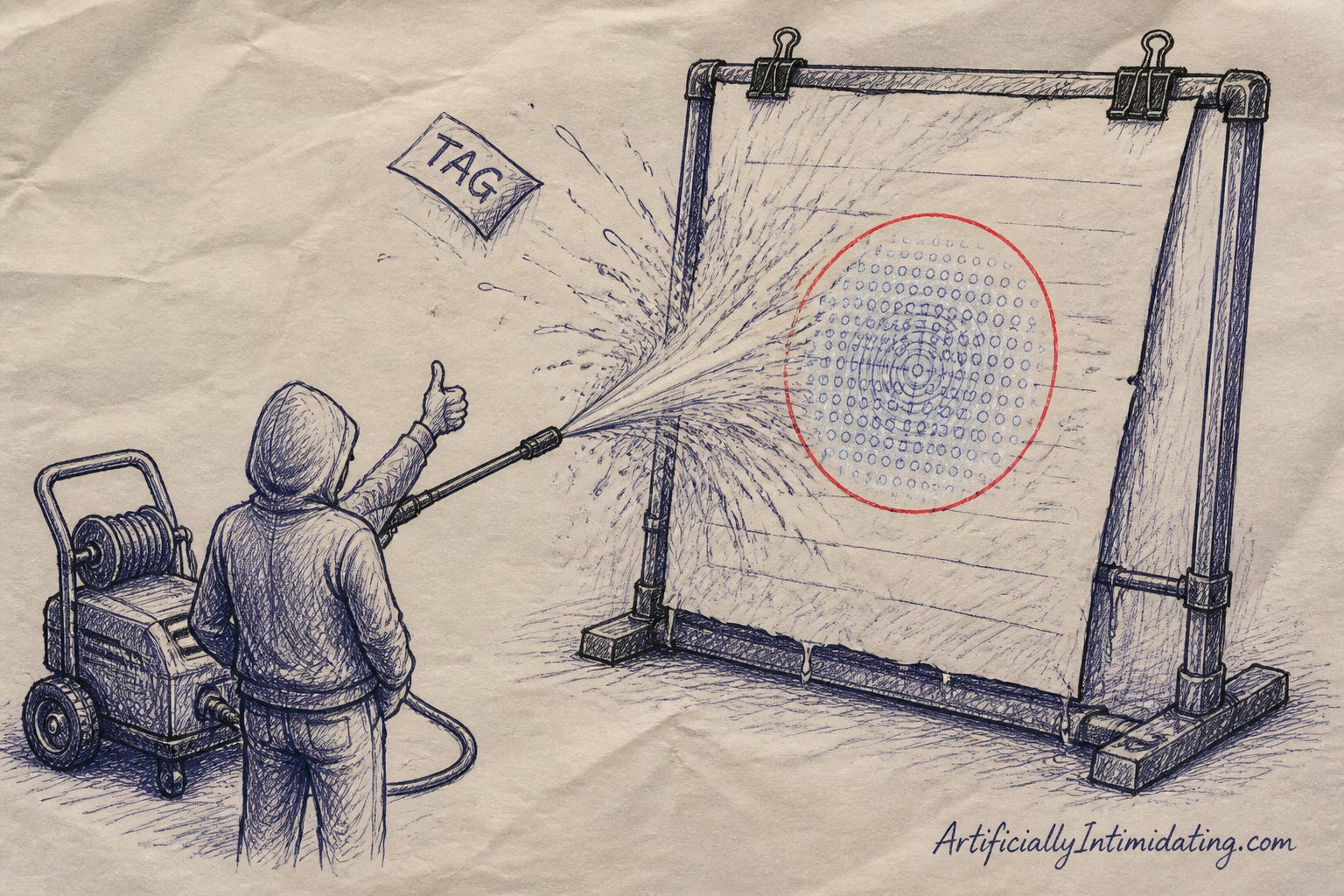
What happened: A wave of tools promising to strip AI watermarks has hit the web, arriving right behind Anthropic's rollout of text watermarking across Claude. The most prominent is watermarks-remover, an open-source project by developer Guillaume Meyer that advertises coverage of Claude, Gemini's SynthID-Text and OpenAI provenance marks across eight file formats. Meyer has been unusually straight about the limits, saying the tool removes metadata for now and that breaking the actual statistical marks may come later.
Why it matters: A watermark on AI text is a hidden statistical fingerprint baked into word choice — invisible to you, detectable by the vendor. Metadata is the separate label attached to the file, which has always been trivial to delete. Most of these tools do the second thing and let you assume they did the first. If you are relying on one to keep something undetected, you are probably wrong.
What everyone's saying: BleepingComputer's finding is that almost none of these tools can demonstrate they work, and the reason is structural: the AI companies have not published their detectors or keys. Nobody outside the vendor can run the official check, so no removal tool can honestly certify a result — and no user can call the bluff either.
My read between the lines: A market has appeared for a product whose effectiveness is unverifiable by construction, and it is selling well. That is not really a story about watermarks. It is a story about how much people will pay to not feel watched. Meyer being honest in his own README is the most interesting thing here, and it will not save a single customer who never opened it.
📖 Further reading: The Font That Beat AI for About a Week — The last time someone shipped a clever way to hide from AI detection, I timed how long it lasted. The answer sets your expectations here.
That's your AI Brief for Thursday.
—Artificially Intimidating


