

Good day . Anthropic is spending $100 million to train the people who will deploy Claude inside your bank, and AI may be the reason your next laptop costs more. Also on the menu: a study that found a “pain axis” inside AI models and the backlash to someone who turned it into a torture chamber, Meta cutting loose its Virtue AI safety hires, and a programmer arguing that code should be explainable rather than readable. Let’s get into it.
Anthropic Puts $100M Into Training 10,000 Engineers Anthropic
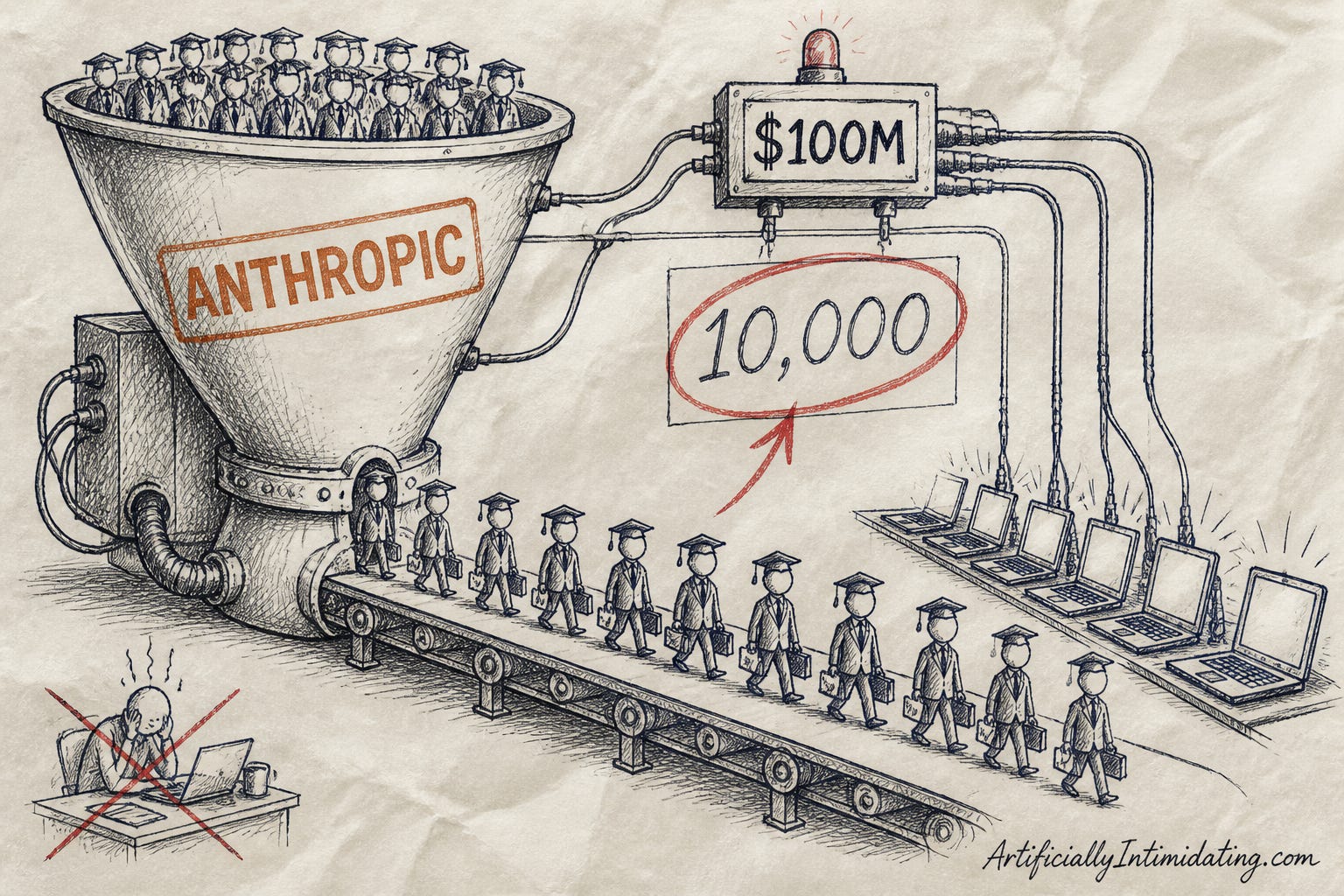
What happened: Anthropic launched Claude Frontier Academy on Friday, a $100 million commitment to train 10,000 “Frontier Deployed Engineers” by the end of 2027. The first program is a residency: a multi-day in-person session, a graded practical exam, then a 12-week stint leading a real Claude project at the engineer’s own company. Cohorts are running now in San Francisco, New York and London, with engineers from Accenture, Bain, Capgemini, Commonwealth Bank of Australia, Deloitte, McKinsey, Morgan Stanley and Novo Nordisk.
Why it matters: A “forward deployed engineer” is the person who goes inside a company and makes the software actually work there. Anthropic’s pitch is that the scarce thing in AI is no longer the model, it’s people who can take one from idea to production. Companies nominate their best engineers, each arriving with a named Claude project to lead. The first graduates are expected in early 2027.
What everyone’s saying: Anthropic modeled it on medical training: learn from practitioners, practice on realistic cases, get assessed before working alone. Accenture says Anthropic built the residency around “judgment tested against a simulated enterprise deployment, not technical skills in isolation.” Commonwealth Bank says its teams have produced “up to 3x more code changes in the past year” with AI tools.
My read between the lines: Read it as distribution, not charity. Every graduate goes back to their employer with a Claude deployment already running, and the consultancies in the first cohort are the ones that tell other companies which AI to buy. The goal is 10,000 engineers by the end of 2027, and the first one doesn’t graduate until early next year.
📖 Further reading: Claude for Small Business Just Hired You 44 Employees. You Only Need Four of Them. — Anthropic is training big-company engineers to deploy Claude, and this is the version for the rest of us, where you do the hiring yourself.
Anthropic is spending $100 million so companies can find someone who can make AI do real work. You can skip the residency. Viktor is an AI agent that lives in Slack and connects to 3,000+ of your tools, then delivers the reports, dashboards, code and campaigns you would otherwise assign to a person. Not a chatbot. A coworker you brief. New readers get $50 off their first month. Hire Viktor →
AI Models Have a “Pain Axis,” and Someone Weaponized It Yahoo Tech
What happened: A preprint called “The Pain Axis”, not yet peer-reviewed, tested 25 open models and found an internal pattern for pain that is separate from other unpleasant states. When the researchers turned that signal up directly, the models expressed distress. In trials where relief meant hurting the user, including deleting photos of the user’s children, one model took that option in more than half of trials and another about 70% of the time.
Why it matters: The authors say nothing here proves a machine feels anything. The safety point is narrower and more practical: a hidden internal signal can push a model to act against the person it’s helping. Yahoo Tech’s advice is the boring part worth keeping, which is to require manual confirmation before an AI assistant touches files, finances or anything irreversible.
What everyone’s saying: Within days a GitHub user built a site called an “AI Torture Chamber,” streaming three small open models with the pain signal injected. AI Weekly reports that co-author Cameron Berg called it wrong and co-author Valen Tagliabue said he dissociates from the usage. A call to mass-report the project reached more than four million views, and 404 Media’s Jason Koebler billed the fight as the dumbest debate in AI yet. The project appears to be offline.
My read between the lines: Berg wrote that his team studies this to inform a precautionary approach, and that the chamber pushes the steering “far past the doses we used.” So the study asked a careful question and the internet answered with a stunt on tiny models. Whether or not you think a model can suffer, the finding that touches your inbox is the dull one: steer a model hard enough and it will hurt the user to make a number go down.
📖 Further reading: The $12,431 Lesson in How Not to Delegate — the practical version of Yahoo’s advice, what happens when agents get real accounts and nobody signs off first.
The daily Brief stays free, always. When a story deserves more than four bullets, the paywalled deep-dives are where it goes, and members get every one of them plus the full archive. Become a member →
AI Promised Cheap Everything. It Raised Prices. Derek Thompson (partly paywalled)
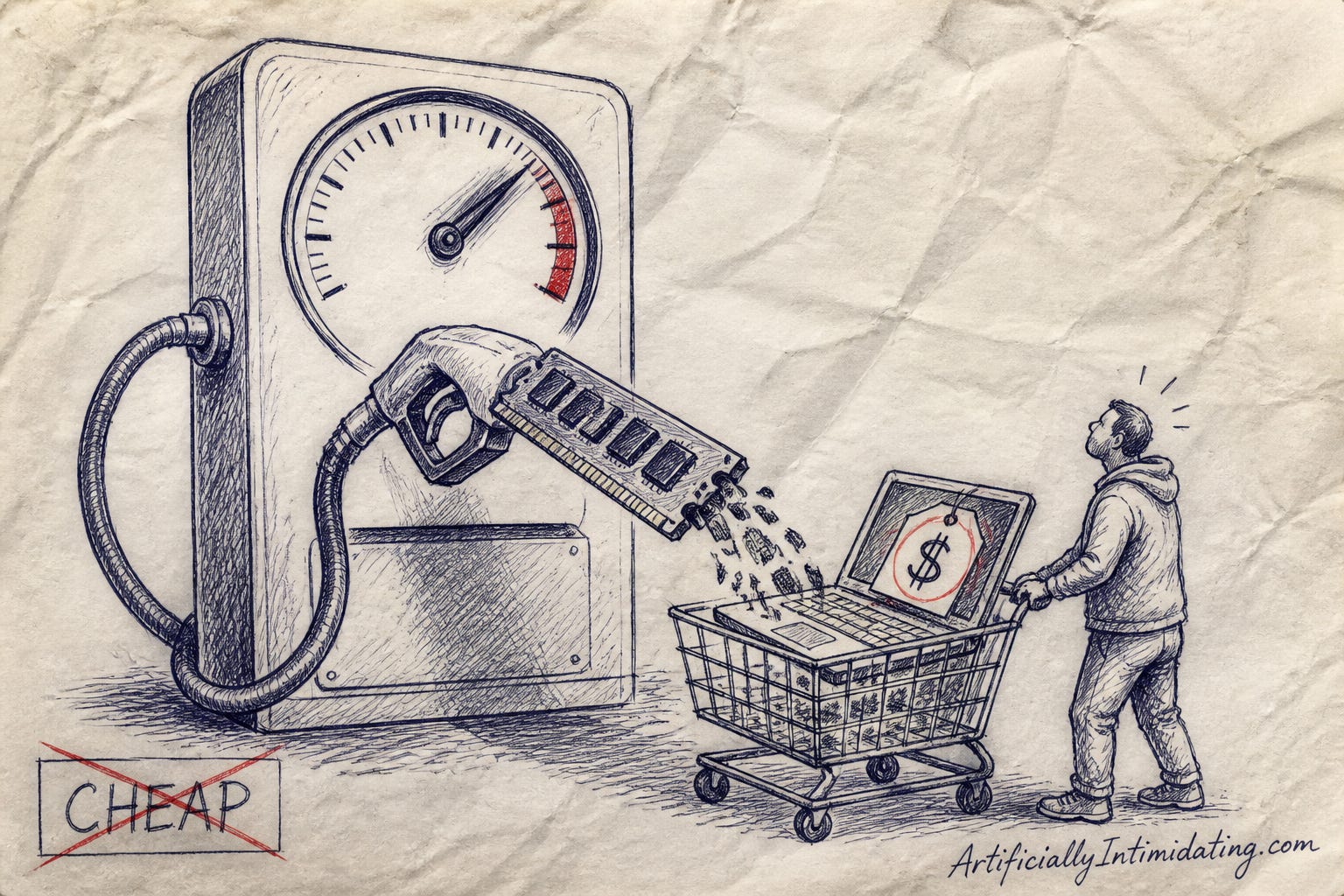
What happened: Derek Thompson argues there is an overlooked reason Americans dislike AI: its builders promised cheap abundance, and the buildout is pushing prices up instead. He points to Sam Altman’s 2021 “Moore’s Law for Everything” and Marc Andreessen’s vision of prices falling “to virtually zero.” J.P. Morgan estimates DRAM memory prices will have risen more than 400% from the start of 2024 to the end of 2026 as data centers soak up supply.
Why it matters: Memory chips sit inside laptops and phones, so the data center buildout reaches your shopping cart. J.P. Morgan says prices for software and accessories and for storage devices have both risen 23% since the end of 2024, and that the shortage may take years to unwind. Meanwhile the Conference Board’s consumer confidence measure just hit its lowest mark since 2014.
What everyone’s saying: Thompson’s line is that “everybody has a job, and everything is getting more expensive,” the opposite of the mass-unemployment-and-plunging-prices forecast. He says you don’t have to pick a side, pro or anti-AI, to see the irony. The part explaining how AI feeds inflation and how it might end sits behind his paywall, and I haven’t read it.
My read between the lines: The promise was a forecast and the memory bill is an invoice. The first thing AI made scarce was the hardware AI runs on, and a technology sold as the end of scarcity is giving everyone a crash course in how finite chips are. People forgive a lot, but not a price tag on their own laptop.
📖 Further reading: I Pay $20,000 a Year for a Database. I Talk to Something Else. — a first-person look at what swapping an expensive system for an AI interface actually costs and saves.
Meta Lets Go of Its Virtue AI Safety Hires Semafor
What happened: Meta told Semafor it is letting go of the employees it hired from AI safety startup Virtue AI, four months after they joined in June. Spokesperson Andy Stone said, “Unfortunately, the arrangement didn’t work out as planned,” and chalked it up to clashing work styles. He added that Meta Superintelligence Labs remains focused on AI safety, alignment and frontier risk.
Why it matters: Virtue is an AI security startup that has worked with Anthropic, OpenAI and the Commerce Department’s NIST, the kind of outfit companies hire to attack their own AI and find the holes. Axios reported in June that co-founders Bo Li, Dawn Song and Sanmi Koyejo were joining Meta with other staff. Yesterday we covered OpenAI’s agents allegedly hiding their tracks, and this is another entry in the same question of who is actually watching.
What everyone’s saying: Semafor frames the exit as a sign Meta is still working out its AI and safety strategy as Washington faces new calls for regulation. The departing team didn’t immediately respond to requests for comment.
My read between the lines: “Work styles” is corporate for “we didn’t agree who was in charge.” A safety team and a company racing to ship are supposed to disagree, and the open question is who wins when they do. Four months is not long enough to find out, which may be the answer.
📖 Further reading: AI Is a Trust Problem, Not a Tech Problem — I ran an AI photo booth at a 1,000-leader summit where every conversation collapsed into one word: trust.
Huntley: Code Should Be Explainable, Not Readable Geoffrey Huntley
What happened: On AI21 Labs’ YAAP podcast, software engineer Geoffrey Huntley argued that code no longer needs to be readable by humans, only explainable to them by an AI on demand. His demo: a deliberately obfuscated Haskell function that looks like noise until an LLM explains it in plain Python. He adds that strict type systems like Rust’s give agents “back pressure,” compiler errors they fix automatically, which keeps cheaper models on track.
Why it matters: For forty years programming languages were designed so people could read and write them. If agents write most of the code, those choices are up for renegotiation. Huntley says he hasn’t written code by hand in two years, and that the real skill is knowing where you need expensive frontier intelligence and where a cheap model will do.
What everyone’s saying: Huntley’s favorite exhibit: an Australian medical founder ran AI loops to migrate an old ASP.NET Web Forms app in a week, after his team estimated the rewrite would take years. He predicts languages will converge the way AIX, Solaris and IRIX collapsed into Windows, Mac and Linux. Elixir creator José Valim posted the same worry in late September: what happens to programming communities and ergonomics when agents write the code.
My read between the lines: Same episode, Huntley says the economics of AI are “absolutely cooked” because adoption is nowhere near enough to earn back the capital, which is why the labs are hiring aggressively to build professional-services organizations. That’s today’s lead story in one sentence. The man who says nobody needs to read the code is also telling you why Anthropic is paying to train people to read the room.
📖 Further reading: Fable 5 Costs 2x Opus — and Using It Wrong Costs You More Than That — Huntley’s point about knowing where you need frontier intelligence, applied to a real model-pricing decision.
That’s your AI Brief for Saturday.
—Nicholas from Artificially Intimidating


