

Good day . A metal painter in Montebello still draws album covers by hand, and the hardest part of his newest one wasn’t the brushwork. It was knowing his mother-in-law follows him on Instagram. Also today: bosses who trust AI over their own judgment, Apple’s 200,000-person health AI study, ChatGPT’s first business agents showing up half-stocked, and a 1921 idea Cal Newport thinks can fix AI work slop.
The Metalhead Who Still Paints by Hand L.A. TACO
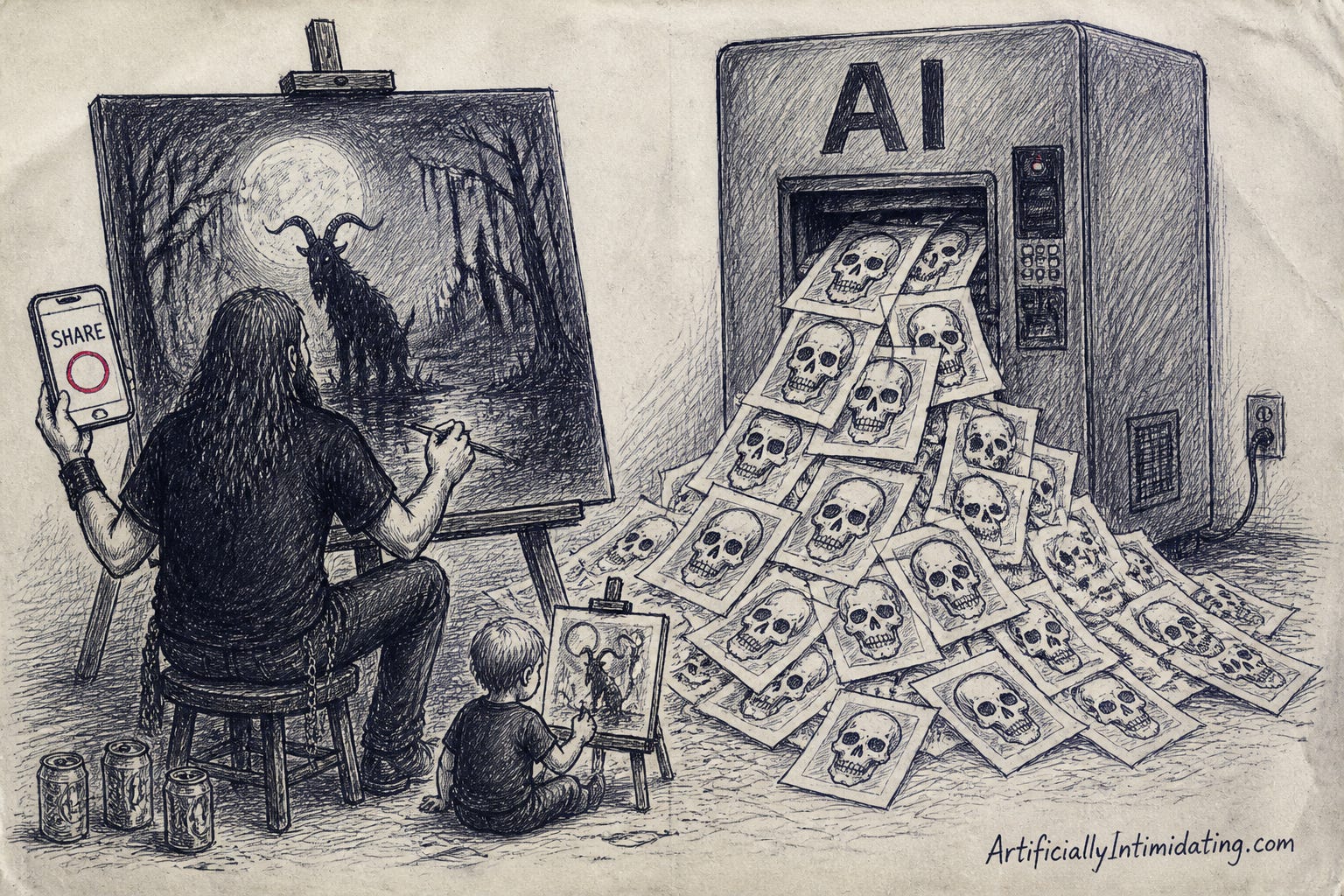
What happened: Guillermo “Memo” Millán, 42, paints album covers, flyers and T-shirt art for black metal, death metal and punk bands from a garage studio behind his Montebello home, Andrew Lopez reports in L.A. TACO. He has worked for Stockholm’s Desolator, Tijuana’s Coaccion and Compton’s The Dark, and his latest is the cover of a split LP for Santa Ana’s Baphomancia and Moscow’s Black Goat.
Why it matters: Anyone can generate a passable metal cover in seconds, and some bands now take that route. “There are some bands that I actually enjoy, but then I see them using A.I., and I’m like, ‘Why are you doing that to your band?’” Millán told L.A. TACO. Others, he says, “appreciate that hand-crafted artwork” and expect it from him.
What everyone’s saying: The scene is pushing back on its own terms. L.A. TACO notes an Oakland venue banned AI-made flyers as “meme slop” and “not very punk.” On Saturday we covered AI music getting its first red carpet. This is the other end of the same fight: one guy, one canvas, his two-year-old son painting at his feet.
My read between the lines: The best detail isn’t the brushwork. His newest cover is so explicit that he spent two days dreading the post, because “I have my suegra on my Instagram. I have my tías and tíos on there.” He drank three beers and hit share. That’s what authorship means: a person who has to live with what he made. The AI can paint the devil. It never has to explain it at Thanksgiving.
📖 Further reading: Every New Tool Was Going to Kill Art, with John Hardin — historian and musician John A.C. Hardin on the tape machine, the 808 and sampling, every tool that was supposed to kill real art. Millán is the next chapter, told from a garage.
Millán paints by hand because the hand is the point. Your Monday status report is not that kind of work. Viktor is an AI agent that lives in Slack, connects to more than 3,000 tools and does the job itself: the report, the dashboard, the bug fix, the campaign draft. It isn’t a chatbot you babysit. It’s a coworker you hand things to. New readers get $50 off their first month. Hire Viktor →
Your Boss Trusts the Chatbot More Than You Fortune
What happened: About a third of managers and executives say they trust AI more than their own judgment on work decisions, compared with 16.3% of non-managers, according to Charter’s AI Pulse survey of 5,002 full-time U.S. desk workers who use AI on the job. Executives were also more than twice as likely as workers to trust AI over a knowledgeable colleague, Fortune reports.
Why it matters: The usual worry is young workers leaning on chatbots. But in the Gallup and Walton Family Foundation Voices of Gen Z study cited in the same piece, 69% of employed Gen Zers said they trust work done without AI more than AI-assisted work. The heavier users sit higher up, and when an executive leans on a bad answer about a promotion or a budget, other people absorb it.
What everyone’s saying: Charter’s Brian Elliott: “AI is great at summaries and high-level answers, which is much of what a leader needs, while workers deal with specifics where AI’s gaps show.” Executives say they fact-check more, 81% to 71%, yet they are “3.3 times as likely as workers to use outputs they doubt,” he says. These are self-reported answers, not observed decisions.
My read between the lines: Elliott’s example is the one to remember: “a CFO who drops the CMO’s campaign into ChatGPT and quizzes her on it.” The chatbot has become a cross-examination tool, and the person who did weeks of work now defends it against a summary. Practical advice: if your boss is going to ask the bot anyway, ask it first and bring the answer to the meeting.
📖 Further reading: Your AI is a yes-man. Here's how to make it fire you. — the prompt I use to make AI argue against me instead of agreeing. If anyone is going to trust a chatbot over a colleague, it should at least be one that’s been told to disagree.
The Brief is free and staying that way. Members get the paywalled deep-dives behind the headlines, like the one where I tested whether AI agents could find, price and book my own business, plus the full archive. Become a member →
Apple Tests Whether You Trust Health AI MacRumors
What happened: Apple launched the Apple Health AI Usage Study on Sunday with OpenEvidence, a clinical AI company whose tool is widely used by doctors. Up to 200,000 U.S. adults 21 and older with an Apple Intelligence iPhone can use a study app that answers health questions with links to peer-reviewed sources and, if they choose, their own sleep, heart rate, activity and lab data.
Why it matters: People already ask chatbots about symptoms. Apple says this study measures trust, comprehension and what people do next, not just whether answers are correct. Apple says study data won’t train AI models, and OpenEvidence deletes questions and responses within 24 hours. CNET adds that a small group of Apple researchers will see coded survey answers and conversation summaries.
What everyone’s saying: Apple’s Sumbul Desai called a dedicated study “the most thoughtful way to understand how people engage with, comprehend, and evaluate health AI.” The top MacRumors comments went somewhere else: “How much do we get paid?” One reader asked for a year of Apple TV or iCloud. Another assumed they’d be “more training data.” Comments are anecdotes, not polling.
My read between the lines: “We won’t train on your data” answers a question people asked two years ago. The question in the comments is simpler: what’s in it for me? A study about trust starts with an audience that has already done the math on tech companies and health data. That gap is the first finding, before a single answer gets rated.
📖 Further reading: AI Is a Trust Problem, Not a Tech Problem — I spent a day at the US Chamber Foundation’s AI+Work Summit, and every conversation about adoption collapsed into one word: trust. Apple just built a 200,000-person study around it.
ChatGPT’s First Business Agents Arrive Half-Stocked Search Engine Roundtable
What happened: Six days after OpenAI opened Businesses in ChatGPT in beta, the first business agents surfaced. Marketplace Pulse founder Juozas Kaziukėnas shared Chewy’s verified agent, blue checkmark and “Start chat” button included. Asked for dog toys, it replied it didn’t have “a live Chewy product catalog connected,” Barry Schwartz reports.
Why it matters: Verified businesses can now update their details, add product feeds with prices and availability, and see how often ChatGPT mentions them and sends clicks, TechCrunch reports. Agents are limited for now to eligible U.S. ecommerce and online service businesses. On Sunday we covered OpenAI giving its agents a wallet. This is the storefront side.
What everyone’s saying: SEO consultant Lily Ray says the agent builder “pulls a lot of recommendations out of your website,” so setup is low-effort. In Hospitality Net, HotelPORT founder Fred Bean, who sells content-governance software, notes OpenAI “still determines what appears in that answer,” and asks: “When the kitchen changes its hours on Friday, who updates the record, and who checks the answer before Saturday night?”
My read between the lines: Bean’s example is a guest who books an accessible room on ChatGPT’s say-so and finds a tub instead of a roll-in shower. “The hotel gets to explain.” That’s the deal: OpenAI writes the answer, the business owns the apology. Claim your profile, then check it every week like a review site, because that’s what it is now.
📖 Further reading: AI Agents Can't Find Your Business. I Tested Mine. — I ran the agent test on my own business. The bots liked us. They just couldn’t find us, price us or book us. Here’s how to run it on yours before ChatGPT’s agents start answering for you.
Cal Newport’s 1921 Fix for AI Work Slop Cal Newport
What happened: In a new episode titled “A 100-Year-Old Solution to AI Work Slop,” Cal Newport reaches back to Mastering Power Production, a 1921 book by industrial engineer Walter Polakov. Polakov split “bounded” efficiency, a 0-to-1 score like a steam engine’s, from “arbitrary” efficiency, any ratio you decide to track. Back in October we covered Newport’s assembly-line argument. This is the sequel.
Why it matters: Newport says knowledge work is managed by an arbitrary ratio: tasks per person. “There’s no 100%. It’s just the numerator can keep getting bigger and bigger.” Hand that system a tool that makes tasks faster, and you get more memos, decks and emails, not more value.
What everyone’s saying: Newport adds a contrarian twist on AI and jobs: “If we weren’t using arbitrary efficiency, I think actually those job numbers would be worse.” His point is that offices are so bad at measuring real output that the confusion is buying white-collar workers time.
My read between the lines: His fix is almost old-fashioned. Once a month, each person makes the case, in plain words, for what valuable thing they produced. That’s a performance review with no slide deck allowed, which is exactly why it would work. It’s also the one report AI can’t pad, because the question is what changed, not how much you sent.
📖 Further reading: The $12,431 Lesson in How Not to Delegate — seven agents, 72 hours, $12,431 invoiced and $0 in revenue. It’s arbitrary efficiency with nobody in the loop, and the fix is the same one Newport prescribes for people.
That’s your AI Brief for Tuesday.
—Nicholas from Artificially Intimidating


