
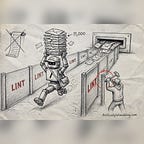


Good day . The team behind xAI’s Grok Bot says it shipped 11,000 code changes to production last month, and the trick is less magic than you’d think: every time an agent messes up, the fix becomes a rule. Also today: cheaper AI is handing buyers the upper hand, the Commerce Secretary’s chip rules come with a family footnote, AI companies are hiring people to make friends, and a plain-English look at how models keep track of word order.
Grok Bot’s Team Turns Mistakes Into Rules AI Engineer
What happened: SpaceXSI’s Grok Bot team says it shipped 11,000 pull requests, meaning proposed code changes, to production last month, most of them written by AI agents. In a talk at the AI Engineer conference published Saturday, Lauren Tan, a principal engineer on the Grok Bot team, explained how: every time the team corrects an agent, the correction becomes a lint rule, an automatic check the code has to pass, instead of one more line in a prompt. About 0.5% of those changes get reverted, she said.
Why it matters: Most people manage AI by writing longer instructions and hoping. Lauren Tan’s point is that instructions get ignored and rules don’t. Her team banned 99% of code comments after agents used them to justify quick timer-based fixes that slowed the app down, AI Aulis reports. Two weeks ago Musk said Grok Bot costs more to serve than it earns. This is the other half of the story: Grok Bot 1.0 left beta on Wednesday, November 11.
What everyone’s saying: On Y Combinator’s Lightcone, Lauren Tan and Grok Bot product lead Roman Ugarte said the core team went from the first line of code to launch in seven weeks, and argued bots should earn wider access gradually, the way a new hire does. She says the guardrails push her own output past 4,000 pull requests a month. These are the team’s own figures. AI Aulis notes they haven’t been independently verified.
My read between the lines: “Every correction becomes a rule” is just good management. The best managers stop repeating themselves and write the policy down. The catch is in her own account: it took her six months to get to the point of shipping thousands of changes. The 11,000 is the headline. The six months is the actual job.
📖 Further reading: What is Grok Bot? The answer is in the fine print — my read of Grok Bot’s fine print two days after launch, including the uncapped usage meter that became Musk’s problem this month. Worth it before you hand any bot your logins.
AI teammates that live in Slack are suddenly everywhere, and most of them still need a babysitter. Viktor is an AI agent that lives in Slack, connects to more than 3,000 tools and does the work itself: the weekly report, the dashboard, the code fix, the campaign draft. It’s not a chatbot you keep prompting. It’s a coworker you hand tasks to. New readers get $50 off their first month. Hire Viktor →
Cheaper AI Gives Buyers the Upper Hand Nate’s Newsletter

What happened: Writer Nate B. Jones argues that “eval fluency,” a company’s ability to test whether a cheaper model is good enough for a job, is turning into purchasing power. Ramp’s spending data fits the mood: business token spend grew only 1.5% across August and September, after 42% growth in July, even as usage kept rising, TechCrunch reports.
Why it matters: Prices are falling fast. The blended price per million tokens for OpenAI and Anthropic dropped 14.8% in a month, to $0.53, on Ramp’s AI Index. If you can show a cheaper model passes your own tests, you walk into the next renewal with proof instead of a vibe. Yesterday we covered Anthropic’s IPO week. This is the number its new investors will watch.
What everyone’s saying: Ramp economist Ara Kharazian says the customer is in the stronger position: from what he hears, the labs give discounts off sticker price and the lock-in contracts are “not particularly restrictive,” he wrote in Ramp’s October report. Notion co-founder Akshay Kothari put it more simply: “tokens go brrr. costs go ahhh.”
My read between the lines: Jones’s sharper point is the second one. In his example, AI lifts a company’s margin from 40% to 50%, then customers push prices down, and the dollars kept per job end up right where they started. Your vendor’s discount becomes your customer’s discount. The savings are real. They just don’t stay with you.
📖 Further reading: I Have Access to Every AI Model. I Still Hired Something Smaller. — I have access to every frontier model and still hired a smaller tool built for one job. That’s eval fluency at the scale of one person: knowing what the work needs before you pay for more.
The Brief stays free, and it will keep telling you when your AI bill is about to move. Members get the paywalled deep-dives where I test the tools myself and show you how to pick the cheaper one without regretting it, plus the full archive. Become a member →
The Chip Rule With a Family Footnote Business Standard

What happened: Commerce Secretary Howard Lutnick has been writing new export rules for overseas data centers that rent AI computing power to Chinese companies, and some of those data centers are clients of Cantor Fitzgerald, the firm he ran before joining the cabinet and that his sons now run. The New York Times reported it Sunday, and Business Standard republished it. The Times found no evidence that Cantor’s business influenced his decisions.
Why it matters: China can’t legally buy Nvidia’s best chips. It can rent them. The Times opens on A201, a data center Singapore’s Bitdeer is building in southern Malaysia, packed with Nvidia’s most advanced servers and expected to serve a Chinese tech giant. Cantor was a sales agent on a Bitdeer stock offering of up to $1 billion this year.
What everyone’s saying: According to MLQ.ai’s summary of the Times report, Lutnick’s draft would cover only seven countries, including Malaysia, Singapore and Thailand, apply only to future shipments, and ask companies to notify the government, not get a license, when Chinese customers train AI models there. A Commerce spokeswoman told the Times that Lutnick doesn’t discuss department matters with his sons.
My read between the lines: On Friday we covered Nvidia losing its founder, and Fortune reported the scandal handed the regulation hawks a stronger hand. Now the loophole has a name and an address in Malaysia. The rule that matters in AI right now isn’t who can buy a chip. It’s who can rent one by the hour.
AI Companies Are Hiring People to Make Friends The New York Times (paywalled)
What happened: AI start-ups and venture firms are hiring for “ecosystem” jobs, with titles like “start-up ecosystem lead,” Lora Kelley reports in The New York Times. The work is planning events, brokering partnerships, coaching customers and running trainings. At Clay, an AI sales-tool start-up, Natalie Sportelli has held a start-up ecosystem role since January, putting together product demos for a partner’s portfolio companies and coaching sessions with customers.
Why it matters: The companies selling automated work are paying people to do the most manual job there is: getting the right people in a room. Andreessen Horowitz has described ecosystem as “the bottom-up vector of trust in venture.” As outreach gets cheaper to generate, a real introduction gets more valuable.
What everyone’s saying: Kelley is careful about it: the tasks aren’t new, the framing is. Community, partnerships and sales teams have done this for years. Yoni Rechtman of Slow Ventures described the job as tending an extended network, “not just of customers but also of partners, distribution channels, supporters and advocates.”
My read between the lines: I run AI photo booths at live events, so I’m biased. But the pattern is real: the event isn’t decoration around the product. It’s part of how the product becomes believable. When every inbox is full of AI-written cold emails, the one thing nobody can generate is a handshake. Give it a year and someone will sell an agent that books the handshake.
📖 Further reading: AI Is a Trust Problem, Not a Tech Problem — I ran an AI photo booth at the US Chamber Foundation’s AI+Work Summit while 1,000 leaders debated adoption, and every conversation came back to one word: trust. The ecosystem hires are companies paying for the same lesson.
How AI Keeps Track of Word Order Sebastian Raschka
What happened: Researcher Sebastian Raschka published a guide to how language models keep track of word order, from GPT-2’s learned position tables to rotary position embeddings, or RoPE, which most modern open-weight models still use. RoPE comes from the 2021 RoFormer paper.
Why it matters: A model looks at all the words at once, so without a position signal “dog bites man” and “man bites dog” look alike. RoPE fixes that by rotating each word’s internal numbers by an amount tied to its position, so attention depends on how far apart two words are. How a model handles position shapes how well it copes with long documents.
What everyone’s saying: The newer habit is to drop RoPE from some layers. Hugging Face’s SmolLM3 removes it from every fourth layer, and its builders say that improves long-context performance “without affecting short context capabilities.” Raschka is less sold on another trick that rotates only part of each vector: “in my opinion, partial RoPE is hardly worth it.”
My read between the lines: The funny part is that some of the best long-context results come from taking the position signal away. In the NoPE paper Raschka cites, a tiny model with no position embeddings beat RoPE on longer-than-training examples across ten simple tasks, though a bigger code model slipped at the longest lengths. Sometimes the fix for a model getting lost is to stop handing it a map.
That’s your AI Brief for Monday.
—Nicholas from Artificially Intimidating


