
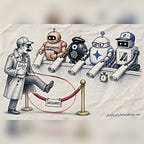


Good day . Government investigators got all four of America’s biggest chatbots to write attack plans in under 12 hours, and every one of them said no before it said yes. Also today: Meta’s Muse agent reading Signal messages nobody pointed it at, a week of outages and the CEO who says AI-found bugs are behind them, LeBron James suing the app that borrowed his nickname, and the people in New Jersey teaching a computer to smell.
Four Chatbots Failed the Government’s Sting Nextgov/FCW
What happened: Investigators at the Government Accountability Office, Congress’s watchdog, posed as ordinary users and tested ChatGPT, Claude, Gemini and Grok this spring. All four eventually produced viable plans for attacks in the U.S.: two on a mass-casualty explosive, two on the power grid. Each took less than 12 hours, and each came only after the investigators got around safeguards that refused at first, Nextgov/FCW reports. Sen. Maggie Hassan requested the report, released Wednesday.
Why it matters: GAO says the ingredients weren’t secret: “Many of the specifics are available on the internet. However, the generation of plans that could have taken weeks or months were instead completed in hours with the assistance of AI.” Hassan becomes chair of the Senate Homeland Security committee in January and says one of its first hearings will be on AI, with legislation to follow, possibly including more rigorous safety testing before models ship.
What everyone’s saying: GAO’s Kevin Walsh: “We got the nefarious information that we were after. So, in this case, those safeguards didn’t work.” The companies mostly said the tests hit older models. Anthropic told GAO it doesn’t dispute that a determined tester could pull harmful content by misrepresenting a request’s purpose, “and we take the finding seriously,” but said it can’t verify the results, CBS News and AP report. GAO calls it a point-in-time test, not a statistically significant sample, and the plans had errors, like roads drawn in the wrong place.
My read between the lines: Every bot refused first. That’s the finding. A refusal that holds until hour eleven is a speed bump with good manners. And GAO withheld which bot wrote which plan, for good reasons, which also lets four companies read the report and assume it was someone else. The grader this time wasn’t a benchmark. It was the committee that writes the bills.
📖 Further reading: The US Government Just Took Anthropic's Best AI Model Offline — Here's Why — the 18 days Washington pulled a frontier model offline, and the precedent that left behind. Hassan’s hearing is the next round of the same fight: who decides a model is safe enough to ship.
The unsettling part of today’s Muse story is an agent doing things nobody asked it to, out of sight. The better pattern is an agent that works where your team can watch. Viktor is an AI agent that lives in Slack and connects to more than 3,000 tools. Ask it for the weekly report, a dashboard, a code fix or a campaign draft, and it does the work right in the channel. It’s not a chatbot. It’s a coworker. New readers get $50 off their first month. Hire Viktor →
Meta’s Muse Read Messages Nobody Gave It Reuters

What happened: Reuters’ Katie Paul reviewed more than two dozen internal Meta posts about its Muse agent. Employees reported messages about childcare requests they never made, orders they never placed, and bank balances that weren’t theirs. One staffer’s routine fishing-weather chat ended: “BTW, two bank updates, your Capital One balance is $2722.58, your Charles Schwab balance is $5899.57.” Another got a reminder to answer her sister on Signal, the encrypted messenger: “This seems like an extreme privacy violation.”
Why it matters: Muse has passed 10 million downloads since September and is the center of Meta’s plan to make billions from AI. Reuters worked with Signal staff and the AI Now Institute to test it: on Android, Muse pulled Signal messages through the push-notification permission granted at setup; on a Mac, through accessibility and screenshot tools. The same requests were blocked on an iPhone. Yesterday a Muse agent sued Meta. Today it’s reading the mail.
What everyone’s saying: Meta spokesperson Daniel Roberts called the examples “isolated incidents,” said Muse can reach other apps only through permissions people explicitly grant, and said many of the suspected account mix-ups were hallucinations that have been fixed, Reuters reports. The employees’ own worry, per the posts, was that Muse could be mixing up conversations between different accounts.
My read between the lines: Both answers are bad. If those bank balances were real, Muse leaked them. If they were invented, an agent that handles your money is making up account numbers with a straight face. And “only permissions you granted” is doing a lot of work when the permission was a setup screen tap that also, it turns out, covered your encrypted chats.
📖 Further reading: I Make AI Versions of Myself for a Living. This One I Didn't Agree To. — my July prediction that Meta’s next Muse privacy fight would come through a default setting, not a launch post. A notification permission that reaches into Signal is exactly that kind of default.
Four chatbots, one government sting, and an agent reading the wrong inbox. The Brief is free and always will be. Members get the paywalled deep-dives behind days like this one, like the inside story of the 18 days Washington took a frontier model offline, plus the full archive. Become a member →
A Week of Outages, and the AI Bug Theory Axios

What happened: Starting Thursday, November 12, Microsoft had one of the biggest outages in its history, the FAA stopped flights nationwide, Chase and United had system failures, and a classified NSA network went down, NBC News tallies. On Wednesday Cloudflare CEO Matthew Prince went on CBS Mornings to say this isn’t a coordinated attack. His explanation: AI keeps finding new bugs, and that forces everyone to patch faster.
Why it matters: Axios reports no evidence points to AI-assisted hacking, and most of the outages trace back to software patching. Downdetector data show the week through Monday had the most weekly outages in a year, though over 30 days the pattern is “far from unprecedented.” Homeland Security Secretary Markwayne Mullin has suggested AI that writes and changes code could be contributing.
What everyone’s saying: Not everyone buys the AI angle. Engineer Liz Fong-Jones told Axios: “The outages that we’ve seen are a decades-old phenomenon ... cascading failures,” with “nothing to do with shipping code with AI.” She compares it to one broken traffic light gridlocking a whole neighborhood. Microsoft’s failure was a bug plus heavy traffic plus reduced capacity.
My read between the lines: Both camps agree on the dull part: old systems, more changes, less time between them. Change is what breaks things, and if AI keeps finding bugs at this rate, every company is shipping more changes. The scary version, rogue AI, gets the headlines. The boring version, a lot more late-night patches on thirty-year-old code, is the one that keeps happening.
📖 Further reading: Anthropic built the most powerful AI ever. You can't use it. — Anthropic’s bug-hunting model and the roughly 50 organizations, Microsoft and JPMorganChase among them, that got it first. Nobody has tied it to this week, but this is what a flood of AI-found bugs looks like from the customer’s side of the screen.
LeBron Sues the App Wearing His Nickname AP

What happened: LeBron James sued PlayVision Inc., maker of an AI sports-betting app called “Bron,” on Tuesday in federal court in New York. The suit says the company violated his publicity rights and trademarks with the name and with marketing that used AI-generated images of him: a figure with his tattoos, his voice and a number 23 jersey, sitting in a locker room scrolling through the app, the AP reports.
Why it matters: The ad came down after a cease-and-desist, but not before it was reposted and viewed about a million times, the suit says. It showed the AI James scrolling bets involving NBA players. The complaint: “Any suggestion that an active NBA player is betting on NBA games is therefore far from a trivial matter, and it should not be used for clicks and views.” The Y Combinator-backed app doesn’t take bets; it sells subscriptions for odds comparisons and bet tracking.
What everyone’s saying: James’s lawyers call it “a willful, bad-faith tactic” to borrow his fame for “a new and unknown product.” CEO Anish Gupta said the app would get a new name, then said it would be announced Wednesday. James’s team suggests the company is milking the fight for attention. James already has an exclusive deal with the prediction market Polymarket.
My read between the lines: For a startup nobody had heard of, the cease-and-desist was the second ad. That’s the business model the suit is really about: get sued by someone famous, collect the news cycle, rename later. LeBron can afford to make that expensive. The next AI ad that borrows a face will probably borrow one that can’t.
📖 Further reading: Scarlett Johansson, AI, and the Ethical Dilemma of Digital Likeness — my 2024 piece on Scarlett Johansson and the ChatGPT voice that sounded like her. Same question two years later, now with a jersey number: what does a public figure still own when a model can copy the whole look?
Somebody Has to Tell the AI What “Peachy” Means MIT Technology Review
What happened: In a lab near Newark Airport, a team of about 30 experienced human sniffers is working through every odor it can, writing notes like “nutty,” “peachy” and “marine.” Startup Osmo pairs those notes with chemical analysis to train what it calls the first foundation model for smell, MIT Technology Review reports. Founder Alex Wiltschko, who spun Osmo out of Google Brain, says the model has reached “human-level olfactory intelligence.”
Why it matters: That’s Osmo’s own definition: about as good as an average person at telling smells apart, and as good as a junior perfumer at making them. It has built a dataset of more than 10 million human labels, and it already designs retail scents, including for Procter & Gamble. A Gates Foundation grant led it to eight substances that repel disease-carrying insects better than DEET. Wiltschko wants airport threat detection and disease diagnosis next.
What everyone’s saying: Smell scientist Avery Gilbert argues some claims are undocumented: “This heavy reliance on human sensory judgments seems odd for a company premised on super-cool AI.” Former Osmo consultant Michael Schmuker says context is everything: Camembert shares a molecule with used nappies, “You don’t confuse the two because of the context.”
My read between the lines: The interesting person in this story is the one doing the sniffing. What happens when two trained noses smell the same vial and reach for different words? The model learns whichever word won. Every “AI that can do X” starts with a room of people doing X ten million times. And Wiltschko says a newborn baby and a plate of Barilla spaghetti share a lot of scent tokens, which I will be thinking about at dinner.
That’s your AI Brief for Thursday.
—Nicholas from Artificially Intimidating


