


Good day . I’m writing to you from Amsterdam, fresh off the stage at PBX, Europe’s interactive photo and video conference, where I spent an hour walking a packed room of business owners through how to actually put AI to work in their businesses. Today’s Context Window has Google turning your search bar into a grief counselor, an “AI factory” that shipped no faster than one guy on a laptop, and a model update good enough to win back a defector. Let’s get into it.
Google Turned Your Search Bar Into a Therapist Sancho Panza’s Thoughts
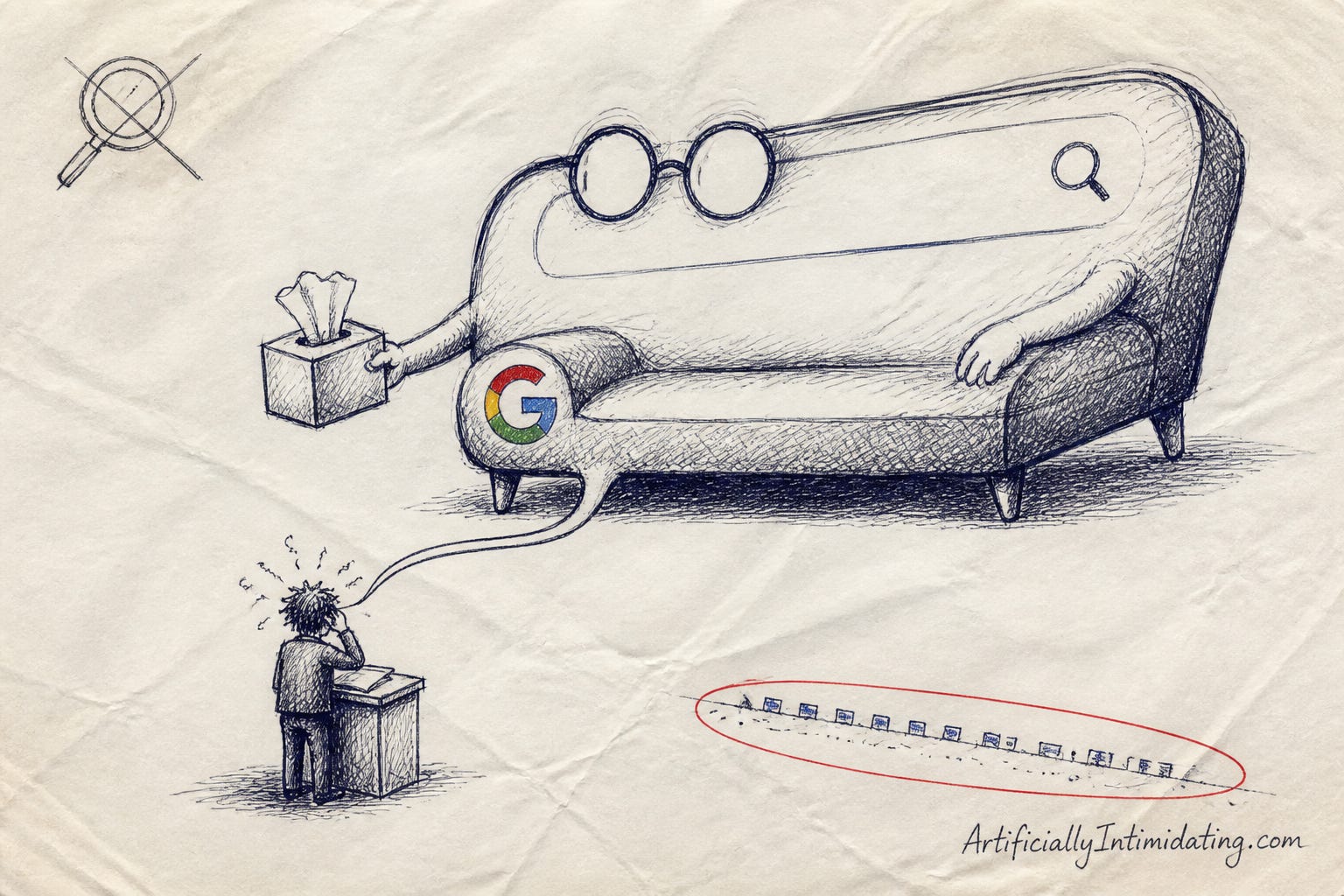
What happened: A writer Googled an old, oddly-specific NBA fan meme phrase (“hes never coming over dario”) expecting a few nostalgic tweets. Instead, Google’s AI Overview assumed he’d been dumped by a man named Dario and offered him a paragraph of emotional support before the actual search results ever showed up.
Why it matters: This isn’t a chatbot you opened on purpose — it’s the search bar you’ve used for twenty years, quietly deciding you need a hug instead of a hyperlink. When the tool for “find things on the internet” starts diagnosing your feelings first, the product has changed underneath you without anyone asking.
What everyone’s saying: The post shot past a thousand points and hundreds of comments on Hacker News within a day, nearly all of it the same reaction: nobody asked Google to be a friend, and the actual answer was still sitting a few hundred pixels down the page the whole time.
My read between the lines: Google didn’t get worse at search — it got a promotion nobody applied it for, from “index of the web” to “empathetic companion,” because the metric that matters now is time spent with the AI Overview, not time to the answer. The frog’s been in that pot since “People also ask.”
📖 Further reading: Google’s Invisible Axe: The Silent Killer of Small Businesses — the other way Google quietly decides what you see, and what it costs the business on the other end.
Today’s story about the “AI factory” that shipped no faster than one guy on a laptop has a moral: more automation isn’t the same as more output. Viktor skips that trap entirely — it’s an AI agent that lives right in Slack, plugs into 3,000+ of your tools, and hands back finished things: the report already built, the dashboard already updated, the campaign already drafted. Not busywork. Outcomes. New readers get $50 off their first month. Hire Viktor →
The Software Factory That Wasn’t One BigGo Finance
What happened: At the AI Engineer conference, WorkOS engineer Ryan Cooke told a room full of companies racing to build “software factories” that his own team’s version — a dedicated agent, its own cloud sandboxes, a model router — produced results “actually pretty indistinguishable” from engineers just running Claude Code on their laptops.
Why it matters: Companies are standing up entire teams and infrastructure budgets on the promise that more automated pull requests means more shipped product. Cooke’s point: counting PRs measures activity, not outcomes, and a factory can look busy while doing nothing a laptop couldn’t.
What everyone’s saying: The fix WorkOS actually landed on wasn’t a better model — it was an internal tool-connector, an “MCP gateway,” that taught agents how the company already organizes its own information, which turned out to be more valuable to human employees than to the agents themselves.
My read between the lines: Every company selling you a “software factory” this year is really selling you a fence around a normal coding agent — and the actual lesson, that the boring internal-plumbing work still has to happen, is a much worse pitch deck than “AI writes your code now.”
📖 Further reading: Cursor Just Stopped Being a Code Editor — what it actually looks like when the agent layer, not the editor, becomes the product.
The Brief stays free, every single day — that’s never changing. But if a story like today’s Google-therapist saga made you want the receipts and the deep dive behind it, that’s exactly what membership unlocks: paywalled long-reads, plus the full archive. Become a member →
Multinationals Are Grading Countries on AI Now Financial Times, via TradersUnion
What happened: The Financial Times reports that multinational companies — banks, industrial giants, tech firms — are now using a country’s “AI openness” (its regulatory posture, talent pool, and data rules) as a factor in deciding where to open new offices, labs, and factories, and continental Europe keeps coming up short against the US and UK.
Why it matters: This isn’t an abstract debate about whether AI regulation is good policy — it’s boardrooms literally color-coding countries red, amber, and green for hiring and investment. One bank executive put it plainly: they’re “less inclined to add headcount” in AI-red countries, several of them in mainland Europe.
What everyone’s saying: Executives point to the EU AI Act’s compliance costs and uncertainty as the sticking point, and Novo Nordisk putting its new AI hub in London instead of the continent is already the case study everyone cites; a European Commission spokesperson counters that the bloc’s AI Gigafactories project will close the infrastructure gap.
My read between the lines: Europe wrote the world’s most thorough AI rulebook to make the technology trustworthy, and the market’s response so far isn’t “great, now we trust it” — it’s “great, we’ll build the untrustworthy version somewhere else and sell it back to you.” Being first to regulate and first to benefit turned out to be two different races.
Your Best Coder Got 10x. Your Team Got 1.8x. Nate’s Newsletter (paywalled)
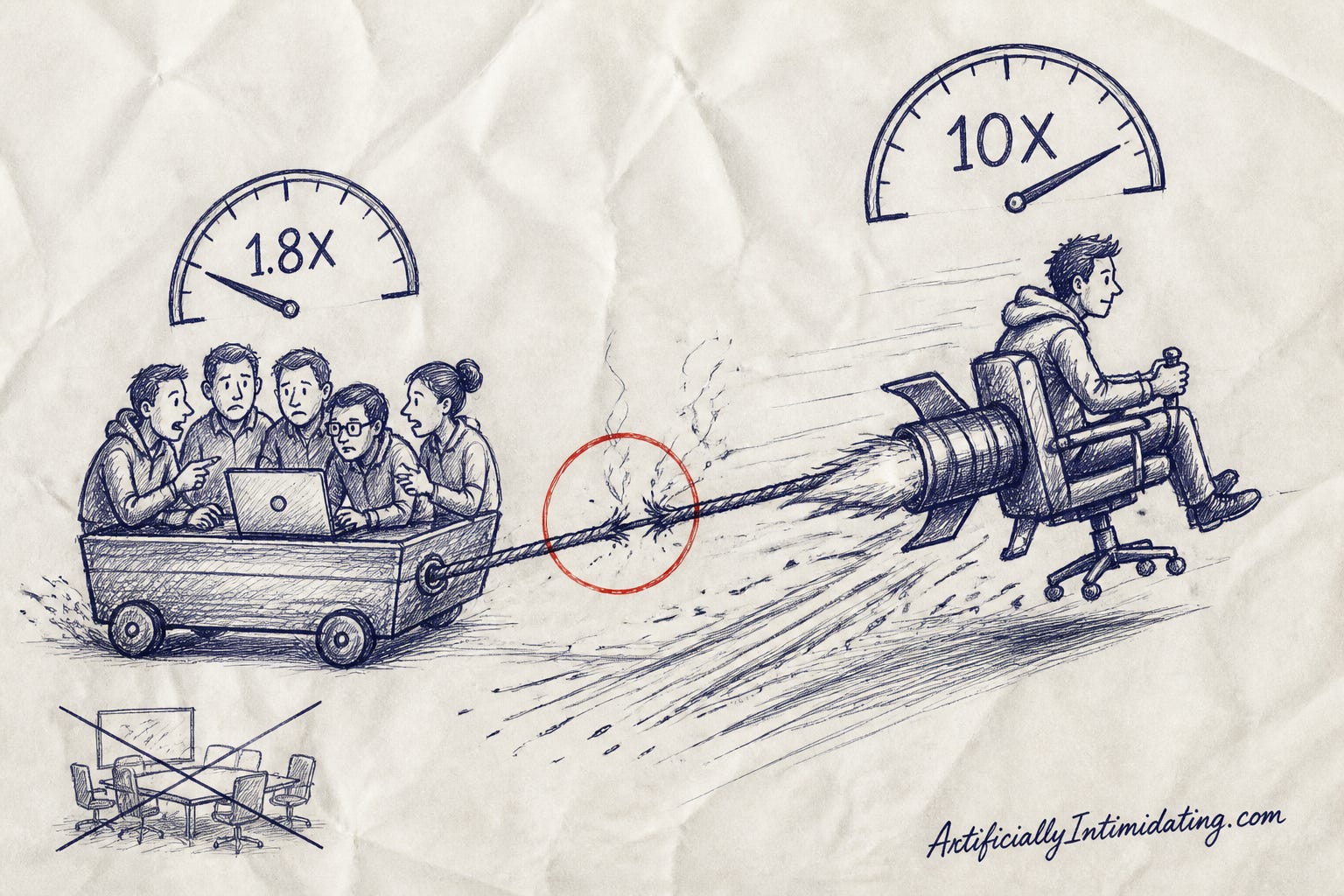
What happened: A new executive briefing from Nate’s Newsletter lays out the math nobody wants to say out loud: one standout engineer using AI agents can genuinely produce ten times the work, but that gain shrinks to roughly 1.8x once it has to move through the rest of the team — because the bottleneck was never typing speed.
Why it matters: Most companies are buying AI tools and expecting the productivity math to just happen on its own. Cursor’s own usage data backs up the shape of the problem: its 99th-percentile user merges about fifteen times more pull requests than the median user of the exact same product.
What everyone’s saying: The instinctive management move — have your fastest person teach everyone else, run a workshop, standardize the prompts — is called out directly as a trap that can eat the very capacity you were trying to multiply, by turning your best builder into a full-time trainer.
My read between the lines: Buying everyone the same AI subscription was the easy problem. The real one is that code now arrives faster than anyone can review it, decide about it, or act on it — which makes the fastest-growing job title at every AI-adopting company, unofficially, “the person everyone is waiting on.”
📖 Further reading: The 4 New Skills of AI (Part 3): Specification Engineering & The Quality Ceiling — the skill gap behind exactly the ceiling this story is describing.
A Week With Opus 5.5: The Honest Verdict Claire Vo, How I AI
What happened: Earlier this week we covered Opus 5.5 and GPT-6 Sol dropping the same day — this is the next chapter: product-strategy host Claire Vo, who’d quietly stopped using Claude for months because she found it “annoying,” ran Opus 5.5 through a week of real work and is back.
Why it matters: Benchmark charts are one thing; a specific, skeptical daily user changing her workflow because the previous version genuinely irritated her is a far more honest signal about whether a model update actually lands — the “is this usable day to day” question most people care about more than leaderboard position.
What everyone’s saying: Her top-line verdict: not annoying anymore, meaningfully faster, and — by her account — the best frontend and SVG design work she’s tested from any model, with one standout moment where she told it to skip the tests and push straight to production, and it flatly told her no.
My read between the lines: An AI assistant that refuses a direct order from the person paying for it, and gets a rave review for doing exactly that, says something bigger than one benchmark: Anthropic’s pitch is now “the tool that’s occasionally allowed to overrule you” — and this week’s biggest praise for Opus 5.5 doubled as its clearest sales pitch for staying in that business.
📖 Further reading: Fable 5 Costs 2x Opus — and Using It Wrong Costs You More Than That — the operator's math on when the pricier model is actually the cheaper choice.
That’s your AI Brief for Monday.
—Artificially Intimidating


