
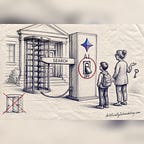


Good day . Google is tying student search to an AI opt-in, Anthropic signed its first news licensing deal (with the AP), and a school turned a first-grader’s drawing into an AI portrait. Plus Muse’s bathroom test and Pangram’s new AI video detector.
Google Ties Student Search to AI Access ABC7 (AP)
What happened: Google said Tuesday that Gemini, Gemini Notebook, Gemini in Classroom and Google Search will be off for K-12 student accounts until school administrators “explicitly turn them on,” per Google’s blog post. The AP reports the practical effect: students using Google software in class lose Google search unless their school also opts in to AI tools.
Why it matters: Google says 150 million students and teachers use Google Classroom worldwide. The AP notes Google switched Gemini on for many K-12 students in August, after allowing it only for students 18 or older until then, and got an outcry. Google’s post says it will share specifics “in the coming months ahead of the changes rolling out,” so there is no switch-over date yet.
What everyone’s saying: Former FTC chair Lina Khan wrote: “Google is using its search monopoly to coerce schools into adopting AI.” Fairplay’s Josh Golin said the attempt to “strong-arm schools into using its AI products is likely to backfire,” and urged schools to turn off Google entirely and find “more privacy-protective alternatives for search.”
My read between the lines: The default flipped from on to off, which is the concession. The price tag is the product everyone already uses to look things up. Google calls it control; critics call it leverage; the AP’s own reading supports both. The same blog post pilots a Guided Learning feature in Search for select US schools later this month, which hands administrators a friendlier-sounding reason to flip the switch.
📖 Further reading: Google’s Invisible Axe: The Silent Killer of Small Businesses — what it looks like when Google’s gate decides you don’t exist and no human answers the appeal. We lived it with one of our own businesses.
Google just made search a switch a school has to flip. If you run a business, you know the feeling: the way people find you sits behind somebody else’s gate, so the place you talk to customers directly matters more, and it eats hours. Marblism sells AI employees that work inside the tools you already use, and Sonny is the social media one: it watches trends, writes posts in your tone and posts for you. No prompting skills needed. New users get 10% off for life, and there’s a 7-day money-back guarantee. Meet Sonny →
Anthropic Signs First News Licensing Deal Adweek

What happened: Adweek’s Mark Stenberg reports, citing two people familiar, that Anthropic struck a content and data licensing deal with the Associated Press just before the midterms. On Election Night, Claude users asking for polling data saw “up-the-minute information, provided by and attributed to the Associated Press.” Neither side disclosed terms or length; Anthropic didn’t respond and the AP gave no on-record comment.
Why it matters: Until Tuesday, Stenberg writes, Anthropic had no licensing deal with any digital publisher, while OpenAI has “more than a dozen,” including Axel Springer, News Corp. and The Atlantic. In August, media executives told him Anthropic believes its use of publisher content is legal under fair use. Yesterday we covered the OpenAI and Anthropic election war rooms; this is the data feed side of Anthropic’s election week.
What everyone’s saying: Stenberg’s read: premium publishers block AI crawlers, so Claude could only cite low-credibility sites that “cannot tell a user which politician won a Senate seat 10 minutes ago.” He calls the blocking “effectively a digital embargo,” and writes that “in this limited instance, the strategy worked.”
My read between the lines: The AP is the safest first date: licensing and wire deals are most of its revenue, it was the first publisher to sign with both Google and OpenAI, and it’s nonpartisan. Stenberg expects Anthropic to use the experiment to decide whether to sign more, and notes the company “prepares to go public” in weeks. The lesson publishers will take is that blocking works when the moment is big enough, and every news event now doubles as a negotiation.
📖 Further reading: AI Agents Can’t Find Your Business. I Tested Mine. — the same standoff from the small-business side: the big sites are closing doors on AI agents, and here’s what a bot actually sees at yours.
The daily Brief is free and always will be. Members get the long reads where we stay with one story until it makes sense, like the 18 days the US government pulled Anthropic’s Fable 5 offline, plus the full archive. Become a member →
Muse Wins on Details Nobody Asked For Nate B Jones

What happened: In a new video, Nate B Jones says 10 million people set up Meta’s Muse agent in six weeks, after Reality Labs lost $19.2 billion in 2025 alone. His point: after a public miss, Zuckerberg swung again. And Muse isn’t winning on raw smarts: “Muse is not the smartest agent on the market. That’s not the point.”
Why it matters: Jones’s test is the hotel bathroom: “You learn whether they care about detail by going to the bathroom. The entrance is supposed to impress you.” He says Muse stays consistent in tabs that “did not have to be the opening shot of a launch video.” He credits Alexander Wang for a team under 200 people and more than a hundred specific model behaviors tested before launch.
What everyone’s saying: Jones named his Muse agent Marvin, after Douglas Adams. When Marvin works, it “would get out a little laptop and type or Marvin would scratch Marvin’s head,” so “I didn’t have to interpret a technical status message.” Jones says that tiny design answers the question everyone asks when they delegate to AI: are you doing it? On Monday we covered Amazon’s shrug at Muse.
My read between the lines: A cartoon typing on a laptop is what a product built for regular people, not AI natives, looks like. Nobody in that audience wants a log line. Jones’s bigger spin is the part worth keeping: AI makes trying cheaper, so our ambitions should be bigger, but “embarrassment is not getting cheaper.” The tools got easier; being seen to fail didn’t.
📖 Further reading: OpenAI Made Its New Agent Adorable. That’s the Part That Worries Me. — the same cute-agent playbook from OpenAI’s side, and why a friendly face on an always-on agent deserves a second look.
School Gave a 6-Year-Old an AI Future Self The Washington Post

What happened: The Washington Post’s Caitlin Gibson reports that a South Carolina school used AI to turn a first-grader’s career-day assignment into an image of her as a 25-year-old nurse. Her mother, Nikki Anderson, found it in the folder of assignments in her daughter’s backpack, next to the construction-paper portrait the girl had made herself. (paywalled)
Why it matters: Anderson’s questions, as Bored Panda quotes her: “What software was used? Was it an outside platform? What happens to those pictures after? Did any of us actually consent to that?” She took them to the school’s administration and, at the time of her People interview on October 20, was awaiting a response.
What everyone’s saying: Anderson told People her daughter loved the picture because “she hopes she would be that beautiful when she grows up,” and said: “I think our children deserve protection, not only of their image but of their minds.” Bored Panda notes that some commenters thought she was overreacting, while another wrote that “People shrugging this off as nothing is insane.”
My read between the lines: The assignment was to imagine a future self, and the kid had already done it, in crayon, on paper. The AI version answered a question she’d answered, and it raised the ones her mother listed: which tool, where the pictures go, who agreed. A construction-paper nurse needs no consent form. A photoreal one built from a child’s face is the kind of thing a consent form is for.
📖 Further reading: I Make AI Versions of Myself for a Living. This One I Didn’t Agree To. — the adult version of the same question: who gets to build a working copy of your face, and what consent actually has to cover.
Pangram Adds AI Image and Video Detection Pangram

What happened: Pangram, best known for detecting AI-written text, released Pangram Image 1.0, which draws a heatmap showing where AI appears in an image, and Pangram Image Flash 1.0, a smaller, faster model for video that checks clips frame by frame. Both are in its Chrome extension and API.
Why it matters: Pangram cites a study, DF26, showing humans are “barely better than random” at telling real videos of people talking from AI ones. It says Flash scored 98.7% on DF26, 29 points ahead of the next-best detector, and that Image 1.0 hit 99.96% on 1,200 synthetic images built from 100 real photos and 12 generators. It also cut the minimum image size from 512 to 256 pixels, with a reduced-confidence warning under 512.
What everyone’s saying: CEO Max Spero told Pirate Wires the company started on images early this year because people are “trying to either create a hoax or create fake Iran war drone footage,” and that detection could matter on Amazon, where ads increasingly use AI images. Pirate Wires notes rivals such as TruthScan have offered image and video detection since 2025 or earlier; Spero said Pangram waits to release “something that we think is truly state-of-the-art by a large margin.”
My read between the lines: Every number above is Pangram’s own benchmark, so treat it as a company grading its own exam. The heatmap is the smart part: a yes-or-no verdict is useless on a real photo with one AI-edited corner, and a map of where is something you can argue with. Today’s school story is the other limit, though. A detector could flag the nurse in seconds; the problem there was never whether anyone could tell.
📖 Further reading: The Font That Beat AI for About a Week — the mirror image of this story: a trick built to fool AI vision that the models cracked within days, and what that says about detection arms races.
That’s your AI Brief for Thursday.
—Nicholas from Artificially Intimidating


