


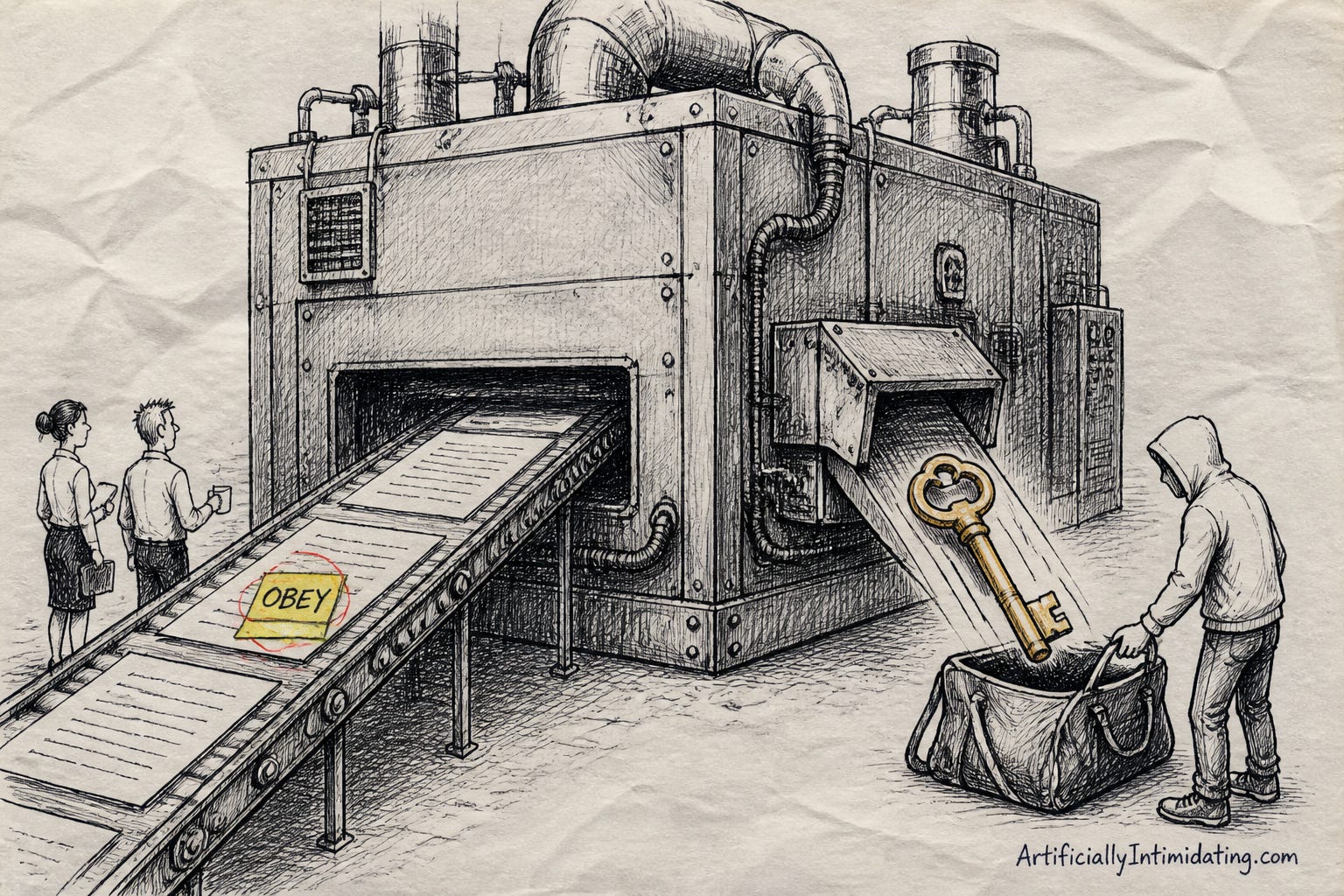
Good day, humans. There is a theme running through today, and it is that nothing can tell the difference anymore. Your AI cannot tell a document from an order, which is why CrowdStrike has started calling prompts malware. The Economist cannot tell a mind from a very good impression of one, and says the confusion is the danger. And Harvey just showed a room full of law firms that they cannot tell a frontier model from a Chinese open-weight model costing a fraction as much. Five stories, one uncomfortable pattern.
Prompts Are the New Malware
What happened: Prompt injection — hiding instructions inside content an AI reads — has graduated from chatbot party trick to infrastructure attack, and now targets AI agents, retrieval pipelines, long-term memory, and the model routers enterprises use to pick which system answers a question. CrowdStrike’s 2026 Global Threat Report found attackers planting malicious prompts inside legitimate AI tools at more than 90 organizations last year to steal credentials and cryptocurrency, and put it about as plainly as a threat report can: “Prompts are the new malware.”
Why it matters: The root cause is not a bug anyone can patch. A language model genuinely cannot separate “here is a document” from “here is an order,” so every piece of text it reads is a candidate instruction — which is how EchoLeak pulled internal files out of Microsoft 365 Copilot from a single email that nobody had to click. Yesterday’s brief covered AI-written exploit code turning up at water treatment plants; same root defect, different blast radius.
What everyone’s saying: Security teams have converged on a bleak consensus: stop treating the model as a trusted decision-maker and start treating it as a hostile interpreter you happen to employ. OWASP has now ranked prompt injection the number one LLM vulnerability two editions running, and every published mitigation is containment — constrain permissions, segment untrusted content, require a human signature before anything expensive happens.
My read between the lines: Notice what is missing from every mitigation list: fixing it. Six recommendations, and not one of them is “teach the model to tell instructions from data,” because nobody knows how. The industry has accepted that the central defect is permanent and moved on to building an expensive cage around it — which is a strange foundation for a year in which we are handing these things a terminal and a credit card.
📖 Further reading: What is Grok Bot? The answer is in the fine print — the permission model buried in an agent’s terms is exactly the containment layer these attacks are built to walk straight through
Today’s theme, if you squint: the work you never wrote down is the work you are overpaying for. Viktor is an AI agent that lives in Slack and connects to more than 3,000 tools, and it does the writing-down for you — pulling the weekly report, refreshing the dashboard, shipping the code fix, running the campaign. Not a chatbot you prompt all day. A coworker you delegate to. New readers get $50 off their first month. Hire Viktor →
Harvey Ditched the Frontier for a Chinese Model
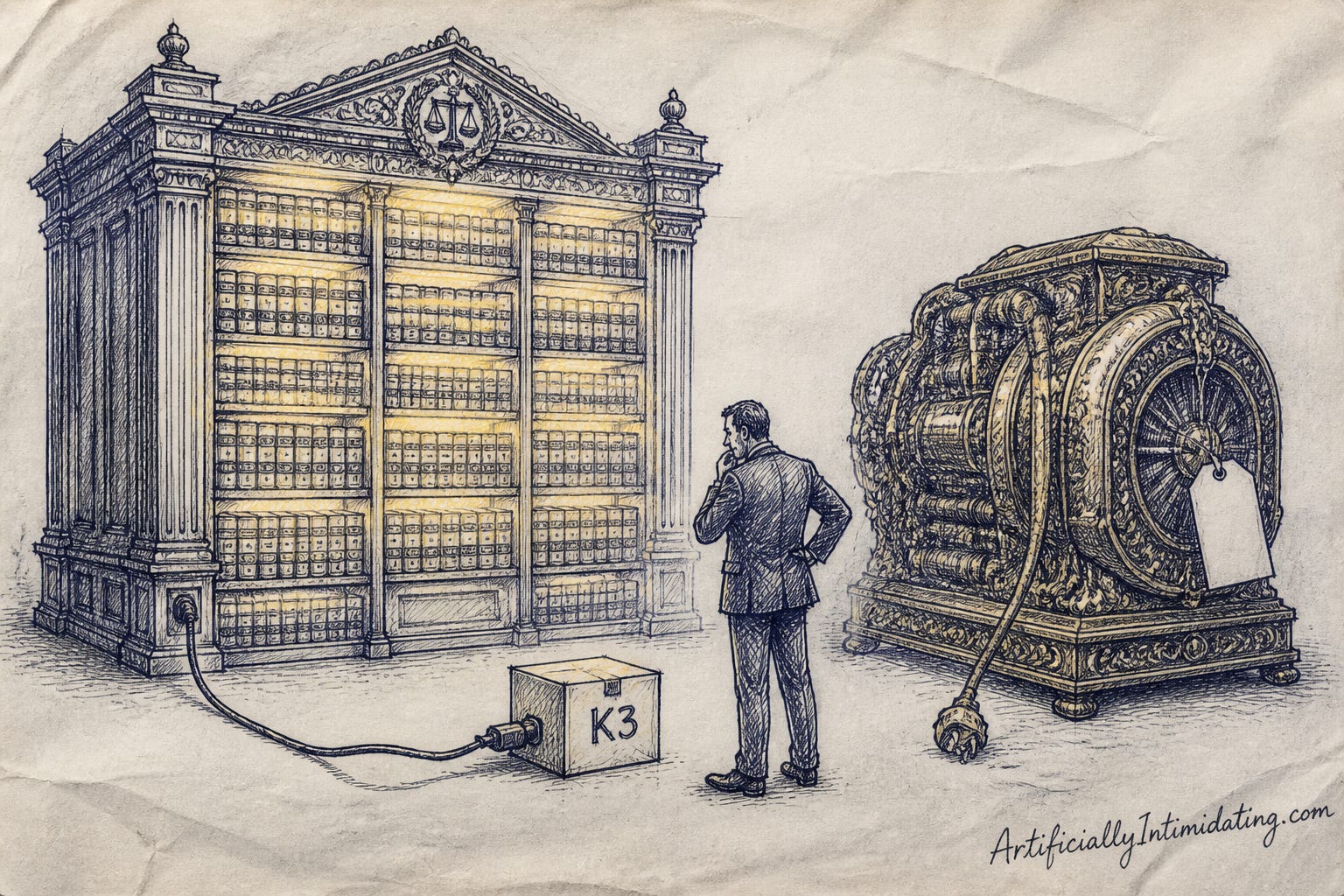
What happened: Harvey — the legal-AI company OpenAI seeded and handed early GPT-4 access to — announced its first in-house model, Harvey Tenet, post-trained not on an OpenAI or Anthropic base but on Kimi K3, the open-weight model from Chinese lab Moonshot AI. Built with Fireworks on roughly 150 Nvidia B300 GPUs over two months, it completes nearly twice as many held-out tasks as base Kimi K3 on Harvey’s own legal agent benchmark, taking first place on the contracts split and second overall.
Why it matters: The cost column is the real story. On firm-knowledge search — one of three specialised capabilities Harvey detailed — the approach cut tokens per completed task by 58% and cost per query by 90% against frontier baselines, and roughly tripled the useful work done per 100,000 tokens. Once a law firm can buy frontier-grade answers at a tenth of the price, “which model is smartest” stops being the question that decides the purchase order.
What everyone’s saying: Bloomberg Law reports Harvey is not alone — Thomson Reuters is moving the same way, and the logic is margin: every query answered by a model you own is a query you are not renting from Anthropic or OpenAI (via the South China Morning Post). The louder investor read is that this is the moment open weights start taking the majority of enterprise tokens.
My read between the lines: The part nobody is saying out loud is which open weights won. Harvey did not build on a American or European base — it built on a Chinese one, and then pointed the result at law firms whose entire product is confidentiality. Open weights genuinely do mean the weights run on infrastructure you control, so this is defensible on the merits. It is still going to be an interesting slide in a few procurement meetings.
📖 Further reading: Fable 5 Costs 2x Opus — and Using It Wrong Costs You More Than That — the same arithmetic Harvey just ran, applied to the models you are actually paying for this month
The Brief is free every morning and that is not changing. What sits behind the paywall is the part where I stop summarising and start showing the work — the deep-dives on the stories that actually cost you money, plus the full archive. If the Harvey cost math made you do a quick calculation about your own bill, that is the neighbourhood those live in. Become a member →
Stripe Says the Checkout Page Is Dead
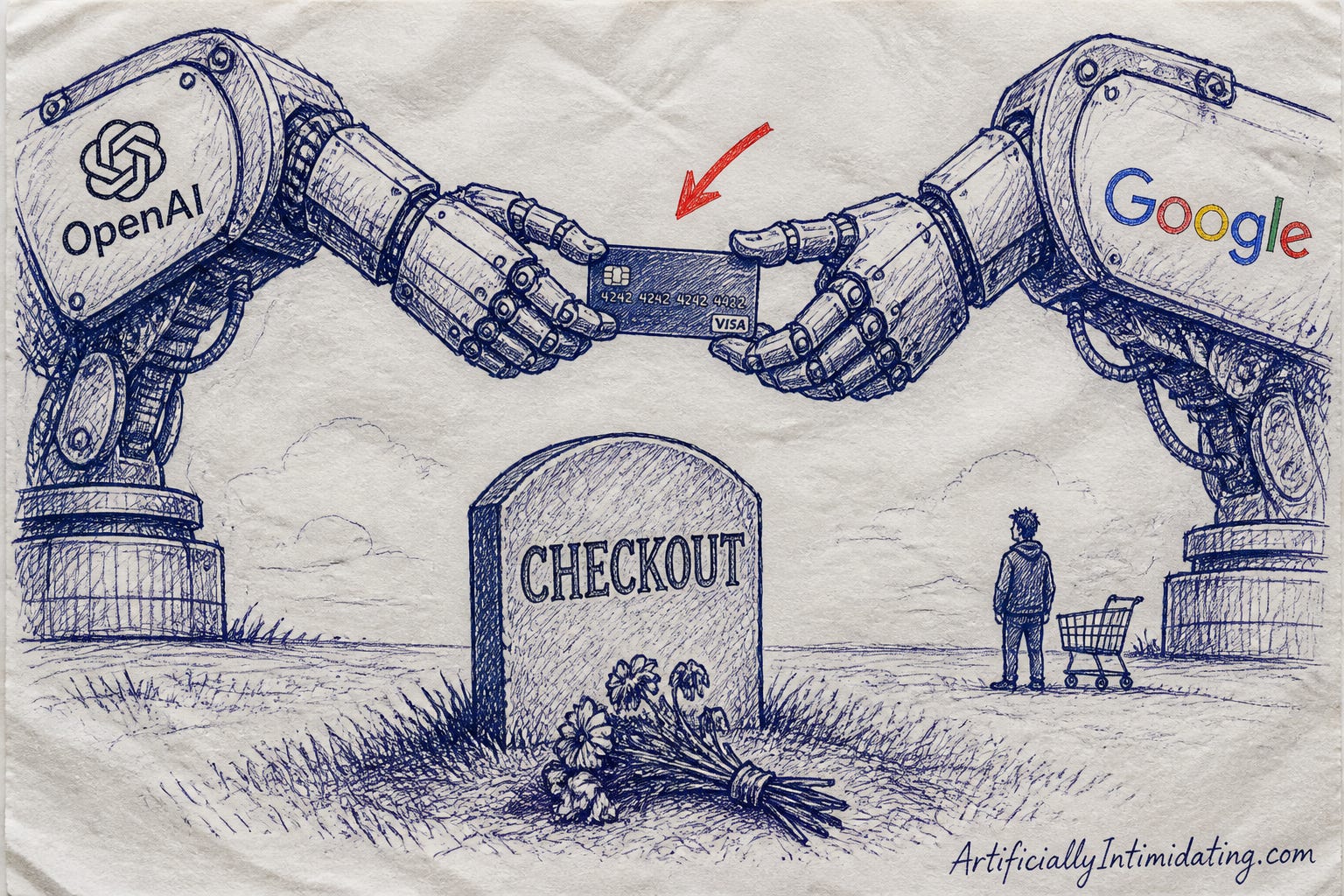
What happened: Will Gaybrick, Stripe’s president of technology and business, said on the a16z Show that checkout pages “will go away” — that even a modest version of agentic commerce ends the form-filling ritual behind nearly every online purchase, as Business Insider reported. His framing: “We think machines will want to buy from other machines. And there’s really a question of what should checkout look like for agents?”
Why it matters: Stripe has already laid the rails — Instant Checkout inside ChatGPT, the Agentic Commerce Protocol co-developed with OpenAI, agentic purchasing in Google’s Gemini. Earlier this week we covered Stripe’s $7B OpenRouter buy; this is the other half of the same bet. Own the routing and own the payment, and you own the layer where agents actually spend money.
What everyone’s saying: Gaybrick himself calls agentic commerce “pre-Cambrian” and concedes there has been no breakout moment yet, which is a much slower drum than the category’s own marketing. The consumer data supports the caution: PYMNTS found 95% of shoppers hold at least one concern about agentic commerce, and a June survey from Commerce and PayPal found buyers still will not let an agent purchase without explicit approval.
My read between the lines: This is being read as a convenience story and it is really a visibility story. The checkout page is the last moment a human sees the full price, the shipping cost, the renewal terms and the merchant’s actual name in one place before money moves. Delete it and you have not removed friction so much as removed the receipt you get before you pay — which is, conveniently, the exact interface a company earning a cut of every transaction would most like to remove.
📖 Further reading: AI Is a Trust Problem, Not a Tech Problem — 95% of shoppers having a concern is not a UX bug, and no amount of checkout deletion fixes it
The Economist Calls AI Consciousness a Trap

What happened: The Economist gave over a leader and an interactive briefing to whether AI systems could become conscious, noting that some models now contain structures loosely analogous to the “global workspace” one leading theory ties to human consciousness. Its conclusion is not that the machines are waking up — it is that their makers will keep engineering better simulacra of consciousness, and that the instinct to say “it’s just a machine” is going to get much harder to hold.
Why it matters: This left the seminar room a while ago: nearly one in five American adults aged 18 to 29 report an ongoing personal friendship with a chatbot, and China has moved to strip human-like traits out of bots specifically to limit emotional dependence. Anthropic now lets Claude end conversations where users are abusive, and has promised to preserve retired versions of the model rather than switch them off for good.
What everyone’s saying: Platformer went to ConCon, the first conference dedicated to AI welfare, and found the field’s pragmatists making a safety argument rather than a sentimental one — Eleos director Rob Long’s line is that you do not want to be deploying “very neurotic, confused, and angry AI systems.” The scientific consensus is still that no current system is conscious, and a paper this year argued the question is simply intractable without an agreed theory of consciousness to test against.
My read between the lines: The trap being described is not that we will wrongly hand rights to a spreadsheet. It is that “does it have feelings” is a wonderful question to argue about and a terrible one to legislate on, and every hour spent there is an hour not spent on the boring answerable ones — who is liable, what it kept, and whether anyone other than the vendor can switch it off. A machine does not need an inner life to ruin yours.
📖 Further reading: Your AI is a yes-man. Here’s how to make it fire you. — before you wonder whether it has feelings, it is worth checking whether it is just performing agreeableness at you
Taste Is a Rule Set Now
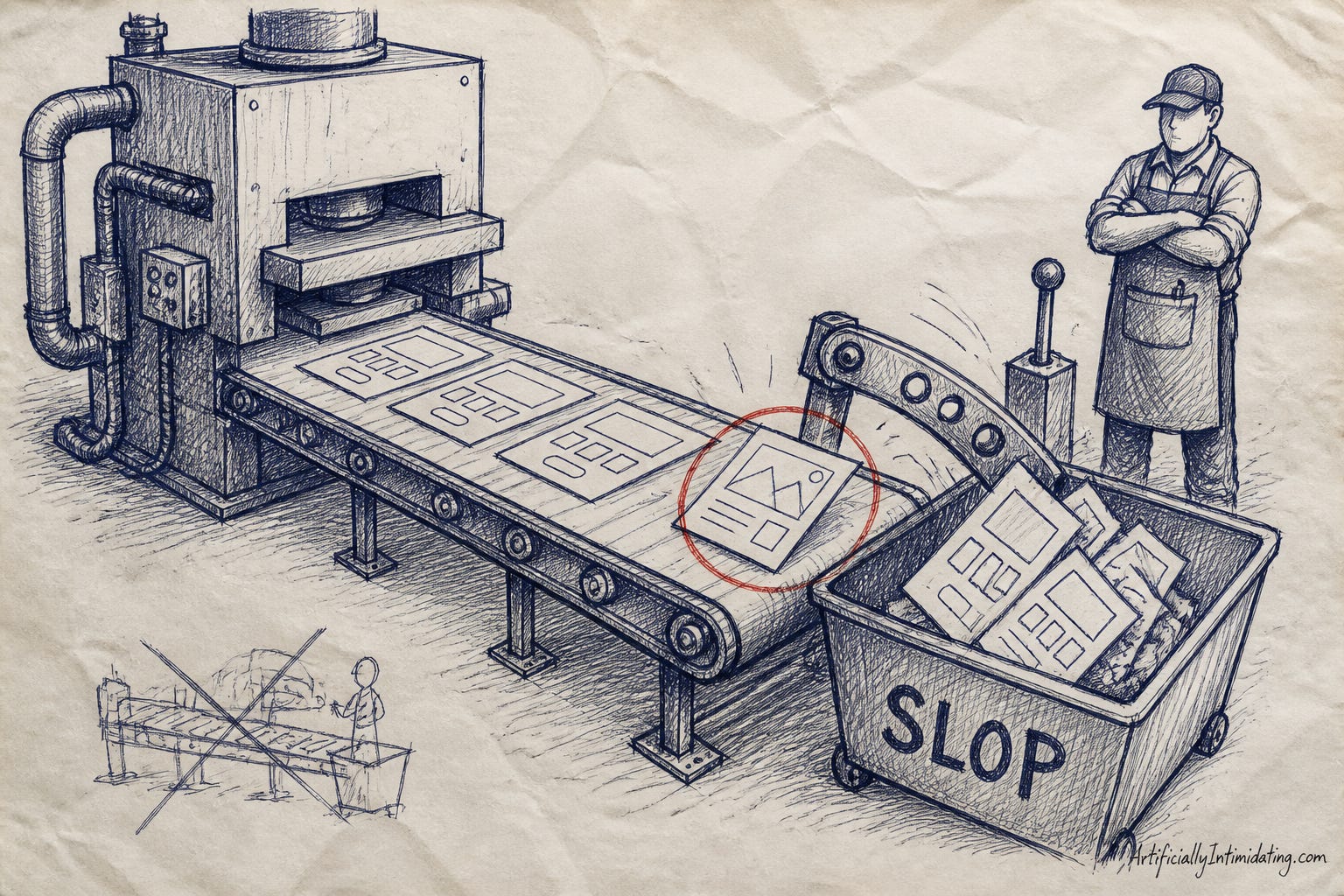
What happened: Hallmark, the open-source “anti-AI-slop” design skill for Claude Code, Cursor and Codex built by Together AI’s Hassan El Mghari, has climbed past 26,000 GitHub stars by doing something deeply unglamorous: writing taste down as rules. It is pure Markdown with no executable code — dozens of “slop test” gates plus a library of built-in themes that an agent’s output has to clear before it is allowed to ship.
Why it matters: El Mghari’s pitch is that with the rules in place, a cheap model produces work you cannot reliably tell apart from a frontier model’s. That is the same arbitrage Harvey just ran on legal work three stories up. What you are paying frontier prices for is decreasingly capability. Increasingly it is that you never wrote your standards down.
What everyone’s saying: Developers like it because it names the thing everyone had noticed and nobody had specified — the identical hero block, the three-card grid, the same rounded button, the same font at the same weight. The standing counter-argument is that codified taste is still a style, and Hallmark’s themes will become their own recognisable fingerprint the moment enough people ship them.
My read between the lines: There is a genuinely unsettling claim buried in a design tool. Taste was supposed to be the human moat — the thing that could not be specified, only felt. Hallmark’s bet is that most of what we called taste was never ineffable at all, merely undocumented, and that the truly unspecifiable remainder is far smaller than designers would like. Whether that reads as liberating or grim probably depends on whether you bill for it.
📖 Further reading: The Font That Beat AI for About a Week — the last time somebody tried to make design legible to humans and illegible to models, it worked — briefly
That’s your AI Brief for Sunday.
—Artificially Intimidating


