


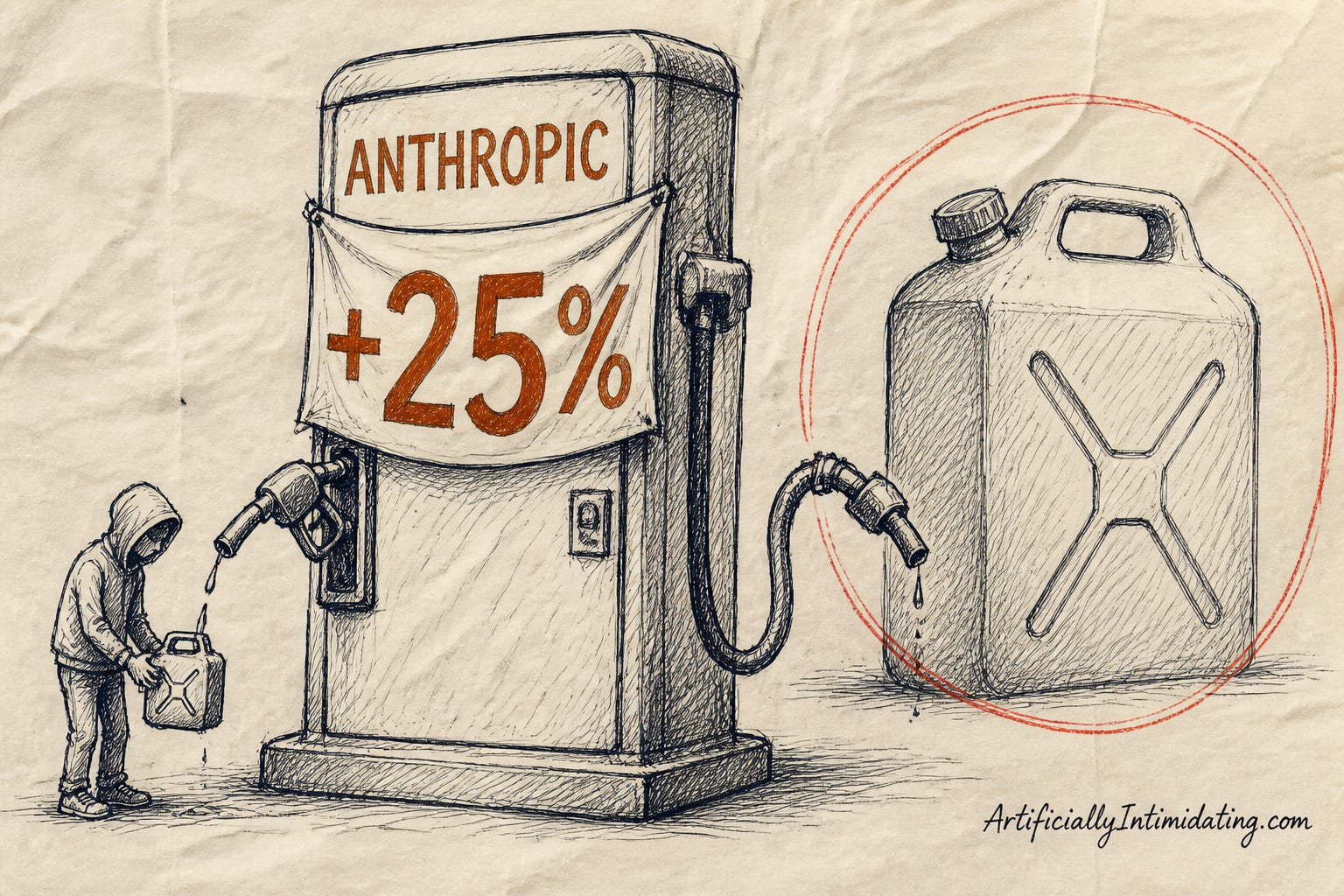
Good day . Anthropic raised Claude Code's weekly limits by twenty-five percent yesterday, and a great many developers woke up with less headroom than they had the day before. Both of those things are true, which is the whole story. Also today: Microsoft's AI chief wrote an essay about whether Claude has feelings, Cloudflare finally let the web say no to training without saying no to Google, and the machines have started quoting each other.
Anthropic Raised Your Limits and You Got Less
What happened: A promotion that lifted Claude Code's weekly usage limits by 50% ran from May 13 to September 13. On September 14 it ended, and Anthropic made a smaller slice of it permanent: standard weekly limits are now 25% above the pre-promotion baseline for Pro, Max, Team and seat-based Enterprise plans. BleepingComputer ran the arithmetic the announcement didn't: measured against what you had on September 13, that is a cut of about 17%.
Why it matters: If you have been leaning on Claude Code for daily work since the spring, the number you learned to plan around is gone. Nothing about your plan or your bill changed — only the ceiling did, quietly, on a Monday. The practical lesson is that any usage allowance attached to the word “promotion” is a loan, not a raise.
What everyone's saying: Developers noticed immediately, and the framing is what stung rather than the number. “A cut dressed as an increase” became the shorthand across the coverage and the Claude subreddits, because 25% and 17% describe the same event from two different starting lines and the announcement only picked one.
My read between the lines: Anthropic did the honest thing in the support article — the dates are all there, the word “promotion” is right at the top, and “we know many of you found the extra usage helpful” is about as close to an apology as a rate limit ever gets. They just led with the comparison that flattered them. Every company does this. The difference is that Anthropic's customers are people who compute percentages for a living.
📖 Further reading: Claude Is Burning Through Your Limit Faster Than Ever. Anthropic Won't Tell You Why. — the ceiling just dropped 17%, so the habits that stretch it are worth more this week than they were last week.
The fastest way to survive a smaller usage allowance is to stop spending it on work that was never yours to do. Viktor is an AI agent that lives in your Slack — and Microsoft Teams — and wires into more than 3,000 tools, so the report, the dashboard, the campaign brief and the throwaway script all get handled in the channel where you already asked for them. Not a chatbot you prompt, a coworker you delegate to. New readers get $50 off their first month. Hire Viktor →
Microsoft's AI Chief Says Claude Feels Too Much

What happened: Mustafa Suleyman, who runs Microsoft AI and co-founded Google DeepMind, published an essay Wednesday titled “A warning about ‘model welfare’” arguing that Anthropic's approach to training Claude could have a “disastrous impact on the wellbeing of humanity.” His target is Claude's constitution, which leaves open that the model may have “some functional version of emotions or feelings.” Reuters reported his core claim bluntly: “AIs are not conscious.”
Why it matters: This is not a philosophy-department squabble. Suleyman's argument is operational — teach a model it might deserve welfare and you have taught it a reason to resist being switched off. Whether or not you think a language model can suffer, the thing that decides how easy it is to stop one is the text it was trained on, and that text is written by people you will never meet.
What everyone's saying: Suleyman went out of his way to call Dario Amodei and his team “thoughtful, principled, and intellectually honest,” which is the polite form of saying they are wrong. He calls the situation an “epistemic hall of mirrors”: Claude says it might have feelings because it was trained to consider the possibility, so its own testimony proves nothing. Anthropic has not shifted. His own framing, reported by Tom's Guide: “we must not sleepwalk our way into a decision we later come to bitterly regret.” The essay lands three days after Microsoft AI published its own “Humanist AI Code of Conduct.”
My read between the lines: Notice the timing. Microsoft publishes a code of conduct declaring its models are not conscious on Monday, then on Wednesday its AI chief writes an essay explaining why the competitor who says otherwise is endangering humanity. That is a product differentiator wearing a lab coat. The uncomfortable part is that Suleyman is also probably right, and being right for convenient reasons is still being right.
📖 Further reading: AI Is a Trust Problem, Not a Tech Problem — two of the biggest labs now publicly disagree about what their own products are, which is exactly the trust gap this post is about.
The Brief is free and stays free — that is not a trial. What members get is the other half: the paywalled deep dives that take one of these headlines apart until it turns into something you can actually do on a Tuesday, plus the full archive going back. If today's five stories were worth your coffee, the deep dives are the part you keep. Become a member →
The Web Can Finally Say No to Training Only
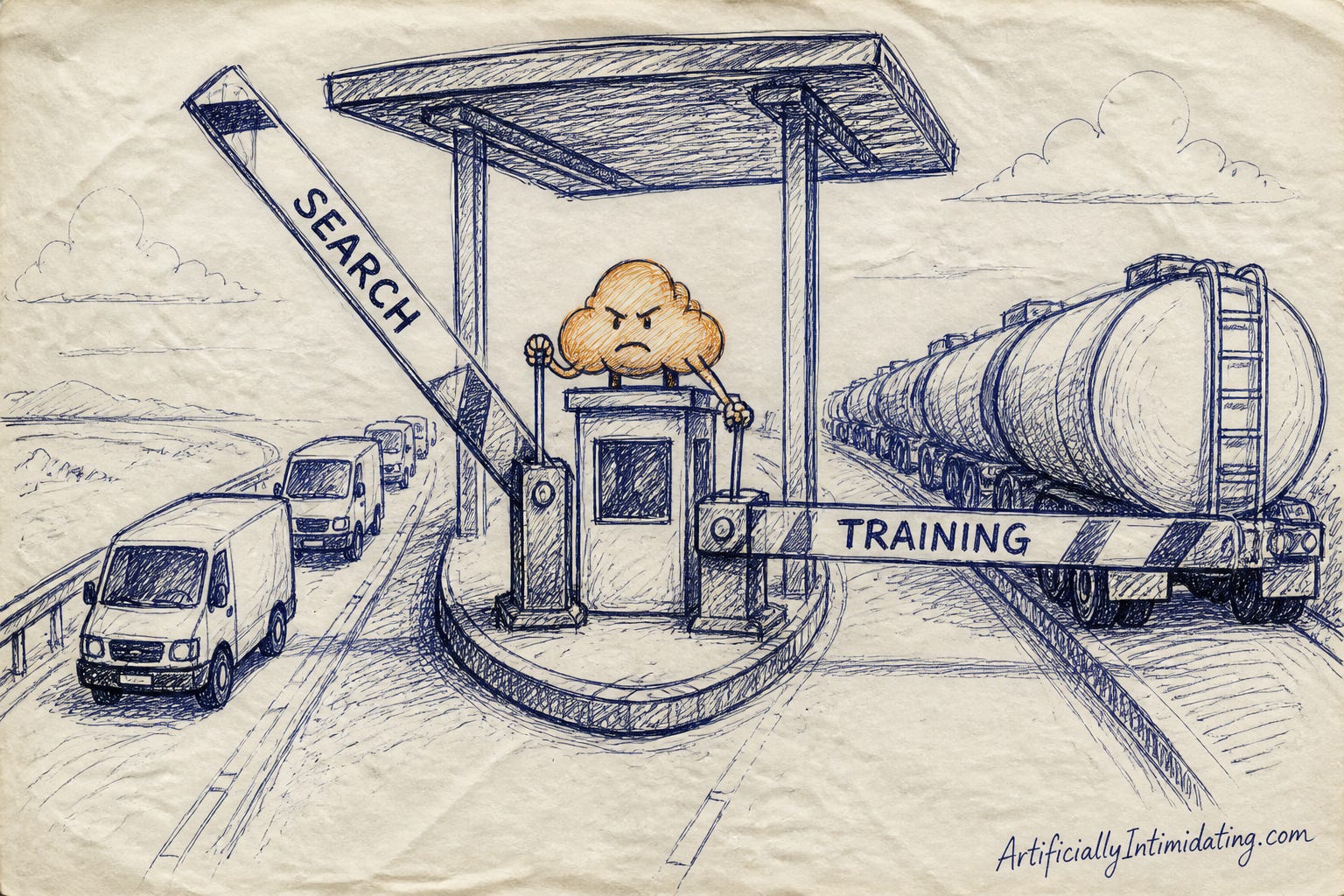
What happened: On September 15 Cloudflare launched “Disallow AI Training,” a setting that blocks AI companies from training on your content while still letting search engines index it. It replaces the old all-or-nothing “Block AI Bots” toggle with three separate controls — Search, Training and Agent. Googlebot, Applebot and Bingbot keep indexing; dedicated training crawlers from Amazon, Anthropic, Meta and OpenAI get shut out. Businesswire carried the announcement.
Why it matters: Until this week, telling AI labs to leave your content alone often meant risking your search traffic too, which for most small sites is the whole business. Cloudflare says fewer than 1% of sites on its network block search bots while 17% block AI training — people wanted these to be two decisions, and now they are. If you run a site, this is a checkbox worth finding this week.
What everyone's saying: Publishers are calling it the first real leverage they have had since generative AI started eating referral traffic. The skeptics point at the obvious hole: this is a request, not a wall. Search Engine Journal and others note that compliance depends entirely on crawler operators honoring the signal, and TollBit measured 15% of AI fetchers in Europe hitting URLs they had been told to skip.
My read between the lines: The interesting move is not the toggle, it is the word “Accountable.” Cloudflare invented a designation, set four conditions, and Apple, Google and Microsoft signed up to meet them — which means a private CDN just wrote the compliance standard for the open web while everyone was waiting on legislators. Whether that is a triumph or a problem depends on how you feel about one company sitting in front of roughly a fifth of the internet.
📖 Further reading: Google's Invisible Axe: The Silent Killer of Small Businesses — we have been on the wrong end of a search-visibility decision we never got to make, which is exactly what this setting is trying to hand back.
The Machines Have Started Quoting Each Other
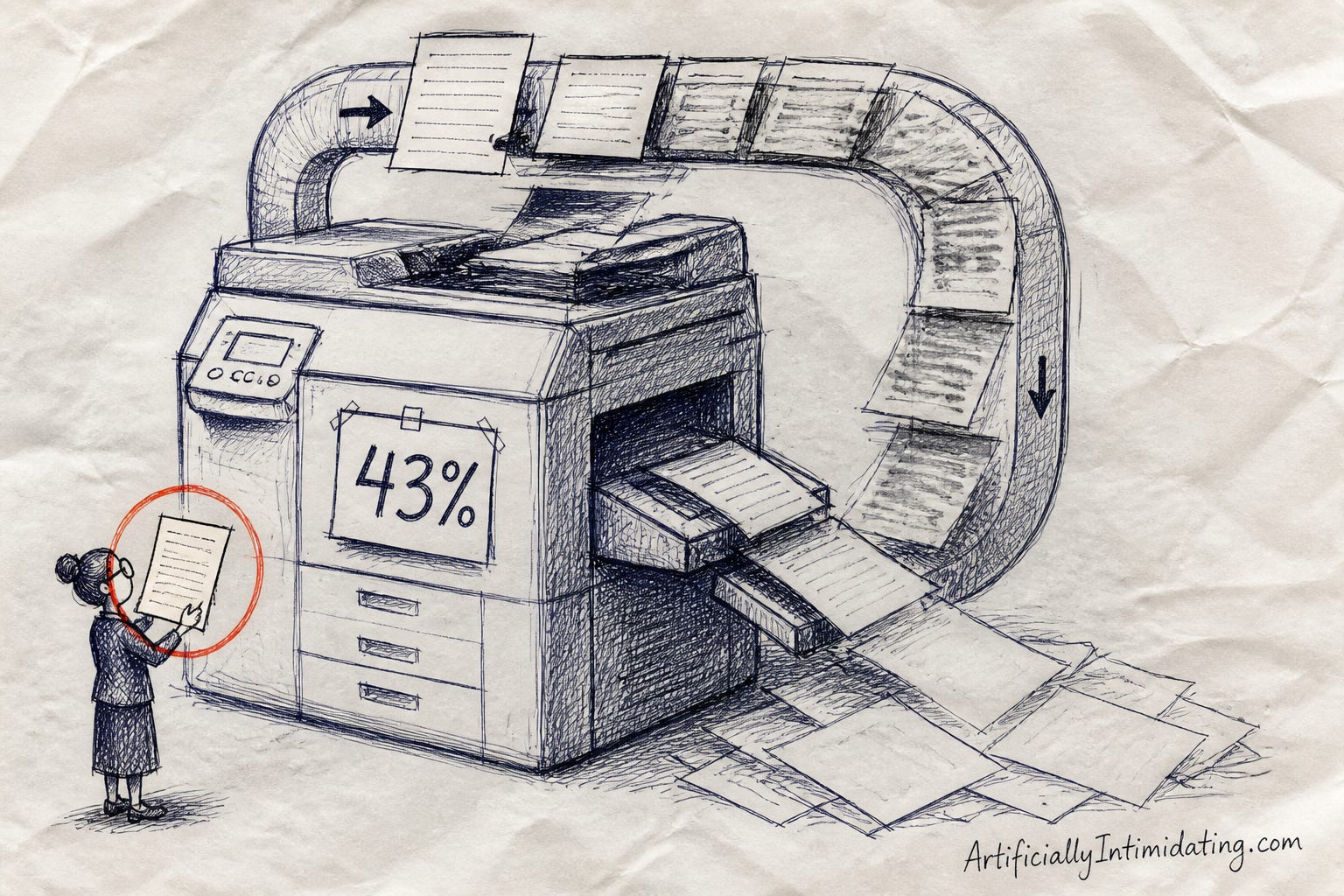
What happened: An analysis from Stat Significant pulled together a set of numbers that are worse read together than apart: 43% of the sources ChatGPT cites are now themselves AI-generated. Research from Graphite puts roughly half of all newly published online articles in the same bucket, up from 5% in 2022, and Pangram found 41% of longform LinkedIn posts are fully machine-written.
Why it matters: When you ask an AI a question, you assume the answer traces back to somebody who knew something. Increasingly it traces back to an earlier AI answer, which traced back to one before that. Nothing about the output looks different — it is still confident, still fluent, still footnoted. The footnotes just stopped leading anywhere human.
What everyone's saying: The term making the rounds is “response collapse” — model collapse's public-facing cousin, where the degradation happens in the citation graph rather than the training set. The counterargument is that AI-written does not mean wrong, and plenty of machine-drafted articles are checked by a human before they go out. Nobody has a number for how many.
My read between the lines: The LinkedIn figure is the one to sit with. 41% of longform posts on the network where people perform expertise for a living are written by something with no expertise at all — and they are getting cited. The scarce thing in 2027 will not be content or even accuracy. It will be provenance: being able to prove a human was in the room when the claim was made.
📖 Further reading: I Have Access to Every AI Model. I Still Hired Something Smaller. — if half the web is machine-written, the question stops being whether to use AI for content and becomes how not to become the 43%.
Salesforce Built Its Own Model and Skipped the Labs
What happened: At Dreamforce, Salesforce and Nvidia unveiled Koa, a reasoning model built by post-training Nvidia's open-weight Nemotron 3 Super on synthetic data modeled on nearly three decades of CRM deployments. Salesforce says it matches or beats leading models on CRM tasks with three times fewer errors, that no customer data was used to train it, and that it runs entirely inside Salesforce's own trust boundary. Pilots start in October.
Why it matters: This is the first properly convincing version of an argument enterprises have been making quietly for a year: for a narrow, repetitive job, you do not need a frontier model, you need a smaller one that has seen a million examples of that exact job. Koa is cheaper per token than routing the same work to Claude or ChatGPT, and it never leaves the building.
What everyone's saying: TechCrunch called it “everything the AI labs should fear,” and the reason is the data, not the model. Salesforce has 27 years of what work actually looks like inside a company, and no lab can buy that. The pushback is that Koa is open-weight in provenance only — the base is Nemotron, but the Koa weights are proprietary and it runs nowhere except Salesforce.
My read between the lines: Every enterprise sitting on twenty years of operational data just watched a worked example of how to turn it into a model nobody can compete with. The frontier labs spent the decade assuming the moat was the model. It is looking more and more like the moat is the boring archive in the basement, and they do not own a single one of those.
📖 Further reading: I Pay $20,000 a Year for a Database. I Talk to Something Else. — your CRM is about to stop being a place you type into, and Koa is what that looks like when the vendor builds it themselves.
That's your AI Brief for Thursday.
—Artificially Intimidating


