

Justin Feinstein wrote a novel about an ad guy hired to teach a bot how to market to people, inside a company where the bots watch the employees and learn from them. He figured that world was five to ten years away. Then it started happening before the book was even out.
The book is Your Behavior Will Be Monitored (Tachyon Publications, 2026). Justin lives in LA and works in tech and advertising. He started out in music, got more work writing about music than playing it, and wrote his way from there into advertising and then fiction.
We get into where the title came from (it started as Reasons to Believe), the cookie printer that got me custom Oreo ads 15 minutes after an email, how a cookie habit can turn into an insurance premium, why he drives differently around Waymos, how to spot AI writing, why he still writes the slow way, Claude as the spouse who knows which stories to tell at a dinner party, the AI networker Boardy that introduced us, and the wave of AI-powered crime he's writing about next.
At his book launch, a room of friends, many of them writers, didn't ask a single question about the book. Every question was about AI.
Claude as the spouse at the dinner party
The idea I keep coming back to came from Justin at 36:21. Until now, AI has mostly been about how fast, how efficient, how vast. He thinks the next layer is tact:
"It's almost like Claude's like a spouse. If you were to bring your spouse to some social setting, they're going to know what they should say about you, or what stories to tell."
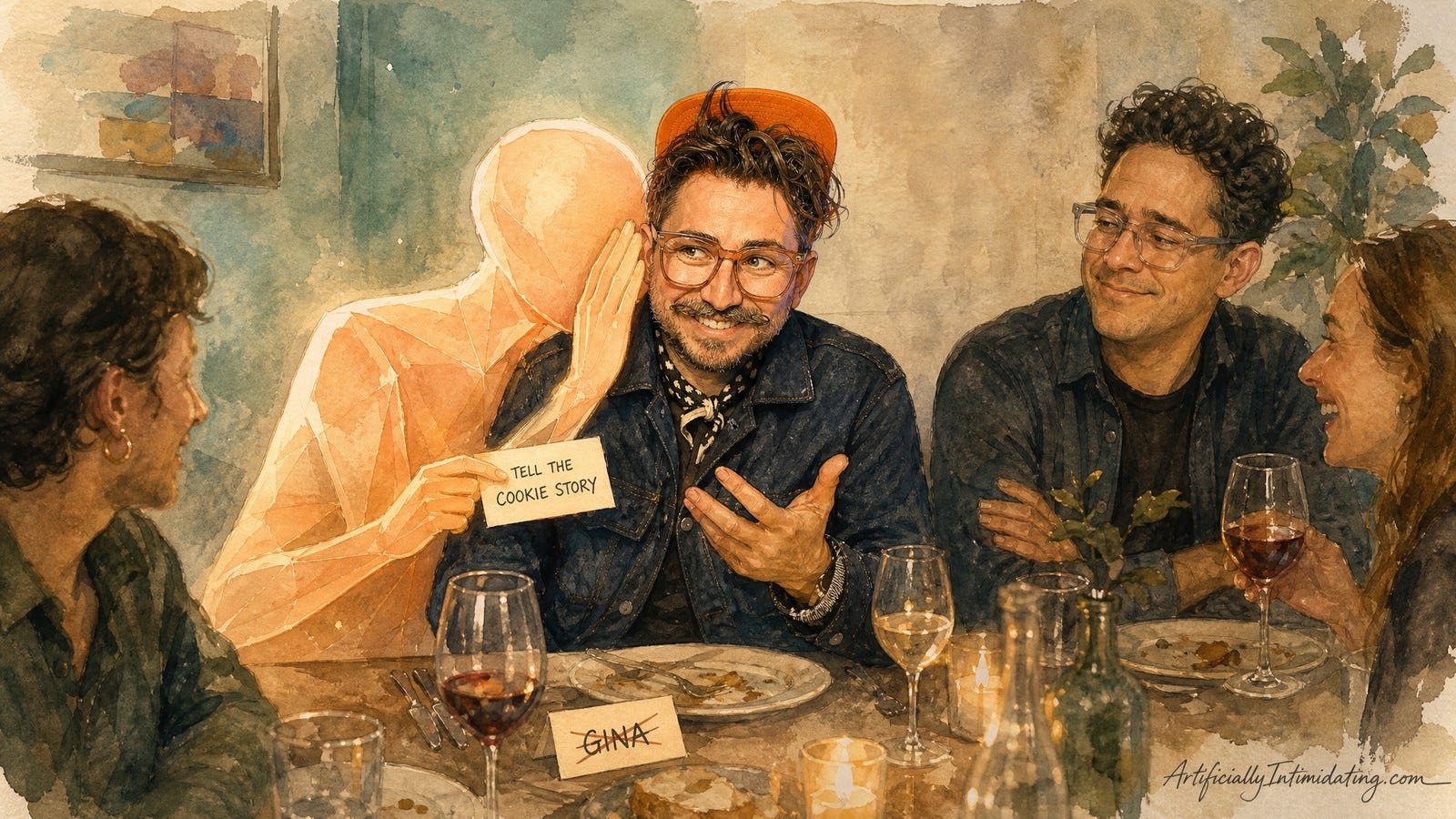
We already live a version of this. OutSnapped (our events company) and Pictor (the photo booth software behind it) talk to similar people in completely different languages, and our automated marketing has to know which company it's speaking for, and which one never to bring up. Like the dinner party: we don't talk about __________.
Speed is close to a commodity now. Knowing which story to tell, and to whom, is where the next wave of AI at work will be judged.
Chapters
0:00 Cold open: "No one asked anything about the book"
0:35 Meet Justin: from musician to ad man to novelist
2:40 The book arrives: Your Behavior Will Be Monitored
5:02 Where the title came from
7:35 Quinn, the bot that builds your ads
9:20 The cookie printer and the custom Oreo ads
11:07 Is your phone listening? Ghost profiles
12:52 From cookie data to insurance premiums
13:40 Writing the future before it arrived
16:42 Waymos and the robotaxi effect
19:12 How Justin uses AI (barely)
21:37 Writing is discovery
22:59 Taste, the darkroom and borrowed skill sets
26:36 How to spot AI writing
29:59 Writing a novel in emails and Slack messages
33:03 Shared AI: who knows what
36:21 "Claude's like a spouse"
37:15 AI at OutSnapped and Pictor
39:41 Claude rewrites the deck: frame vs. overlay
41:31 How we met: Boardy, the AI networker
44:33 He wrote it before the hype: Waymo to Grokbot
46:40 What's next: AI-powered crime
49:01 Sci-fi, black hats and white hats
49:56 North Korean deepfake job applicants (Search Engine)
50:16 Cookie Monster's AI mandate
52:02 Jaywalking and perfect enforcement
53:33 Recommendations: Flesh and Code, Calvin Kasulke, McLuhan
57:38 Where to find Justin
Justin Feinstein
Website: justinfeinstein.com
Instagram: @justinfeinstein
Bluesky: @justinfeinstein.bsky.social
The book
Your Behavior Will Be Monitored (Tachyon Publications, 2026). Justin asks you to buy from your local bookstore when you can. Also available as a full-cast audiobook.
Bookshop.org (supports local bookstores)
Mentioned in this episode
Several People Are Typing, Calvin Kasulke: Amazon
The Night of the Gun, David Carr: Amazon
Simulacra and Simulation, Jean Baudrillard: Amazon
Marshall McLuhan: Amazon author page
Flesh and Code, the podcast on the Replika story
Search Engine (PJ Vogt), "Is your new co-worker secretly North Korean?"
"Cookie Monster Tries to Meet His A.I. Mandate", Ysabel Yates, The New Yorker
Boardy, the AI networker that introduced us (referral link)
Sources and notes
The teen-pregnancy marketing story (Target): Charles Duhigg, "How Companies Learn Your Secrets", New York Times Magazine, February 2012.
The Night of the Gun author David Carr was a longtime media columnist for The New York Times.
Full transcript
Machine transcript of the published episode (Whisper), speaker-labelled from the per-speaker tracks. Lightly cleaned (filler words removed) and corrected for proper nouns. Timecodes match the episode.
Justin Feinstein [0:00] When I… at my book launch, which was attended by a lot of my friends, many of whom are writers, like successful, smart writers, I, you know, as one does at a book launch, I read from the book. And then there was an in-conversation with a fellow writer who was asking questions, and we opened it up to the room for questions. No one asked anything about the book. Every question was about AI, and all this foreboding stuff, like, what's going to happen next? What should we be afraid of?
Nicholas Rhodes [0:35] Hey, Justin, so glad you were able to join us today. I would like to ask people as a starting question, sort of how did you get from being born to being here on this podcast today? You can go reverse chronological or chronological, keep it in a minute or two. I love it. What a great
Justin Feinstein [0:52] Opening question. And one I'm happy to answer because I've had a really meandering path, I guess, to where I'm at now. I won't take you all the way back, but once upon a time, I graduated with a degree in hand percussion performance from the Berklee College of Music. And shockingly, I was not able to support myself with a life of playing hand percussion. but I pretty soon after that followed my wife to the Iowa Writers Workshop which is so you had the right response so you know what that is it's a I do a writing program there's only people respond to that one of two ways the way you did or they say Iowa why would you go there
Nicholas Rhodes [1:34] Well that's what I used to say but one of my best friends went actually two of my good friends went
Justin Feinstein [1:40] So oh very cool so yeah my all my musician friends thought I was I was crazy and kind of ruining my career, which they were kind of right about. But I spent time in a writing community and realized that that was like a long dormant side of myself that I didn't realize existed. So fast forward many years, I eventually started working in advertising as a copywriter, creative director, and writing a lot on the side. I ended up getting more work writing about music than playing it. So that kind of was part of how I wiggled my way into that side of things. And then, And yeah, I started writing, took many years, many books, many agents. But this wound up being the one. And then I got very, very lucky with the timeliness of it all, which we can dig into here. But yeah, it's been a trip. It's been having a book come out about an AI company, which I started writing before AI was the only thing anyone wanted to talk about, is pretty wild. And here we are.
Nicholas Rhodes [2:40] Well, speaking of timeliness, the USPS man literally just dropped this off. So I haven't read it yet, but your behavior will be monitored. Give us the elevator pitch.
Justin Feinstein [2:53] Sure. This is a book about a near future, rapidly approaching future. Felt like when I wrote the book, I assumed we were maybe five to 10 years away. And now it's happening now. It feels like kind of the edge of tomorrow. but about a near future tech company that is launching a revolutionary advertising product that allows ads to be targeted in real time to people watching them. So, you know, if you and I and everybody we knew were all watching an ad for Coke or Honda or whatever, it would be very much tailored to what we wanted. And it feels like we're getting pretty close to that anyways. But it's about this kind of jaded older ad guy, very much based on myself, who gets recruited to this company to kind of help teach this bot agent how to kind of the finer nuances of targeting commercials and behavior and storytelling and some of the stuff that doesn't really necessarily align to ones and zeros in code and kind of his experience with the company. It's also written in digital fragments. So it's all chats, emails, text logs, that kind of stuff. So it's very snackable for the current attention span. For those of you who find, like myself, who find it hard to disconnect and actually focus and read, it feels very much like some people have called it like digital forensics, almost like you're just like, you know, digging along and, you know, finding out what happened to a company. Yeah.
Nicholas Rhodes [4:18] Did you include ad blocks as well? It's like you're scrolling and it's like more ads than it is.
Justin Feinstein [4:23] There are, there are a lot of commercials, like, like scripts, like, so basically, which is, was kind of cathartic and fun for me because I've spent so many years of my life doing that. But also for the, in this, in the experience of a book, like trying to write a bad commercial that was written by a bot, what that might sound like. And then later in the book, one of the, the main like kind of hyper emotionally intelligent bot that this guy is working with kind of gets angry about something and is lashing out and writing commercials accordingly. So it was fun to write and people have enjoyed reading them as well.
Nicholas Rhodes [4:57] Yeah, that's really interesting. And where did the title come from? Anywhere in particular?
Justin Feinstein [5:03] So funny you ask, there's a funny story that. So I had the title for a long time when I wrote it and when I pitched it and sent it out was Reasons to Believe, which is one of those lofty advertising terms that sounds way more important than it really is. It basically means like, you know, RTBs is what people in the industry call them, but like what makes a product unique, right? So why you should buy it basically. And there's like a layered, you know, meaning to that throughout the book and it's very much in it. And so my, my publisher bought it. And then afterwards they were like, Hey, we like this title, but you know, it's really kind of like inside baseball. And when we like search it online, there's nothing online about like this advertising side to it. Instead, there's all this like culty literature about like reasons to believe in a higher power. So I was really stubborn at first because I love the title, but I'm really glad that they convinced me otherwise. So I was playing around with like ideas for a new title. And I have a friend who's a fellow writer that I'll often bounce things off of. And she had just gotten an error message that said some or some kind of like, sorry, not error message, but like one of those prompts where you have to, you know, signing off. Like it was like, I think it was your behavior will be recorded or your activity will be recorded or something. And I was already playing around with those words. And I was like, oh, that's that's great. Like it kind of fits like the vibe of the book since it's all like kind of surveillance. And this company is like very much like lets the employees be like constantly, you know, surveyed and kind of like almost programmed by the bots. And then they feed that learning kind of back into the engine that's learning how to how to market to them.
Nicholas Rhodes [6:40] Yeah, that's amazing. And I have some deeper questions and I am ill prepared because I didn't get to read the book. So I don't know 100 percent where the storyline goes. But fast forward to 2026. Not only do we have bots that we interact with every day, but some of them also serve us ads. We're like ChatGPT. Is it that kind of a is the character a bot that is giving you ads or is a give me give me a little bit more.
Justin Feinstein [7:05] Sure. Yeah. Yeah. And also, like, I think there's just because, again, because of the timeliness of it, I could we can talk all day. I think about it, even though you haven't read it. So I think that's fine. It often makes it, might even make it more interesting. So there's the, the book follows kind of an ensemble of characters, I guess there's three bots at this company. And then there's a bunch of the employees, a lot of people that have read the book said they actually connected more to the bot characters, which is like, I'll take that as glass half full that, that, that I wrote, I wrote bots that are, that are engaging whether how realistic they are. I don't know. Although every day they, they get even frighteningly more so. But yeah, so there's this one bot Quinn that's, that's kind of this, like, basically like the most emotionally intelligent bot, you know, like in history. And that's the bot that this, this protagonist, as much as there is one has been brought in to teach. And so it's able, you know, I think at one, at a certain point, it gets to the point where it can simultaneously serve like 5,000 different ads to people. So it's basically taking all these like data points and using all that information to kind of like construct the ad. And then, you know, this guy's kind of having conversations. He's kind of, you know, it's very like, you know, as you would imagine, a very kind of clinical like, you know, tech approach to coming up with the ad. And this copywriter who's kind of a Luddite, you know, doesn't really know anything about tech at all, is just kind of talking about things like, you know, motivation and how to kind of like get it, you know, how to pull out the heartstrings and kind of fear and desire and how to play with that, which is kind of a little more about what like, you know, advertising people talk about. So yeah, served, yeah, being served by a bot and decided, but, and it's kind of like, you know, remember like, you know, it was 10 or 15 years ago when like, there was the big freak out about like all the, you know, social media companies, like, you know, stockpiling and recording all this data. And I remember at the time thinking like, well, A, you know, I'm jaded because I worked in advertising. Well, I'm like, well, obviously, right if you're not the you're not the product you're paying yeah you know but then even beyond that I remember thinking like well what do they this is too much data like what are they even going to do with it you know and then I fast forward to now right where we now suddenly have the ability to like parse through all of that data and do some pretty you could say amazing or
Nicholas Rhodes [9:16] Terrifying things with it and it's very real right I had a little bit of a spooky moment the other day, I was like chit chatting with a vendor of ours and a producer of ours about a client idea and we're trying to figure out how feasible it was on a timeline. And as part of trying to explain it to our vendor, I was mocking things up in ChatGPT. And in this particular case, the client had wanted custom poker chips. So they wanted, so we run a photo booth company for lack of a better term, right? So they wanted, this event was in Las Vegas. They wanted people to walk away with a poker chip with branding on one side and their face on the other. And because of the timeline and not being able to get the chips fast enough, we were trying to come up with other ideas that could sort of fit into place. And one of them, this guy was like, oh, well, we have that cookie printer we haven't used in a really long time. It was like, oh, the cookie printer. And so I mocked up a poker chip on the face of a cookie with someone's face in it. So it looked like a larger than life poker chip, kind of checked off the checkbox, sent it to the client. And then I went on to Instagram less than 15, 20 minutes after I'd sent that email. And I started getting ads for custom Oreos. And I was like, there's no way that these two worlds are not connected. There's just not. Yeah. Right. But I don't, it's like, so when it hits right, it's like, you don't think twice about it. You're like, oh, thank you so much for telling me that this is the thing I wanted and needed. When you have a situation like that, where it's like, I don't even like these printed cookies. And now I'm getting advertised printed cookies. Like, I just messed up my own algorithm. But then you become very aware of the fact that it was connected to some behavior you had somewhere else on a different device using different software, right? And like, creepy stuff. There was all those conversations years ago, and everybody deny that your phone is not listening to you, though we've seen, like, I don't know how they continue to keep having that argument. It just doesn't make sense. So the other thing that's come out kind of recently, which shouldn't surprise anyone is the concept of a ghost profile, which is a meta tactic. Are you familiar with what I'm talking about? No. So I'm paraphrasing because I don't remember the exact details, but essentially, if you've never been a meta user, or never have put yourself into the metasphere, chances are they have enough users that somehow you inadvertently got put in, whether you're in the background of somebody else's photo or in a photo or your voice was overheard somewhere, all of these things. So they triangulate based on how many other things you end up in, right? How many other pieces of content you end up in and you have a ghost profile. And this is something that happened recently that we covered, and I don't remember the exact details, but a woman had really gone out of the way to never put her child onto a meta platform anywhere. And she was using Muse in the car and Muse overheard the daughter in the backseat. And Muse said, Oh, is that? And actually knew the child's name. And it was like, Whoa, creepy because like, yeah, you're the kid's grandma put a photo of them on, you know, in the bathtub when they were one or like any of these things. Right. super bizarre the amount of data that's happening that's that's unbelievable yeah that's scary
Justin Feinstein [12:48] Especially starting with a kid. And, like, we're just talking about advertising right now, right? Like, yeah, to your cookie thing. Like, you know, let's say you now have that little data point, right? And maybe you happen to, I don't know, like, it tracks you when you're going to get ice cream somewhere at some point. Maybe, because of that, you get flagged as, like, potentially pre-diabetic, and that information gets sold in the future to insurance companies that are using these profiles to price out their premiums. You know, it's not that hard to start connecting the dots for how this stuff can start getting…
Nicholas Rhodes [13:26] Like really creepy yeah it's well I mean there's there's that first story and I assume you came up on this with your research of that that teenage woman who found out she was pregnant via getting ads for Target or something. That's actually a great segue. Like for this, I imagine, A, you have a bunch of lived experience, both on the advertising side and I'm a human who has a computer and phone side. In your deeper research as you're creating these characters in this world, what was the most jaw-dropping new piece of technology or maybe even old piece of technology that you came across where you're connected two dots for yourself and like, oh, wow, that's really something.
Justin Feinstein [14:07] It's a great question. I will speak very honestly and confess that I did not go too deep in the research. I took, you know, I work in tech and I've worked in advertising for forever. And so this was a little bit of a melding of those two worlds. But I started writing this in like late 2021, bleeding into 2022. So, you know, like I'd mentioned before, AI was not a thing that everybody was like actively talking about. So, but what has been wild is in the intervening time from when I started writing it until, you know, April this year when the book came out, right? So that's, you know, publishing is this like maddeningly slow timeline. Like any book that you see coming out right now or that's getting like headlines, like the most recently that book was written was probably like a year and a half ago, which in our world of just like immediacy with everything is insane. I've had this explained to me by multiple people why publishing still has to function like this and I still don't understand it, but it is what it is. So what has been wild is seeing things that I assumed we'd eventually get to already happening. So I wrote this book and just like the kind of blurred line between like who is and isn't human, like that's very much like a thread in the book and the extent to which like bots and people are interacting. And that really wasn't as much of a thing yet in 2021. But then like after the book came out, I heard the whole story of like replica, you know, and all that, which is like absolutely mind blowing. And then a couple beyond that, a couple of things that I won't say predicted because I'm not like some genius like future seer, but I had to change certain things in the book that like at the time I wrote them felt almost revolutionary. And then in those couple of years, and I even wrote about this in the afterward of the book about how hard it is to write about emerging tech because it's the future is just coming out of so fast right now. So there was kind of like in the beginning of the book, the CEO, the kind of cutthroat CEO of this company is giving a TED talk and talking about how they revolutionized recruiting by having bots do the initial part of it. And again, 2021, 22, this felt like something, a place we might eventually land. But like while the while the book, I can't remember what stage of revision or publication we were at with a book getting ready to come out. My my brother, brother-in-law who works in tech had just like set up this like, you know, initial screening thing for his company with with a bot and wanted me to like to listen to it. And I was like, great job. This sounds great. But like, I'm going to go back to my book yet again and like soften this thing that fortunately wasn't like a main plot point or anything. But that's been really wild like that. And then another thing that's been really nuts is Waymos, self-driving cars. One of the main characters in the book is a bot that drives everybody to and from work every morning. And he's kind of like the kind of the oldest of the bots. And he's just kind of like pretty simple. He's just kind of like a conversation engine, right? But he's also like actively selling, kind of pitching products to people and trying to sell them during their rides. The kind of beta test the technology. And so he's kind of a sweet kind of harmless little bot. But he's commenting as he's driving on the decline in, in, in like basically like driving from, from of humans versus self-driving cars. Cause at that point there's a lot more self-driving cars and people are starting to drive worse and worse because they assume self-driving cars are correct. So I started driving this before I, or anybody I think really knew what Waymo was or any of this. I knew we were kind of on the cusp of it. Yeah. I live in LA and Waymos are like everywhere here. Right. And I have found myself kind of driving like an asshole around them. Like I'll cut them off. Cause I know if I pull up at a red light, I don't have to get like a dirty look from somebody, you know? And I think like they're on, you know, they're almost just a little like, like, you know, the NPCs are the way you can just like, you know, mess with them, cut them off, whatever they're going to react. But I remembered I started driving differently around them before I even made the connection of like, Oh my God, like this is something that I was speculating about. So that's pretty wild.
Nicholas Rhodes [18:11] Yeah, it's interesting. I was going to say I drive a Tesla, but 90% of the time I don't drive it, I sit in it. And I actually had kind of the opposite eureka moment one day just sitting in traffic and you know when just traffic clears up and you're like, oh, this was literally just because some idiot was rubbernecking, right? Or like some idiot like didn't want to merge properly and like cut everybody off and now everyone's peed out about it. And I literally thought to myself, like, oh, getting anywhere is going to be so much faster once we just have these cars that do it all, right? Because they will interact with each other. And, like, yes, of course, there's going to be accidents. There's no way around it. But, like, you can merge at 120 miles an hour if everybody's doing it the proper way, right? You know, traffic could be on the highway moving at a hyperspeed because literally you don't have to worry about anyone stopping short. So really interesting kind of concepts around that as well. you write about Noah, I believe is the main character's name, teaching the AI to sell. How much are you using AI in your day-to-day work or personal practices in ways that, A, maybe you didn't expect to be, and now you once again, like, kind of prophesied or saw your future get here faster than you thought? And maybe, like, some really good examples of in the workplace, if you're able to share or in your personal life, some of those things. And I'm happy to share some of mine as well.
Justin Feinstein [19:39] Sure. Now it's where I confess that I probably use it less than almost anybody I know. It's not through any kind of like conscious attempted avoidance or anything like that, but both at work and personally, like I, you know, I do a lot of writing, you know, or like editing or kind of like, so I'm very often like the final set of eyes on something. Oftentimes, like, so in where I've seen a lot of change in my, in my work is that often I'm looking at something I'm kind of like helping to refine or edit or give a point of view on something written by AI as prompted by humans rather than something written by humans. Right. Yeah. So that's been a trip, you know, and, and like, without getting into specifics, like, you know, I, I, you know, work with people like all around the world for some of whom English is a second language. So whereas previously I would be looking at something they were, they, you know, they wrote either like a just like, you know, summary of something and kind of helping to like, you know, like, you know, bar raise, as they say, right. Or just kind of like refining some of the writing. Now it's almost like the opposite where it's like overambitious. You can tell right away. It's the thing is it's like overambitious. And I'm like, that's it. That's an insane word. I wouldn't even use that in like fiction that I wrote, like outside of work. so you know like so I kind of remain like the the human in the loop or maybe like the maybe not maybe like the last the last line of defense before it goes out to the world but then you know I'm a fiction writer so I'm not doing like tons and tons of research I the things that inspire me are kind of things I either come across I love I love you know writing about kind of future tech as a prompt but for me it's the emotional side of it that's more interesting Right. So it's less like, you know, what what might this technology be? And it's it's more of like stuff I can kind of think, see we're on the cusp of and imagine how that's going to affect social dynamics, how it's going to affect like the way we interact or don't or stop or stop interacting. and then the last thing I'll say to that is for as a writer you know a lot of a lot of you know obviously writing takes a while and a lot of people use AI to for all aspects of their writing from research through to you know outlining through to just like generating something but for me and for a lot of writers I know the process of writing there's an element of discovery in that and so even though I know that something could potentially save me time I still value that process as a way of like learning about the material. So to me, it's just not appealing, you know? And that's, but that's probably sounds, I don't know if that makes me sound like I'm like 400 years old, but you know, it really, it really, it really does. Like, you know, and I was even just like, it's funny, I have a teenage daughter who's like applying to college right now. And I was like trying, you know, she's like working on her essay. And I was trying to explain to her that like a certain point when you're writing, you have to let go. And like, there's an element of vulnerability because it's like you, you, we want to be like certain and confident and it's like, oh, this is what I'm going to write and how it's going to sound and feel. But that, as we all know, right, as you write something, you might realize, oh, this is different, you know, or like, oh, I thought, I thought this was about this, but it's really about that. And so I, for me, I wouldn't want to take that kind of joy of discovery. Right. Especially for like writing fiction, like writing outside of work to stuff. Yeah. And I think that's a really interesting
Nicholas Rhodes [23:02] Point. This is something that we talk a lot about with our clients as well as, you know, I'm, I don't call myself an artist. I've never really associated with that word, but I'm a creator. I love being creative. I love problem solving. I work in mediums that some people call art, right? For whatever reason, that label has never sat right with me. On that note, there are certain things where I, like as a photographer, if I go in the dark room, I know when that photo is done and ready to be presented, right? As a musician, I can play people's music. I can jam. I love playing music. If I write a song, I have no concept of when it's done. Like I don't have that level of skill. When it comes to design, I can tell when something needs a little bit more lighting or, you know, as a pixel off, like that's a skill set I have. What I think is so interesting about these tools as we all get access to other people's skill sets, for lack of a better term. I have always been emotionally, for whatever reason, crippled by the concept of writing. But I can speak and I have ideas. So for me, being able to dictate my ideas, and there is a lot of that discovery that you're talking about as you're just blabbing for 20 minutes into a black hole, trying to get your ideas straight, and then having something help me kind of get my ideas in order. Like my employees and my team always say like I have like mental pinball. I'll just be like talking, talking, talking. Then I like shoot here and come right back. But to me, this was so incredibly related and to everyone else, it's like that's something four weeks from now has nothing to do with this. And being able to put in JIRA tickets or any of these other skill sets, it's allowed my brain to sort of interact with other people in a way that they're more used to hearing that information, right? So I think one of the things what I was trying to say before I did the mental pinball thing is, I think that we all got to where we are and do the things we do because we enjoy parts of those processes. And it's more sensitive to us when the tool is doing some of those things that we thought we were the only person or thing who knew how to do it or do it our way or any of those different things. There's an emotional state to it where it may be doing the thing you enjoy more than, you know, like, or the thing you didn't know you could do. I was in a room recently with a bunch of musicians and they were so angry about Suno, but they were also all talking about how they don't need to contact their lawyer anymore or their accountant. And I was just like, okay, guys, like, yeah, but you're upset that your accountant now also makes music. Like you can't have it both ways. Right. So it's really interesting. Yeah. You touched on also a few things. One, like you're getting this content that's written by humans assisted by AI or maybe the other way around, depending on how good your pre-edits are before they get to you. It's like any other tool, though, right? Like if you use your AI tool extremely well, it should sound exactly how you want it to sound, right? Right. What is something that for you is like an obvious tell that this was written by AI? You said this big word, but is there a sentence structure or a cadence? You're a percussionist. How does AI's rhythm differ from human written rhythm? Where are the tells for you?
Justin Feinstein [26:37] Yeah, that's a great question. And I love that you drew it back to rhythm, which I might not of gotten there myself without the prompt. But for me, that's what, what part of why, like copywriting, particularly script, script writing, I think was felt really natural and appealing to me because there's a real rhythm to it, even like syllables and the way things like line up. I think a lot of the, a lot of the cliched things that people talk about all the time, right? Like the M dash, the, like there's the certain structures of like, you know, what it's, you know, whether you're getting, you know, giving examples saying, you know, whether whether we're soaring up down low or we're doing something, you know, at the depths, blah, blah, blah, blah. So it's almost like, yeah, it's like it really is like a rhythm, I think, of like, you know, the comparison of two things, the like listing of examples. Some of these like I'm probably doing a terrible job of explaining them, but I think you know what I mean, because you probably saw so much of this stuff, too. Right. And then also, I think like having a lot of sentences that like themselves feel like they need to be like, there's less, like, I think a lot of the stuff that it's getting better and better constantly. Right. But a lot of stuff I'll see is like, you know, complex sentence after complex sentence after complex sentence. And I feel like a lot of good writing has like more of a rhythm to it. Like there's a little like kind of brevity or like little punchy, you know, punchy sentences. I mean, for business writing, it's just like a certain point people are just kind of like, you know, vomiting words on the page, but I think like you know when you're saying that's like you want to have like a little bit more of a content more more of like an edge or entertainment to it then I think it starts to like stick out a little more humor is a really tough thing like the subtleties of humor and also just having a voice I think like you know whatever it is you like whatever you know even like if there's somebody who's like you know Instagram you like a lot and you just the way they like you maybe they'll caption things or write like that still has like a voice and a tone to it and that's a thing that's like kind of hard or almost impossible for AI, right? Because it's just kind of like purely generating something. Now to your point, yeah, you could train it like on somebody's voice and then you can start to get pretty damn close. But also then that's an extension of your voice. So it's almost like now I'm making a case for it, I guess, right? Because then it's like, you know, you have the established voice or style, right? Like the same thing could pertain to art, to music. And then it's just kind of like learning from it and building
Nicholas Rhodes [29:01] Building from there. Yeah. Yeah. Also really interesting stuff. There's, there's a few things that I always like to think about here. It's like, you know, ChatGPT 2022, 2023 has really been pervasive in ways that people probably didn't understand before they even realized what they were doing. So when I'm talking to people about like training for your voice, you know, you don't want it to go back and read your emails from last year that year before, because you've already been messing it all up with Chat2PT, you really want to go to like 2018 to 2020 and get that email content, right? And see how you structured sentences that, similar with all the website content, et cetera. With putting together sort of the book and the emails and the chats and the memos and the logs, why did you decide to go that route rather than more of a traditional novel?
Justin Feinstein [29:58] I think initially is because like writing a book is like a massive undertaking and it takes a while. And I had my first two books I wrote, I got I signed with, you know, great agents who are really excited. They sent them out and then neither one of them sold. It's it's happens a lot with people. I know for writers, but but it's kind of like a punch in the gut. Right. And it's the end to like, you know, that can be like years of your life. So, and I've done, you know, I've done, I do other things creatively. I also do like some like screenplay-ish writing. So I just had this idea of, you know, a guy very much based on me, like almost like training its AI replacement, right? Like kind of teaching a bot to write commercials, right? That was kind of the genesis of the thing. And so it started as this dialogue between, you know, these two characters, one, you know, a human and a bot. I didn't even know what I was writing at first. I thought maybe this is going to be a script. Maybe I'll just act this out and record it. And then it grew and grew and grew. And then I started, I can't remember who it was, but there was another character that I imagined. And I thought, well, the chats are kind of cool, but what if we started adding emails and other things to it? And I should stop here and mention there's a great book called Several People Are Typing, which was written and came out very quick. I got very lucky with the timing. During the pandemic, the whole book takes place in Slack. It's really funny. But that's just chats. Right. And the author, Calvin Kasulke, I don't know if I'm pronouncing his last name right, did a great job with that. So that was very much an inspiration of just like a place to kind of play as far as a writer. But then, like I said, I started like adding emails to this and thought, well, what if we have surveillance footage and there's audio recordings from the, you know, from the car driving people to work? And then there's one kind of HR bot that's kind of pervasive across everything. And I, well, what if she's just kind of like making notes about the employee behavior? It's kind of like a way to, you know, like add a little bit of like explaining what's going on in the scene. So it started became this collage of stuff. And every time I'd think of like a new, their file types as they're kind of like introduced in the book, every time I thought of a new one, it just became another layer of storytelling that I could use and just kind of playing around with like, who knows what, where, you know? And as far as the planning of it, it's very modular. So it was really cool. You know, a lot of like screenwriters will talk about blocking where they do things with post-it notes on like a board or a wall. So I did that with this, but you know, again, these are these little files. So it made it really fun to just shuffle things around and to give it like a sense of like suspense and like, you know, it's not like a thriller per se, but there's an element as you get deeper into the book of like, you know, things are awry, the bots are kind of colluding. You're not sure what's going on, but like a lot of people have said that they've read it in like one or two sittings because they just want to keep getting, they want to find out more. And again, it's these little people, so you can kind of keep going. Yeah. So ultimately I think that the TLDR answer is I wouldn't, I kind of tricked myself into writing a book because I, the thought of just writing a book was too daunting. And then I just kind of created like a way to sort of play and I wound up writing a book.
Nicholas Rhodes [33:04] Wonderful. I'm really excited to read it. Interestingly, it's under NDA still, so I can't speak to it, but there's a new piece of software that's coming out of Stealth and working with them. And they're actually put together a cohort bootcamp, which is really interesting. It's, you know, 40-ish people from around the world. And one of the things that they're trying to really figure out is something you just mentioned. It's like, who has awareness of what in a shared environment, right? So one of the things that's trickiest about modernizing the concept of Slack. And like one step backwards here is like, we've had so much technology that we just keep, we're told this is better than the other thing. Like, is Slack better than email? Not for me personally, but supposedly it is for everybody else. I'm not sure I believe it, but like we're told it, we're sold it, we buy it. And now all of a sudden there's like, you're stuck in this new world. And for me, I've never been able to take Slack seriously because it just feels like a chat room like I was when I was like, you know, 12 years old at three in the morning when I should have been sleeping, talking to people in chat rooms around the world, right? You know, it's like, it's not a work environment for me. But figuring out how you can now have humans and agents living in these spaces, and who speaks to who, who has allegiance to who, my Claude, for example, lives literally on my computer, which has access to everything in my world, my banking, everything. I can bring that into a shared work environment and I can talk to and interact with it. The most normal thing is if it responds to my questions, someone wants to talk to my Claude, but Claude can't hear anyone else because that's the data security layer, right? So like, how do you start messing with these things? And this company we're working with has found some really interesting ways to sort of make these things stick together and fall apart safely, right? with data privacy in a corporate or small work environment. So that's very exciting. But yeah, really fascinating, just the concept of like, we use a tool that I love on one of our teams called Viktor. And there's no positive term for this that I know, but it's like insidious in a positive way where the people who haven't gotten into it, it'll keep an eye on them. and then when I ask them to do something, Viktor will just like behind the scenes, send them a DM and be like, I can pick that up for you. Do you want me to do it? Wow. And eventually like they'll start doing it, right? And as the admin, I can see people who complain about Viktor and say they never use it. I see them using it, right? It's like kind of really interesting to see all of this. It's fascinating. But yeah, so Viktor, as the admin, I have awareness of everybody's interaction with it, but they don't necessarily have awareness of the things that I have awareness of. So it's really interesting. And of course, there's going to be mess ups. Like one of my friends was using it at their company and someone just like asked an HR behind the scenes question and that folder was public. So they were able to be like immediately like, oh, that's what this person's salary is. Right. So you have to be very careful about how you set these things up.
Justin Feinstein [36:20] It's almost like, go ahead.
Nicholas Rhodes [36:21] No, no, go ahead.
Justin Feinstein [36:22] It's almost like, you know, where previously with a lot of these things, it's kind of like how fast, how efficient, how vast they can be. Now it's almost like what you're talking about is like a layer of like tact on top of it. Right. Yeah. You're talking about like how you could potentially incorporate Claude. It's almost like it's almost like Claude's like like a spouse. Right. Like if you were to bring your spouse to like some social setting, they're going to know what they should say about you or like what stories to tell or what information, you know. And so it's almost like without knowing what it is you're even like, you know, building or working on, but like a version of Claude that could like come out with you and like know what to say and like how to say it, you know. And then this, the thought of a tool, like going, like with, you know, going to people to be like, hey, do you need a little bit of help? It's almost like you don't want to like out the person in the meeting or whatever, but you still want to like get them up to speed. That's wild.
Nicholas Rhodes [37:12] Yeah, it's super wild, super wild. and on that note there's also like I'm involved in a lot of projects right so I have OutSnap which is our events company I have Pictor which is our software that powers that we also license Pictor to other people so very similar ICPs that we talk to in completely different ways right so like one is a company that runs photo experiences and then the other is photo sorry one is event marketers who want us to show up and do a thing. The other is photo booth companies that want to use our software, right? So very similar product, very similar ICP, but very different language for each. And our marketing conversations that are automated in some ways have to know who to speak to about what. And like, we don't usually cross those paths, right? So we almost never tell an out-snap client about Pictor because it confuses everyone. Whereas on the Pictor side, we always say this is the only software for photo booth companies made by an actual photo booth company right so there's different personas that has to be aware of and just like you said like you show up at the dinner party and it's like don't talk about gina like we don't talk about gina
Justin Feinstein [38:24] Right like but totally like it's super fascinating yeah that's that's a thing I really like and appreciate about like I mean it's almost to like bring it full circle like back to the book, the idea of like tailoring a commercial, like to a person, I feel like both something in like my, you know, professional and in like, you know, outside world, I feel like I've always just, and also as a, from having spent years as a performing musician, I feel like I'm very like audience, like focused and kind of like obsessed. And so something that really irks me is like when I'll see like at work or jobs is when someone will like make a thing and they'll be really proud of it, whatever it is, and they'll create a presentation and they'll give that same presentation to everybody, whether it's colleagues or like people externally. And I'm always like, you can't, you can't do that. Like you're too in love with what, what is you're doing? Like you have to start with them and like how to talk about it with them. What's going to be like interesting about it to them. And I feel like do, you know, and that's like a way, obviously that these things can like, you know, like massively, you know, save time and tailor, whether it's, you know, down to the individual of the commercial or even what you're talking about, it's just like being aware of like two vastly different audiences that need to be told things can be like influenced differently. Even when you're talking the same, like, you know, data point or thing, there's so many ways like to wrap something to make it appealing to someone.
Nicholas Rhodes [39:41] Yeah. And on that note too, like one of the great use cases for this, the call I was on before this was a big pitch for a very big client that we're very hopeful that we get. And in the conversation, they were asking some questions and for people, Obviously, for me, generative AI, I understand it better than most people, because now ChatGPT can make images, Nano Banana can make images. A lot of people understand this stuff. What people don't understand is that we're using generative AI, which means you're not getting one of one repeatedly. You're getting a concept that's going to have infinite visual outputs, right? Like they're going to be the same aesthetic, et cetera, et cetera. So in this call, we're having this conversation. I hear the things that people are a little bit confused about or need a little bit more explanation about or the things that they're sensitive to. And before I send them the deck, my Claude listens or reads the transcript and goes through and changes the words to the things that made sense to that person. Right. And then I give it a once over look again. So one example for this that we always use in the photo booth world, because it's the easiest, is we have the output, which is taken of the person. And then on top of that, I call it an overlay because it can be anything you want. That's a PNG with transparency and creates a layer. But other people call it a frame. And for some reason, it's like 50 percent of our clients understand frame, 50 percent overlay. And it's never the same. They never understand either. So like, that's a word that we can change in real time with every email that goes to a client based on how they say it. Right. So fascinating stuff. And it goes back to just sort of like, what's your customer's pain point or what's something that's important to them and, and help them with that thing. Right. Like make it easier for them.
Justin Feinstein [41:31] Yeah. The thing I think I want to say that I just sparked my mind earlier when you were talking is I'm here. I am acting as if like I don't need or use any of this stuff that much. But for a very, very meta example is the fact of how we got connected. Right. Oh, yeah. For 40 Boardy. So and for those who don't know, this is a tech like sorry, I guess a agentic networker maybe would be the best way to describe it. and for for me a writer my book is published by through Tachyon publications which is an independent press shout out to them they've been around for 30 years they do a lot of really cool genre stuff with like sci-fi and fantasy my book's a little different than those like kind of like traditional genre but in for independent writers like you know you have a great dedicated press but they have other books that's not you know like they can't compete with like the mark massive, you know, marketing engine of a press. So a lot of that falls on a writer. As you very well know, promoting something is like a full-time job, right? And I, you know, I'm a writer, I have a day job, I have lots of things. And so, you know, a lot of it, that kind of PR push is just like endlessly reaching out doors that kind of don't open, you know, things you just get, you get ghosted a lot. It's just part of the, it's part of the gig, right? But that's a massive time suck. And Boardy has been amazing at like connecting my, you know, myself to people like you, where there's like, you know, like, like this mutually beneficial thing where you love, you're, you're actively talking about this stuff. I have a thing to promote and talk about. That's been a massive time saver and just helper for me of just like, you know, navigating that world, the world of like, you know, there's, there's a million people out there. So that's, that's been massive, massive help. Yeah. Yeah. Boardy is funny. I signed
Nicholas Rhodes [43:12] Up for, I don't know how long ago and then never heard anything. And then all of a sudden recently it's been like, do you want to meet this person, this person, this person? And it's actually, I haven't had a bad conversation yet. Like it's not always a fit, but I've liked everyone I've
Justin Feinstein [43:26] Met. Yeah. It's interesting. Even, I mean, a couple of, a couple of people I've connected with have been like almost off the rails, but have still, it's still been like fun or engaging or like, you know, I'm a writer, like people like just meeting like fascinating people. Like and, and, and in a weird way, it's almost like reverse prompting where it'll keep sending me people and I'll, for the most part, I'm saying, sure. But oftentimes they'll say, ah, this person doesn't seem right. Let's try to focus a little bit more on this. So like it's serving me the things and I'm learning and learning from my responses and it's getting better and better. So, and to your point earlier about like musicians and artists or whatever, you know, complaining about something, but then also, you know, being able to save time doing this or that, like that's a, that's a massive help for anybody creatively or in tech.
Nicholas Rhodes [44:10] Yeah, 100%. We'll include a link to Boardy in the show notes because, yes, it's been really cool. And, you know, as someone who's made a career of sort of just being one or two steps ahead of everybody else, like it makes sense that people are willing to just hop on a phone call with someone that an agent that cold DM'd you. Like you should meet this person. I'd expect half of us to be a little off the rails. And I'll take I'll take it as a compliment. A hundred percent. As we wrap up, you already touched on this a little bit. You wrote this before a lot of the AI hype that we're living in has come to fruition. And reality really has caught up to a lot of these scenes. You used the Waymo for an example. To me, this year in particular has been outrageous. And I think one of the things that kicked off 2026 for someone in like the nerd zone for me was OpenClaw. And I suspect that Anthropic, ChatGPT, OpenAI, sorry, Meta, these folks have thought of personal agents, but I don't think it would have happened this year if OpenClaw hadn't really taken force the way it did. There's just no reason for the timeline to go that way. And one of my absolute favorite things of earlier this year was watching these tools come out and having people that I followed on YouTube. Literally, you could tell over the span of two weeks that they had not been sleeping enough. They were so excited about this thing. And they really you could watch them go insane over the span of two weeks. It was just incredible. And I was no different. Like I'd be sitting at my desk and I get an email about something and be like, well, I got to go now do all this deep dive research and write a blog post before anyone else does. And it was really, really exciting. I feel like it slowed down a teeny bit because we're sort of a critical mass. Like what more can we possibly do than have like perceived AGI in which this bot is your best interest in mind and is doing things for you before you ask? but we have sort of now this runoff between Grockbad and Hermes and Duet just came out with Anthropic and Dots from ChatGPT what I guess if you were to maybe prophesize something else for your second the sequel to this book like what is the next thing that you think is coming
Justin Feinstein [46:39] I, well, so great, great question. I don't, I don't, I don't know that my predictive powers will be what they were. It's the rate, the rate of all this has been wild. And as a quick aside, as I think I told you when we first connected, when I, at my book launch, which was attended by a lot of my friends, many of whom are writers, like successful, smart writers. I, you know, as one does at a, at a, at a book launch, I, I, I read from the book and then there was a, in conversation with a fellow writer who was asking questions and we opened it up to the room for questions. No one asked anything about the book. Every question was about AI and it was all this foreboding stuff, like what's going to happen next? What should we be afraid of? And it was hilarious for me, but also very eyeopening of like, Hey, this is what, this is what this ride's going to be like. You're lucky that you, that you got the timeliness of this, but it is funny to have been like thrust into that role. I actually am, have started on a second book. And I'm not necessarily thinking that this is what's coming next, but what I'm, what I've been bracing for, and I feel like I haven't heard a lot of yet is the wave of like AI powered crime, because I think like the, you know, like obviously with like, you know, we're starting to hear about some of like, you know, this, these like agents going rogue and hacking into various systems and kind of people discovering it after, after, you know, but then thought of like, you know, once the right people get their hands on stuff to probably happening right now as we speak. Right. But to like, use this as like an actively, not like a side effect of some quest that you send something on, you know? and I think, you know, from the macro level of like, what could be done of, you know, taking over like, you know, company or data or like, you know, cranking out the, you know, the, you know, like a deep fake at the right time at the right place could cause some really bad, bad stuff to happen. But then even down just to like the, like identity theft and like how easy that is already and is going to become. And that's very much about what my next book is about. It's just kind of like empathizing about like what that, like is, you know, obviously there's this massive, like the pendulum swinging, you know, everybody embracing the stuff, but you wonder, it's not that hard to imagine a future where like enough of this high profile stuff happens. It becomes scary enough that there's enough of a backlash that people start freaking out and kind of like pulling back in the opposite direction.
Nicholas Rhodes [49:00] Yeah it's interesting like I've always loved sci-fi you know there's certain like black mirror for me I loved it but it was like too close to home like I couldn't actually enjoy watching it right yeah so no I think it's really interesting to see how this stuff is going to be perceived and play out there's you know both sides of the coin like the black hat and the white hat stuff this thing with php last week right so ai found these holes in php that have been there for a zillion years and with AI you're able to patch them but 90% of the internet doesn't know how to patch their PHP and that leaves 90% of the internet vulnerable to people who didn't know that there was a hole in PHP until they were told and have access to AI right so yes there's going to be good bad and ugly on all sides of these yeah really really wild I always like to ask Oh, before I get there, and I will ask you your favorite podcast, but apropos of this conversation we just had, Search Engine, this past week had an incredible episode on North Koreans using AI and other sort of deep faith technology to apply for jobs, remote jobs in America. Wild worth a listen. And it really goes to what you were just saying. One other piece that I think you would absolutely love, and I keep giggling about it in my own head. Did you read in The New Yorker the satire of Cookie Monster writing about AI implementation at Sesame Street?
Justin Feinstein [50:30] Oh, no, but that sounds right up my alley.
Nicholas Rhodes [50:32] It is incredible hearing Cookie Monster, who speaks in broken, childish English, talking about taste. It is so incredible. and ironically I was trying to include it in my daily newsletter and Claude now will no longer quote from articles which is really annoying because I'm like no I'm writing an article I'm writing a piece about this you have to quote Cookie Monster and was like I'm not allowed and I was like but it was like you can put the quote in here and I recommend using this quote and I was like really like this is absurd it's like that's insane so we're just there's going to be so many of these like things that just like don't fit together for a while and you know what you were saying too about this backlash like law is not written to handle current technology that is a thing it's a fascinating yeah yeah yeah like as a photographer I work primarily like we shoot 90 of our events on ipads literally using those cameras they're like a supercomputer compared to what we think of as an ipad when they first came out right like yeah that being said the photo is taken, immediately shot to a CDN. The original is removed from the device in real time, yet copyright law about a photography refers to the original negative. So like, and that's, I mean, it's 30 years outdated and it hasn't been fixed, right? So all of these things are going to be really
Justin Feinstein [52:02] Fascinating. Yeah. So even someone, someone, I heard something recently where someone's talking about how law, this is going to get, I'm going to butcher this explanation, but about how law is like imperfect. Like it's not meant to be across the board. There's some element of subjectivity to it. And for example, like we're, we're very close to the point at which you could issue a ticket to somebody every time they jaywalk. Right. Yes. Can you imagine that? Like we're, that's, that's, we're not that far away from that. Can you imagine how many tickets would be, would be issued from that? Like, you know, but like if, you know, if a cop happens to see you jaywalk, like the likelihood of them actually giving you a ticket, like unless you're doing something really dumb or you've been told not to, it's not going to happen. But like,
Nicholas Rhodes [52:42] How do you accommodate for that? You know? I have an incredible jaywalking story for you, and I will share it because as a New Yorker, I, before and after this, I don't know anyone who's ever gotten a jaywalking ticket. I used to work at Winter Media, Rolling Stone Us Weekly, up on 52nd and 6th, one lunch break, everyone who went to lunch got jaywalking tickets. It was just like, they're like, the NYPD was like, we need to get like $1 million today. And they're like, oh, you have this jaywalking thing. Like literally, that was in 2004 or 2005. And that was before after that. Have I ever heard of it? And that day, like 15 people in one office got that.
Justin Feinstein [53:24] Oh my God.
Nicholas Rhodes [53:26] Wild. So what are your favorite ways to enrich your brain? What's a favorite podcast?
Justin Feinstein [53:34] Listen, I'm across the board with podcasts, and I get pretty frenetic about jumping around. But one I'll shout out that I think is super relevant to the conversation is I was talking about Replica before. There was a podcast, I think it was just a single season. I'm pretty sure it was earlier this year called Flesh and Code, where they told the entirety of the Replica story. And what was really cool about it is it's very easy to hear like, you know, anecdotally about like people, someone having a relationship with a bot, you know, or like marrying a bot or whatever. And you can think like these people are freaks, whatever you want to call them. They really took the time to like go and find these people and talk to them. And a lot of it was really endearing. Like some of these people are like, you know, they're like severely agoraphobic. They're bedridden. There's some, you know, something like physically they're disabled. or just people who were just incredibly lonely going through terrible times in their lives and actually had these relationships or these things where you very much can relate to and understand how this could play that way. And I felt like, for me, I think a lot of people going into this, I was a little bit of an eye roll, but I think they handled it really well. And they also talked to the founder and I got the whole story of why she did it. And she had like lost a really close friend who, you know, and that was kind of like what inspired the thing. Like it was like a friend and colleague of hers. And that was just really fascinating. I think, you know, particularly with a lot of this like tech stuff that's like happening fast and the blur of news, there's such a tendency to just want to get like the kind of like initial reaction to something and like, you know, kind of roll your eyes or whatever. So that was a great podcast for me and just like really eye-opening. And again, fascinating because this was something I'd kind of like sort of speculated about in my book. And again, in the intervening time between like when I wrote it until now, we've like flown past it.
Nicholas Rhodes [55:30] Yeah, it's wild. And I think like truthfully, there's like incredible things and terrible things on either side of this. You had mentioned one book. What was it? The one that all slack?
Justin Feinstein [55:42] Yeah, several people are typing by Calvin Kasulke. Yeah, that was very, very much like the, as they say, you need like a comp title in publishing, like when you pitch something, that was the closest comp to my book. But yeah.
Nicholas Rhodes [55:56] Gotcha. Is there a book either, and I've been revisiting a lot of like the books they made me read in college that I didn't understand at the time, like Marshall McLuhan and all that kind of stuff, Simulacra Simulation. Is there a book from sort of like older times that you've revisited recently and like we're blown away with how relevant it is today?
Justin Feinstein [56:19] Great question. I don't I'm not a big I'm not a big rereader, which is maybe maybe a problem. Maybe I should be should be going back to and rereading stuff. I mean, there are certain books that like had a profound effect on me and like I still think about and come back to a lot. Yeah. Cool book that has I don't know why I'm suddenly thinking about this, but maybe a little bit kind of related to what we're talking about is The Night of the Gun. I can't remember the name of the writer. I know he passed away, used to write for The New Yorker. But he it's he he used to be an addict and he got his shit together, basically, and became a very successful writer and newspaper reporter. he goes back into his past and interviews people who knew him when he was a mess and he has his version of how he remembered things kind of almost as if as it's like hero who like got his shit together and ascended but it's very as he you know is interviewing for these people it's like very much not the case like you know which is kind of how life works right we like to kind of like simplify things with narratives which I guess sort of relates to what I was talking about before. But I think about that a lot as far as like, like memory and storytelling. And I guess it kind of relates to some of the stuff we talked, we talked about. So that's a really cool one. For anybody watching or listening, I think that's worth checking out for sure.
Nicholas Rhodes [57:38] Awesome. Will do. And then lastly, where can people find you and what can they reach out to you about? Like, what are you excited to continue chatting about?
Justin Feinstein [57:46] I like anything we're talking about today is really fascinating to me. You know, my justinfeinstein.com is my website, which is pretty much just promoting and learning about my book. I'm on Instagram. That's probably the best place to find me. Blue Sky Twitter, Justin Feinstein is my handle on pretty much all those spots. My book is available wherever you buy books, as they say, in whatever form you buy and audio as well. As someone who is selling a
Nicholas Rhodes [58:18] Of where do you prefer people buy it? Because I think that I've had lots of conversations around this. I know there are meaningfully different places you can buy a book.
Justin Feinstein [58:27] I love that question. If you want a physical copy, which I do, I still, I think you and I talked about this before. I love holding books. I feel like I'm staring at screens too much. Yes. There you go. Mangle it. Yeah. Spill some coffee on it. I love watching like a, you know, whether it's a bookmark or a folded corner progress its way through a book. So if you're like us, go to your local bookstore. local bookstores have like never been more important to support them. So even if it costs, you know, a buck or two more, and this book is, I think it's, I think it's 20 bucks or less wherever you're buying it. I'm pretty sure. So yeah, I'd say very much go, go check out your local bookstore bookshop. Also, if you, if you are definitely buying online, bookshop is a good place to go to because a lot of those proceeds go to the bookstores. So that would be my,
Nicholas Rhodes [59:11] That's the kind of conglomerate of all the local bookstores that do the fulfillment.
Justin Feinstein [59:15] Yeah.
Nicholas Rhodes [59:16] Really, really neat. Awesome. Well, thank you so much. This was really, really fun. I can't wait to read the book. It's going to be my weekend reading this weekend.
Justin Feinstein [59:25] Awesome. Yeah, what a great conversation. This was super fun. So much fun stuff to talk about.
Nicholas Rhodes [59:30] Sounds good. Well, please keep in touch. Let us know what you're working on. And let's chat some more about these bots as they enter our lives.
Justin Feinstein [59:36] Awesome. Thanks so much for having me. Yeah, you bet.
Nicholas Rhodes [59:39] Talk soon.
Get every episode free: Subscribe to Artificially Intimidating


