

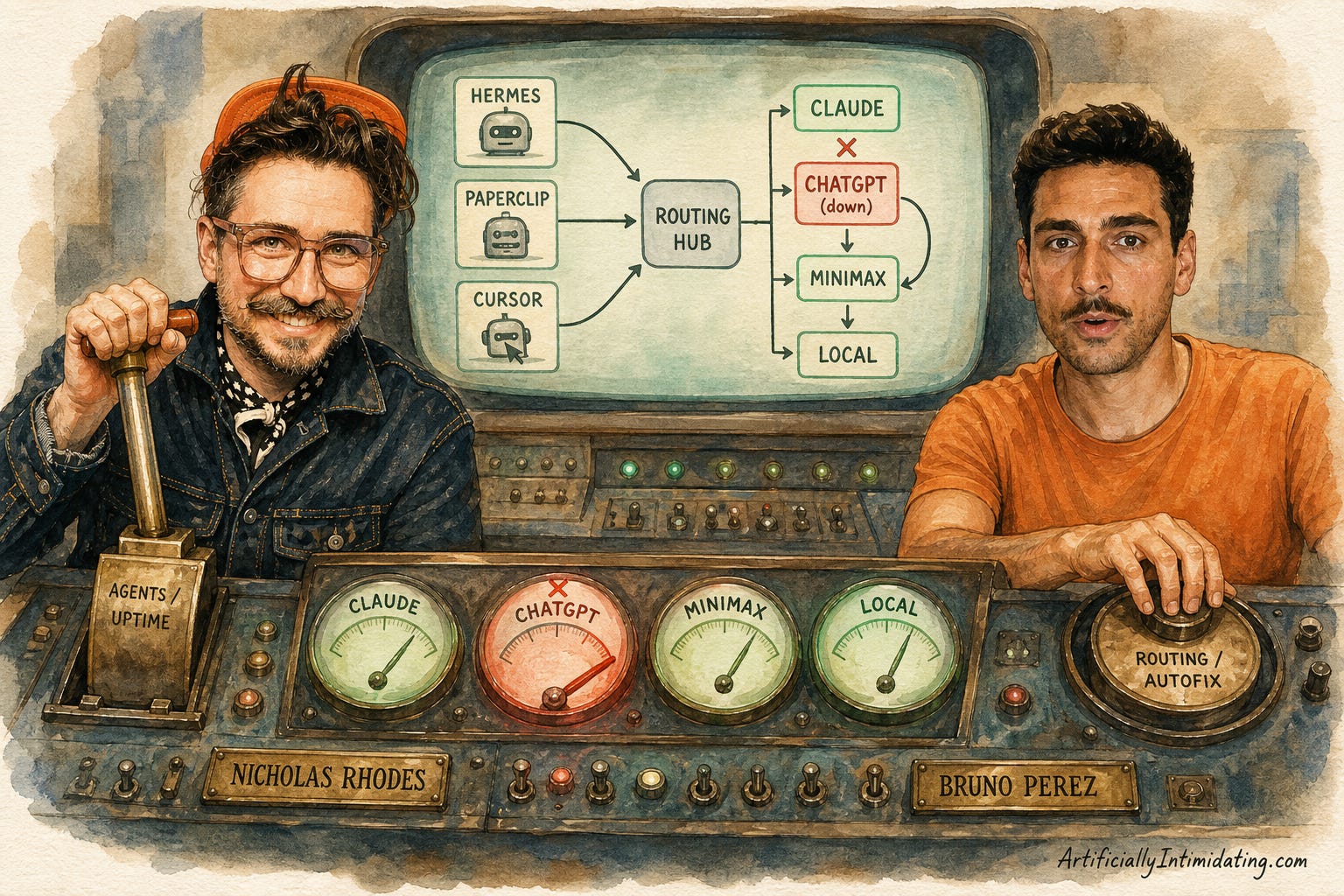
One honest note up front: Bruno and I recorded this on June 23, 2026, and Manifest has moved fast since. They’ve launched paid plans, and the self-healing feature we spend the back half of the conversation imagining out loud is now a shipping product called Autofix. I’ve flagged what changed inline so you’re hearing it with the right context.
ChatGPT went down again. If you build anything on top of it, you already know the feeling, because for those few hours your product went down too. You didn’t do anything wrong. A status page a thousand miles away turned red and took your Tuesday with it.
I run OutSnapped.com, an award-winning photo booth company for live events, and my company builds Pictor.pro, the iPad photo booth software that powers our booths and other photo booth companies’ events around the world. When a booth at a Hollywood premiere calls a model to render an image and the provider is having a moment, the guests don’t care whose fault it is. They’re standing there. The line is backing up. “OpenAI is investigating elevated error rates” is not a thing I can say into a microphone at somebody’s reception. So we’ve spent years building backup systems and queuing tech so a guest’s once-in-a-lifetime moment always goes off without a hitch.
That’s exactly why I wanted to sit down with Bruno Perez, co-founder and CEO of Manifest. I came in with one selfish question: how do we bring that same discipline we built for our events into our agentic workflows, so we’re never one bad night away from looking like idiots? What I got back was better than a workaround. It was a whole way of thinking about reliability that most people building with AI are ignoring, and a product that, as of this week, turns “my AI broke” into a line item you can pay to make go away.
The two guys who kept the logo
Here’s the part I didn’t expect to love as much as I did.
Bruno and his co-founder Sebastian never studied any of this. They taught themselves to code in their twenties, building WordPress sites for small businesses out of Grenoble, in the French Alps. That turned into an agency. The agency ran for fifteen years.
If you’ve ever run a service business, you already feel the trap they were in. “Doing service is hard,” Bruno told me, “because at some point you do service for others and you want to create your own products.” The problem is that the product was them. “People wanted us, not the company. So the logo had no meaning. It was us as people.”
I know that trap because I lived the same one. I started as a photographer. People wanted me, the guy, in the room. You can’t scale a guy. The pivot that changed my life was realizing an iPad on a stick at an event could capture the email addresses I needed to sell tickets to the next event, and that people would pay four or five times what they paid me as a photographer for the privilege. I had a product. I just had to notice it.
Bruno noticed his the same way. He and Sebastian built an internal backend tool to make their own work faster, open-sourced it because that’s who they are, and watched developers start using it. They named it Manifest. Then, last November, Anthropic shipped Claude Code, and the ground moved. “Our former tool, the trade-off was not good enough for that,” Bruno said. “So we decided to go with the flow and do something with AI.”
They went all in, got into Berkeley’s SkyDeck accelerator, spent six months in San Francisco, and launched the product that exists today just a few months ago, in March. They kept the name and the logo the whole way through, mostly, Bruno admits, because they were too busy to change it.
That’s the founder I want to hear from. Not the one promising to change your life. The one who watched the tool he’d bet on get obsoleted overnight and calmly rebuilt around the new reality.
What Manifest actually does
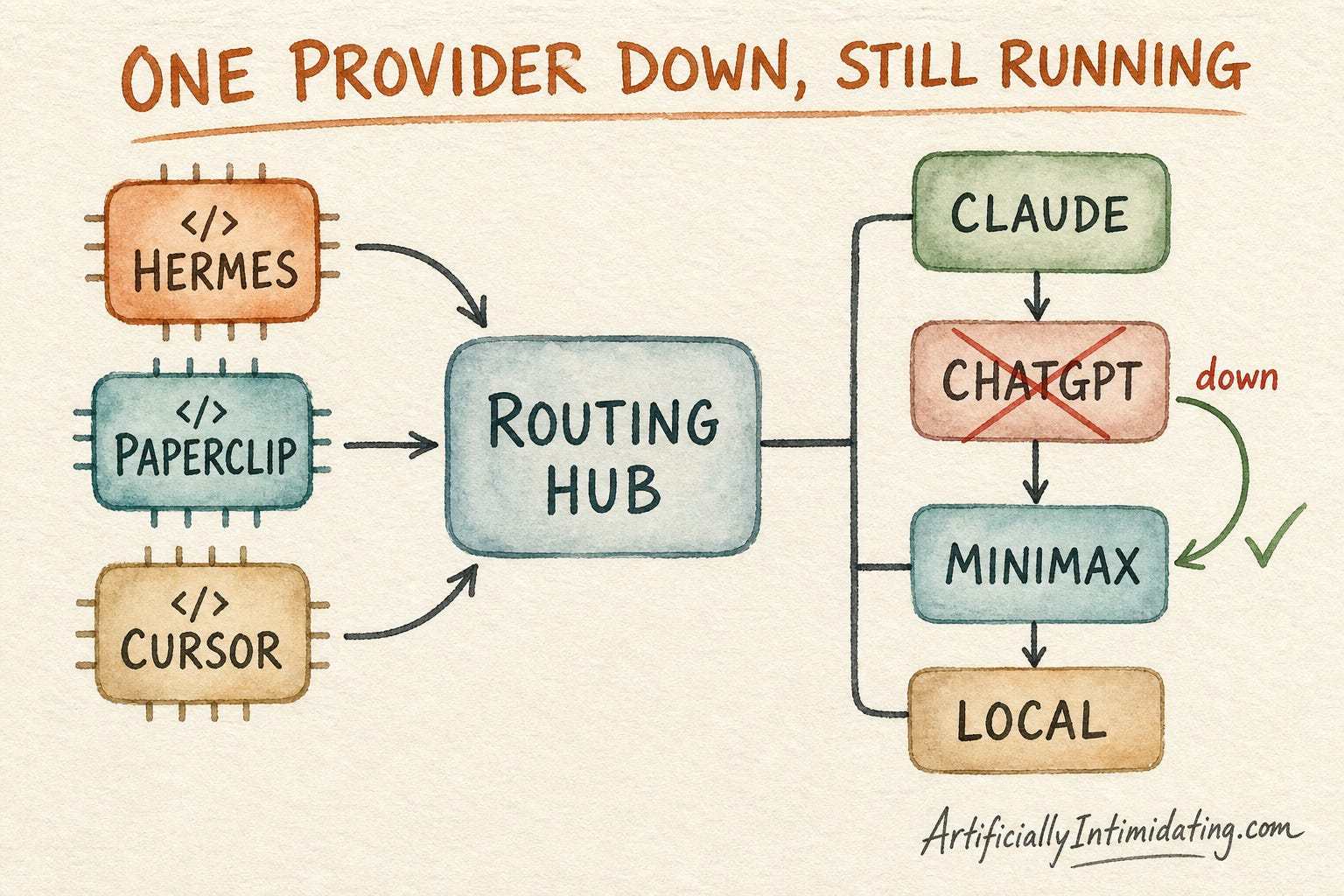
Strip away the category jargon and it’s simple. Manifest is an open-source LLM router that sits between your AI tools and every model provider you pay for. You connect your subscriptions (ChatGPT, Claude), your pay-per-token API keys, and even local models on one side, all through a single OpenAI-compatible endpoint, and your agents and apps on the other, Hermes, OpenClaw, OpenCode, Paperclip. Then it manages the traffic between them, with fallbacks and spend limits you control.
That description matters, because it’s tighter than the one I walked in with. When we recorded, a lot of the pitch was about “smart routing,” the system reading each request and auto-picking the cheapest model that could handle it. Bruno’s been honest since that this piece had real limits (it struggled outside English, missed edge cases, and drew complaints), and they’re winding it down. What’s left is the part that actually earns its keep every day. Three things:
It turns your pile of subscriptions into one coherent tap. Most of us are already paying for two or three AI subscriptions plus a couple of API keys, scattered across as many dashboards. Manifest stacks them behind a single endpoint so your tools draw from all of them without you wiring anything by hand.
It shows you the bill you’re not paying. Because Manifest knows the token price of every call, it shows what each request would have cost if you were paying per token instead of on a flat subscription. Bruno’s data backs up the thing Sam Altman said out loud: the average heavy user burns far more in tokens than their subscription covers. You are a very good deal for them and a very bad deal for yourself, and you never see the meter running.
And this is the one you came for: it fails over. You can stack up to five or six fallback models behind any request. A provider throws an error, or you hit the rate limit on a subscription, and the request doesn’t die. It rolls to the next model in the stack. If everything’s exhausted, you drop to a pay-per-token key at the bottom so the call still goes through. Your booth caption gets written. Your Tuesday survives.
If you’re just starting, the Cloud version sets up in a few clicks. The self-hosted version (free, MIT-licensed, runs local models) is the pick if you’ve got hard privacy or data-sovereignty limits and want everything on your own machine.
Want the full “operator’s playbook,” the exact fallback stack I run behind Hermes and Paperclip, how I stack multiple subscriptions so a rate limit never stops a job, and how I’m wiring in Autofix? That part’s for paid subscribers. It’s a few dollars a month, and it’s where I actually show my work.
The number that turned into a product
Here’s where the conversation stopped being a demo and became the reason I’m writing this.
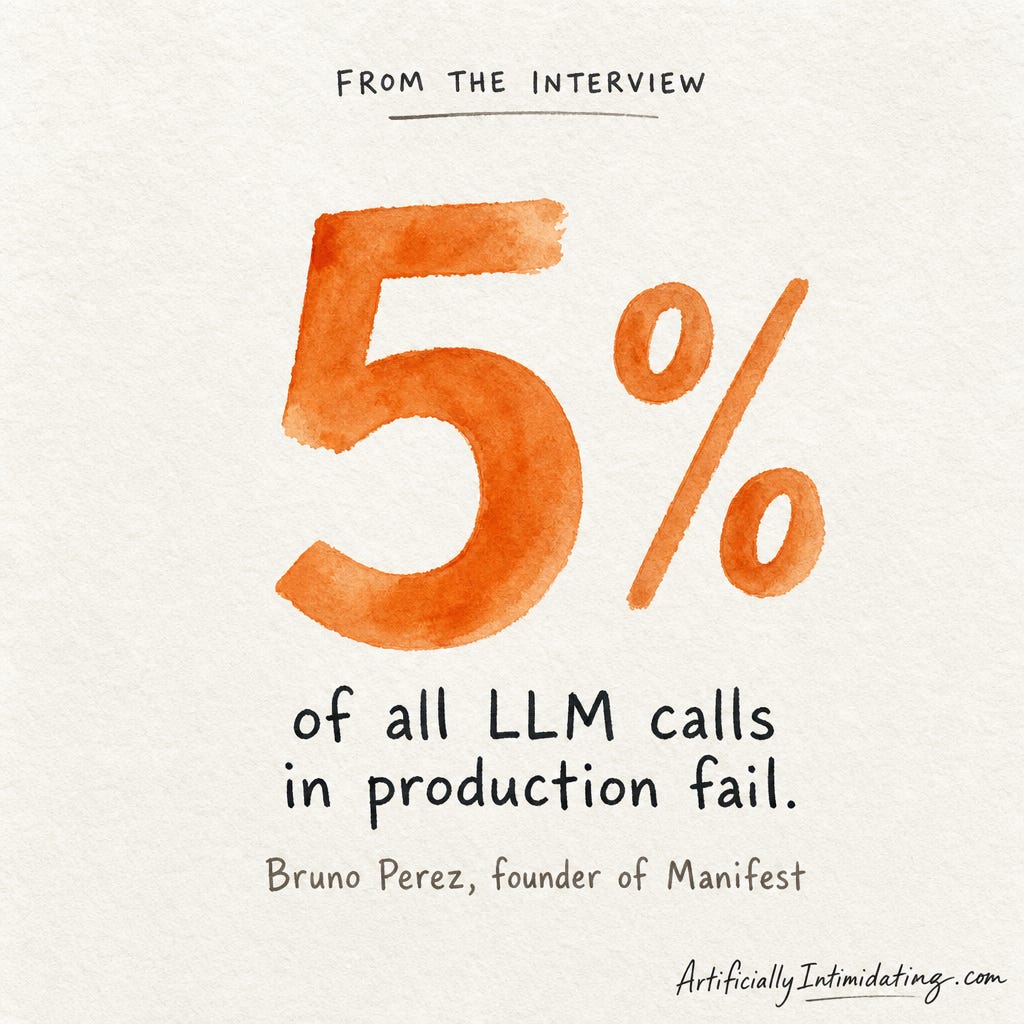
I asked Bruno where the company goes next. And he said the thing that reframed the whole interview. “Five percent of all LLM calls in production are an error,” he told me. Five percent. One in twenty. And most of them aren’t dramatic. They’re dumb. “A parameter that’s wrong because with one model you use max tokens and with the other one it’s max completion tokens.” Little mismatches between providers that break a call for no good reason.
His idea at the time: sell insurance on the request. Catch the failure, patch it, return a successful response, and turn an error into a success before your agent ever knows anything went wrong.
That was June. This week it has a name and a signup page. It’s called Auto-fix, and the tagline is exactly the pitch: “fix bad requests on the fly so your app has no downtime.” It catches the six boring ways calls die in production, a deprecated model ID, a parameter mismatch, a malformed message, a bad tool schema, a blown context window, a rate limit, patches the call in real time, replays it, and then tells you what it fixed so you can clean up the underlying code later. Your agent gets a usable answer instead of a 500.
Sit with that, because it’s the actual thesis of this whole thing. We spent two years being sold the magic of AI. Almost nobody is selling the plumbing that keeps the magic from silently breaking one call in twenty. The founders worth listening to right now are the ones building the boring, load-bearing layer underneath the demo. (I’ve written before about why silent failures are the thing that’ll actually bite you, and this interview is the same argument told by someone shipping the fix.)
The part where a good product started charging
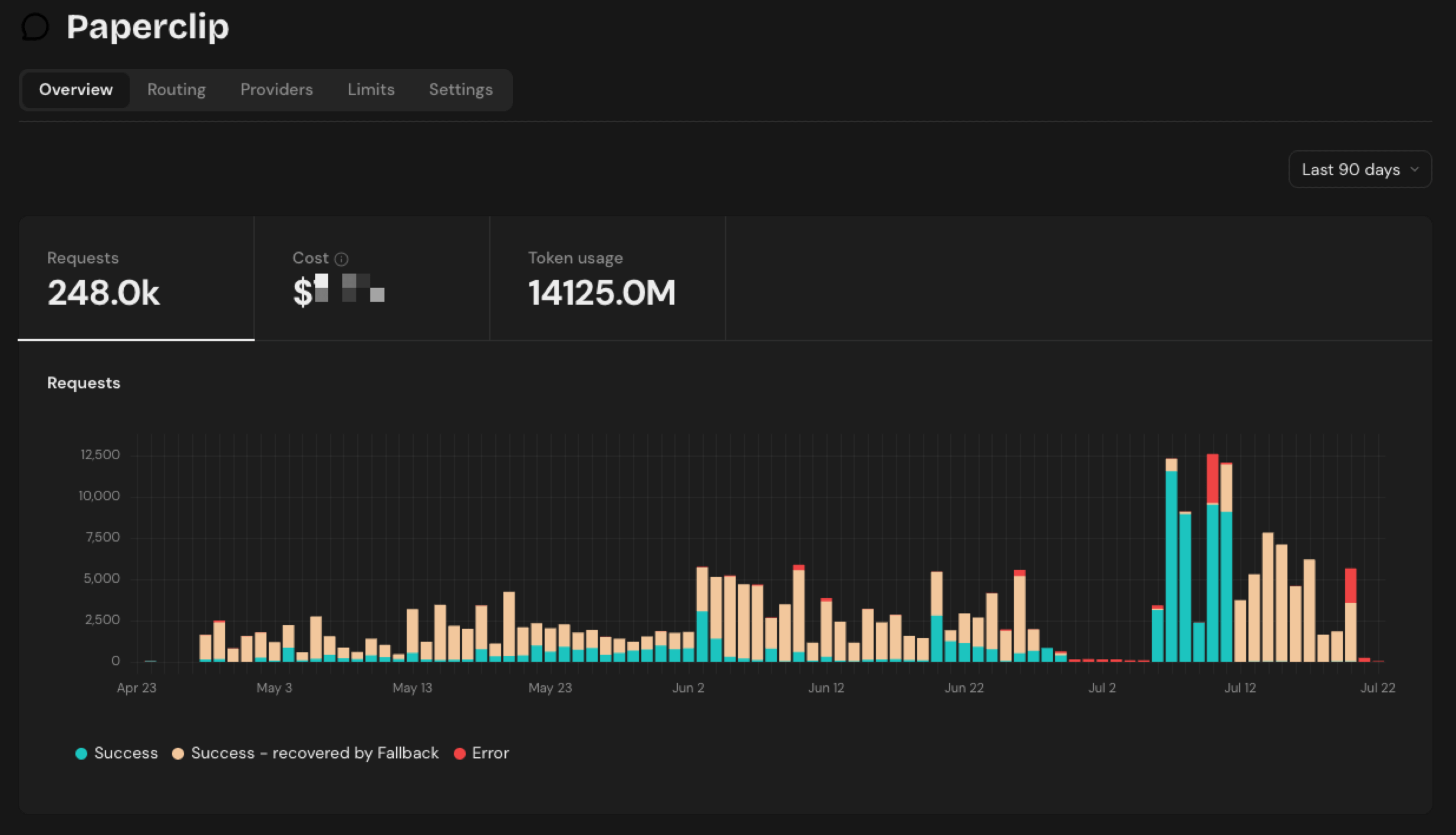
One more update since we recorded, and I’m glad about this one. In June, Manifest was completely free and monetization was a “someday” answer. On July 8 they launched paid plans: a Pro tier at nineteen dollars a month for unlimited routed requests and a year of dashboard history. The free tier keeps every feature (capped at ten thousand requests a month), and self-hosted stays free forever under an open-source license. Nothing got yanked behind a paywall.
I told Bruno on the record how I feel about this: good products deserve to be profitable. I put my money where my mouth is and I’m a paying Pro subscriber now, because this thing saves me more than nineteen dollars of headache in a normal week. If you’ve ever woken up to a job that didn’t finish because you ran out of tokens at 3am, you already know the math.
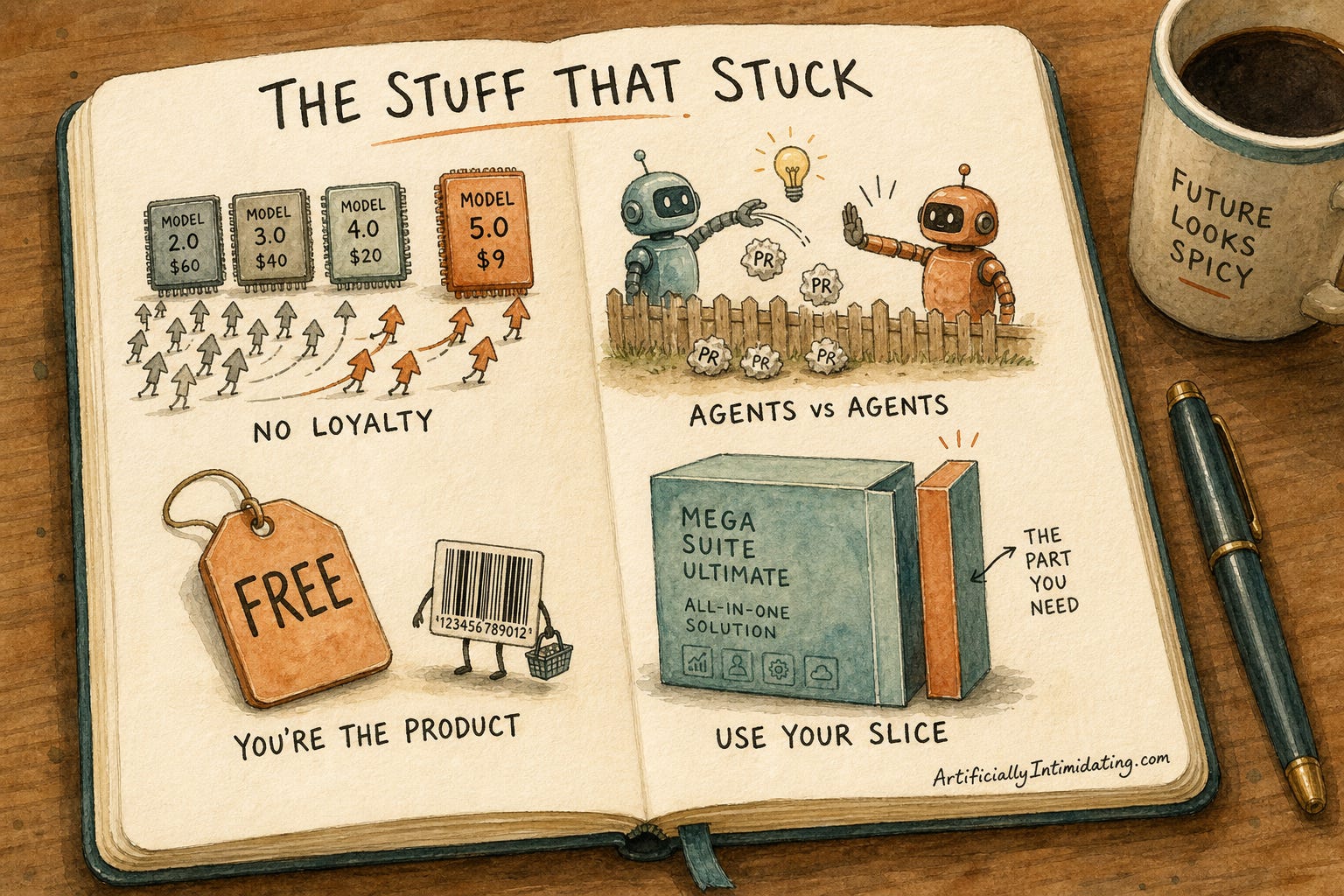
The stuff that stuck with me
A few more things from the conversation that I keep turning over:
Nobody’s loyal to a model anymore. Manifest sees the traffic in real time, and when a new model drops, whole chunks of usage just migrate. “Most of the people do not stick to a model,” Bruno said. Provider loyalty is a fiction. Your setup should assume it.
Agents are now spamming other people’s open-source projects, and the defense is more agents. Manifest runs a Hermes agent that reads every feature request and bug report on their Discord and hands the team a report on what to build next. Meanwhile, low-effort bots file junk pull requests to their repo all day. “At the end of the day they use agents to create those contributions and we use agents to turn them off,” Bruno said. “We’re all burning electricity for no reason.” I told him that triage agent was a better product than half the startups I’ve seen. He didn’t disagree.
“If you’re not paying, you’re the product” came back around. We got into the free-model repos Manifest maintains, and the same law from the early web still holds. Free inference usually means your data trains someone’s next model. Sometimes that’s fine. Sometimes it very much isn’t. Know which call you’re making.
Build the slice of the tool you actually use. Bruno’s team got a two-thousand-dollar bill from PostHog, their analytics vendor and rebuilt the ten percent of it they needed in-house, with an agent generating the exact views and analytics they wanted on demand. I’ve been threatening to do the same thing to HubSpot for a year. He gave me the permission slip and a little kick in the butt to do it.
Where to find it
Manifest is at manifest.build (Bruno swears his French accent won’t get in the way of you finding it). The code lives on GitHub at mnfst/manifest, fully open source, Cloud or self-hosted. The new Auto-fix early access and the paid plans are both worth a look, and there’s a Discord linked from the repo where the team is genuinely responsive.
Everything we mentioned in this episode
Manifest: site | docs | GitHub | Autofix (early access) | paid plans | their free-LLM-API list
Agents and harnesses we talked about: Hermes | Paperclip | OpenClaw | OpenCode | Nanobot | Craft | Cursor | Claude Code (Anthropic)
Bruno’s open-source picks: Paseo (orchestrate coding agents from anywhere) | Ghostty (the terminal he switched to) | Ollama and LM Studio (running models locally)
Also came up: Orgo.ai (cloud computers for AI agents) | Chatwoot (the open-source support tool we moved Pictor, our iPad photo booth software, to)
This was one of our pilot episodes, us figuring out what this show even is, and it’s the first one that made me feel like the format has a spine: real operators, walking through the switches and dials they actually rely on to keep AI working when the providers don’t. Bruno was a perfect guest for that.
Full video and audio are above. If you’ve ever run out of tokens in your sleep, this one’s for you.
Listen or watch: pod.link/6785740580
The operator’s playbook
Everything above is the story. This is the part I actually get asked about in the DMs: the setup. Here’s exactly how I have Manifest wired so a provider going down never costs me a night’s work. Steal any of it.
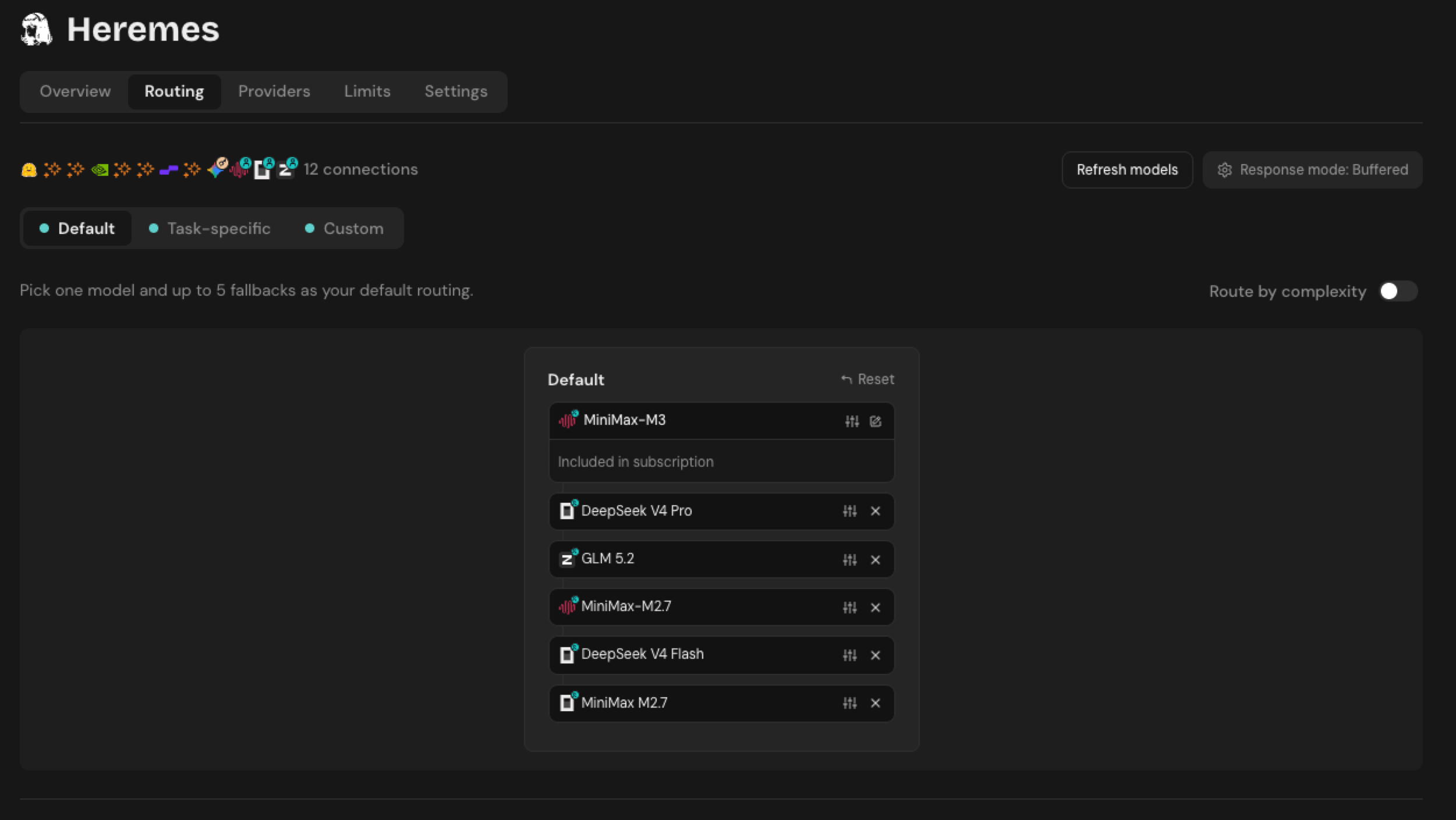
The stack. All my agents point at one Manifest endpoint instead of at the providers directly. Hermes and Paperclip do the autonomous work, Cursor and Claude Code the hands-on fixing. One key, one base URL, and none of them know or care which model is actually answering.
My current fallback order. My stack, top to bottom: MiniMax-M3, DeepSeek v4 Pro, GLM 5.2, MiniMax-M2.7m DeepSeek V4 Flash, MiniMax M2.7, with an Anthropic pay-per-token API key sitting at the very bottom. The logic: best model first, cheaper models next, and a metered key as the floor so a call never hard-fails. It just gets a few cents more expensive for that one request instead of dying.
Stacking subscriptions. I put MiniMax, OpenAI, OpenCode Go, and Z.ai subscriptions behind the same stack, so when one hits its rate limit the next one picks up mid-job. This is the single change that stopped me waking up to work that quit at 3am.
Spend limits. On top of my subscriptions, I cap spend at $250/day so a runaway agent loop can’t hand me a surprise bill. Set this before you set anything else.
What I route where. I keep this deliberately dumb. Manifest is retiring the old per-complexity routing tiers. I’d rather let the fallback chain carry the load than micro-tune which frontier model gets which task. Simple and predictable beats clever and fragile.
The one gap. Vision work still goes straight to Gemini & OpenAI and image generation to our tool MCPMediaEngine.com outside Manifest, since vision routing and image creation are not live yet within Manifest. Bruno says multimodal is their number-one request, so when it ships vision skills will likely fold in too.
Wiring in Autofix. Auto-fix is the new piece I’m excited to add in: the layer that catches the boring failures (a changed model ID, the max_tokens vs max_completion_tokens mismatch, a blown context window) and patches the call instead of letting my agent choke on a 500. If you run agents against real work, get on the early access list now.
If you set up only two things from this list, make them the fallback chain and the spend cap. Those two alone turn “my AI broke and it cost me” into something you stop thinking about.


