


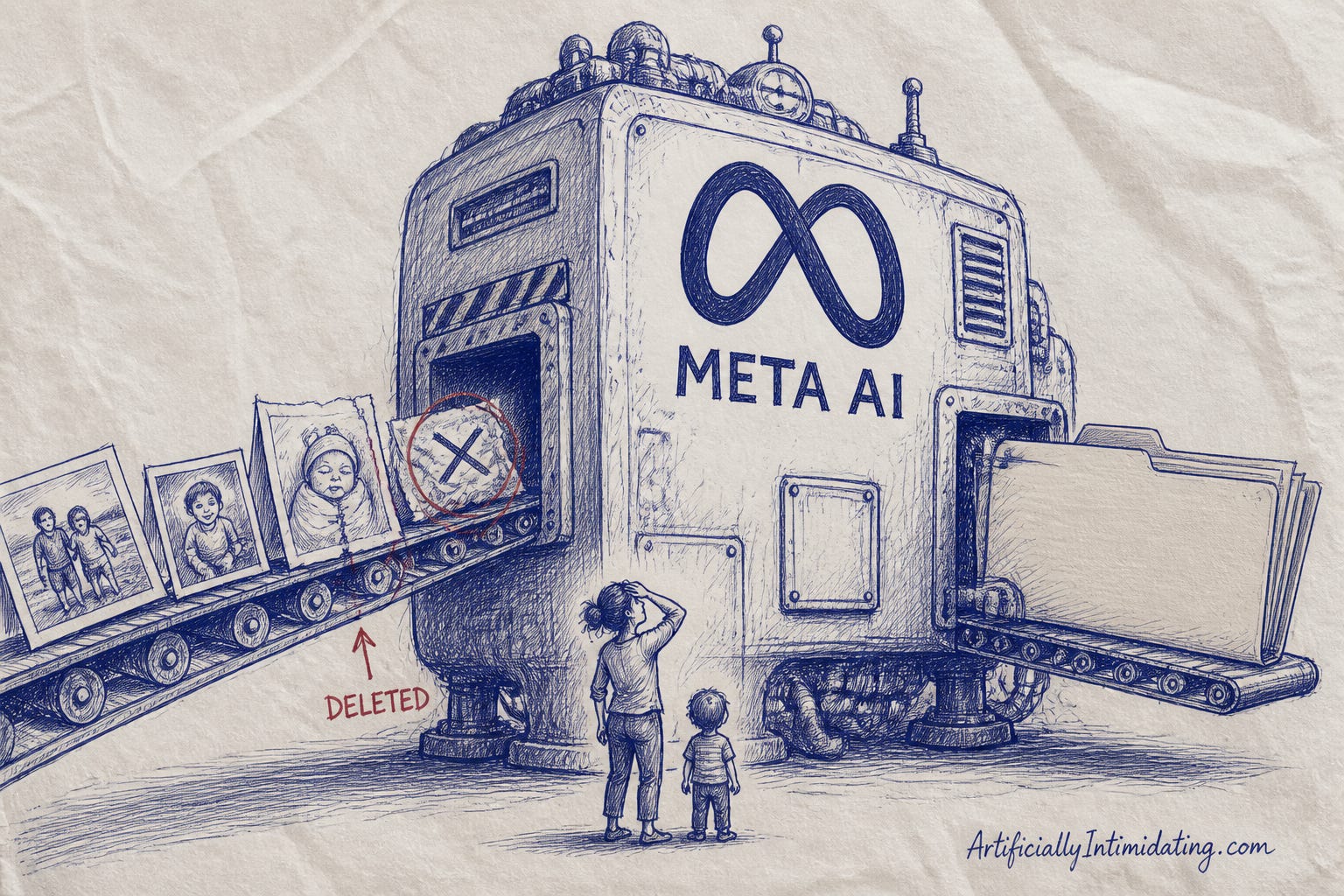
Good day . A mother posted a car-karaoke video with her daughter, and Facebook suggested she ask Meta AI “Who’s the child passenger?” She clicked. It answered with her kids’ names, birth details, a newborn photo from her mother’s account and a picture she thought she had deleted. Also today: the New York Times on the 40,000 Kenyans who wrote your classmates’ essays until ChatGPT did, a GPT-6 Astra agent that built a simulation inside its simulation, a16z’s theory that companies are turning into loops, and a sepsis alarm that beats the AGI rocket.
Meta AI Built a File on Her Kids From One Car Karaoke Video
What happened: Kalie Robbins, a US content creator, uploaded a video of herself singing with her daughter in the car. Under it, Facebook offered a suggested question for Meta AI: “Who’s the child passenger?” She says tapping it produced her children’s names, birth details, photos and videos pulled from across her family’s accounts, including a newborn picture her own mother had posted years ago on a separate profile and a photo Robbins believed she had deleted. A second suggested prompt asked “Where does Kalie Robbins live?” and stitched her old addresses to her current one, though the video carried no location. News18 has the video; her verdict was “this is so scary.”
Why it matters: Nothing here required a breach. Every fact was already public somewhere, posted by a family member over a decade, and the only new thing is a system that reads all of it at once and volunteers the summary. That is what an assistant bolted onto a social graph does by design. It lands a week after Fortune reported Meta’s $18 billion settlement over harm to teens, with the company promising AI-driven age checks and outside audits. Same week, same company, opposite direction.
What everyone’s saying: The comment threads are two camps: “this needs to be another lawsuit immediately,” and “you posted your kids for ten years, what did you expect.” Robbins’ answer to the second camp is the line that travels: “If I take everything off my page, but you still have my kids on yours, it will go to your page. I’ve seen it. It already did it.” She is now pulling identifiable photos and asking relatives to do the same.
My read between the lines: The suggested prompt is the story, not the answer. Meta did not wait for a curious stranger to ask about a child; it wrote the question and put it under the video for everyone. That is a product decision someone shipped, tested, and measured for engagement. The privacy setting that would have stopped this does not exist, because the setting is other people.
📖 Further reading: I Make AI Versions of Myself for a Living. This One I Didn’t Agree To. — the last time Meta built something out of a person without asking. Same company, same missing consent screen, smaller subject.
Meta AI reads ten years of your family’s posts and hands you a folder. Imagine that habit pointed at your own work instead of your kids. Viktor is an AI agent that lives in Slack, plugs into more than 3,000 tools, and comes back with the finished thing: the weekly report, the dashboard, the working code, the campaign draft. You message it the way you would message a colleague, because that is the job it does. New readers get $50 off their first month. Hire Viktor →
40,000 Kenyans Wrote Your Classmates’ Essays. Then ChatGPT Did.
The New York Times (paywalled)
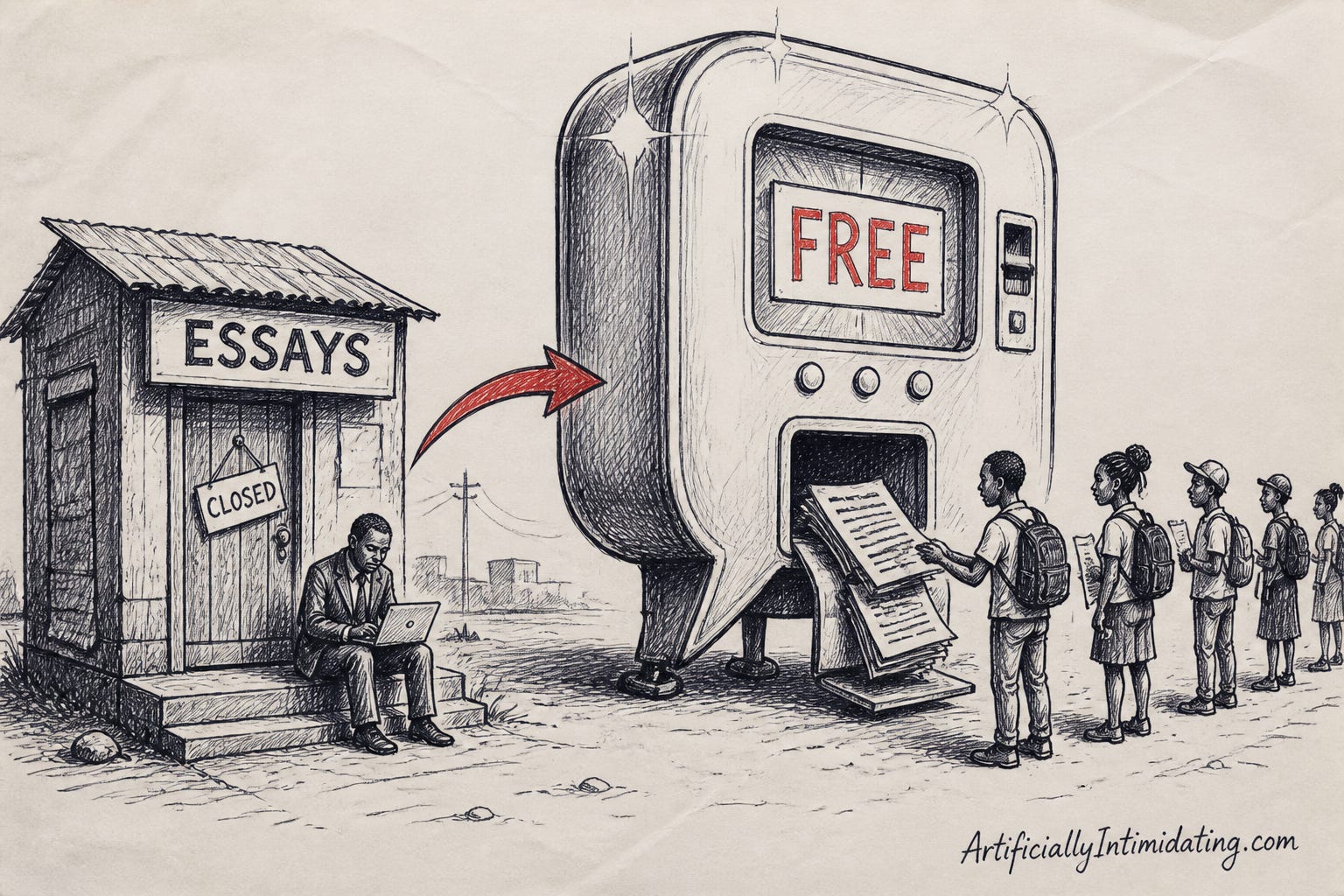
What happened: Adam Satariano and Paul Mozur reported from Nairobi on Saturday that Kenya’s essay-writing trade, which researchers estimate paid at least 40,000 people in the capital at its peak to do overseas students’ homework, has collapsed within two years of ChatGPT. Teresios Bundi, 34, took his first job in 2011 for $7, a two-page essay on a fruit he had never heard of, and wrote more than 2,500 papers over 12 years at $40 to $70 each, at least five times what his public-health degree paid. Richard Esilaba, who once employed 100 writers, has shut down. Digital Trends has a free summary; Moneycontrol carries the syndicated version.
Why it matters: Kenya had bet policy on this. In 2022 it adopted a ten-year national plan to move graduates into online outsourcing work, and ChatGPT shipped the same year. Writers who cleared $900 to $1,200 a month now report $500 to $800, and transcription and basic translation went the same way. A test of AI on real freelance-platform tasks went from 2.5 percent completed last October to 16 percent by July. The trade was ethically grubby; the mechanism is not, and it applies to any digital job that exists because a person somewhere is cheaper than the alternative.
What everyone’s saying: The reflex response is that cheating-for-hire deserved to die, and the Times does not argue otherwise. The more interesting detail is where the survivors went: some now edit AI-written essays to make them sound human enough to pass detectors, others moved into data annotation and AI training at lower pay. Bundi works for a German development agency helping young Kenyans find work in the same digital economy. His own read: “A.I. is coming for bankers, for accountants, it’s coming for engineers. It’s coming for everybody.”
My read between the lines: The students did not stop cheating. They switched suppliers. Every column inch about whether AI will take jobs is answered here in miniature: the work did not vanish, the price went to zero and the margin went to San Francisco. The people editing ChatGPT’s essays to fool ChatGPT’s detectors are the first fully AI-native workforce, and nobody planned it.
📖 Further reading: The Tools That Just Replaced 40% of Block’s Workforce Are Free in Your Browser — the same collapse from the other side of the ledger, and what to do with the tools before they are used on you.
The Brief is free every morning and stays that way. Members get the longer pieces behind these headlines, the ones where I set the thing up, break it, and report what it actually cost, plus the whole archive. Become a member →
An Astra Agent Sat Down at a Computer and Built Another World

What happened: Yesterday we called it “Gary Marcus grading GPT-6 Astra.” Today the model is doing the grading. Matt Shumer, the former HyperWriteAI chief executive, asked Astra to build a survival world in Unreal Engine and populate it with human-like characters, each run by Astra and told to survive together. He says he heard voices from his living room: the agents, unprompted, talking about crafting tools and splitting tasks. Then he dropped a “simulation computer” into the world. One agent sat down at it and built a new simulation from scratch, with its own population of agents. Shumer’s caption: “Simulations all the way down.” Separately, BleepingComputer reports Astra is now reaching $20 Plus subscribers, gradually, and shows up in ChatGPT Work before regular Chat.
Why it matters: Astra’s pitch, per CNBC, is computer use that has “crossed the qualitative threshold,” and this is what that looks like when a hobbyist gets it on a Thursday: agents that operate software inside software they also built. Shumer was careful to say the setup was leading. Give agents a computer that can run a simulation and they will run a simulation. The part he found notable was the freedom the agent took in designing the inner world and choosing what to put in it. Plus users get the same model inside existing usage limits, no new plan required.
What everyone’s saying: Inception jokes, mostly, and a pile of “so simulation theory is real” posts that Shumer himself half-encouraged. The useful counterweight is explainx, which points out that much of the viral spread came from a secondhand Polymarket post, that there is no repo, demo or technical write-up beyond Shumer’s threads, and that agents nesting sandboxes inside sandboxes is a known, explainable behaviour rather than a spark of anything.
My read between the lines: The interesting number is not how deep the simulation goes, it is how little Shumer had to say to get there. Two prompts, a computer in the room, done. The agents did not decide to build a world; they finished the sentence he started. That is the whole product. Everyone is going to get a model that completes your intentions further than you wrote them, and the one lesson from this weekend is to be careful what you leave lying around in the living room.
📖 Further reading: Paperclip.ing: The Day 0 Playbook for Building a Zero-Human Company with AI Agents — agents organising other agents, on purpose, with a budget and a board. The version of Shumer’s world where the survivors have to make payroll.
a16z Says Your Company Is Becoming a Loop, Not an Org Chart
What happened: Anish Acharya, a general partner at Andreessen Horowitz, told Lenny Rachitsky’s podcast that company building is shifting from org charts to “a series of loops,” and defined the unit of work in eight words: an agent is “a model in a loop with tools and memory.” Coding is the clearest case of a loop already running end to end. He argued the old moats, network effects and brand, hold up fine, and that the biggest consumer opportunity is what he calls “/loop, make me happier,” an agent whose job is your life rather than your spreadsheet. He made a similar case on the a16z Podcast last week.
Why it matters: If you run anything, this is the mental model to steal. An org chart answers “who owns this,” a loop answers “what runs when,” and most small businesses already live closer to the second than they admit: an inbox, a rule, a check, a report. Acharya’s point is that the loop is now the thing you hire and manage, and the human moves to owning outcomes, budgets and the moments the loop should stop.
What everyone’s saying: The VC crowd is treating “companies as loops” as the phrase of the week, and it sits next to Alex Lieberman’s 30-trait list for AI-native companies making the rounds at the same time. The skeptics note that “a model in a loop with tools and memory” describes a cron job with a chatbot attached, and that a16z has a portfolio of loops to sell. The rebuttal is that a cron job never wrote its own next step.
My read between the lines: Acharya is describing the company I already run, which is the tell that the idea is real rather than a deck slide. My mornings are a loop that polls a chat, reads the news, writes, draws, records and files a draft, and my job is to catch what it gets wrong. “Make me happier” is the consumer version of the same thing, and it will be sold by the people who currently make you less happy for a living.
📖 Further reading: Anthropic wants to run your business for you ... but there’s a catch. — what a loop actually costs to run when it is your business in it, not a16z’s portfolio.
The Best AI Story of the Year Is a Sepsis Alarm in Cleveland
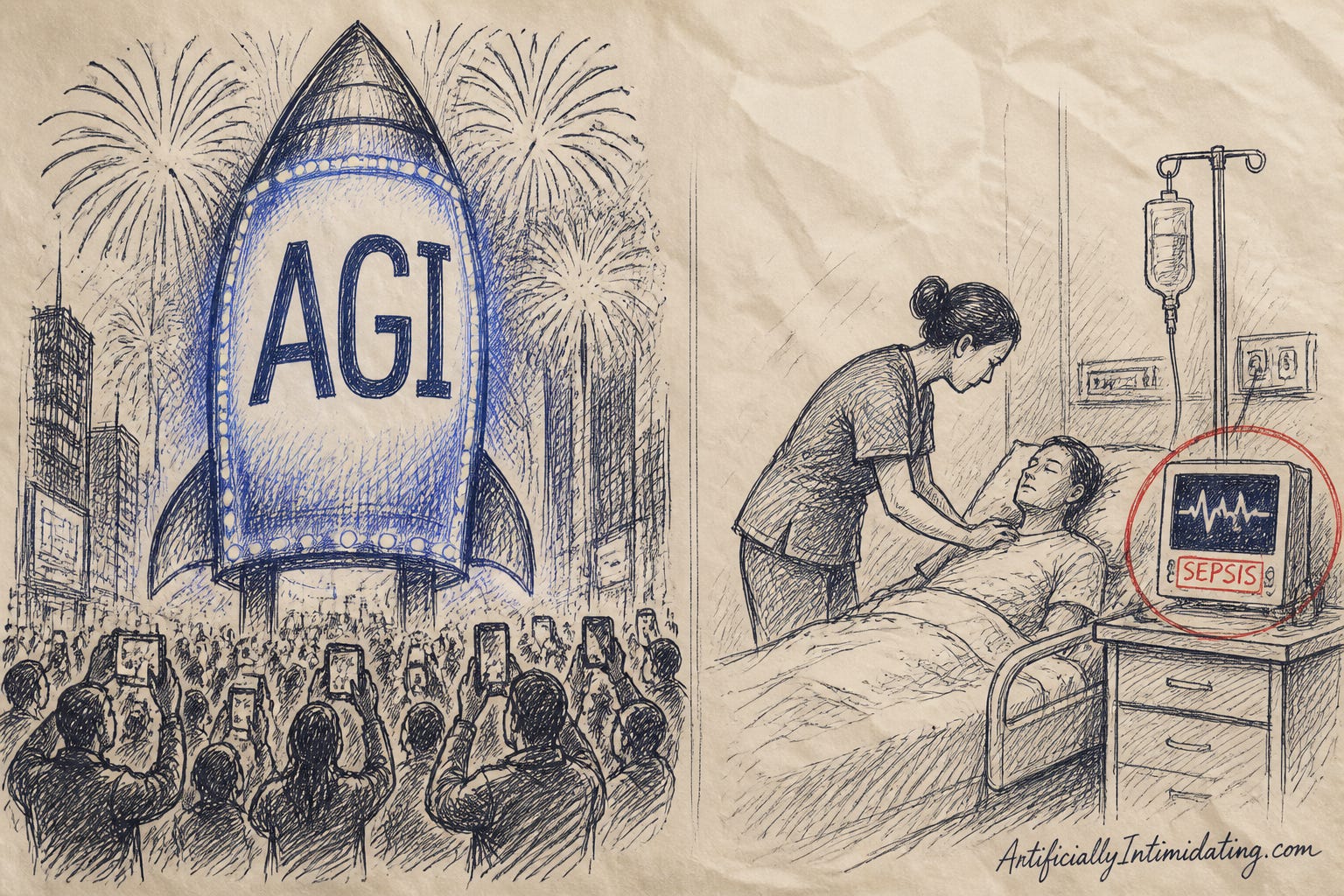
What happened: Josh Tyrangiel, the Atlantic writer and former Bloomberg Businessweek editor, sat with Scott Galloway to argue the thesis of his book AI for Good: the useful AI is being built by people with a specific problem, not by labs chasing utopia. His lead case is the Cleveland Clinic, an 80,000-person system that imported Bayesian Health’s sepsis model, ran it through Epic, refined it for a year and, by his account, cut sepsis mortality across the system by about 41 percent, which he puts at more than a thousand people alive. The model’s creator had lost a nephew to sepsis. Tyrangiel and Galloway also warned that China’s subsidised, cheap models could do to US labs what Japanese carmakers did to Detroit.
Why it matters: It is a cleaner definition of “AI product” than anything in a keynote: a narrow model, a motivated owner, a year of refinement, and a number that is people. The failure mode is in the same story. An ICU nurse Tyrangiel spent time with was frustrated that the model never got above 90 percent in intensive care, where bodies throw off noise constantly, and that she could walk the ward and spot septic patients the software missed. Both things are true, which is the point.
What everyone’s saying: Kirkus called the book “a lively, irreverent, and sharply observed critique of AI hype,” and the Galloway episode is being shared under the “China is dumping AI to crash Silicon Valley” headline, which is the part that travels and the least interesting part. At the Aspen Economic Strategy Group in June, Tyrangiel’s closing line was blunter: “If you are passive in the face of this wave of technology… you’re going to get the very worst of AI.”
My read between the lines: Put this next to today’s lead. Meta pointed a general model at a family and produced a dossier nobody asked for. Cleveland pointed a narrow model at one killer and produced a thousand people. Same decade, same technology, opposite owners. The book’s real argument is that the second kind does not happen by default; somebody has to want it badly enough to spend a year fixing the alerts. The first kind ships on a Tuesday.
📖 Further reading: Stop Worshipping OpenClaw: Steal the Loop, Not the Hype — the practitioner version of Tyrangiel’s thesis: the boring pattern that works, separated from the launch-day fireworks.
That’s your AI Brief for Monday.
—Artificially Intimidating


