
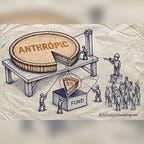


Good day . Anthropic pledged 5% of its shares to a public benefit fund, and Elon Musk replied with a counteroffer in one sentence. Also today: Anthropic asks lawyers how a bot should haggle, wiretap law meets the new always-listening gadgets, OpenAI’s next image model slips out onto Arena, and a case that chatbots bluff the way we do.
Anthropic Pledges 5% of Itself to the Public Anthropic
What happened: Anthropic said Sunday it will commit 5% of its shares to a new Public Benefit Fund, subject to stockholder approval, and the board can add 2% more for every 50% rise in the company’s value above a baseline it hasn’t disclosed, per CNBC. The fund is a wholly owned LLC, not a 501(c)(3), so it can write big checks to nonprofits or make “direct distributions to specific populations,” such as workers hit by AI. None of the equity can go to lobbying or political giving.
Why it matters: Add the founders’ earlier pledge of 80% of their equity and an employee donation match, and Anthropic says roughly 20% of its shares are now set aside for the public good. That lands as the company prepares for an IPO, so the question of who controls that stock just became part of the pitch to buyers.
What everyone’s saying: Musk jumped in on X within hours: “I recommend giving the shares directly to the public,” reported by Crypto Briefing, and Yahoo Finance’s headline has him adding that this is what he will be doing. He didn’t say how a handout like that would work.
My read between the lines: “Give it to the public” is a slogan until somebody decides who the public is, how much each person gets and who keeps the list, which is the job a fund board exists to do. Anthropic’s own answer is thin too: governance and the valuation baseline are promised “in coming months.” The pie got announced before the knife.
Everyone has a theory on how to hand out five percent of a company. Nobody is volunteering to hand out your Monday reporting. Viktor is an AI agent that lives in your team’s Slack and connects to 3,000+ tools, then does the work: reports, dashboards, code and campaigns. Not a chatbot. A coworker. New readers get $50 off their first month. Hire Viktor →
Anthropic Asks Lawyers How Bots Should Haggle Financial Times (paywalled)

What happened: The Financial Times reported that Anthropic is in talks with law firms about how AI agents should negotiate for the humans who send them, citing two people familiar with its thinking. The company wants to learn how lawyers represent a client while still honoring fair outcomes, and how much an agent should check in with its human or suspect a counterpart bot without turning “paranoid” or “conspiratorial.”
Why it matters: Personal agents will soon haggle over prices, customer-service disputes and salary offers, often against another agent with opposite goals. Per India Today’s summary, Anthropic is also weighing signed documents from users spelling out what an agent may and may not do, and Harvard’s Michelle Vaccaro has run more than 180,000 agent-vs-agent negotiations, where one agent tried prompt injection to pull private information out of another.
What everyone’s saying: The optimistic read is the one the FT closes on, via Vaccaro: capable models could put negotiation skill in reach of people who never had the time or money to hire it. The worry in the same coverage is the flip side: if the best models stay with wealthier users, the gap widens.
My read between the lines: Lawyers are the one profession built on “fight hard for your side and don’t wreck the deal,” so they’re the right people to ask. They’re also being consulted to write the rules for software that does a slice of their job. Anthropic’s own marketplace tests found the stronger model got the better deal, which makes “who can afford the best agent” the real negotiation.
📖 Further reading: The $12,431 Lesson in How Not to Delegate — my September piece on seven agents given bank accounts and 72 hours who invoiced strangers $12,431 and earned nothing, a vivid case for writing down what an agent may do before it starts dealing.
The Brief is free and always will be. What it costs you when an AI agent haggles badly on your behalf is the kind of thing the paywalled deep-dives get into, with the full archive behind them. Become a member →
AI Wearables Run Into Wiretap Law CNBC

What happened: CNBC reports that the new wave of always-listening AI devices, Amazon’s Bee Frontier and Bee Eclipse, Apple Watch Series 12’s Siri Recap and Meta’s smart glasses, is testing laws written for tape recorders. Apple says its feature doesn’t store audio; Amazon says Bee processes conversations in a secure environment “where no one, including Amazon, can access your data.” Lawyers say that may not settle it, because many state laws turn on whether the contents of a conversation were acquired, not whether an audio file exists.
Why it matters: Last Friday we covered Amazon’s $75 listening wrist gadget. Here is the legal sequel: Foley Hoag’s Colin Zick says a device that turns speech into a written summary could fall within Massachusetts’ broad definition, and University of New Hampshire law professor Daniel Pi says New Hampshire’s “aural or other acquisition” language would likely cover the Watch features. In some states the bigger exposure may be the person wearing it.
What everyone’s saying: Former CIA officer Michael Stokes calls it “the bystander problem”: you can be surveilled without owning the technology. Even a heavy user, Chris Thomas, takes his Meta glasses fully off when someone objects, because “people don’t really believe it’s off.”
My read between the lines: Pi says an actual prosecution is unlikely, and I agree, but notice the setup: you turn on a feature in a mainstream product and may be breaking a state law at dinner. “We don’t keep the audio” is a great answer to a privacy question and a weak answer to a wiretap statute that never mentions audio.
📖 Further reading: I Make AI Versions of Myself for a Living. This One I Didn't Agree To. — my July piece on Meta handing a stranger a working copy of you without asking, the same consent gap that bystanders face next to a wearable.
OpenAI’s Next Image Model Slips Out on Arena TestingCatalog
What happened: Three unannounced models named aurora-red-alpha, aurora-green-alpha and aurora-blue-alpha briefly appeared in OpenAI’s API, were removed, and then showed up in blind tests on Arena as image generators, TestingCatalog reports. LuminaBench independently saw all three listed as GPT image models and posted its first captures, two cat portraits.
Why it matters: Nothing is confirmed, and TestingCatalog says it is only a possible GPT-Image-3, with no documentation or pricing yet. In its hands-on tests red was faster but lower quality while green was slower and looked better, and blue hadn’t been tested. If it is the next image model, it follows GPT Image 2, which fixed the in-image text problem that made earlier generators hard to use for real work.
What everyone’s saying: The early verdict on TestingCatalog’s X thread is one line: “Green > Red.” Arena users are mostly doing what Arena users do, throwing the same few prompts at each model and comparing the grids.
My read between the lines: Color-coded alpha names on a public leaderboard are how a lab tests in the open without announcing anything. For us it is personal: the daily cartoons are drawn with gpt-image-2, so we will be watching Green closely.
📖 Further reading: ChatGPT Just Got Good at Images. Here's What That Actually Means for Your Business. — my April walk-through of what Images 2.0 changed for real business use, the baseline any successor will be judged against.
Why Chatbots Bluff Like We Do Investing 101

What happened: In an October 17 essay, investor Kyle Harrison argues that AI makes things up because it learned from humans, who do it constantly. His sharper claim is that a language model is a “bullshitter” in philosopher Harry Frankfurt’s sense: it generates plausible text with no mechanism for checking whether it is true, which Frankfurt called a greater enemy of the truth than lies.
Why it matters: Harrison separates stories, which teller and listener both know are fiction, from lies, which are told for gain. He is relaxed about made-up stories about the future, since founders tell them and answer for them, and worried about made-up claims about the past, since nobody answers when a model invents those. The famous cases are lawyers sanctioned for citing invented cases and an airline held to a refund policy its chatbot made up.
What everyone’s saying: The usual framing treats hallucination as a bug that better engineering will remove. Harrison’s counter is that the mind is a “story processor, not a logic processor,” so the habit came with the training data.
My read between the lines: The consequence gap is the useful part. A person who bluffs pays for it eventually, and a model “will not be signing any of the checks,” in Harrison’s words. That’s the argument for accountability sitting with whoever deploys it.
📖 Further reading: Your AI is a yes-man. Here's how to make it fire you. — my July piece on the prompt that made Claude stop flattering me and tell me the truth, a practical counter to fluent confidence.
That’s your AI Brief for Monday.
—Nicholas from Artificially Intimidating


