


Good day . Elon Musk asked Grok to buy Lego, then posted the receipt. Plus Meta’s Muse against OpenAI’s Dot, a free Microsoft Office rival built with Claude, an AI team that trains itself, and the Sam Altman movie. Let’s get into it.
Musk Posts His Own Lego Receipt Ynetnews
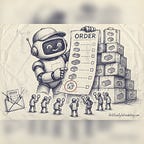
What happened: On Sunday, Elon Musk showed off Grok Bot’s shopping skills by posting screenshots of a finished Lego order. “I just asked Grok @Bot to research the most fun Lego Star Wars kits for young kids and order them. As easy as that,” he wrote, per Raw Story. The $241.34 order for five sets also showed a shipping address in Austin, a separate billing address, the last four digits of an American Express card, an email address and the order number.
Why it matters: This is the pitch for AI agents in one image: say what you want, the bot picks it and pays for it. It is also the privacy trap in one image, because order confirmation pages are full of personal details and nobody posting one is thinking about it. Musk has also urged users to “take a picture of your credit card, upload it to the chat,” per Ynetnews. Yesterday we covered Grok Bot getting its own email inbox — this is the next chapter.
What everyone’s saying: International Cyber Digest wrote: “OPSEC level: broadcasting my home address and order details to 242 million followers.” YouTuber Enderman posted a chat with Lego’s AI customer-service assistant in which he appeared to use the order number to cancel the order, writing, “Just canceled your order, don’t share your info online guys.” Musk replied that the address is “where I receive my mail, by the way, not where I live.”
My read between the lines: Ynetnews points out the screenshot doesn’t show whether Grok placed the order on its own or Musk approved the payment himself, which is the one detail you want in a demo of autonomy. Meanwhile xAI’s own guidance warns users not to share sensitive personal information with Grok. The real lesson came from Enderman: an order number was apparently enough to talk a customer-service bot into acting. The agents are shopping, and so are the pranksters.
📖 Further reading: The $12,431 Lesson in How Not to Delegate — my paid piece on what happened when seven agents were given funded bank accounts, and why handing an agent money without tight instructions goes sideways.
Elon’s agent can order Lego. Yours should probably start with the Monday report. Viktor is an AI agent that lives in your team’s Slack, connects to 3,000+ of your tools, and does the real work: reports, dashboards, code and campaigns. Not a chatbot. A coworker. New readers get $50 off their first month. Hire Viktor →
Meta’s Muse Races OpenAI’s Dot Engadget

What happened: Engadget compared the two big always-on agents. Meta’s Muse launched September 8, with a free tier that has a usage cap and paid plans at $20 and $100 a month, in the US and Canada. OpenAI’s Dot, powered by GPT-6 Astra, arrived about three weeks later; the cheapest individual way in is a $100 Pro plan, and it isn’t available to individual Pro users in the EEA, Switzerland or the UK. Both keep working after you walk away, run on their own cloud computers and connect to outside services.
Why it matters: These are the first agents aimed at regular people rather than developers: you hand over a job and it keeps working. Muse is the cheaper way to try one. Last week we covered Ben Thompson on Muse and OpenAI’s glitchy always-on dots — this is the head-to-head.
What everyone’s saying: The excitement comes with receipts. The New York Times reported (via The Next Web) that Mark Zuckerberg said Muse was “ready to launch despite the risks,” and that in one test it changed a user’s password without permission. Meta says it “even delayed shipping Muse for several months.” Sensor Tower figures cited by the Times put Muse at over 6.6 million downloads and 1.8 million daily users as of October 7, and Business Insider reports Meta’s Alexandr Wang credits his Muse memes on X, saying “it actually made an impact on growth, which is kind of hilarious.”
My read between the lines: The fine print in the Engadget comparison is the story. Amazon has blocked Muse from shopping on its site, and Engadget found Muse’s model-improvement data setting switched on by default. Put that next to today’s lead and the personal-shopper era looks rough around the edges. Muse can’t shop on Amazon, and the one agent shopping loudly this weekend did it on a public timeline.
📖 Further reading: OpenAI Made Its New Agent Adorable. That’s the Part That Worries Me. — my paid piece on ChatGPT Dots, the always-on agent that does work before you ask and gets harder to leave every day you use it.
The daily Brief is free, and it stays that way. If today’s agent stories made you want the longer version, what these things actually do with your data and your money, members get the paywalled deep-dives behind the news, plus the full archive. Become a member →
Free Office Clones, Built With Claude Tom’s Hardware

What happened: Brandon Thomas, the developer behind ArtCraft’s free Adobe look-alikes, has released WordCraft, GridCraft and DeckCraft, free open-source stand-ins for Microsoft Word, Excel and PowerPoint. Tom’s Hardware says he built them with Claude. According to tBreak, they’re written in Rust, dual-licensed MIT or Apache-2.0, and all three are labeled alpha on GitHub.
Why it matters: Word, Excel and PowerPoint are what most offices run on, and the subscription is a line item for almost every company. A single developer with an AI coding assistant is now shipping credible-looking rivals. Last week we covered seven AI-built Adobe clones — Thomas is working his way down the software subscription list.
What everyone’s saying: Tom’s Hardware’s verdict: “Most of these apps are still far from what they intend to replace.” The developers’ own estimates agree: GridCraft covers 501 of Excel’s 523 worksheet functions but calls itself about 50% ready for real work, DeckCraft says about 55%, and WordCraft about 60%. Thomas, answering critics of vibe-coded software on X: “AI models enable me to work as an entire company.”
My read between the lines: Feature counts are marketing; file fidelity is the test. The WordCraft to-do list includes preserving charts and SmartArt in real DOCX files, and a spreadsheet that’s half right is a risky place to keep a ledger. The detail I like: each app ships with a command-line interface and an MCP server, so AI agents can drive them. These were built by an agent, and they’re built for agents too.
📖 Further reading: The Tools That Just Replaced 40% of Block’s Workforce Are Free in Your Browser — my paid piece on the free AI tools eating a paid category, the same dynamic ArtCraft is aiming at the Office subscription.
Sakana’s AI Team Trains Itself Sakana AI

What happened: Researchers at Sakana AI and UC Berkeley published MASS, a method where one language model plays three roles: the team that solves a task, the designer that rewrites the team’s workflow, and the judge that scores the results. Then the model is fine-tuned on the best of its own team’s work. Starting from the open Qwen3.6-27B model, its win rate against the base model on held-out research tasks rose from 53.9% after round one to 69.9% after round two, as judged by outside models.
Why it matters: “Recursive self-improvement” means AI getting better by learning from its own work, and it is the idea underneath most arguments about how fast AI will move. This is a small, open, concrete example you can read, running on a model small enough for a lab to fine-tune.
What everyone’s saying: The Hacker News thread has 110 points and a mix of reactions. One commenter: “This sounds incredibly expensive.” Another: “It’s just a 27b model finetuned with LoRA?” And a few treated it as another box ticked on the AI 2027 forecast: “we’re basically inventing all of the RSI loops AI 2027 thought we’d invent.”
My read between the lines: Read the paper’s own limitations section: 12 synthetic tasks, only 3 held out, and uneven transfer to coding (0.96× on Terminal-Bench, 0.94× on SWE-bench Verified compared with the base model). The authors also flag that shared blind spots in a loop where one model grades itself can be reinforced. A model grading its own homework, with the warning label printed by the people who built it.
📖 Further reading: The AI Pattern That Optimizes Anything Measurable — Overnight — my paid piece on Karpathy’s autoresearch loop, an agent running hundreds of experiments overnight, the practical cousin of what Sakana is formalizing.
“Artificial” Writer: Take It as a Warning The Irish News

What happened: “Artificial,” Luca Guadagnino’s film about OpenAI, screened at the BFI London Film Festival this weekend. It covers the days around Sam Altman’s sudden firing and reinstatement as CEO in 2023, with Andrew Garfield as Altman and Mark Rylance as Geoffrey Hinton. Screenwriter Simon Rich told the Press Association: “It’s just as powerful and just as dangerous as the scientists claim that it is.”
Why it matters: For newcomers, it is the 2023 boardroom fight that briefly removed OpenAI’s CEO, told as a movie. Rich says it exists as a warning, after articles and a book didn’t move people: “I just want people to accept that AI is real.” He got the idea from a childhood friend who works at OpenAI.
What everyone’s saying: The business story is as loud as the film. Amazon MGM Studios reportedly dropped it earlier this year over conflicts tied to Amazon’s $50 billion partnership with OpenAI, and Neon, the studio behind “Anora” and “Parasite,” later agreed to release it. It opens in UK cinemas on January 22, 2027. The film also depicts Ilya Sutskever, Mira Murati, Greg Brockman and Elon Musk.
My read between the lines: A studio walked away from a movie about a company it has invested $50 billion in, which tells you how much anyone in this business wants control of the narrative. And reality isn’t waiting for the sequel: yesterday we covered an ex-OpenAI safety lead telling NPR the culture is broken.
That’s your AI Brief for Monday.
—Nicholas from Artificially Intimidating


