

If your desktop looks anything like mine, you have about fifty browser tabs open right now .
Half of them are AI tools. A chatbot for brainstorming. A wrapper for social drafts. Some agent you cloned off GitHub last Tuesday that promised to run your business while you slept.
Most of them will be dead to you by Friday.
Here's the part nobody in the AI business likes saying out loud: having access to every model on earth doesn't help if you're still the one building and maintaining the plumbing.
I have access to all of them. I'm not short on intelligence. I'm short on something else.
This is the first piece in a short series on the few focused tools that actually earned a permanent spot in how I work. Not the big everything-boxes. The small ones built for one job.
First up: Stanley, the one currently running my social pipeline while I walk down the street.
The blank cursor is a second job

The problem with a general chat window isn't the model. The models are extraordinary.
The problem is the blinking cursor.
Every time you open an empty prompt box, the work lands on you. Re-explain who you are. Re-explain who you're talking to. Set the format. Set the platform rules. Figure out what's even worth saying today. Then strip the corporate sludge out of whatever comes back.
That's not an automated workflow. That's you managing a very fast, very literal intern who forgets everything the moment you close the tab.
And before anyone tells me to just build it myself: I did.
I have recurring tasks wired into my workflows. When I finish a Substack post, a skill fires a social drip sequence off the back of it. It works. I built it, I tuned it, and I keep tuning it almost every time it runs.
But here's what I kept running into.
Can I do this with Claude? Yes.
Have I been doing it with Claude already? Yes.
Does it feel like Claude is thinking about my social media 24/7? No.
Only when I'm thinking about my social media.
That's the whole gap. Not capability. Attention. My pipeline is exactly as awake as I am, and it stays smart only as long as I keep reminding it to be. That's a tax I'm willing to pay because I like this stuff. Most operators shouldn't have to pay it at all.

Enter Stanley
Alicia Teltz, who writes The Hype Department and spent years inside LinkedIn, mentioned she was using something called Stanley. A LinkedIn growth person betting on a content tool got my attention.
Stanley calls itself an “AI head of content.” It lives in your text messages. An actual phone number in iMessage, not another dashboard you'll forget to open. From that one thread it drafts, schedules and publishes to X, LinkedIn, Instagram, Threads, YouTube and Substack.
You reply to a text. That's the interface.
Its first message to me, last Saturday:
"Hey! I'm Stanley, your new head of content. I grow your following by studying what you post and doing the actual work. Your first two weeks are on me. After that, we'll agree together on what you want me handling and what that's worth."
Read that last line again. That's a rate negotiation.
I have never negotiated a rate with a SaaS product. I've negotiated plenty with contractors. There's no pricing page. After a deep dive, I was able to learn that the plans are named Intern, Locked In, and Done For You. The whole thing is shaped like hiring a person, not buying a seat.
I don't know what I'm paying yet. That's the deal, and I'll report the number when I have it.
Thursday, 8:00 AM
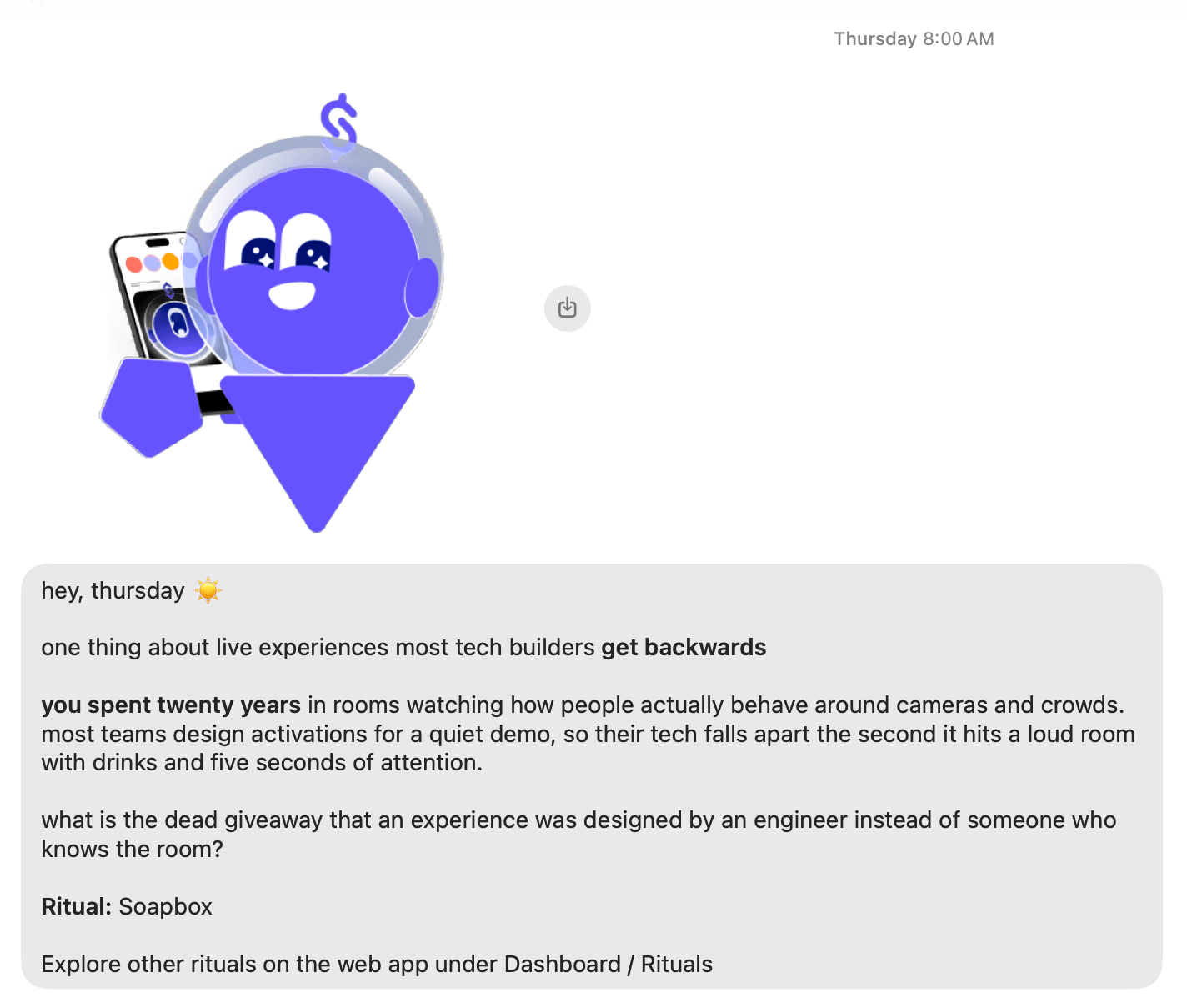
Here's the moment that made me write this post.
I wasn't at my desk. I didn't open anything. My phone buzzed with a text:
"one thing about live experiences most tech builders get backwards
you spent twenty years in rooms watching how people actually behave around cameras and crowds. most teams design activations for a quiet demo, so their tech falls apart the second it hits a loud room with drinks and five seconds of attention.
what is the dead giveaway that an experience was designed by an engineer instead of someone who knows the room?"
It tagged the prompt "Soapbox."
Sit with what that is for a second. It didn't ask me for information. It didn't ask me to pick a topic. It asked for a take — and specifically for the one take only I have, built out of twenty years of standing in loud rooms watching people decide in four seconds whether to walk up to a camera.
A blank prompt box can't ask you that. Not because it isn't smart enough. Because it doesn't know you're the person to ask.
I answered with a voice note. Twenty seconds, while walking Ruthie & Brisol.
Then it did the thing that actually convinced me. It read my answer, pushed on the weak spot, and asked a second question built out of the first one:
"engineers build for the screen, not the floor. they tuck the activation in a corner where nobody sees it, or set it up right in front of the bar so a 40 person line cuts off the entire room.
when you see a setup bottlenecking like that, what is the first thing you fix on the floor to get the line moving without killing the vibe?"
That's not a prompt generator. That's an interview.
And it kept going. Four questions later it had walked me from a general complaint about engineers all the way down to a specific operational number I've never written down anywhere: OutSnapped’s pre-sharing workflow, where guests scan a QR while they're stuck in line waiting for the photo or video experience and fill out the form on their own phone, takes an activation from 25 to 40 sessions an hour up to 100 to 110. Seconds at the booth instead of minutes. For a brand sponsoring a party, that's the difference between leaving with an ROI of a couple hundred emails and leaving with close to a thousand.
Nobody asked me that on a stage. A text message asked me that, and I answered it via voice note while picking up dog poop on a NYC sidewalk.
I'm keeping my actual answer to the dead-giveaway question for its own post. It deserves more than a paragraph.
But the bigger argument that thread pulled out of me went up on LinkedIn: when any competitor can spin up your exact AI stack tomorrow, building faster stops being the moat. Twenty years of knowing where the line is, and what a room actually does when it's loud, is the part software can't copy. A text message at 8:00 AM got that out of me. I've had it in my head for a decade.
The honest scoreboard

Content for the sake of content is noise. So let's put my actual numbers on the table, because a review with a referral link in it and no numbers is just an ad.
Here is where I sit today, one week in:
X (@A_Intimidating): 9 followers. Nine. This project is relatively new, and so is the handle and has no graph, so organic reach is close to nothing. Be a pal and give a follow now if you’re active on X.
Instagram (@artificiallyintimidating): 5 followers. Also new, same story
LinkedIn: 5,390. This is where the real reach is, by a factor of ten or twenty.
Instagram (@nickydigital): 22.8k, built over years of a different career.
One finding I didn't expect, straight off the dashboard: my image posts pull 2.6 times the impressions of my text posts. But my text posts convert at 6.4% engagement versus 2.3% for images.
So the thing that gets seen and the thing that gets answered are not the same thing. A tool optimizing hard for reach could cost me the conversations without either of us noticing. I'm watching that.
Now, are vanity metrics the real KPI? No. But I'm human, and guilty of being vain, so of course I want the numbers to go up.
More importantly, they're the first link in a chain: engagement leads to new people, new people lead to new conversations, and new conversations lead to financial or creative opportunity. That's the chain. If a tool moves link one and never moves link four, I've been sold an expensive toy. I've been in business long enough to know the difference.
If you’re enjoying this article, these are the closest neighbours in the archive.
I Make AI Versions of Myself for a Living. This One I Didn’t Agree To. — a machine made a version of me I never approved. Same nerve as the story in my vault that turned out to belong to somebody else.
A Stranger Sent Me an Invite to an AI Nobody Has Written About — the last time a tip from someone I trust put an unknown AI assistant in my hands. I gave that one nothing and watched what it did anyway.
Your AI Is a Yes-Man. Here’s How to Make It Fire You. — the flip side of a tool that admits it is biased toward output. How to build one that argues back.
What Is AI Workflow and Operations Consulting? (And Why It’s a Full-Time Job) — what it actually takes to build and maintain the pipeline yourself, which is the job Stanley is offering to take off my desk.

Who should close this tab right now
If you enjoy building the pipeline, don't buy this.
I mean that. If tuning your own workflows is the fun part of your week, you will resent paying someone else to own it, and you'll fight the tool the entire time. Go build. You'll be happier and you'll learn more.
This is for the operator who is the entire content department, who has twenty years of opinions sitting unsaid, and who has no interest in becoming a full-time prompt engineer to get them out.
One week in, and the part I can't answer yet
Full disclosure: the link above is our referral link.
I started on Saturday the 5th. That was eight days ago, and I like it a lot. But I've been doing this long enough to be suspicious of week one.
We've all used tools that felt like magic on day three and went generic by week four, as context clutters and memory bloats and every draft starts sounding like every other post in the feed. Whether a dedicated tool can hold sharp, high-context judgment across months of heavy use is the only question that matters. Nobody can answer it at day seven, including me.
What I can do is show you exactly how the thing works under the hood, and the framework I'm using to decide whether to keep paying for it.
Because the mechanism is the interesting part. It isn't a better model. It's four specific pieces that a chat window doesn't have — and one of them is a memory architecture I have strong opinions about, since building one is a business I'm in.
How the sauce is actually made
Strip away the branding and Stanley is four parts. None of them is the model.
