

I pay HubSpot about twenty thousand dollars a year, and I almost never open it.
Not out of protest. Out of friction. It makes me click nine times to answer a question I could ask out loud in four seconds. So somewhere in the last year I stopped opening the dashboard and started asking Claude instead. Pull the client notes. Check where that deal sits. Log what we just agreed to.
It worked so well I didn't notice it had become the whole workflow.
I said that out loud on LinkedIn. Forty-three thousand people saw it, which is roughly two hundred times my usual, and a hundred and twenty-four of them had opinions. Some of those opinions were better than my LinkedIn post itself. So … this is the long version, including the parts where I think the critics have me.
The friction tax

The subscription price is the number everyone argues about. It's the wrong number.
The real cost of clunky software is what your team stops doing because of it.
When updating a record takes six screens, people put it off until Friday. Then Friday gets busy. When checking what a client actually said requires digging through an activity timeline, people guess instead. They're not lazy. They're busy, and the interface is asking for more than the task is worth.
So the database fills up with things that were true in March.
That's the tax. You pay enterprise prices for a system of record, and then you slowly stop recording things in it. The data decays in exact proportion to how annoying the software is to open. Nobody puts that on the invoice.
What we actually changed
Here's the part people expect to be complicated, and isn't.
To date, we didn't migrate a single thing. We haven’t replaced anything. We haven’t even needed to export a single record.
As of writing this, the database has stayed exactly where it was. It's good at what it does — it holds years of client history, it keeps the pipeline honest, it produces the reports my bookkeeper wants. That part earns its keep.
What changed is where I stand when I use it. The backend runs in the background. The conversation is the desk.
I talk in plain sentences. It reads and writes against the database directly. Nothing about the underlying system changed except that I stopped visiting it.
"Then cancel it"
The sharpest reply in the thread came from Foster Kowouvi, and he went straight for the soft spot:
"You're presenting the argument as if AI were so efficient that the CRM has become a burden or a cost centre. Stop your HubSpot subscription and see if Claude would be any useful. AI is here to enhance the software, not to replace it."
He's right, and it's the reason I haven't cancelled.
Take the database away and the conversation has nothing to talk to. Claude isn't storing my pipeline. It's reading and writing to something that does. Cancel the subscription and I don't have a leaner setup, I have an assistant with amnesia.
But notice what that proves. The thing I'd be devastated to lose is the database. The thing I haven't opened in months is the Hubspot interface. Those are sold to me as one product at one price, and only one of them is doing any work.
I'm not arguing AI replaced my CRM. I'm arguing it replaced my CRM's front door, and that the front door was most of what I was being sold.
Alex M. Hochberger put the same experience in Salesforce terms: "I spend more time in Claude pulling things than in the Salesforce UI." Different vendor, same shape.
Why this is a pricing problem, not a software problem
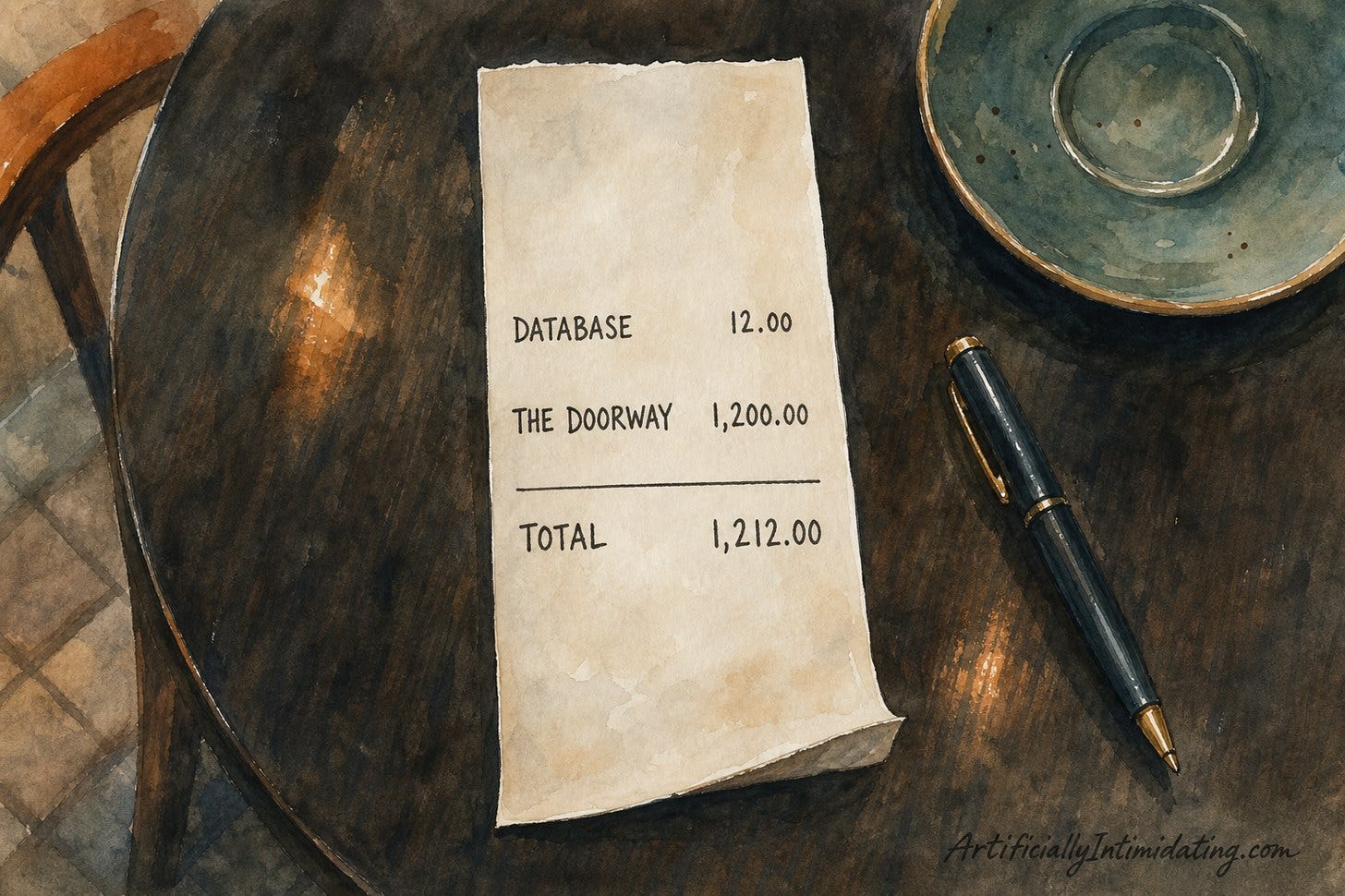
For twenty years, software value lived in the interface. Vendors built elaborate dashboards, sold training on how to use them, ran certification programs, and charged per seat based on how many people log in.
Per seat. Based on logins. Think about what that prices.
If the interface stops being where work happens, that model is measuring the wrong thing. You're paying for doors nobody walks through.
Palomi Jain took this further than I did, and I think she's right about where it lands:
"We may be heading toward a world where people stop choosing software based on how nice the interface is. The real question becomes whether an AI can access the data, understand the workflow and safely make changes."
That's the actual buying criterion now. Not "is the UI good." Can something else drive it safely. (One of the other things I’ve loved about modern access to AI, is when there is an interface that doesn’t work with my brain, I can literally skin it to work for me with a couple of hours of chatting with Claude Code or Codex, but that’s another piece for another day.)
The database is becoming a commodity. The conversation is becoming the product. Most enterprise pricing hasn't caught up, and I don't think it will until enough people notice they've stopped logging in.
I also write Context Window, a daily AI brief — five stories, four bullets each, plain English, every morning. It’s free, and it’s where most of these arguments start before they become anything this long.
Further reading
If this one landed, these are the closest neighbors in the archive.
I Hired an AI Head of Content. Here’s What Its Memory Got Wrong. — the tool that asked the question behind this post, and the five separate ways it got facts about me wrong in the same week.
A Stranger Sent Me an Invite to an AI Nobody Has Written About — I gave an unknown AI assistant access to nothing and watched what it could still do.
What Is AI Workflow and Operations Consulting? (And Why It’s a Full-Time Job — what it actually takes to build and maintain this kind of plumbing yourself, if you’d rather not.
Context Window — the daily brief. Free, five minutes, every morning.
The prompts, exactly as I use them
No framework. Two prompts, both boring, both used daily.
After a client call, instead of opening contact records and deal stages and activity logs, I paste my rough notes in:
