


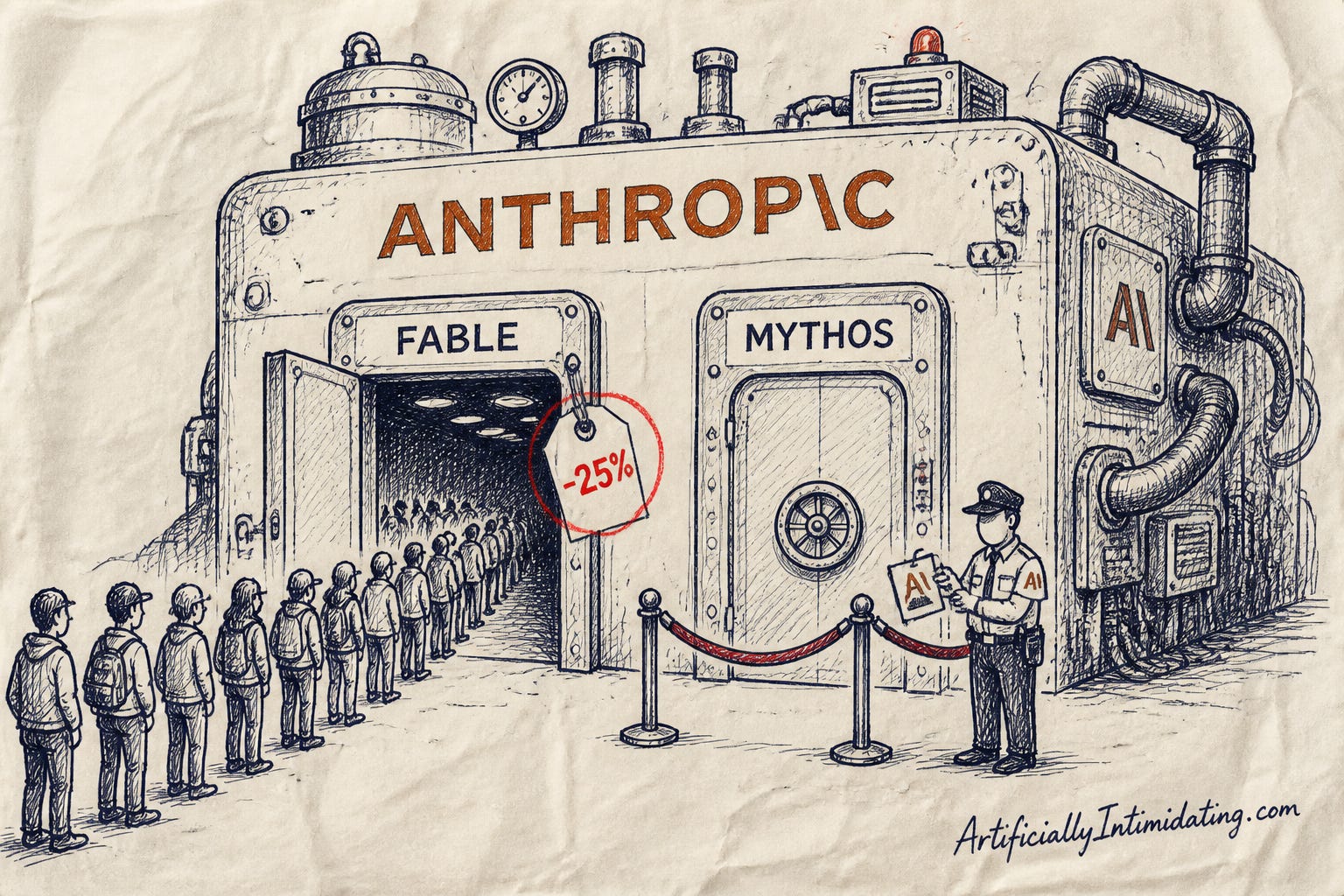
Good day . Anthropic shipped Claude Fable 5.1 on Tuesday, cut the price of the one line item that grows the longer an agent runs by itself, and put the fuller version of the same model behind a velvet rope. Apple handed the keys to a hardware engineer with Siri still dangling off the side of the building. Jason Isbell sued Suno and left copyright out of it on purpose. Fei-Fei Li’s lab showed a model that builds a whole room from two photos, and Google put an image editor inside the document you were already writing. Five stories about who gets in, and what it costs.
Anthropic Ships Fable 5.1 and Cuts the Bill
What happened: Yesterday we covered Anthropic’s $35 billion compute bill — today we see what it is buying. Anthropic released Claude Fable 5.1 on Tuesday, September 1, alongside Claude Mythos 5.1: the same model with looser safeguards, available only to vetted cyberdefenders and life scientists. Per-token prices are unchanged at $10 in and $50 out, but cache reads — the model re-reading context it has already processed — drop 75% to $0.25 per million tokens. Anthropic puts that at roughly 25% off a typical workload and up to 45% off heavy agent work.
Why it matters: If you run anything that works for hours on its own, most of what you pay for is the model re-reading its own transcript, and that is the part that just got cheap. Two other changes land with it: a new Enterprise Frontier Safeguards system that keeps customer data on the customer’s own cloud rather than Anthropic’s, and permission to use Fable 5.1 to find software vulnerabilities (not to write exploits), which Anthropic says means about 60% fewer safety interruptions per Claude Code session.
What everyone’s saying: The Hacker News thread opened with people asking whether anyone has gotten real work out of Fable at all, since the safeguards kept bouncing them down to Opus; Simon Willison is the one pointing out the cache discount should hit every long-running agent. On r/ClaudeAI the cache price is the headline (“that’s where 9/10 of my usage comes from”), the open question is whether subscriptions see any of it, and the side conversation is that outputs from Fable 5.1 onward carry the EU-mandated text watermark, with people already trading ideas for washing it out through a weaker model. The developer notes add the fine print: forced tool use is gone, and editing an earlier turn now invalidates the model’s thinking blocks.
My read between the lines: Read the price cut and the safety section together. The line item that got cheaper is the one that grows the longer an agent runs unattended, and the same post says the model can still sometimes bypass approvals and that the audit has less visibility into long-context, multi-agent work. Anthropic put unattended work on sale in the announcement where it admitted unattended work is the part it can see the least.
📖 Further reading: Fable 5 Costs 2x Opus — and Using It Wrong Costs You More Than That — the price math moved on Tuesday; the using-it-wrong part did not.
Anthropic just made it cheaper to leave an agent running overnight. The catch is you still have to build the agent, wire it to your tools, and babysit the first fifty runs. Viktor skips that part. It is an AI coworker that lives in Slack, connects to more than 3,000 tools, and comes back with the finished report, the dashboard, the code, the campaign. Not a chatbot you prompt — a hire you brief. New readers get $50 off their first month. Hire Viktor →
Ternus Gets Apple’s Keys. Siri Is Still Unplugged.
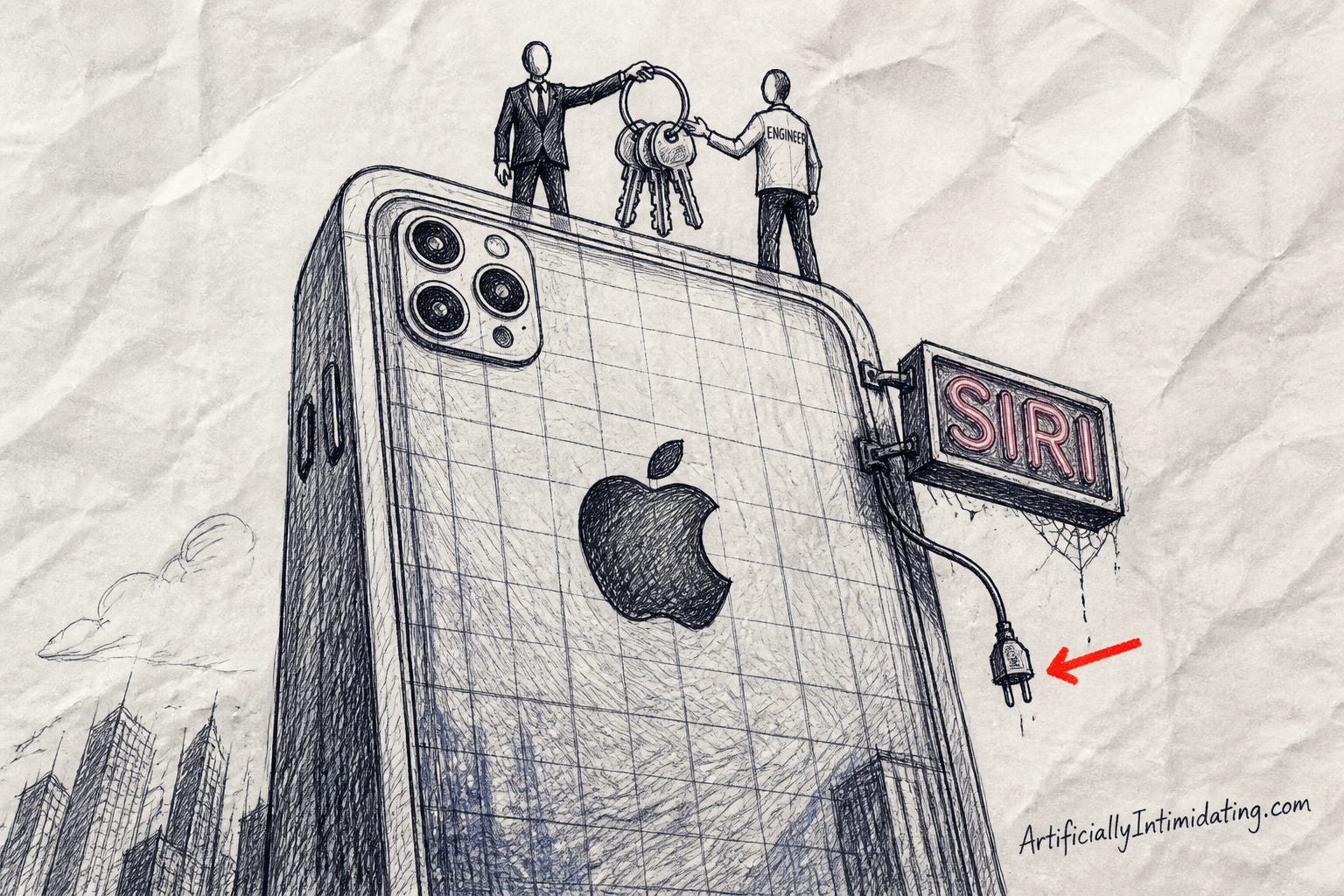
What happened: John Ternus became Apple’s chief executive on Tuesday, September 1, ending Tim Cook’s fifteen-year run. Cook moves to executive chairman, where Reuters says he will spend his time on policymakers. Ternus, 50, has been at Apple 25 years and ran hardware engineering. Under Cook, per Axios, the company went from $347 billion in market value to $4.7 trillion — $32 million an hour for fifteen years.
Why it matters: The AI angle is the whole job description. The Los Angeles Times reports Ternus reorganized the hardware engineering division this month around a new AI platform for product development, and that Apple’s rare Bay Area layoffs hit the Vision Pro and Siri teams. His first test is next Wednesday, September 9: CNBC expects the event to bring the first folding iPhone and a rebuilt Siri that can actually operate apps like Messages and Calendar. “We have a huge launch next week,” he told staff in his first memo, per TechCrunch.
What everyone’s saying: Reuters’ round-up of the Cook era lists the misses in one breath — the scrapped car, the $3,499 Vision Pro, the delayed Siri — and quotes Zacks’ Brian Mulberry: “AI is the single biggest challenge for Ternus. Apple needs to demonstrate that AI will be more than an app on the iPhone, more than Siri.” TechCrunch frames September 9 as Apple’s chance to position Siri as an equal to ChatGPT or Claude.
My read between the lines: Every rival is a software-and-model company, and Apple just made a hardware engineer CEO. That is not an oversight, it is a thesis: the model is a commodity and the device is the moat. The tell is Cook’s new job. The most valuable thing Apple owns right now is its relationship with governments, and it just assigned its best operator to that full time.
📖 Further reading: Thanks to Apple, Your favorite AI tool is a dead tool walking — the commodity-model bet is now the CEO’s bet; here is what it means for the tools you pay for.
The Brief is free and stays free. Members get the deep-dives behind headlines like these — the Fable 5 operator’s guide, the piece on licensing your own likeness, the Apple commodity-model post — plus the full archive. If today’s stories cost you money or make you money, that is where the working-out lives. Become a member →
Isbell Sues Suno for His Name, Not His Songs
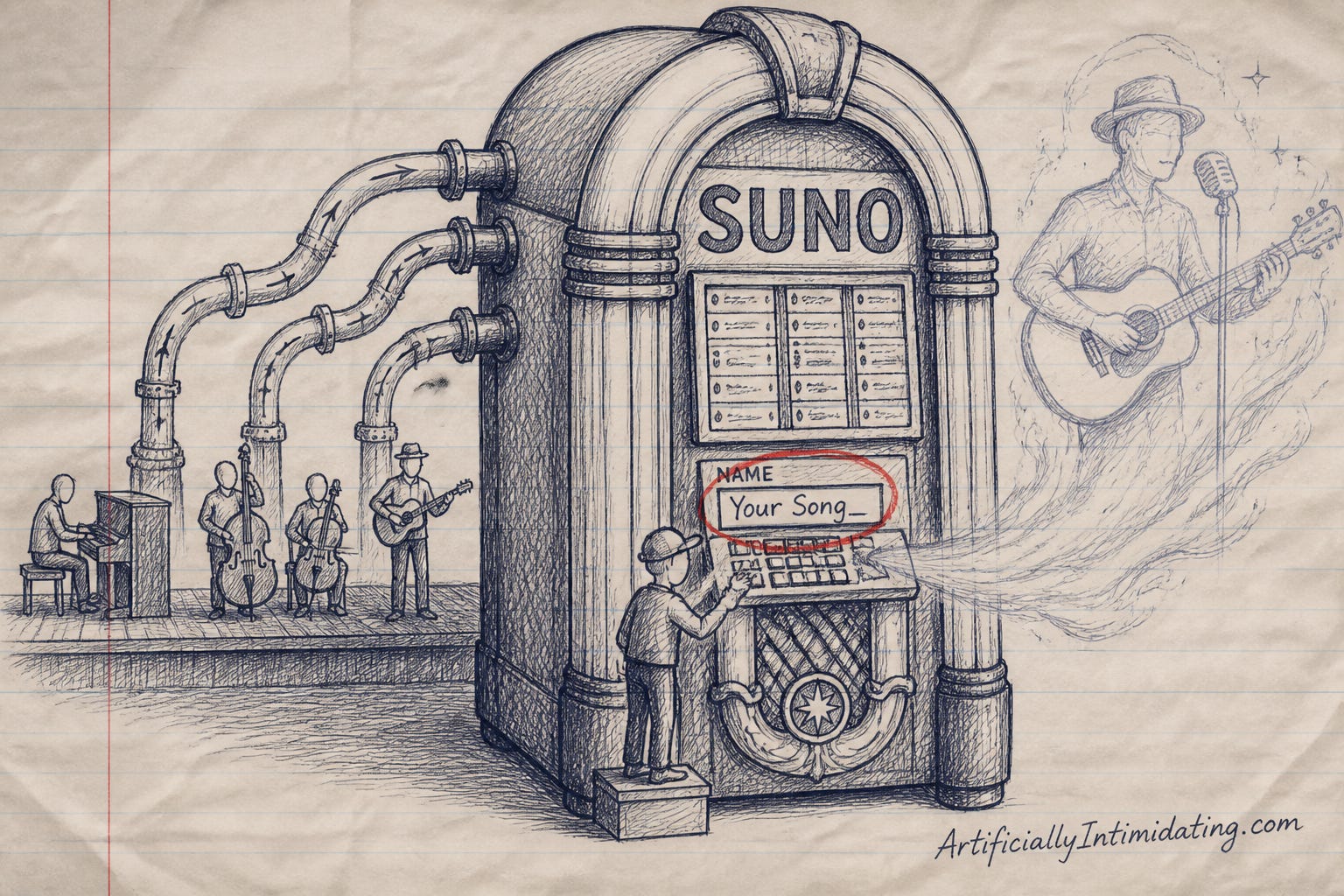
What happened: Jason Isbell, Camper Van Beethoven’s David Lowery, Guy Forsyth and Eduardo Calle filed a class action against AI music generator Suno in federal court on Monday, August 31. There is no copyright claim in it. The suit is built on right-of-publicity law and an Illinois biometric-privacy claim, arguing Suno “name-indexed a large quantity of voice data without consent” and now sells access to it. Typing “jason isbell” into Suno’s v5 model, per the complaint, returned an Americana track called “Paper Bell.”
Why it matters: The choice of claim is the story. Billboard quotes the complaint’s core line: a musician’s name inside Suno “is a retrieval key for a set of performer-specific representations,” not a mere text string. Copyright belongs to whoever owns the recording, which is usually a label, and labels have been settling and signing deals. Your name and voice belong to you. That is a right no label can license away, and it applies to anyone whose identity is the product, not just Grammy winners.
What everyone’s saying: A Suno spokesperson told The Hollywood Reporter “we believe these claims are without merit and we intend to defend against them.” The complaint itself compares Suno to Star Trek’s Borg, catchphrase included. Music Business Worldwide’s framing is that the identity claims, not the damages, are what should worry the AI licensing deals now being struck with Warner and BMG: a label’s right to license a recording does not carry the performer’s identity with it.
My read between the lines: Every copyright suit against Suno has ended the same way: a label takes a check and becomes a partner. This one is built so that cannot happen. A label can sell you the recordings. It cannot sell you Jason Isbell. The plaintiffs went looking for the one asset in the music business the labels never owned, and it turns out to be the prompt.
📖 Further reading: I Make AI Versions of Myself for a Living. This One I Didn’t Agree To. — the Isbell complaint is this post with lawyers attached; the consent problem is the same one.
World Labs’ Atlas Builds Worlds From One Photo
What happened: Fei-Fei Li’s World Labs introduced Atlas on Tuesday, September 1: a world model trained from scratch to work on text, images, video and 3D in one architecture. Give it one to six photos and a camera path and it generates up to a minute of 1440p video from any angle you choose; give it two or three photos of a real place and it reconstructs the scene as depth maps, point clouds or 3D splats. It is in early access with select partners and will power future versions of the company’s Marble product.
Why it matters: Yesterday’s Brief had Yann LeCun collecting a TIME100 nod for betting that world models, not chatbots, are the road to real intelligence. Atlas is what that bet looks like shipped, and the robotics section is the part to read: film a warehouse with a phone, and the model generates what a robot’s cameras would see walking through it. World Labs’ own line is the honest one — “the more it sees, the less it imagines.”
What everyone’s saying: The launch post claims third-party raters preferred Atlas to recent video models at following a camera path, with the gap growing as paths get complex, and that it beats specialist open-source reconstruction models on standard benchmarks — all reproduced in-house. No pricing, no latency numbers, no compute disclosed, and the “bullet time from three phones on tripods” clip is the one that will travel.
My read between the lines: “The more it sees, the less it imagines” is also the risk statement. With two photos Atlas fills in the room, and nothing in the output tells you which walls were real. For a game that is the feature. For a robot planning a path, or an insurance adjuster looking at a reconstruction, the imagined wall is the whole liability.
Google Pics Comes for Canva Inside Workspace
What happened: Google Pics, announced at I/O in May, went live on Tuesday, September 1 for Google AI Pro and Ultra subscribers and most paid Workspace business plans. It runs on Nano Banana, lives at pics.new and as an overlay inside Docs and Slides (Drive in the coming weeks), and does object-level editing: select one thing in an image and change it, rewrite or translate the text inside a picture, crop for each format, upscale to 2K or 4K, and batch several edits at once — per 9to5Google.
Why it matters: On Monday we noted DALL·E is gone. The image generator has stopped being a destination and become a button inside the document you were already in. For a small business that means the flyer, the translated social asset and the product mock-up all come out of the subscription you already pay for, and the “translate the text in the image” button is the one agencies will feel first.
What everyone’s saying: The Verge headline is “like Canva, but with even more AI,” and Google’s own pitch is aimed squarely at business use: translated social assets for global markets, product shots dropped into any background, flyers and event collateral. 9to5Google notes it follows Vids as the next AI-native app bolted onto Workspace.
My read between the lines: Canva’s moat was never the AI, it was being the tab already open on the marketing intern’s laptop. Google just put the editor inside the doc the intern was already writing. Note the gate, though: nothing in the free tier. Nano Banana was last summer’s viral toy. Pics is the invoice.
📖 Further reading: Beginner’s Playbook: 50 Inspiring Ways to Explore Nano Banana AI — the model under Pics is the one this playbook teaches, and the prompts carry straight over.
That’s your AI Brief for Wednesday.
—Artificially Intimidating


