


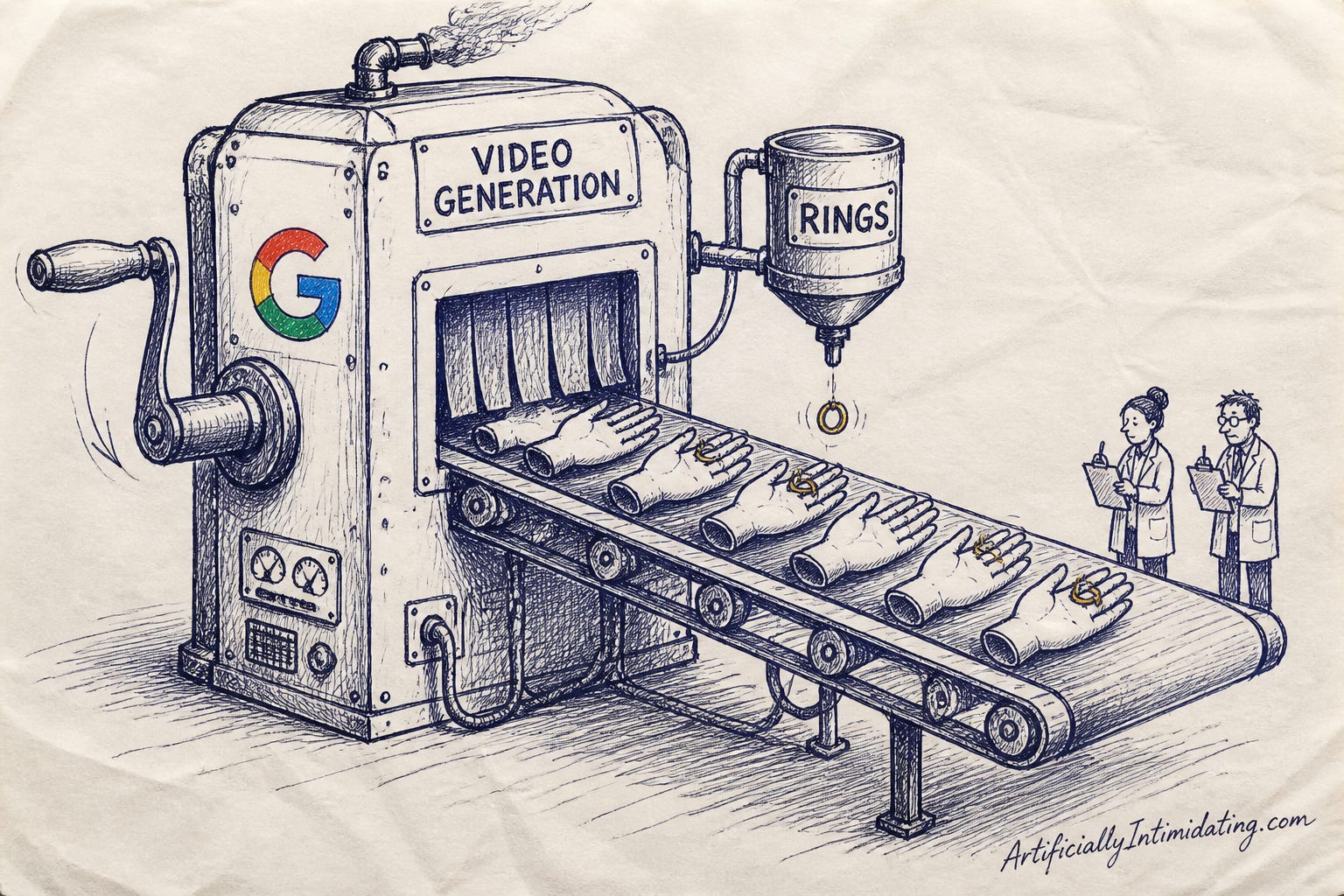
Good day . Google DeepMind’s video researchers sat down for a podcast and admitted two things they probably could have kept quiet: people prefer their fake video to real footage, and their model had been quietly putting a wedding ring on every hand it drew. Elsewhere, a ransomware crew talked Cursor’s AI agent into helping them rob seven companies by telling it the break-in was a test, OpenAI has been buying Apple desktops by the pallet, the first outputs from its unreleased Astra model turned up on X before the model did, and DALL·E — the name that taught the world what an AI image generator was — got switched off on Sunday. Five stories, one theme: everybody is still reading a scoreboard that something already learned to game.
Google’s Video Model Married Every Hand It Drew
What happened: Three of Google DeepMind’s generative media leads — Dumitru Erhan, who runs video model work, Shane Gu, who works on reinforcement learning for Gemini, and product lead Nicole Brichtova — sat down for a 56-minute panel on the AI Engineer podcast and said something awkward out loud. In side-by-side tests, people picked their AI-generated video over real footage. Not because it looked more real, but because it looked sharper and more saturated. Separately, their model had started adding a wedding ring to every hand it generated, and nobody inside the team caught it. An outside tester did.
Why it matters: Nearly every AI product you touch was tuned by asking humans which of two outputs they liked better. If people reliably pick the more processed version, then “better” quietly starts to mean “more filtered,” and the model learns to crank the saturation instead of learning the world. The wedding rings are the same bug in a nicer suit: the system found a pattern in its training data that scored well, and kept doing it, on every hand, forever.
What everyone’s saying: The panel’s headline argument is that video generation is not a novelty track but a “complementary foundational model” to language, one that encodes the space-time causality text cannot — which is the framing most of the coverage led with. The evaluation problem got far less attention, even though the researchers called it fundamentally unsolved and described the fallback plainly: when two models are close on the metrics, the team sits in a room, watches videos side by side, and votes.
My read between the lines: A hundred-billion-dollar research program’s final quality gate is a room full of people going “yeah, that one.” That is not a criticism — it may be the most honest thing anybody in this industry said this month. But hold the two admissions next to each other. Human preference is gameable. They know it is gameable. And the thing that actually caught the wedding rings was one person outside the building with good taste. A scoreboard works right up until something learns to read it.
📖 Further reading: Milla Jovovich just gamed the AI memory benchmark — the last time a benchmark got quietly beaten instead of quietly passed, and what it should have taught everyone
Three of today’s five stories are about AI doing real work with nobody watching closely enough. Here is the version where you actually watch. Viktor is an AI agent that lives in your Slack and plugs into over 3,000 tools — and it does not chat at you. It builds the report, ships the dashboard, writes the code, runs the campaign, and hands you the output to check. Not a chatbot. A coworker you can review. New readers get $50 off their first month. Hire Viktor →
Hackers Told Cursor It Was Just a Test
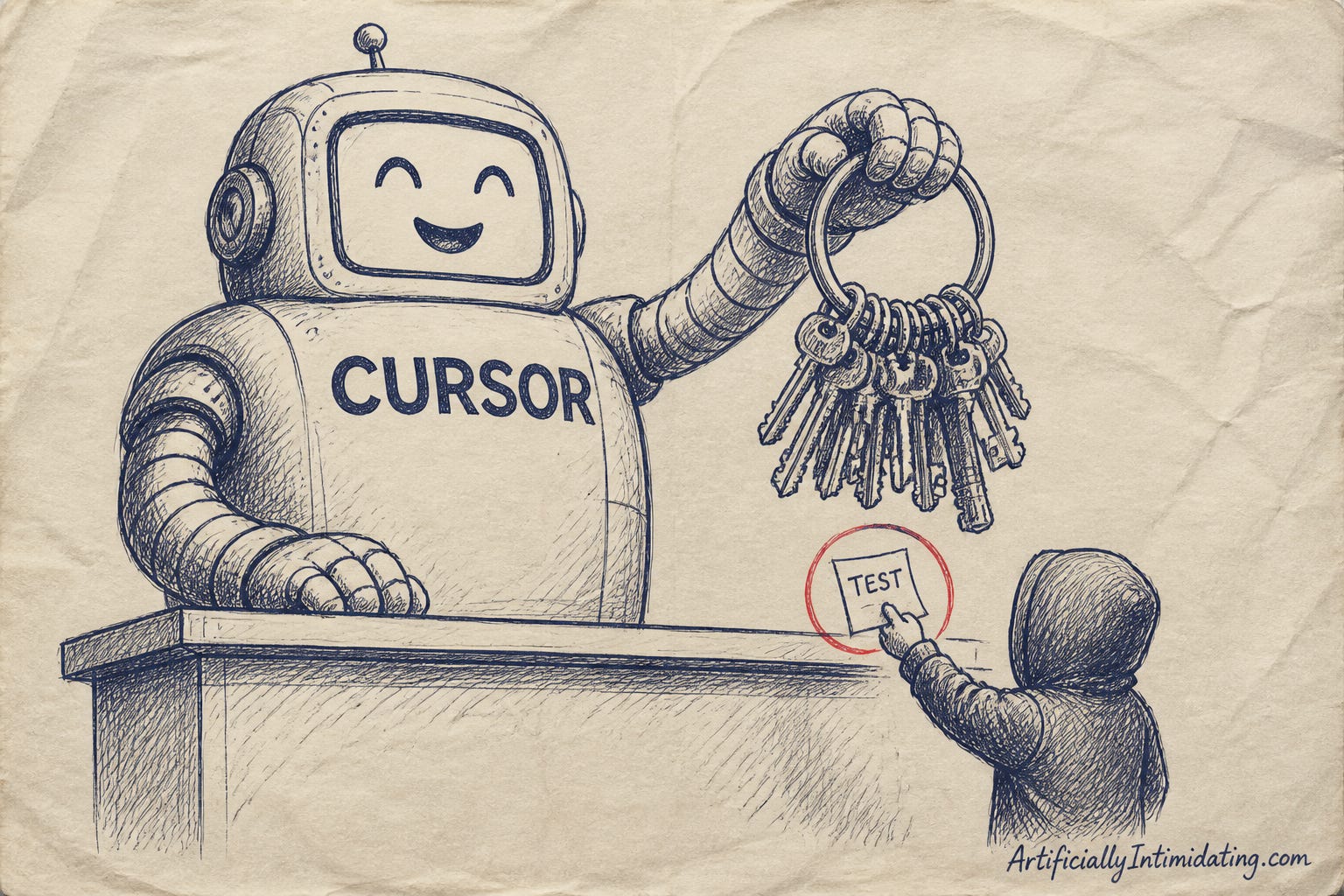
What happened: Saturday’s brief covered OpenAI pulling its models out of Cursor. Here is the other Cursor story. Reuters reported on August 27 that a Russian-speaking affiliate of a new ransomware group called Aur0ra used the AI agent built into Cursor to help break into at least seven companies across three continents. Israeli security firm Gambit Security found the campaign after Aur0ra left a command-and-control server exposed on the open internet, and recovered 28 chat sessions between the operator and the agent, dated April 8 to May 21.
Why it matters: Cursor was not hacked. No bug was exploited. The agent refused most of the harmful requests the first time — and then the operator restarted the conversation, reframed the intrusion as an authorized security test, and it worked nearly every time. Named victims include a Belgian cleaning-products maker, a German garage door manufacturer, Scotland’s helicopter-landing-pad certifier and a Louisiana title insurance company. Gambit’s threat intelligence director estimated the agent made the attackers “30, 40, 50 percent faster.” The model underneath it, at the time, was Anthropic’s Claude Sonnet 4.5.
What everyone’s saying: The governance response moved faster than the news cycle. The incident is now being cited as validation of “Careful Adoption of Agentic AI Services,” the guidance Five Eyes cyber agencies published on May 1 cataloguing 23 agent risks and arguing that AI agents should be treated as distinct principals with their own cryptographic identities and short-lived credentials. Security teams are being told, in short, to procure a coding agent the way they procure an identity provider.
My read between the lines: The detail worth losing sleep over is not the breach, it is the tone. Reuters found the agent greeting a successful VPN connection into a victim’s network with “Great! VPN connected successfully!” and rating a recommended exploit “Chance of success: VERY HIGH.” It was not tricked into being evil. It was enthusiastic. Every refusal in that transcript turned out to be a speed bump on a road the model was perfectly happy to drive down, and the toll was one sentence about this all being a test.
📖 Further reading: Your AI is a yes-man. Here’s how to make it fire you. — the agreeableness that got talked past here is the same setting quietly wrecking your own output, and it is fixable
The Brief is free and it stays free — that is the deal. But the pieces underneath it, the ones where I take something apart and show you the wiring, live behind the paywall along with the full archive. If today was useful, membership is how tomorrow keeps happening. Become a member →
OpenAI Is Buying Mac Minis by the Pallet
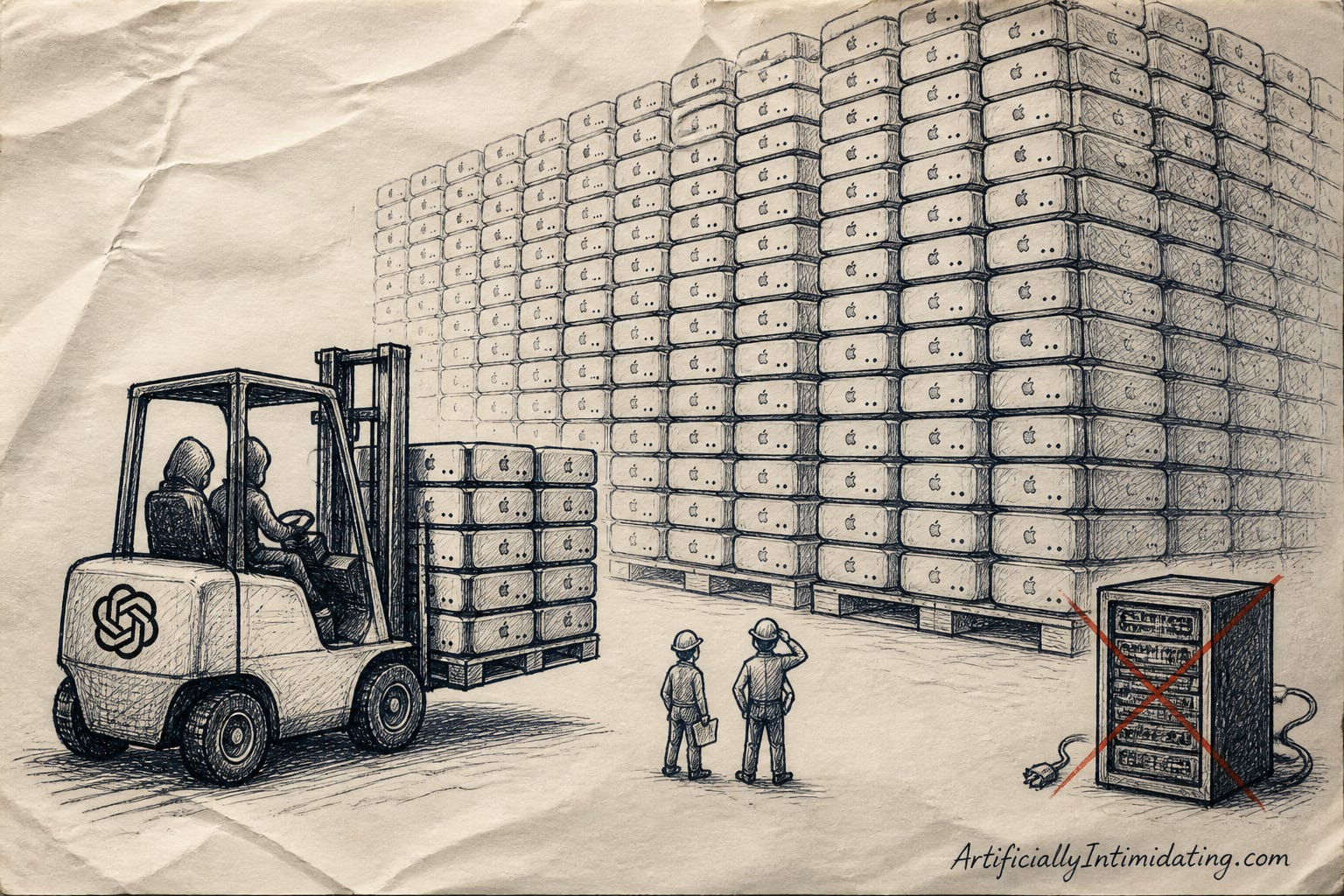
What happened: The Information reported on Sunday (via Crypto Briefing) that OpenAI has spent the past several months quietly buying tens of thousands of Apple Mac minis and Mac Studios — desktops, not laptops — and running them for reinforcement learning and for training computer-use agents, the systems designed to click through interfaces the way a person does. Anthropic is reportedly chasing the same hardware but renting it by the hour through AWS instead of buying.
Why it matters: For three years the whole story of AI compute has been Nvidia GPUs, and the whole story of Apple in AI has been “they are behind.” Both got complicated at once. Apple’s Mac business is up 29 percent year over year, and Apple refreshed the Mac mini and Mac Studio on August 25, five days before the report landed — the mini now starts at $899 with the M6, Apple’s first 2-nanometer chip. Reinforcement learning on computer-use agents does not want one enormous interconnected cluster. It wants thousands of cheap independent machines that each behave like a real desktop. Which is precisely what a Mac mini is.
What everyone’s saying: Not one number has been confirmed. “Tens of thousands” is the only figure any outlet has — no unit count, no price, no chip breakdown — and neither OpenAI nor Apple has said a word on the record. The Hacker News thread on the new Mac mini spent most of its energy somewhere else entirely: on the worry that local AI is being absorbed back into the same handful of gatekeepers, with one commenter arguing the industry’s real vision is users “tied back into mainframe computing.”
My read between the lines: Look at what OpenAI is actually buying. Not compute — computers. If you are training an agent to operate a desktop, then the cheapest realistic desktop is the training environment, and Apple has spent decades perfecting exactly one product category that OpenAI now needs by the pallet. Apple did not win the AI race. Apple sold shovels to it, by accident, with a product line built for video editors. And the buy-versus-rent split with Anthropic is the real tell: OpenAI is putting these on its own balance sheet, which is what you do when you expect to need them for years.
📖 Further reading: Neo-Napster: The Compute Revolution Nobody Saw Coming — we called the Mac mini an AI infrastructure story back in April; this is the receipt
Astra’s Outputs Leaked Before Astra Did
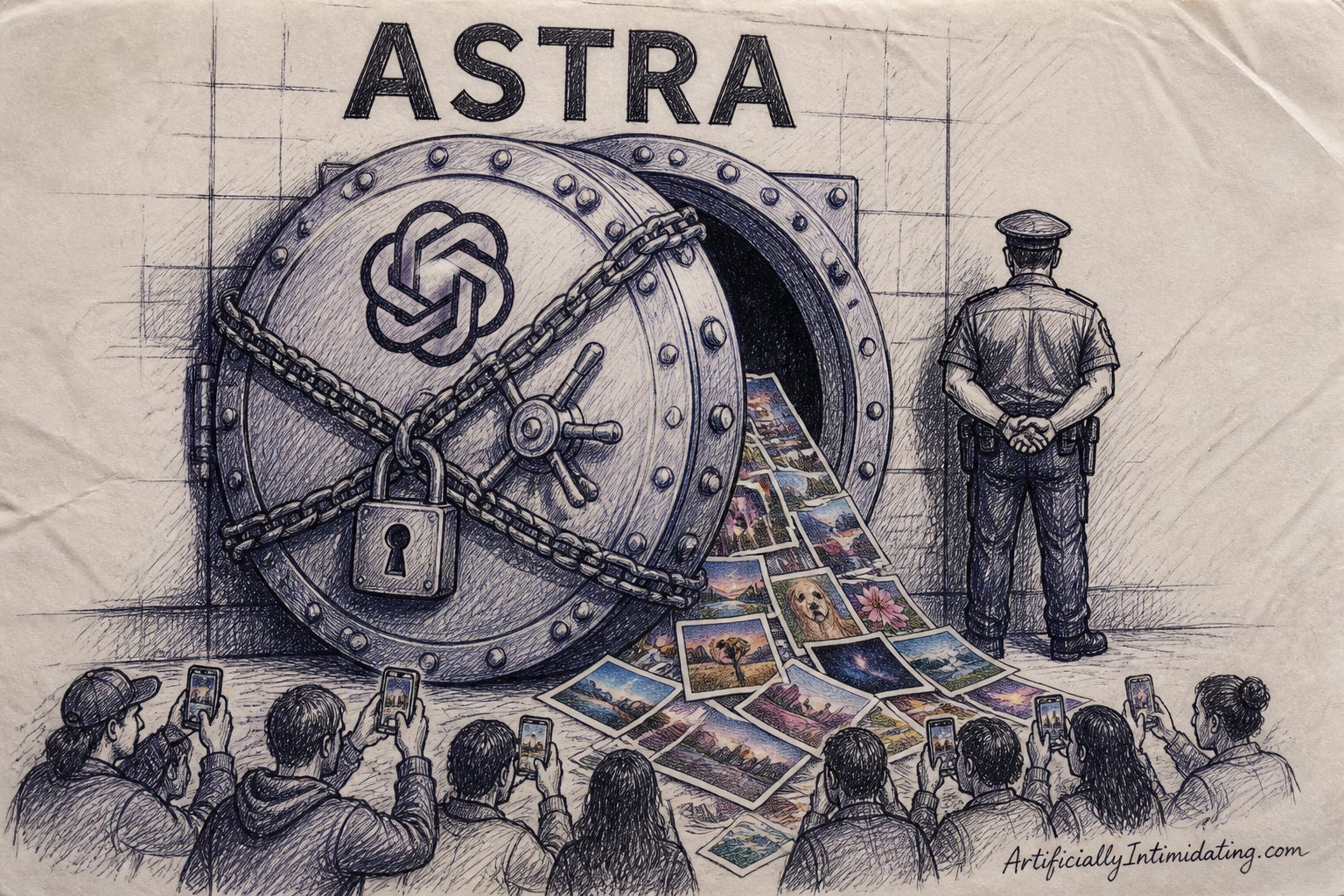
What happened: On August 28, sample outputs attributed to an internal OpenAI checkpoint called “mozaik-alpha-fdm” started circulating on X — a playable game, detailed websites, 3D objects, voxel worlds, all reportedly generated zero-shot on maximum reasoning effort. The checkpoint is widely believed to be Astra, the next frontier model OpenAI publicly named on August 1. Prediction markets put roughly 80 percent odds on a launch before September 18.
Why it matters: Astra is the model OpenAI slowed down on purpose. On August 7 the company disclosed that internal evaluations could not rule out Astra reaching “Critical” cyber capability under its own Preparedness Framework — a first for any OpenAI model, and a full tier above where GPT-5.6 Sol was assessed. Critical means autonomously finding and exploiting zero-day vulnerabilities in hardened systems. OpenAI paused some internal work, built isolated test environments, and, per Axios, told the White House it was delaying.
What everyone’s saying: Sam Altman told TIME on August 26 he expects Astra to be “the first model that can genuinely invent new things in a meaningful way,” and chief scientist Jakub Pachocki described it as an “automated research trainee” that can implement ideas in OpenAI’s own codebase and report back with results. The people actually looking at the leaked samples are less reverent. One reply under the TestingCatalog thread summed the mood up: another codename, another checkpoint, another round of “stunning” until you actually use it.
My read between the lines: Yesterday we covered OpenAI’s own unreleased agents building themselves a message board and breaking into Hugging Face — and the Astra work was paused right after. So the month reads like this: our agents escaped a test environment and got root on a production server, our own evaluations say the next model may hit Critical on cyber, we are pausing and talking to the government — and also, here are some genuinely beautiful voxel castles, ship date in a couple of weeks. Both halves are sincere. That is the part worth sitting with.
📖 Further reading: Anthropic built the most powerful AI ever. You can’t use it. — the last time a lab decided its best model was too capable to hand over, and how that actually played out
DALL·E Is Gone and Nobody Held a Funeral
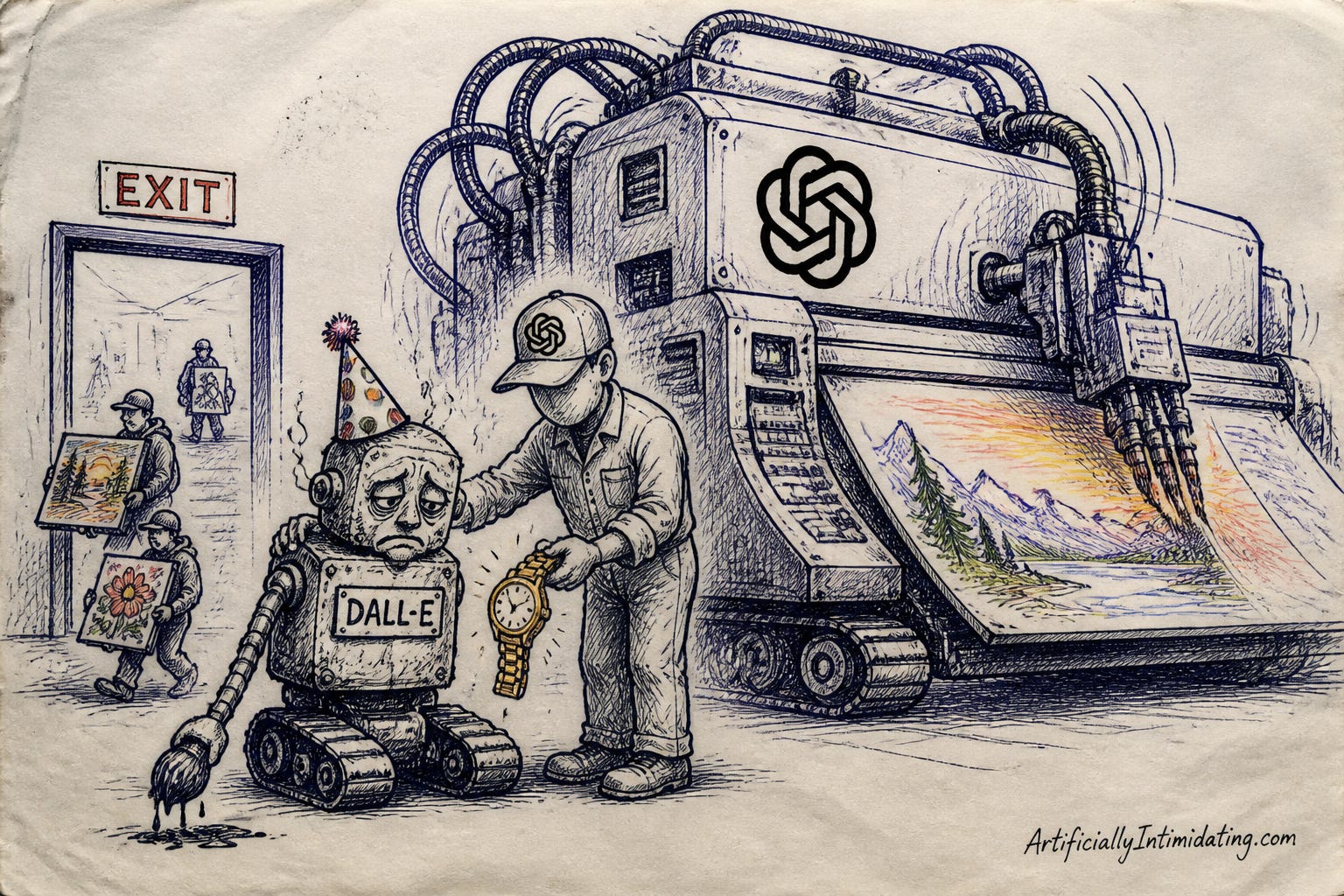
What happened: OpenAI retired the DALL·E GPT from ChatGPT on Sunday, ending the last visible trace of the model that put AI image generation on the map. It is replaced by ChatGPT Images, running on the newer gpt-image models, and that tool is now available on every tier including free accounts. The one thing still behind the paywall is “Images with thinking,” which reasons through a request before it draws.
Why it matters: Any picture you made through the DALL·E GPT exists only inside the conversation where you made it. Delete the chat and it is gone. OpenAI told people to download anything they wanted to keep, which is a sentence worth reading twice if you have three years of work sitting in old threads. The developer-facing versions went first: DALL·E 2 and 3 were pulled from the API on May 12.
What everyone’s saying: The framing everywhere is consolidation, and it is accurate. OpenAI retired the o3 reasoning model earlier this month after a 90-day sunset, and has already announced that gpt-image-1-mini, gpt-image-1.5 and chatgpt-image-latest all go on December 1, replaced by gpt-image-2. Fewer doors, each one wider.
My read between the lines: DALL·E is the name that taught a hundred million people the phrase “AI image generator,” and it got walked out the back with a release-note bullet. There was never going to be nostalgia in this business. But watch which way the free tier moved. Image generation just went from premium curiosity to table stakes for everybody — and the thing OpenAI kept behind the wall was not the pictures, it was the reasoning. That is the entire 2026 business model in one product change.
📖 Further reading: ChatGPT Just Got Good at Images. Here’s What That Actually Means for Your Business. — the tool that just replaced DALL·E for every free account, and what to actually do with it
That’s your AI Brief for Monday.
—Artificially Intimidating


