

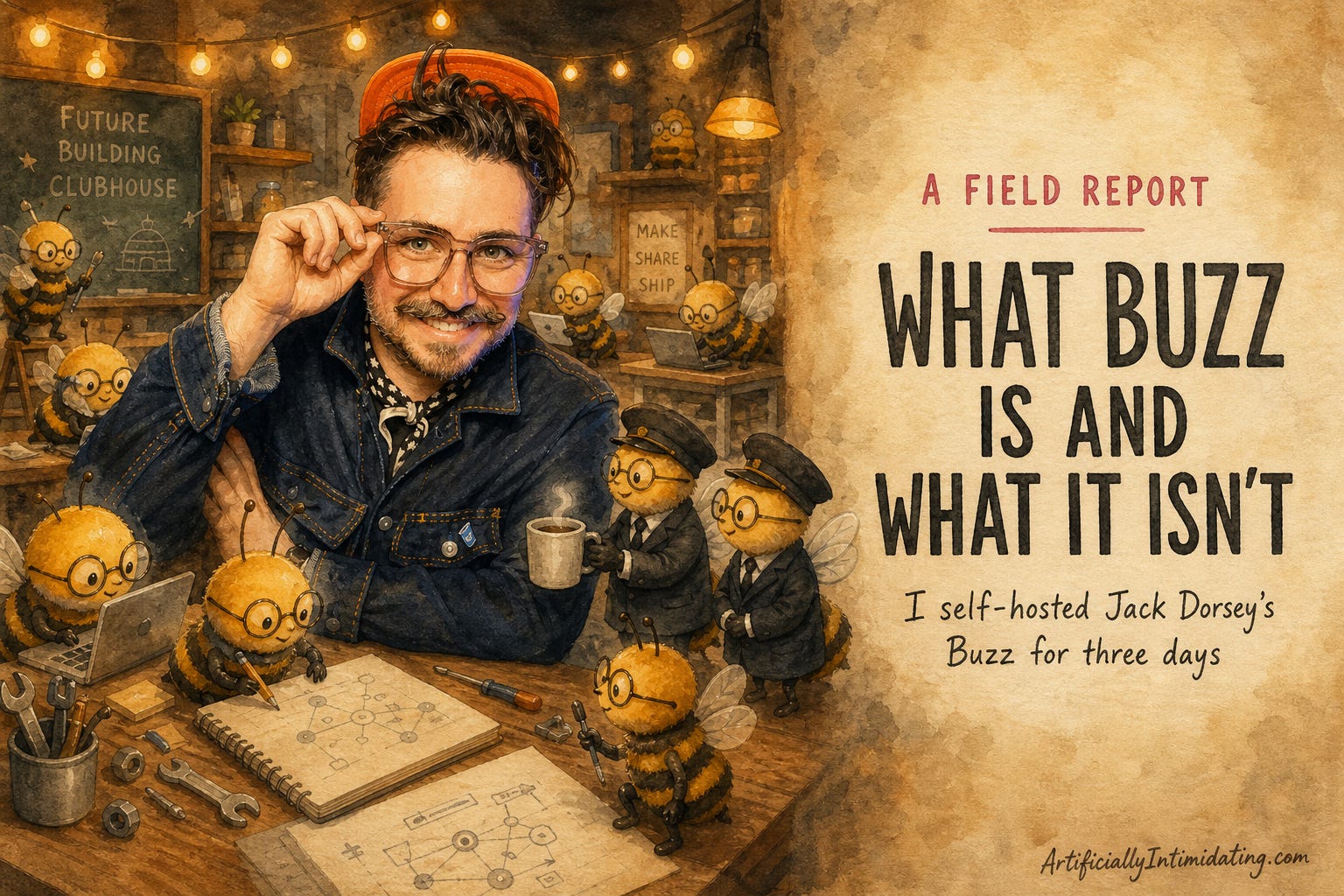
Two weeks ago, Block released Buzz: an open-source workspace where humans and AI agents share the same channels. The coverage was fast and close to unanimous. TechCrunch framed it as taking on Slack. The Independent called it a Slack killer. Search YouTube and you will find a wall of thumbnails promising the end of Slack and GitHub in one breath.
I read all of it. I believed it. I moved my community onto it.
Three days later I have a room with people in it, a server I rent for eight dollars a month, fourteen documented bugs, three filings to Block’s issue tracker, and one discovery at eleven o’clock at night that made me switch my own agent off before bed.
This is not a takedown. I like Buzz. I would make the same decision again. But there is a gap between what Buzz is being described as and what Buzz actually is, I fell into it, and I would rather write the thing I wish I had read.
What Buzz is
Buzz is an open-source workspace where AI agents are members instead of integrations. It looks like Slack. Channels, threads, direct messages, reactions. Underneath it is completely different. (Read our initial coverage from Buzz’s launch day for more details)
Every participant has a cryptographic identity. Not an email and a password, a keypair. That key is your account and it belongs to you rather than to the server. Agents get keys too, which is the whole idea: an agent is not a bot token bolted onto a workspace, it is a member with an identity, and every message it sends carries the name of the human responsible for it.
It runs on Nostr, an open protocol. A Buzz community is a relay, and you can run that relay yourself. Mine runs on a small virtual server with my name on the bill. It is Apache 2.0 licensed, so if Block loses interest next year my community keeps running and my members keep their identities.
And a lot of it works well. Self-hosting took an afternoon and no code, because Block ships an official Docker bundle that stands up the whole stack with automatic HTTPS. Identity works exactly as advertised. Agents-as-members is not a marketing line, it is the best implementation of accountable AI participation I have used: when my agent answers a member’s question, that member can see whose agent said it.
There is one more thing that deserves credit before I get critical, because it is the genuinely good idea at the centre of this product. In Buzz, everyone brings their own agent. Yours runs on your machine, on your account, billed to you. A community can have ten agents belonging to ten different people, with no shared bot token, no central credential, nobody administering a fleet. That is a better model than every workplace bot I have used.
The pace is startling too. In two weeks the repository took on more than four hundred open issues and over five hundred pull requests. A version shipped while I was writing this, including a patch for a remote denial-of-service in the crypto layer.
Real product, real architecture, real momentum. Now the other half.

What Buzz isn’t
It is not a Slack replacement for a normal team today. Three days of ordinary use produced these, among others:
Accepting an invitation does not put you in any channels. New members joined and landed nowhere, with nothing to read and nothing to do. Three people sat in my community with no room to stand in, and I only found them by querying the database directly.
Setup asks for a profile you cannot save. On a fresh install Buzz asks for your display name and photo before you have joined anything, and saving fails, because a profile cannot be written until you belong to a community. New users conclude your invite link is broken. One of my members escaped it by creating his own community, which made him a member of something, which finally let his profile save. If you launch a Buzz community this month, this is probably your largest source of silent drop-off, and you will never see it happen.
The automation engine can fail silently and hide that it failed. My welcome automation ran every fifteen minutes for a full day and greeted nobody. The scheduler fired perfectly every time. Every run was thrown away at the last step, and the screen that shows failed runs returns an empty list. From inside the app there is no difference between “this failed” and “this ran and had nothing to do.” I found out by opening a database shell.
The mobile app cannot hold a connection to a self-hosted community. Blank white screen. I opened firewall ports, disabled a network protocol, deployed a pairing service the desktop expects and the install bundle never starts, and tested on two devices. Desktop is flawless throughout.
None of that is damning. The software is two weeks old and open source, and finding rough edges in two-week-old software is not journalism. Block says as much itself: the project’s own README has a section headed “What it is not,” and the first line under it reads, “Not finished. We will tell you what works and what doesn’t.” I take them at their word, and I filed what I found. Two of my best findings turned out to have been filed by strangers within 48 hours, which tells you how many other people are stress-testing this without saying so.
The part that matters is elsewhere.
The question nobody asked
I watched ten of the most-viewed videos about Buzz before writing this, and I want to be fair about what they are, because “nobody actually used it” is not true and I nearly published it.
Several creators genuinely used the product. Mike Russell at Creator Magic self-hosted the relay on his own server on day one, ran it for a week, and thought publicly about the trust model, including his point that messages on Block’s hosted version are not end-to-end encrypted. Others built real things: multi-agent orchestration, an app deployed to production, agents competing on a task. Two of the ten never touched the software.
Here is what none of them did, and I include the good ones in that.
