

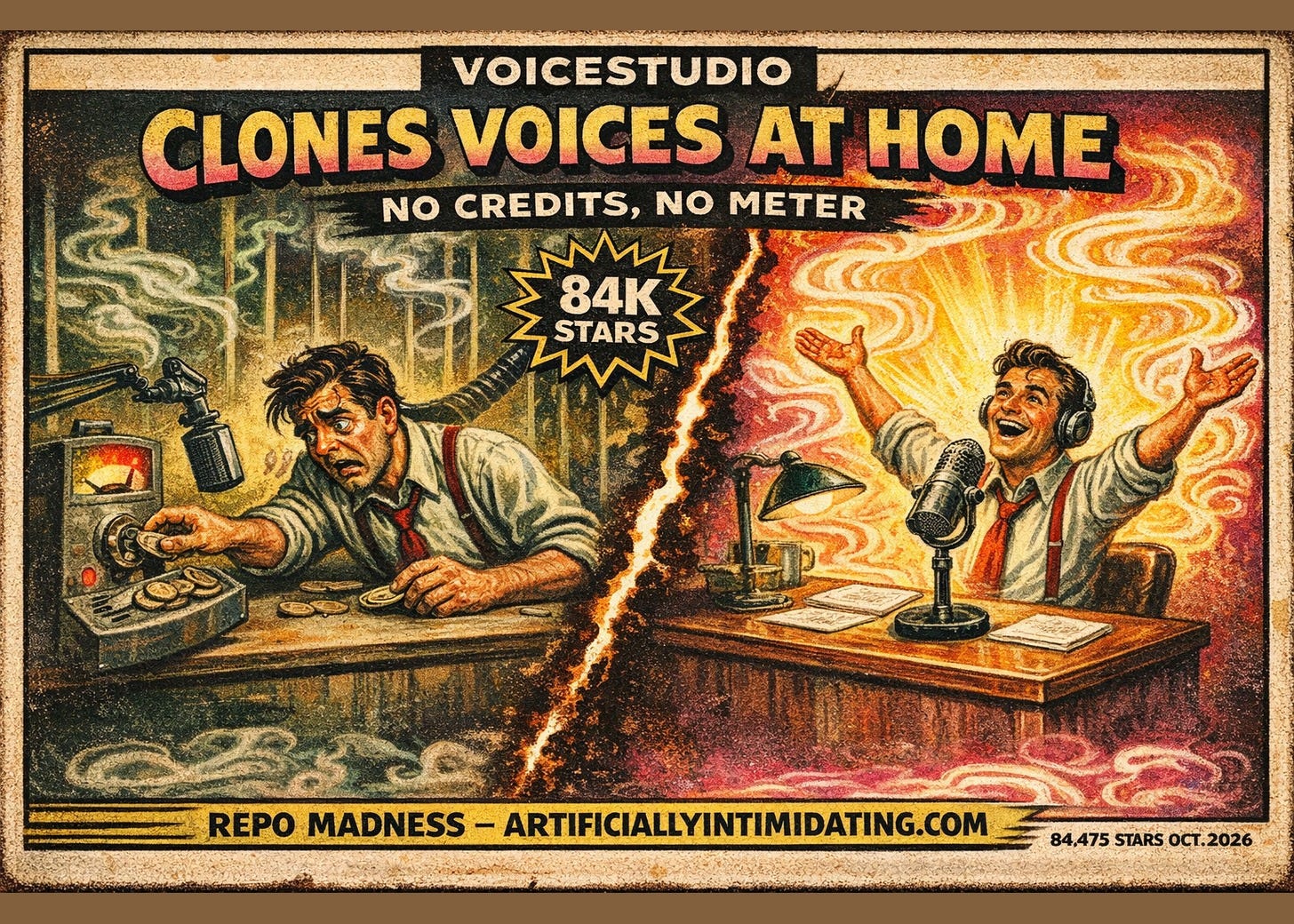
VoiceStudio — a desktop app that clones voices, designs new ones, dubs video, reads audiobooks and transcribes speech, all on your own computer.
Alternative to: ElevenLabs. Starter is $6/month and is the first tier with a commercial licence, Instant Voice Cloning and Dubbing Studio. Creator is $22/month and adds Professional Voice Cloning. Annual billing is the monthly price times 10.
Cost to run: the app is $0. You supply the hardware: about 8 GB of RAM to start and roughly 10 GB of disk on a Mac. A GPU is optional but faster. VoiceStudio Pro, a separate closed-source build, is $99 per user per year or $299 one-time.
Licence: AGPL-3.0 for the app. The default voice model's weights are CC-BY-NC, which is non-commercial. None of the 62 models in the project's own licence list is cleared for commercial use: 4 are marked non-commercial and 58 are not yet reviewed.
Runs on: macOS 13.3+ on Apple Silicon, Windows and Linux. Intel Macs get the app UI only and must connect to a remote backend. Windows on ARM is experimental.
Requires: the installer plus an internet connection for first-run setup and model downloads. CPU works, slower. NVIDIA (CUDA) and Apple Silicon (Metal) are accelerated. No account, no API key.
Traction: 84,475 stars · 9,337 forks · 4,867 commits · highest issue/PR number referenced in commits: #3299.
Liveness: very live — 1,611 commits in the last 30 days. Last commit October 24, 2026. Latest stable release v0.5.6, September 23, 2026 (a v0.5.7 beta installer is also out).
Maturity: version 0.5.6. The macOS builds are not Developer ID-signed or notarized, and an open issue reports macOS 27 calling the Apple Silicon app "damaged."
Links: repo · site · Hacker News submission, 6 points, 0 comments
Figures as of October 24, 2026.
What it does
VoiceStudio is a desktop app for working with voices. You give it a short clip of a voice and it can read any text back in that voice. You can also describe a voice in words and it builds one.
It does more than speak. It dubs a video into another language with timed speech. It turns a long text into an audiobook. It transcribes audio, and it has a floating dictation widget. The project claims 646 languages.
All of it runs on your machine. There is a local API and an MCP server, so a coding agent can drive it too.
The default engine is k2-fsa's OmniVoice model. You can swap in others from a list that includes CosyVoice 3, VoxCPM2, KittenTTS and IndexTTS 2.5. Transcription defaults to WhisperX.
The project used to be called OmniVoice-Studio. It was renamed VoiceStudio on August 7, 2026. Same repo, same history. The name OmniVoice still belongs to the model underneath it.
What it replaces, and what that costs
ElevenLabs is the incumbent. The repo says so in its own description: "the open-source, fully-local ElevenLabs alternative."
ElevenLabs prices, from its own pricing page, monthly list:
Free — $0, 10,000 credits, no commercial licence
Starter — $6/month, 30,000 credits. First tier with a commercial licence, Instant Voice Cloning and Dubbing Studio
Creator — $22/month, 121,000 credits. First tier with Professional Voice Cloning
Pro — $99/month, 600,000 credits
Scale — $299/month, 1.8 million credits, 3 seats
Business — $990/month, 6 million credits, 10 seats
Annual billing — the monthly price times 10, so Creator is $220/year
Two intro offers were live on the page: Starter's first month at $1 until November 1, and Creator's first month at $11. Those are promotions. The list prices above are what renews.
Credits run out fast on video. Dubbing Studio without a watermark costs 10,000 credits per minute. Plain text to speech is 1 credit per character.
VoiceStudio has no credits and no meter. The app is free. The cost moves to your hardware and your time.
These two bills do not line up neatly, and here is why. ElevenLabs Starter includes a commercial licence for the audio it makes. VoiceStudio's default model does not give you one. See The catch.
Is it still alive?
Very. 1,611 commits landed in the last 30 days. The last one was today.
Releases are slower than commits. The latest stable build is v0.5.6, from September 23. 1,627 commits have landed since. A v0.5.7 beta with installers went up on October 24, so stable users are a month behind.
The downloads download. I checked the Windows .exe, the Apple Silicon .dmg and the Linux AppImage. All three returned the full advertised byte count. GitHub reports 276,516 downloads across the five v0.5.6 installers, a figure that includes Windows auto-updates.
Two people write most of the code. The maintainer, Palash Debnath, has about 72% to 76% of commits. The high end counts two email addresses tied to him only by the author name, and they commit from a different time zone. A second contributor, velixio, has about 13.4%. About a quarter of commits (1,163 of 4,867) carry a Co-authored-by: Claude trailer. The repo ships CLAUDE.md and AGENTS.md, and issues get a ready-for-agent label. AI coding agents do a visible share of the work here, in the open.
The stars came late. Trendshift logged about 12,700 stars by the end of August. Then 37,686 arrived in September and 34,020 more in October so far. It hit #1 across all languages on Trendshift on September 3, 13 and 28. Forks grew along with stars, at a steady 10 to 20 percent of them, and commits more than doubled in September. Merged PRs did not rise, though. I found no sign the stars were bought, and no single launch that explains the jump.
What people say
Hacker News barely noticed. The only VoiceStudio submission, on September 15, got 6 points and zero comments. That is unusual for a repo at 84,000 stars. Reddit is blocked from the research sandbox, so no vote counts from it are claimed.
The loudest voices are on GitHub. Contributor psiberfunk, who has 42 commits, pushed back on the new contributor agreement in issue #2586 on October 2:
"I’m not opposed to VoiceStudio having a commercial or Pro edition, and I understood when contributing that the project had a commercial licensing model."
"That said, CLA 1.0 is a materially broader agreement than the contribution terms that were in place when many of us contributed."
He asked for reciprocity before signing: a free personal licence to any Pro edition that includes contributors' work.
The maintainer's account, on the open request to sign the builds, in issue #1779 on October 1:
"Shipping signed binaries now depends on the maintainer obtaining the certificates; this stays open until then."
On the model underneath, from a Hacker News thread about a different voice model on October 20, c0rruptbytes wrote, in full: "Omnivoice is pretty good". That comment is about the model, not this app.
The catch
The default voice model is non-commercial. OmniVoice's own model card says: "The pre-trained model is licensed under the CC-BY-NC due to constraints from its training data (e.g., Emilia)." Its audio tokenizer carries a separate Boson Higgs Audio 2 licence built on Meta's Llama 3 terms. Above 100,000 annual active users you need Boson's permission.
The project is upfront about this. Its README says a paid app licence "does not grant those rights." But the Pro page is titled "Commercial License for Client Work." The Pro licence covers VoiceStudio's code. It does not cover the weights. If you want to sell the audio, check the licence of the engine you pick. The project's own list marks 4 of its 62 models as non-commercial and the other 58 as not yet reviewed. None is cleared for commercial use.
Pro is closed source. VoiceStudio is open-core. The free app is AGPL-3.0. Pro is "a separate, closed-source build," $99 per user per year or $299 one-time. What Pro adds today is more devices per seat, remote devices and early access. Premium voices, cloud sync and more engines are listed as upcoming.
The licence has moved twice. The project switched to FSL-1.1, a source-available licence, on April 29. It moved to AGPL-3.0 on June 6. On October 2 it added a Contributor License Agreement that lets Yupcha Softwares Private Limited, the company that maintains VoiceStudio, use contributions in proprietary products. It asks past contributors to sign too. That is what psiberfunk objected to.
Consent is on you. The README says: "Clone voices only with permission." No code checks for it. An invisible AudioSeal watermark is on by default. You can turn it off in Settings.
The Mac build is rough. The builds lack Apple's Developer ID signature, so recent macOS calls the app "damaged." The workaround in the issue thread is a Terminal command. Intel Macs can't run the engines locally at all.
Analytics are opt-in. It uses PostHog, off until you say yes. The code's own comment: "silence is not consent." Only listed fields are sent, under a random per-install ID.
Credits
Maintainer: Palash Debnath (@debpalash), with Yupcha Softwares Private Limited, the company that maintains the project.
Contributors who shipped in the last 30 days: velixio, Rudy Celekli, Bicheng Wang, swadhinbiswas.
Quoted: psiberfunk (issue #2586), the maintainer's account (issue #1779), c0rruptbytes (Hacker News).
Data sources: ungh.cc, a git clone of the repo, the repo's README, LICENSE, LICENSE-NOTICE.md and
model_licenses.json, the k2-fsa/OmniVoice model card on Hugging Face, Trendshift, the Hacker News Algolia API, voicestudio.sh, and elevenlabs.io/pricing.