

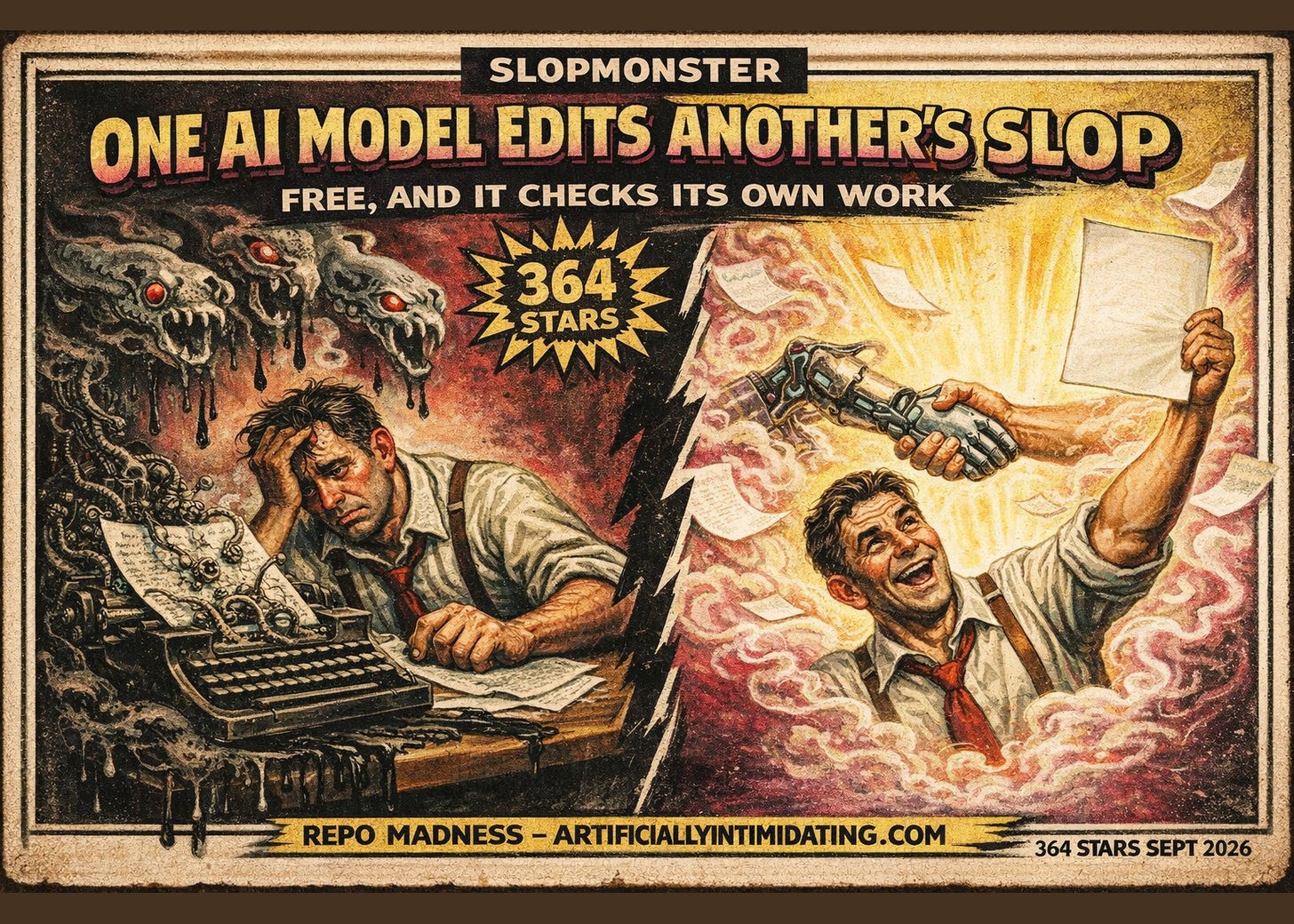
SlopMonster: The Free Tool That Makes One AI Model Edit Another's Slop
SlopMonster — a lint-rewrite-relint loop for AI-written copy. It scores your draft against five "AI tell" categories, hands it to a different model family for a rewrite, and won't stop until it scores clean.
Alternative to: a manual process, by the project's own design — its README states plainly it will never claim to "beat AI detectors," and that detector-bypass tools are deliberately excluded from what it draws on. The thing it substitutes for is a writer hand-editing an AI draft to strip the AI-ness out. No solid per-piece time figure exists publicly; treat any hours estimate here as directional, not verified.
Cost to run: free code, not free to run — every rewrite pass is a real call to a rival-family model (GPT or Claude) through whichever CLI you have installed and authenticated.
Licence: MIT.
Runs on: Python 3, standard library only, for the scoring step. No dependencies.
Requires: an already-installed, already-authenticatedcodexorclaudeCLI for the automatic rewrite step. Without either, it just prints the rewrite prompt for you to paste into a chat window yourself, for zero API cost.
Traction: 364 stars · 39 forks · 5 watchers · 14 total commits, spanning the repo's entire 19-day life.
Liveness: young and actively maintained relative to its age — one open issue is getting real design discussion, and pull requests are merging within days. About 86% of commits are from one person, Jack Roberts.
Maturity: no tags, no releases — a 19-day-old repo, not a mature one.
Links: repo · open issue on rhythm-based tells
Figures as of Sept. 17, 2026.
What it does
SlopMonster runs a four-step loop on a piece of writing. First, LINT: a dependency-free Python script scores the text out of five, checking for AI vocabulary (matched two ways — by word root, so it catches "elevates" as well as "elevate," and by exact phrase, so present-tense "we craft furniture by hand" scores clean while the AI-tell past tense "crafted" still gets flagged), 17 catalogued AI sentence shapes ("not just X, but Y," self-answered rhetorical questions), punctuation cadence (too many em-dashes in a short window), a narrow rule-of-three rhythm check, and a hard rule against inventing statistics — any number sitting next to a people-noun like "10,000+ happy users" gets flagged unless you explicitly override it.
If it doesn't score five out of five, step two REWRITEs: kill the flagged vocabulary, kill the flagged sentence shapes, then deliberately reintroduce human irregularity — varied sentence length, a rough edge, a specific real number per claim. Step three is the clever part: CLEANSE hands the draft to a different model family than whichever one wrote it. A Claude draft goes to GPT through the codex CLI; a GPT draft goes to Claude. The project's own reasoning: "a model marking its own homework is the one thing this step exists to prevent." Step four always re-lints, because the model doing the cleansing can strip old tells while introducing new ones.
What it replaces, and what that costs
This is a genuinely unusual case for what it stands opposite, because SlopMonster draws a bright line in its own documentation: this skill will never claim to "beat AI detectors." Detectors are noise. The target is a human reader's gut — and it explicitly says detector-bypass repos are excluded from what it builds on. So it isn't positioning itself against Originality.ai or GPTZero, and it isn't positioning itself against paid humanizer tools like Undetectable.ai ($9.99 to $42.50 a month depending on word volume) or StealthGPT (roughly $15 to $50 a month), even though those exist and do something adjacent.
What it actually replaces is a writer manually combing a draft for AI tells and hand-fixing them — which is exactly what its own rewrite instructions describe doing, just automated and cross-checked by a second model. There's no solid public number for how long that takes per piece. The closest data point found, from a writer who tracked a month of AI-assisted copywriting, found she saved only "an hour or so overall" using AI to draft once you count the editing time back out — which suggests manual humanizing can eat most of AI's drafting speed advantage. Treat any specific minutes-per-piece figure as an estimate, not a verified fact.
It's not free to run in practice: every CLEANSE pass is a real call to whichever model CLI you have installed, on top of whatever subscription or credits that CLI already draws from, and a genuinely stubborn draft can need several round trips before it scores clean.
Is it still alive?
Relative to its age, yes — and its age matters here. The repo is 19 days old with 14 total commits, all falling inside the last 30 days by definition. About 86% of those commits are from one person, Jack Roberts (GitHub: ItsssssJack), with two outside pull requests merged by day nine.
Whether commit frequency is even the right way to judge this kind of project is worth asking directly. This isn't a framework with dependencies to patch — it's a Python script plus a set of prompt and rule files, closer to a curated reference than a piece of infrastructure. But it isn't purely static either: the scorer has real logic that can have real bugs, and it already has — one merged pull request's own commit message says "fix two real bugs," and there's a currently open issue (#10) where a user has identified a whole class of AI writing tells the scorer's five rules don't catch: rhythmic and structural patterns, as opposed to vocabulary or punctuation ones. That issue is open with no maintainer reply yet.
What people say
Nothing on Hacker News — checked directly, and the only hits are unrelated uses of "slop monster" as a generic insult in other threads. Reddit is unreachable from where this was researched. The one real venue of discussion is the project's own GitHub issue tracker, where issue #10 is a genuinely sharp piece of feedback: the person points out that the scorer's own README contains a line — "Developers call this a linter. Everyone else can call it a checker that will not let you ship" — that is itself an example of the rhythmic AI-tell pattern the current rules don't catch. That's a good, self-owned irony, and it's real: the maintainer hasn't yet responded to it.
The catch
The scorer is explicitly English-only, and not in a way that fails loudly: the README says copy in another language "scores 5/5 because the scorer cannot read it, not because it is clean." That's a silent false-negative, by design, not a bug someone forgot to fix.
The proof-detection rule is deliberately trigger-happy — it flags any number next to a people-noun even when the number is true and sourced, on the theory that it's safer to make you manually confirm a real stat than to let a fabricated one slip through. And the pipeline has had real, since-fixed bugs of the kind that matter: a timeout used to leave a zero-byte file that the checker then stamped "CLEAN," and a formatting quirk used to corrupt drafts that contained their own markdown rules or frontmatter. Both are fixed, but they're a reminder this is young code, not a mature one.
Credits
Built by Jack Roberts (GitHub: ItsssssJack), who also built the separately popular power-design Claude skill. Figures pulled from ungh.cc, a full clone of the repository, and the project's own README, LICENSE, and source. Pricing for adjacent humanizer tools checked directly on Undetectable.ai's pricing page and a third-party review of StealthGPT's.