

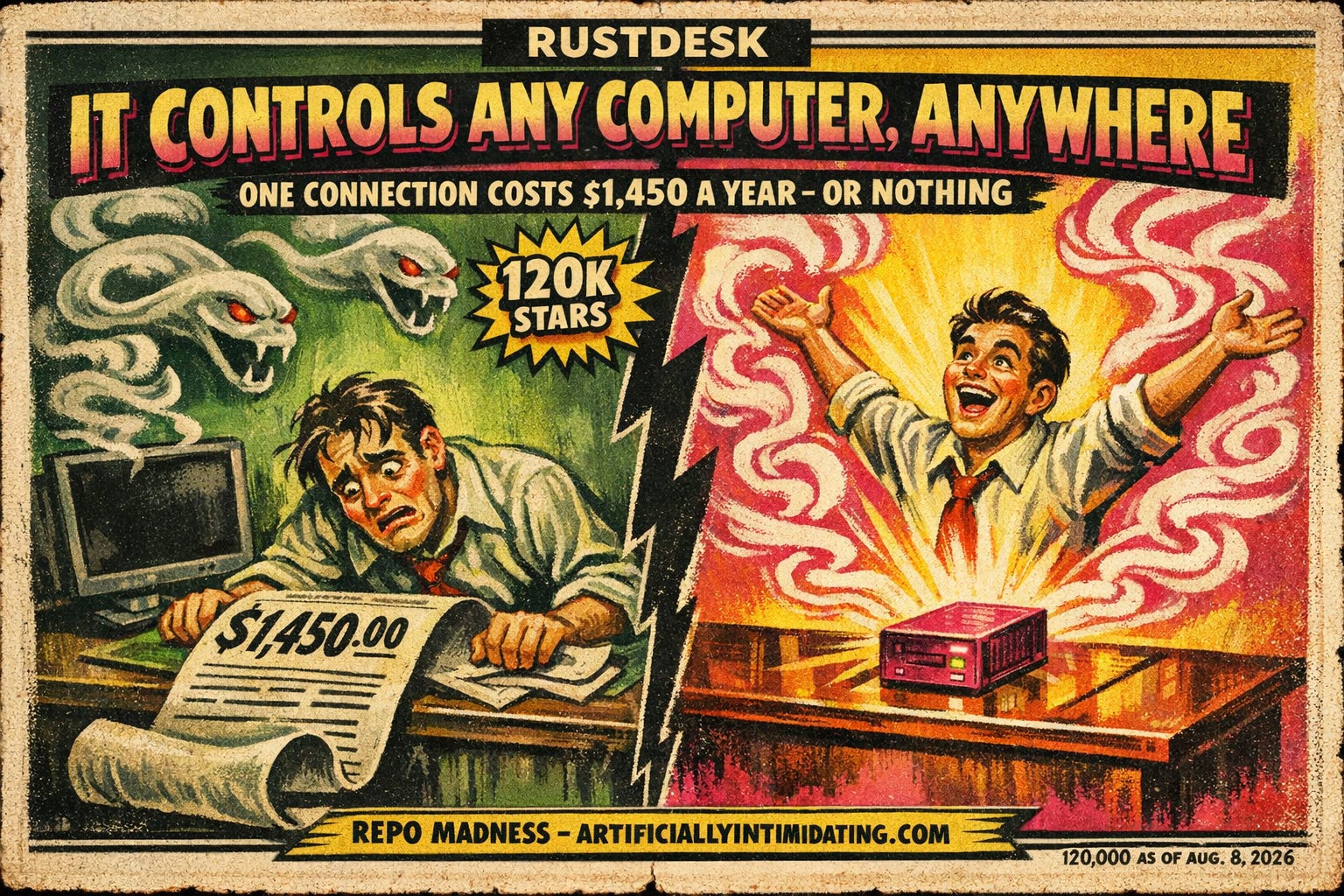
In mid-2020, a small team needed to work remotely, so they bought a commercial TeamViewer licence. Their own website describes what happened next: they were "taken aback by the exorbitant cost." Then, in the site's words, "Following a restless night, they embarked on a mission to create an alternative solution."
That's it. That's the origin story. A software invoice made someone angry enough to lose sleep, and the thing they built instead of sleeping now has 120,000 stars on GitHub.
I priced the incumbent this morning. TeamViewer Premium is $120.90 a month, billed yearly -- $1,450.80 a year. For that you get 15 licensed users, 300 managed devices, and one concurrent connection. One. If two of your people need to be on two different machines at the same time, you buy another channel. TeamViewer Assist runs $245.90 a month, which is $2,950.80 a year. Entry-level Remote Access is $24.90 a month.
AnyDesk is not meaningfully cheaper. Solo is $28.90 a month for one connection, one user, 100 managed devices. Standard is $49.90 a month and still starts at one connection -- extra connections are $29.90 each, per month. Advanced is $111.90 a month for two.
RustDesk costs nothing. You can point it at their public relay for free, or run your own relay on a VPS for the price of the VPS. If you want their hosted console with SSO and access control, RustDesk Pro is $11.88 a month for an individual and $23.88 for the basic tier. That's roughly a fifth of the AnyDesk Solo price, for more.
Here's the part I keep turning over. I'm a small business. If TeamViewer had repriced for 2026 reality, I'd have no reason to leave. Charge a fair price and you keep me. Don't adjust, and you don't lose me to a competitor. You lose me to a free repo built by someone your own pricing radicalised.
And if a small business can make that swap on a Saturday, think about what an enterprise client is paying, and how many more engineers they have sitting there to roll their own tooling from an open-source base. Stale pricing funds the people building your replacement.
What it actually does
RustDesk is remote desktop. You install it on a machine you want to reach and a machine you're reaching from, you get an ID and a password, and you connect. Windows, macOS, Linux, Android, iOS, and a web client.
Two things make it different from the incumbents. First, no account is required. There's no seat you're renting, so there's no seat count to enforce, and no "we've detected commercial use" popup mid-session. Second, you can run the whole backend yourself. The rendezvous server that maps IDs to addresses, and the relay that forwards traffic when a direct connection can't be made, are both yours to host.
The connection tries to go peer-to-peer first. The relay is the fallback for when NAT traversal fails. On their public servers, that means RustDesk's infrastructure sits in the path some of the time, and the ID server has to know which device talked to which, when. That metadata is the actual price of the free tier, and self-hosting is what buys it back.
It's written in Rust, hence the name. The desktop UI moved from the proprietary Sciter runtime to Flutter in version 1.2.0.
Why I'd deploy it
The bill. That's the honest answer.
I'm going to start on the public relay, because I want to know the thing works before I stand up infrastructure for it, and because the fastest way to find out whether a free tool is actually good is to use the zero-effort version first. If it earns it, I'll move to my own relay. At that point the metadata question closes and the cost is a $5 VPS.
That's the same shape as the Buzz self-hosting run: prove the software, then own the infrastructure. Nothing about RustDesk changes the order of those steps.
Is it actually trending
Yes, and it has been for years, which is a different and better signal than a one-week spike.
As of today, August 8 2026: 120,000 stars, 18,300 forks, 620 watchers, 11,303 commits, AGPL-3.0. Trendshift records that rustdesk/rustdesk "has been featured on GitHub Trending, first reaching #1 on Jan 21, 2024," and that it has trended on Trendshift's daily, weekly, monthly and yearly lists.
The liveness check is where it gets interesting. The most recent commit landed at 01:33 UTC this morning. The latest release is 1.4.9. And there are 78 open issues against 4,208 closed, on a repo with 120,000 stars. That ratio is not normal. Most projects at this scale have four-figure issue backlogs. Someone is triaging.
One detail I didn't expect: a large share of recent commits are co-authored by claude. The maintainers are shipping with Claude Code, including a Wayland portal fix (#15726) in exactly the area of one of their longest-standing open bugs.
What the community says
The r/rustdesk conversation over the last 30 days is small and unglamorous, which is its own kind of signal. This is a tool people use rather than argue about. Twelve threads, 99 comments.
The line that sums up the whole category came from u/neophytenomad in a thread called "Learn me bout Rustdesk": "Im a Teamviewer refugee myself." Refugee. Not "user," not "switcher." That word is doing a lot of work about how people arrived here.
On the public-relay question, u/TedGal was answering someone trying to set this up for elderly family, and put it plainly: "By Rustdesk company. ;) I was using it for months before self-hosting it, never had a problem."
And the most-upvoted piece of advice in the window is a hardening note, not a feature. u/DETOMINE1234, 12 upvotes, in a thread titled "Is rustdesk Safe and legit.": "Short answer, yes it is. Just remember that this is a powerful tool (remote control and all that), so depending on how you use it, it may need hardening and/or specific configuration." The most popular reply under it, from u/Roofless_ at 7 upvotes: "RustDesk + Tailscale. Good combo."
That's the community's actual recommended configuration, and it's worth more than any feature list.
The honest catch
Three, and I haven't run this yet, so these are reported rather than earned.
The free relay is shared infrastructure with no SLA. RustDesk posted publicly this year that they are "working hard to make our free RustDesk public servers safer and reduce botnet abuse that harms innocent users," and noted that the work "sometimes brings attacks and hostility." Read that as: the free relay is being actively defended against abuse, which is reassuring about their intent and a warning about your dependency. Fine for helping your mum. Not something to build client work on.
If you're not on Windows, budget pain. Three issues are pinned at the top of the tracker, and two have been open for years: macOS screen-recording permission failures (#3261, open since February 2023) and screen capture failing under Wayland on KDE Plasma 6 (#8600, open since July 2024). Pinned means acknowledged. It does not mean fixed.
Scammers use it, and your users have heard. RustDesk's own homepage opens with a warning in capital letters, "WARNING: YOU MAY BE BEING SCAMMED!", telling people not to install it if a stranger on the phone asked them to. That's the correct thing for them to do, and it's a real cost you inherit. There is a reason a thread titled "Is rustdesk Safe and legit." pulls 30 comments. Whoever you install this on will need that conversation.
The dissent worth recording: nobody in the last 30 days of r/rustdesk argued that it's bad software. The pushback is entirely about configuration and trust, not capability. Take that for what it's worth -- it's a subreddit for the product, and people who bounced off it don't post there.
The verdict
I'm installing this one. Public relay first, my own relay after it earns it.
What I want to know is the part no spec sheet answers: how it behaves on a real network with real NAT, what the self-hosted relay actually costs to run for a month, whether the macOS permissions are as bad as the tracker suggests, and how long it takes to get from docker compose up to a working connection. If it survives that, there's a field report in it.
Credits
RustDesk is built by Purslane Tech Pte. Ltd. in Singapore, published under AGPL-3.0. The core team lists Joseph Jacks as CEO (he founded OSS Capital in 2018 and helped start KubeCon before it was donated to the Linux Foundation) and Daniel Lamb as Community Assistant.
Recent merged work in this window came from lunar-me, fufesou, xPrimeTime, panos78, maisondasilva, Fadouse, Stephan-P, Mr-Update, danielmarschall, and the rustdesk maintainer account.
The community reads above are from u/neophytenomad, u/TedGal, u/DETOMINE1234 and u/Roofless_ in r/rustdesk. Star and trending history via Trendshift.