

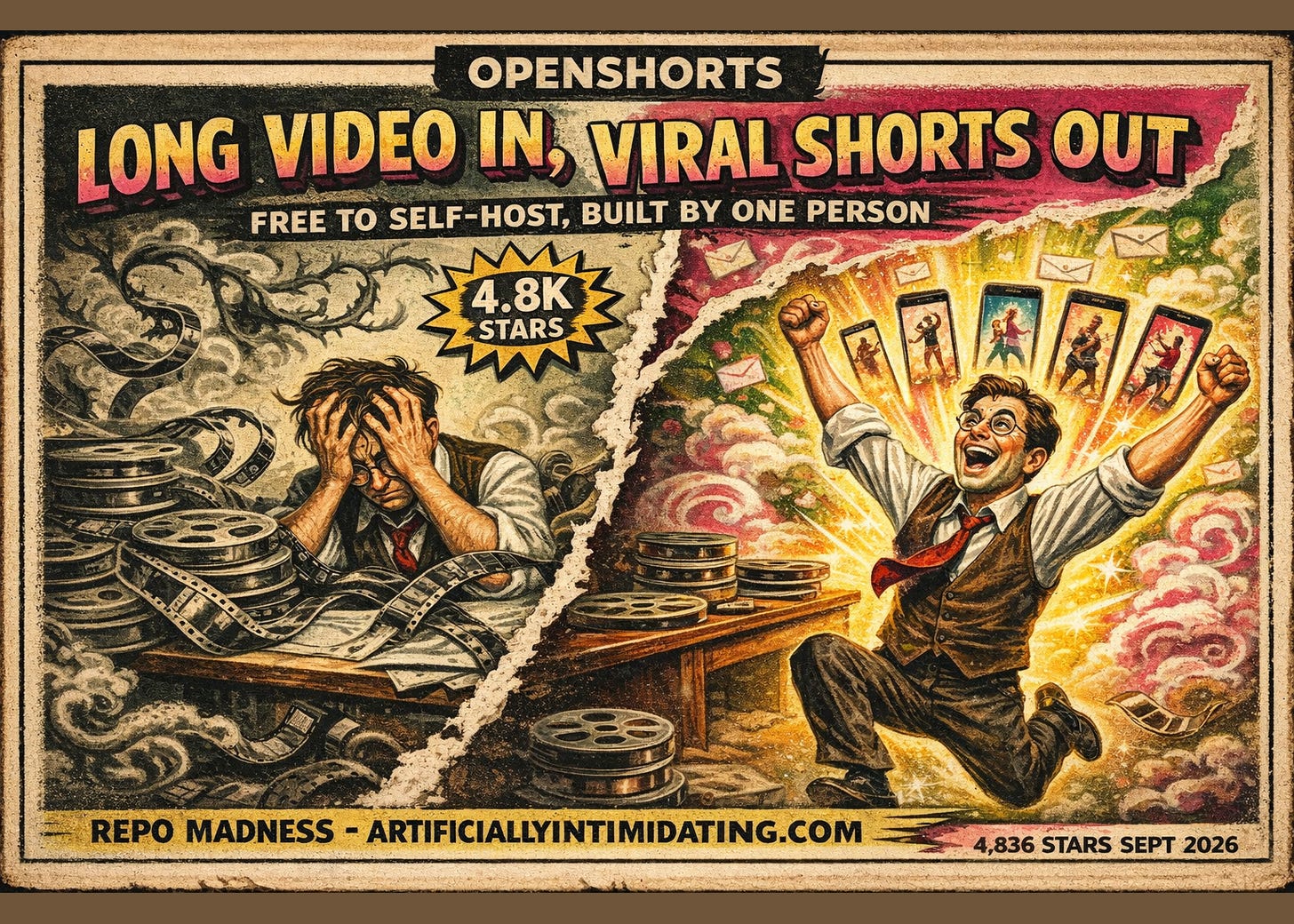
OpenShorts: The Free Opus Clip Alternative You Can Self-Host
OpenShorts — turns a long video into short, vertical clips automatically: AI picks the highlight moments, tracks faces to reframe for 9:16, burns in styled captions, and can dub the result into 30-plus languages.
Alternative to: Opus Clip Pro, $29/mo ($14.50/mo, $174/yr, billed annually) for 3,600 credits a year and no watermark. Quso.ai (formerly Vidyo.ai) Essential, $39/mo ($26/mo billed annually). Manual editing runs roughly 30 to 60 minutes of an editor's time per finished minute of video — a 20-minute source video is 10 to 20 hours by hand.
Cost to run: free, self-hosted, MIT-licensed core. Not free to run at scale — it needs a Gemini API key (free tier available) for moment detection, and its AI Shorts feature costs $0.65 to $2 per video in third-party API calls (ElevenLabs, fal.ai). Its own hosted cloud tier starts at $12/mo for 100 minutes.
Licence: MIT for the self-hosted core. Thecloud/directory alone carries a separate source-available commercial license — readable and self-hostable for personal or internal use, not resellable as a competing paid service.
Runs on: Docker and Docker Compose, 8GB+ RAM. CPU-only by default (5 to 8 minutes to clip an 8-minute video); an NVIDIA GPU cuts that to about a minute.
Requires: a Gemini API key (or any OpenAI-compatible local model via Ollama, LM Studio, or similar, for moment-picking only — some features hard-require Gemini). ElevenLabs for dubbing. Upload-Post for direct social publishing.
Traction: 4,836 stars · 1,173 forks · 35 watchers · 158 commits in the last 30 days, 326 in the last 90.
Liveness: very live — near-daily commits, last push yesterday. One person, Juan Carlos Cavero Gracia, wrote about 89% of all 426 commits, under two different git identities.
Maturity: no tagged releases and no version numbers in nine months of development — self-hosters run unpinnedmain.
Links: repo · site
Figures as of Sept. 17, 2026.
What it does
OpenShorts is three tools bundled into one FastAPI-and-React app. The main one, Clip Generator, transcribes your video word-by-word (faster-whisper), finds scene boundaries (PySceneDetect), then has Gemini score the transcript against those scenes to pick three to fifteen "viral moments," each 15 to 60 seconds. FFmpeg cuts the moments precisely, then an AI reframing step picks a layout per scene — tracking a single speaker's face, blurring the background for a wide shot, splitting the frame for two speakers, or inset-screencasting a presenter over their screen — and burns in styled captions. There's an optional dubbing pass through ElevenLabs that can translate and re-voice the clip in over 30 languages.
A second mode, AI Shorts, goes further: give it a URL or a brief, and it writes a script, generates an AI presenter, voices it, animates it, and composites b-roll into a finished short — no source footage required. A third mode handles YouTube titles, thumbnails, and descriptions, and publishes directly. It also ships as an MCP server and a pip install-able CLI, so an AI agent can call it directly.
What it replaces, and what that costs
Opus Clip's Pro tier is the closest direct comparison: $29 a month month-to-month, or $14.50 a month ($174 a year) billed annually, for 3,600 credits a year and no watermark — its free tier caps you at 60 credits a month and stamps a watermark on everything. Quso.ai, which absorbed the once-separate Vidyo.ai brand, prices its Essential tier at $39 a month, or $26 a month billed annually.
The honest manual-labor comparison is real too: the industry rule of thumb is 30 to 60 minutes of an editor's time per finished minute of video, which puts a 20-minute source video at 10 to 20 hours by hand.
OpenShorts itself isn't zero-cost once you're actually using it — its own hosted cloud tier starts at $12 a month for 100 minutes, and self-hosting still means paying Gemini, ElevenLabs, and fal.ai for the calls it makes on your behalf. AI Shorts alone runs $0.65 to $2 per generated video. This isn't a saving if you weren't already paying Opus Clip or Quso.ai — it's an avoided cost, and the workflows aren't identical, since OpenShorts leans on your own API keys rather than a flat subscription.
Is it still alive?
Very, and moving fast. It's nine months old, created in December, with 158 commits in the last 30 days alone and a push as recently as yesterday. But it's essentially a one-person project: Juan Carlos Cavero Gracia wrote 381 of the repo's 426 commits — about 89% — under his primary git identity, with a handful more under a secondary identity and the GitHub account "mutonby." There are zero tagged releases and zero GitHub releases in nine months of work, which means anyone self-hosting is running unpinned main with no version discipline.
A screening pass on this repo flagged a cluster of near-identical forks under other GitHub accounts as a possible "clone farm." That doesn't hold up on a closer look — the forks in question are legitimate GitHub forks, flagged as forks by GitHub itself, not separate copy-pasted repositories farming stars. The fork-to-star ratio is unusually high, which is more likely explained by people forking specifically to strip the paid-cloud branding and run their own instance for free, since the entire product pitch is "self-host free or pay us $12 a month."
Mutonby is a real, identifiable person. His GitHub profile links to a LinkedIn under the name Juan Carlos Cavero Gracia and an X handle, @fotoexamen, and lists Upload-Post — the same paid social-publishing service OpenShorts requires an API key for — as his own site. He's also the builder of shortcast, a separate macOS clipping app with 381 stars and its own independent traction, which argues for a real, repeat builder rather than a one-off drop.
What people say
Thin. There's a single Show HN post from March, one point and zero comments. No Product Hunt listing. No independent reviews found. What little indirect signal exists: indie hacker Pieter Levels replied to the maintainer's X account once, suggesting some visibility in that circle, though the full context of that exchange wasn't retrievable. Outside of GitHub's own star count, there's essentially no independent press on this project.
The catch
Even skipping Gemini for moment-picking with a local model, Gemini is still hard-required for automatic layout selection, on-screen content detection, and any video without dialogue — it doesn't fully work offline. The local-LLM path is fragile in its own right: Ollama's default context window silently truncates unless you raise it, and smaller models don't reliably return valid output.
The free hosted tier is watermarked and capped at 20 minutes a month; the cheapest paid tier, $12 a month, only buys 100 minutes — about 12 cents a minute. And every social-publishing feature routes through Upload-Post, a separate paid dependency built by the same person who built OpenShorts, beyond its own 10 free uploads a month.
With zero tagged releases in nine months and roughly 89% of the commit history from one person, anyone self-hosting this is betting on one builder's continued attention, with no version pins to fall back to if something breaks.
Credits
Built by Juan Carlos Cavero Gracia (GitHub: mutonby, X: @fotoexamen). Figures pulled from ungh.cc, a full clone of the repository, and the project's own README and LICENSE. Pricing verified directly on Opus Clip's and Quso.ai's own pricing pages.