

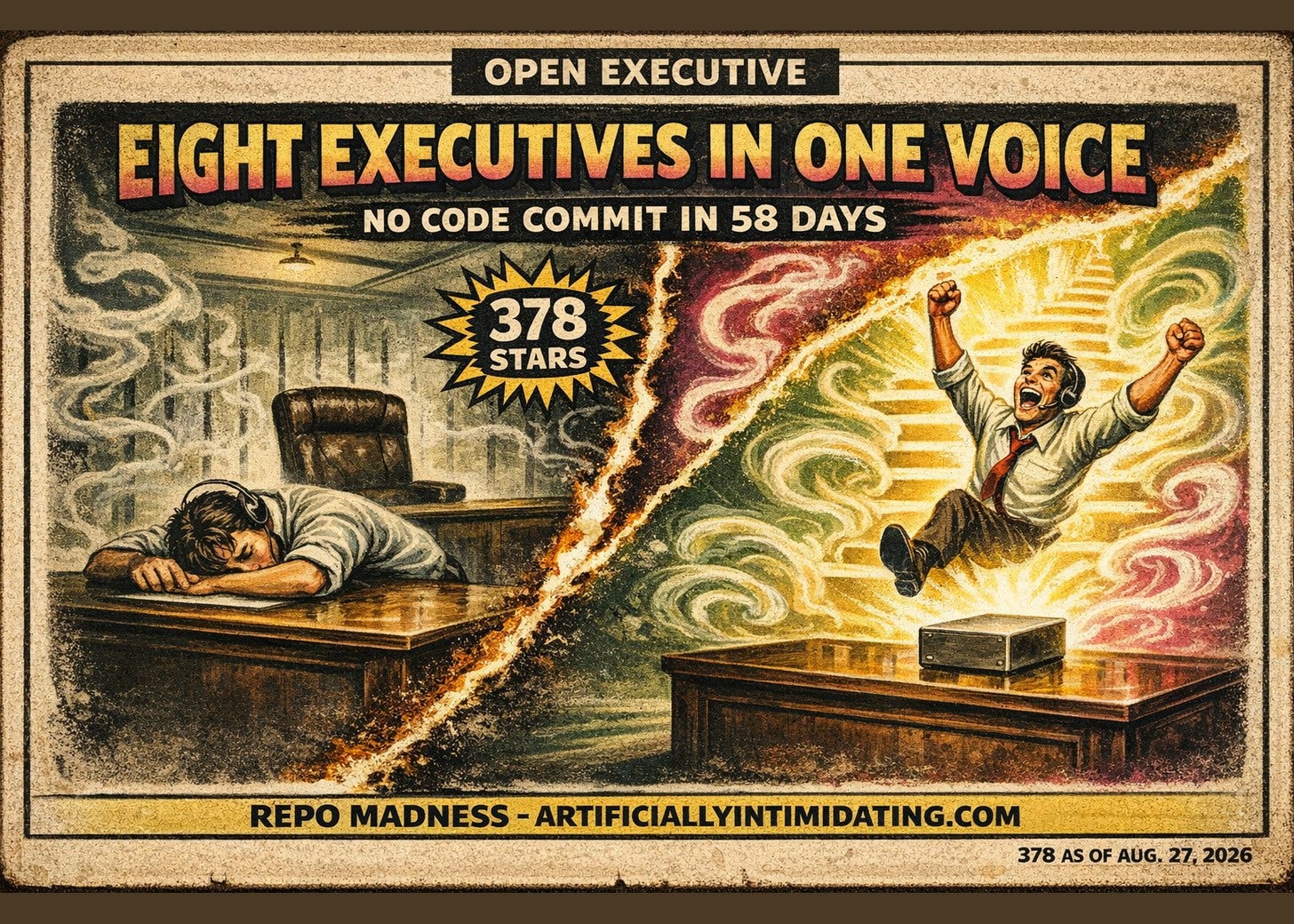
Open Executive — a self-hosted AI system that acts as a company's executive team: one executive voice backed by eight specialist Claude agents.
Alternative to: one fractional executive seat. Go Fractional's own 2026 CFO benchmark: average $176/hr, 25th percentile $125/hr, 75th percentile $220/hr, typical scope 23 hours a week, starting retainer from $11,500/mo — for ONE function, from listing data rather than a rate card.
Cost to run: $0 licence. Compute is Anthropic API at list — claude-opus-4-7 at $5/$25 per million tokens on four specialists, claude-sonnet-4-6 at $3/$15 on the rest, claude-haiku-4-5 at $1/$5 for routing and a background pass after every reply. Per-turn total unmeasured. A no-key local-model path exists.
Licence: Apache-2.0. Free for commercial use, requires attribution.
Runs on: self-hosted — Linux, macOS, Docker. Fly.io configs ship in the repo.
Requires: Python 3.11+, Node 22+, and either an Anthropic API key or a local OpenAI-compatible server. First boot downloads a ~90 MB embedding model. One API instance only.
Traction: 378 stars · 32 forks · 7 watchers · 16 commits on main · 5 contributor accounts · 1 open / 1 closed issue · 11 open pull requests, every one from dependabot.
Liveness: slow — 888 files landed in one commit on 2026-06-11, and main has taken no commit touching code since 2026-06-30; the only two commits in the last 30 days are README demo-video edits made on 2026-08-26. Last commit 2026-08-26.
Maturity: CHANGELOG declares 0.1.0 dated 2026-06-30 and links to a release tag. The repo has no tags and no releases. SECURITY.md says "Always run the latest `ma
n`."
Links: repo · sentelabs.ai · Hacker News thread, 232 points and 143 comments
Figures as of August 27, 2026.
What it does
You describe your company once — industry, stage, headcount, revenue model, competitors, priorities — and upload whatever documents you have. After that you talk to one advisor.
Behind that advisor sit eight specialists: Strategy, Finance, HR, Legal, Operations, Marketing, Product, and Board Communications. A router decides which ones a question needs and calls them in parallel. Each one pulls context from two places: a built-in library of 96 markdown files running to roughly 99,000 words, and a separate index of your own uploaded documents. Their answers get synthesised into a single reply. You never see the handoff.
Two things sit on top of that. After every response, a cheap background pass extracts decisions and initiatives into a SQLite file, so the next session opens knowing what it told you last month. And a scheduler can fire on its own — surfacing a follow-up before you ask for it.
It talks through a web UI, Slack, Discord, Telegram, Google Chat, email, or a CLI.
What it replaces, and what that costs
The reader this is aimed at has a seat nobody is sitting in. Not a full-time CFO — a founder who needs finance judgment eight hours a month, or marketing judgment, or someone to read a contract before it gets signed.
What they do today is hire a fractional executive.
Go Fractional, a marketplace that places them, publishes its own 2026 rate distribution for fractional CFOs:
25th percentile: $125/hr
Average: $176/hr
75th percentile: $220/hr
Typical engagement scope: 23 hours a week
Starting retainer: from $11,500/mo
Three limits make that comparison honest. It covers one function, not eight. The distribution is built from live listings and candidate profiles, not from a published rate card. And 23 hours a week is near-full-time fractional — the light advisory arrangement most small companies actually buy costs far less, and Go Fractional publishes no tier for it.
Do not multiply that by eight. Open Executive ships eight specialist roles, but nobody hires eight fractional executives. One seat is the honest unit of comparison.
What the repo costs instead
The licence is free. The compute is not.
Open Executive defaults to three Anthropic models, and the repo names them explicitly. At Anthropic's published list prices:
`claude-opus-4-7` — $5 in / $25 out per million tokens — pinned to four specialists (Strategy, Finance, Legal, Board) with extended thinking on
`claude-sonnet-4-6` — $3 in / $15 out — the Executive persona and the remaining four specialists
`claude-haiku-4-5` — $1 in / $5 out — intent routing, plus the memory-extraction pass that runs after every single reply
The architecture is expensive on purpose. One question fans out to several specialists at once. Four of them sit on the most expensive tier. There is a committee mode that runs draft, then three parallel critiques, then a revision — five model calls for one answer.
What a month actually costs is unverified. The project publishes no figure. Nothing in `docs/` estimates one. Nobody in a 143-comment thread posted a measured number. Prompt caching is built in and the README claims up to 85% cache hits after a few turns, which cuts input cost substantially — but 85% of an unknown is still unknown.
There is one way to run it for nothing. The local-model path takes any OpenAI-compatible server — Ollama, LM Studio, vLLM, llama.cpp — and works with no Anthropic key at all. Server-side web search, prompt caching and extended thinking are disabled on that path, and the README warns that small models route badly because the whole design leans on tool use.
Is it still alive?
This is where the entry turns.
The repository is substantial. 888 files landed in the first commit on 2026-06-11. 508 Python files. A FastAPI backend, a Next.js 15 frontend, 42 eval scenarios scored by an LLM judge, deployment runbooks, a security policy, a code of conduct.
Then look at the log.
The last commit that touched a `.py`, `.ts` or `.tsx` file was 2026-06-30 — 58 days ago. Between 2026-07-03 and 2026-08-26 the repository received no commits at all, a 54-day silence. The only two commits inside the last 30 days both landed on 2026-08-26, both edit the README, and both add a link to a demo video. Hours later the project was submitted to Hacker News.
Eleven pull requests are open. Every one is from dependabot. The oldest was opened 2026-06-30. Two of them — `nanoid` and `dompurify` — are the kind you merge quickly. Neither has been merged, while SECURITY.md tells you to always run the latest `main`.
The CHANGELOG declares a 0.1.0 release dated 2026-06-30 and links to `releases/tag/v0.1.0`. Checked two ways — a full clone and the releases API — the repository has no tags and no releases. The link goes nowhere.
Two issues have ever been filed. One was closed the day after it was opened, in July, by the contributor who filed it and then wrote the patch himself. The other, opened 2026-08-26, is a stranger asking the maintainers to join his Discord. Discussions are enabled and completely empty.
What does work: the deployed instance is real. `openexec-api-dev.fly.dev/health` returns 200 and the UI redirects to a Google sign-in exactly as documented. Nothing 404s. This is not Cattr, where every download was a dead link.
So: slow, not abandoned. Two months of real work, then two months of quiet, then a README edit and a front-page post. Whether the code resumes is the open question, and the log is the only honest answer available today.
One number was moving while this was being written. Stars went from 357 to 378 in about ninety minutes on the morning of August 27. Treat every count here as a snapshot.
What people say
The Hacker News thread hit 232 points and 143 comments. Almost none of it is about the software. It is a referendum on whether executives are replaceable, and the repo is the prompt.
Reddit is blocked from the research sandbox, so no vote counts from it are claimed here. Hacker News does not expose per-comment scores through its API, so none are printed. The quotes below link to the individual comments.
The sharpest reading came from someone who actually opened the knowledge files and quoted them back:
"CEO here, thanks just fired all my C suite team... 'Walking away costs you the deal. Signing costs you the company. The math is obvious in retrospect; harder in the moment when there's quota pressure' — such valuable, should I say load-bearing insights"
— euio757
On cost, one line got there before anyone else:
"looks like a good way to run up a really large anthropic token bill."
— walrus01
The most useful objection is the cheapest one:
"That said, if you look at what it's actually doing (read the question carefully, then read what it actually said) I am not convinced this is better than what ChatGPT could do out of the box already."
— janalsncm
And the strongest case for it, which is not about CEOs at all:
"A serious point about this is that it's an AI that's an organization. This matters... Everybody has been talking about 'human-level AI', or 'superhuman-level AI'. This is a different kind of AI — corporate-level AI."
— Animats
One question in the thread never got answered. The submission's framing is that a team was fired to make room for AI and built this in response. A commenter asked which company — "I don't see that in the repo but maybe I missed it." Nobody said. The submitter, GrumpySciGuy, is on the team, and confirmed the story without naming the employer: "Team was let go. Decided to do a startup."
The catch
The story is the product's marketing, and it was posted by the team. "CEO fired developers, developers built an AI CEO" is a good hook. It is also a submission by a company founder about his own company's repo, with the firing employer unnamed and unverifiable. That does not make it false. It makes it unchecked.
This is a consulting funnel, and the team says so plainly. Sente Labs sells discovery engagements and paid support for deploying its open tools. On Hacker News: "We open sourced this knowing that if people find this useful we can get a support work out of it (similar to the Redhat model)." That is an honest answer to a fair question. It also explains a repo with 888 files, five contributor accounts and no roadmap.
The first commit is signed by an AI. The 888-file initial release is authored by `Claude <noreply@anthropic.com>`. So are both README commits from 2026-08-26, on a branch named `claude/add-demo-video-readme-tkv5o3`. Of five contributor accounts on the repo, one is dependabot and one is Claude.
You cannot scale it. The scheduler claims jobs with `UPDATE ... RETURNING`, so two API machines double-fire every scheduled action. `max_machines_running = 1` is set in the Fly config and the README says not to override it.
The README has drifted. It states that `evals/` contains 29 scenarios. `evals/` contains a runner and two judges; the 42 scenario files live under `packages/core/openexecutive/evals/_scenarios/`. Small, but it is the kind of drift that accumulates when nobody is committing.
"Harvard MBA-level knowledge" is the project's phrase, not a measured claim. What is actually there is 96 markdown files, roughly 99,000 words, written by the team.
Your company profile leaves your machine. Everything under `company/` is gitignored and stays local, but the profile and retrieved document chunks go into prompts sent to whichever API you configure. On the local-model path, they do not.
My read
Nicholas is not going to run the agent stack. His read is that the knowledge base is the asset.
That is defensible. The 96 markdown files are Apache-2.0, free for commercial use with attribution, and they do not need a maintainer, a scheduler, a vector store, or a single Opus call. They are the part of this repo that cannot go stale in a 58-day silence, because a written framework has no dependencies to bump. Lifting them into an existing Claude setup gets the thinking without the operational surface.
The honest accounting: OutSnapped already pays a bookkeeper, an accountant and a fractional CMO. Doing this stops none of those. Those are people doing work, not a subscription with a cancel button, and a markdown library does not do their jobs. Nothing here reduces an invoice. What it adds is a set of frameworks to think with, at zero marginal cost, which is a different and smaller claim than a saving.
If the commit log wakes up, the agent stack is worth a second look. If it survives that, there's a field report in it.
Credits
Built by Sente Labs (sentelabs.ai). Named contributors on the repository: John "Rufus" Johnson (johnrufusone), Alex Cohen (kilrathu), and Dan Maiale (dtmaiale), whose local-model pull request is the only outside code contribution merged to date and the reason the no-API-key path exists.
Voices quoted: euio757, walrus01, janalsncm, Animats, cactusplant7374 and GrumpySciGuy on Hacker News.
Data sources used for this entry: a full `git clone` of the repository for commit, authorship and branch history; the `ungh.cc` GitHub mirror for counts; GitHub's issue and pull request pages; the Hacker News API for thread and comment permalinks; Go Fractional's published 2026 CFO rate benchmark; and Anthropic's published API price list.