

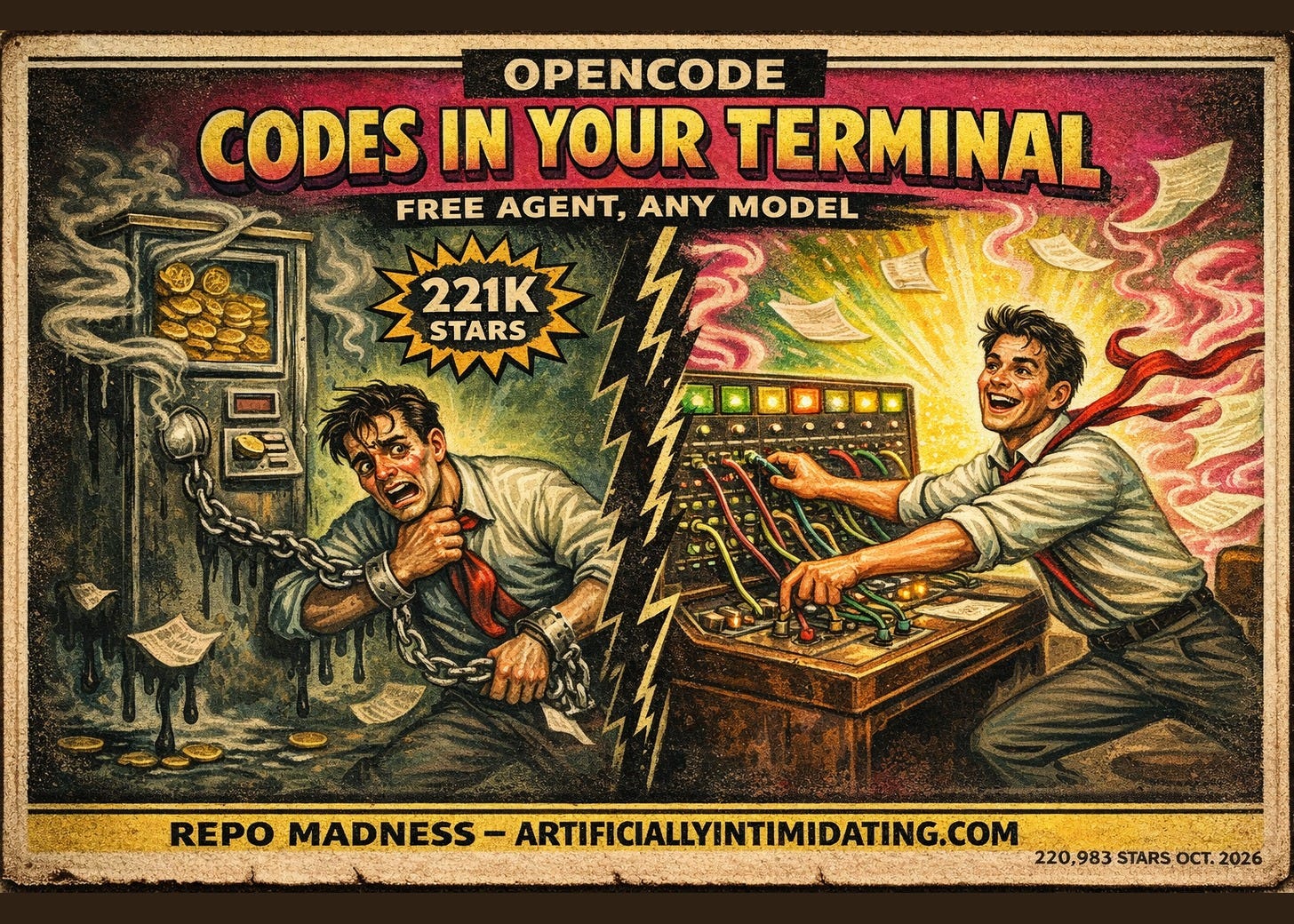
OpenCode — a free, MIT-licensed coding agent that runs in your terminal, reads your repo, edits files and runs commands, with any of 75+ model providers behind it.
Alternative to: Claude Code, included in Claude Pro at $20/month billed monthly, or $200 a year billed up front (the page rounds that to $17/month). Also Cursor, whose page now starts paid plans at Plus $8/month (Grok models only) and Premium $30/month, and GitHub Copilot Pro at $10/user/month.
Cost to run: the client is $0, and it ships with free models you can use without an account. Anything better means paying a model provider. OpenCode's own options are Zen (pay as you go, $20 top-ups plus a $1.23 card fee) and Go ($10/month or Go Plus $40/month). The project publishes no monthly cost estimate.
Licence: MIT. Free for commercial use.
Runs on: macOS, Linux and Windows, in the terminal, with a desktop app and web UI.
Requires: a model. That means an API key, a supported subscription login (ChatGPT Plus/Pro or GitHub Copilot; the v1 docs also list GitLab Duo) or a local model through Ollama. Claude Pro/Max logins are not supported.
Traction: 220,983 stars · 29,544 forks · 20,846 commits · highest issue/PR number referenced in commits: #58731. GitHub shows about 2.5k open issues and 1.3k open PRs.
Liveness: very live — 1,246 commits in the last 30 days, npm
@opencode/cli2.1.4 on October 23. Last commit October 24, 2026.Maturity: version 2.1.4 on npm, while GitHub Releases still carries the v1 line (v1.19.4, October 22). SECURITY.md says: "OpenCode does not sandbox the agent."
Links: repo · site · Hacker News thread, 1,274 points
Figures as of October 24, 2026.
What it does
OpenCode is a coding agent. You open it in a project folder and tell it what you want in plain English. It reads the code, edits files, runs commands and shows you what it did.
It is the same kind of tool as Claude Code, OpenAI's Codex CLI and Cursor's agent. The difference is the model. OpenCode is not tied to one company's AI. It connects to more than 75 providers, plus local models on your own machine.
Version 2.0 went out on npm on September 11 and was formally announced on October 12. It added a background service, background subagents, a rewritten API and a "Code Mode" that every MCP server uses by default.
The project lives at anomalyco/opencode. It used to be sst/opencode, and its code switched to the new address on January 2, 2026. The old address still points here. The lead maintainer is Dax Raad.
What it replaces, and what that costs
The closest incumbent is Claude Code, which you get with a paid Claude plan. Prices from each vendor's own page:
Claude Pro — $20/month billed monthly, or $200 a year billed up front (the page rounds that to $17/month). Claude Code is included
Claude Max — "From $100" per month. The page would not show the higher tier's plan price, so it is UNVERIFIED here
Cursor — Plus $8/month (Grok models only), Premium $30/month, Super $100/month, Ultra $200/month, Teams from $30/user/month
GitHub Copilot — Pro $10/user/month, Pro+ $39, Max $100. Copilot Business price did not render: UNVERIFIED
Cursor's page has changed. It no longer lists the Pro and Pro+ tiers. Premium and above include "generous usage of Grok models" but no allowance for other companies' models. Those are billed at API list price.
OpenCode itself costs nothing. But a coding agent is only as good as the model behind it, and the model is where the bill lives. OpenCode does not make that bill go away. It lets you choose who sends it.
Your options, roughly from cheapest:
Free models — bundled, no account needed. The lineup changes with promotions, and OpenCode says your data is stored only when you use these free models
Local models — free per token, through Ollama, on your own hardware
A subscription you already pay for — ChatGPT Plus/Pro, GitHub Copilot or GitLab Duo. Usage counts against that plan
OpenCode Go — $10/month, or Go Plus at $40/month, with limits that reset every 5 hours, weekly and monthly
OpenCode Zen — pay as you go. You start by adding $20, plus a $1.23 card fee per $20 top-up (about 6%). It claims "zero markups" on the models themselves
Your own API key — any of 75+ providers, billed by them
The one thing missing from that list: a Claude subscription. More on that below.
Is it still alive?
Very. 1,246 commits landed in the last 30 days, and the last one was today.
It ships constantly, on two tracks at once. Version 2 goes out on npm as @opencode/cli. That is what the README and the installer now push. Version 1 keeps getting patched on GitHub Releases and on npm as opencode-ai. There is no v2 release on GitHub, only tags.
The downloads download. The v1.19.4 Linux build from GitHub returned 79,667,571 bytes. The v2.1.4 Linux package from npm returned 113,868,298 bytes.
This is a big team, not a solo project. 891 different email addresses committed in the past year. The top human committers are Dax Raad (2,910 commits), Aiden Cline (2,382), Kit Langton (2,172) and Adam Elmore (2,077), after merging each person's duplicate identities. A bot, opencode-agent, has 2,590.
On Trendshift it peaked at #1 TypeScript repository of the day, first on June 15, 2025, and #1 repository of the week across all languages in week 2 of 2026.
What people say
OpenCode gets real attention on Hacker News. Its launch-style thread in March drew 1,274 points and 618 comments. The 2.0 announcement drew 888 points. Reddit is blocked from the research sandbox, so no vote counts from it are claimed.
A fan, vadepaysa, on the March thread (comment):
"OpenCode Zen almost always has a FREE coding model that you can use for all kinds of work. I recently used the free tier to organize and rename all my documents."
A lukewarm one, nater5000, on the 2.0 thread, October 14 (comment):
"I've only used OpenCode a bit, but I found it was sufficient for the workloads I was throwing at it. It wasn't quite enough to beat out Codex or Claude Code as my go-to choice, though."
And on the breach thread, October 17, jchw asked who was affected (comment):
"I don't use OpenCode but I would like to know who this impacts. Surely people who are just using OpenCode locally with their own credentials wouldn't be impacted, right? [...] Not saying this isn't bad, but it isn't clear and they're not sharing any information."
The catch
The hosted Console was breached. On October 17, the project's own account, @opencode, posted: "We had a security breach last night related to a large scale distillation attack that impacted 1.4% of OpenCode Console users." The Console is OpenCode's hosted service, where some users save provider keys. The email users received, as posted on Hacker News, said keys "saved in your workspace may have been exposed." The free local client is a separate thing. If you ever stored keys in the Console, rotate them. About 12 minutes later the account posted an edited version that adds: "If you did not get an email you were not impacted, it was a subset of users who had external providers linked."
It can't use your Claude subscription. A March 19 commit titled "anthropic legal requests" removed the bundled Claude Pro/Max login. The v1 docs now say: "Anthropic explicitly prohibits this." You can still use Claude models with an API key, which is billed per token, not by subscription.
There is no sandbox. SECURITY.md is blunt: the permission prompts are "a UX feature," and "not designed to provide security isolation." The project has three published security advisories, and all three let an outside party run commands on the user's machine. One, a web UI cross-site scripting flaw from January, is rated Critical (9.4) and was fixed in 1.1.10. The other two are rated High, fixed in 1.0.216 and 1.18.22.
Upgrades and long sessions can bite. Open issues include #53971, titled "V1→V2 migration silently drops legacy messages missing required fields (agent/model/parentID) — old sessions show empty history," and #33356, about the local database growing past 13 GB because old events are never pruned. These are cited by title.
Free and some paid models keep or train on your data. On OpenCode Go, the Muse Spark "Contributor" models are marked as used to train future Meta models. Several others keep data for 30 days. The privacy table on the Go page lists each model.
Usage claims are the project's own. The site says OpenCode is used by "over 16M developers every month." There is no published method. The repo's own download-stats file stopped updating on January 29.
My read
The agent is free. The model never is.
That's the part people skip. You can download OpenCode in a minute and pay nothing for it. But the work happens in the model, and somebody bills you for that. Claude Code bundles the two into one subscription. OpenCode splits them apart.
So the real feature isn't the price. It's the choice. You pick who sends the bill, and you can switch when someone else gets cheaper or better. That's worth something. Just don't install it thinking your AI spend goes to zero.
If it holds up on real work, there's a field report in it.
Credits
Maintainer: Dax Raad (@thdxr), with Anomaly. Project account @opencode.
Contributors who shipped in the last 30 days: Aiden Cline, Kit Langton, Luke Parker, Shoubhit Dash, James Long, Adam Elmore, Frank, Brendan Allan, David Hill, and about 65 others.
Quoted: vadepaysa, nater5000 and jchw (Hacker News), and the @opencode account.
Data sources: ungh.cc, a git clone of the repo, the repo's README, LICENSE and SECURITY.md, the GitHub security advisories page, the npm registry, Trendshift, the Hacker News Algolia API, opencode.ai (home, Zen, Go), claude.com/pricing, cursor.com/pricing and GitHub's Copilot plans page.