

Apple spent the least on AI data centers. Now Mac Minis are sold out, Perplexity runs on one, and peer-to-peer compute pools are turning friend groups into GPU clusters. Is this Napster for the cloud era?
Neo-Napster: How Apple’s Mac Mini Accidentally Became the World’s AI Infrastructure
I was a college kid when Napster hit.
If you’re old enough to remember, you know the feeling. One day you’re buying CDs at Tower Records. The next day, every song ever recorded is sitting on your roommate’s laptop, free, waiting for you to click download. We all knew it was wrong. We did it anyway. The pull toward democratized access was stronger than any guilt trip the RIAA could throw at us.
Napster didn’t just change music. It revealed something ugly: the labels had been ripping off artists for decades, and the only thing keeping that system alive was that nobody had an alternative. Then suddenly, everyone did.
Here’s what happened next, though. The labels didn’t die. They adapted. They fought back. And somehow — through Spotify, Apple Music, and a web of equity stakes in streaming platforms — they concocted an evil genius plot to ripping off both the consumers and the artists even more than before while somehow looking like the good guy while villainizing the streaming platforms. The middlemen survived. They always do.
I’ve been thinking about this a lot this week. Because something that kinda-sorta-rhymes with Napster is happening right now in AI compute. And I’m not sure most people see it yet.
The $100 Billion Question
Right now, Amazon, Microsoft, Google, and Meta are spending roughly $100 billion per quarter on AI infrastructure. They’re building what I’ve been calling “GPU cathedrals” — massive data centers stuffed with Nvidia chips, cooled by rivers, powered by nuclear plants. It’s the biggest infrastructure buildout since the railroads.
Meanwhile, Apple’s data center spending is down 19%. They’re the runt of the litter in the AI capex race. The financial press has been writing them off. “Apple is late to AI.” “Apple doesn’t get it.” “Apple is falling behind.”
Except... Apple might have already won. They just didn’t do it the way anyone expected.
The Accidental AI Infrastructure
While the hyperscalers were building their cathedrals, Apple shipped over a billion devices running Apple Silicon. M-series chips. Unified memory. Neural Engines. Every Mac, iPad, and iPhone sold in the last four years is, quietly, an AI-capable computer.
This wasn’t supposed to matter. Apple built M-series chips because they wanted better battery life and performance for consumers. The unified memory architecture — where CPU, GPU, and Neural Engine share one big pool of RAM — was a design choice for efficiency, not an AI play.
Then something weird happened.
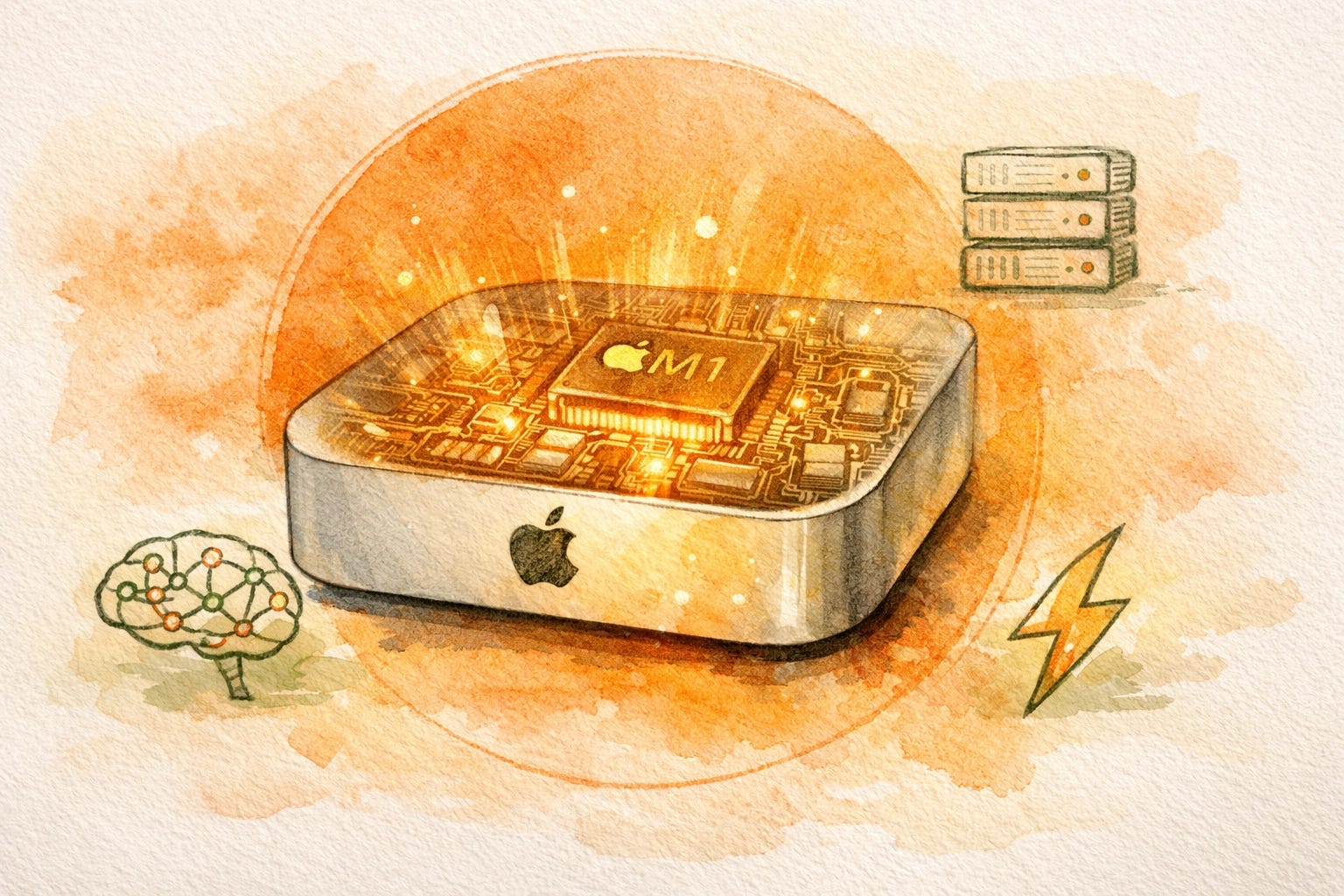
In late January, an open-source AI agent framework called OpenClaw went viral. It let you run autonomous AI agents locally on a Mac — agents that could control your apps, browse the web, manage your files, handle your messages. The catch? It ran best on a Mac mini with maxed-out RAM. (If you’re wondering how this compares to other tools, check out my breakdown on Hermes vs. OpenClaw.)
Mac minis sold out. CNN called it “the hottest Apple product right now.” Shipping estimates stretched to 10-12 weeks. People weren’t buying Mac minis to edit spreadsheets. They were buying them to run AI agents that work while you sleep. I almost bought a wall of Mac Minis myself before realizing a $6 VPS could handle the same workload in a way that better suited my personal needs.
Apple must have been pleasantly surprised. They built a consumer computer. The market turned it into an agent server.
Then Perplexity Made It Official
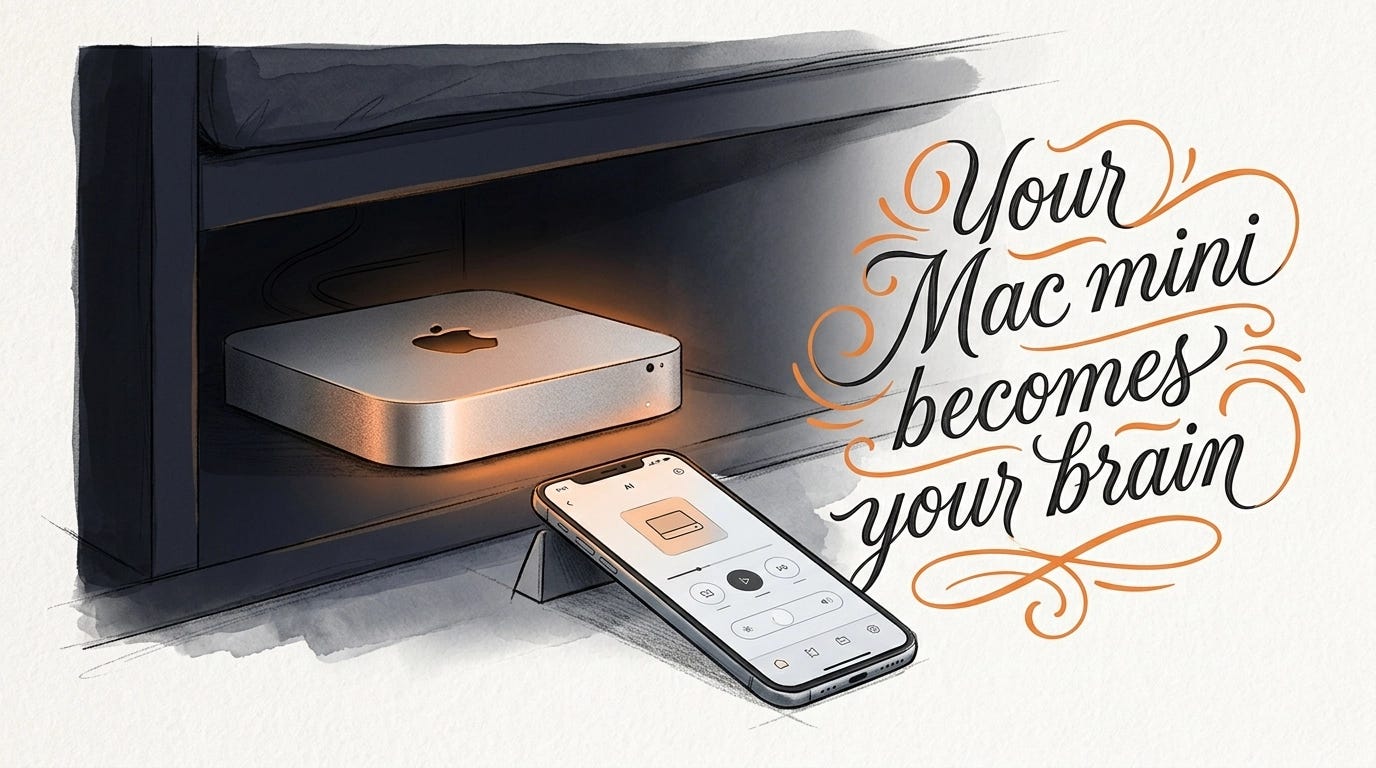
Yesterday — literally yesterday, April 16th, 2026 — Perplexity launched “Personal Computer for Mac.” The recommended setup? A dedicated Mac mini with maximum RAM, running 24/7, connected to your local files and apps.
Let that sink in. Perplexity — an AI search company valued in the billions — built a product whose primary hardware recommendation is a $599 Apple desktop computer sitting in your closet with no screen attached.
The “AI computer” is a Mac mini under your bed.
That’s not a joke. It’s a product. It costs $200/month for the Perplexity subscription, and they want you to buy a dedicated box to run it on. Your phone becomes the remote control. Your Mac mini becomes your brain.
And Now: The Pools
This is where it gets really interesting.
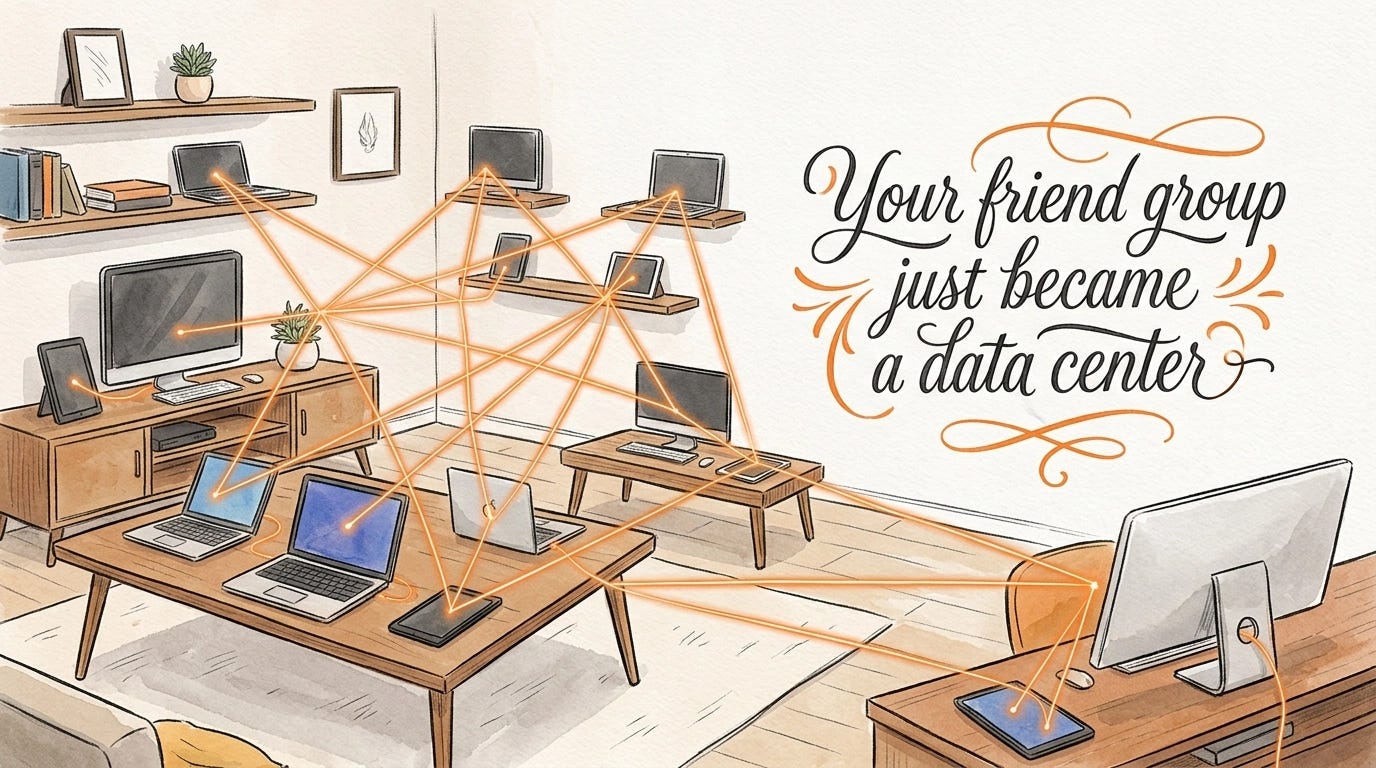
Two days before Perplexity’s launch, a company called Hyperspace shipped a feature called “Pods.” The idea is simple and wild: take a handful of laptops and desktops owned by a group of friends, coworkers, or family members and pool them into a single, peer-to-peer AI cluster.
No central server. No cloud provider. No vendor lock-in. Just your machines, talking to each other, running models too large for any single device, exposing a single OpenAI-compatible API endpoint. If the pool can’t handle a job, it falls back to cheap cloud — but only as a last resort.
Your friend group just became a data center.
This is the part that feels like Napster.
Neo-Napster
I’m calling this “Neo-Napster” because the pattern is unmistakable, even though the details are different.
Napster took centralized music distribution and made it peer-to-peer. Neo-Napster is taking centralized AI compute and making it peer-to-peer. In both cases, regular people suddenly have access to something that was locked behind massive capital expenditure and corporate gatekeepers.
There’s no piracy here, though. Nobody’s breaking the law by running AI models on hardware they own. There’s no guilt in this version of the story. You bought the Mac mini. You own the compute. You can do whatever you want with it.
But the energy is the same. That feeling of “wait, I can just... do this? Without asking permission? Without paying rent to Amazon?” That’s the Napster feeling.
And here’s the question that always keeps me up at night — the question I think every founder, builder, and operator should be asking:
How long do we have before this ends up the same way?
Because remember what happened with music. The labels didn’t die. They adapted, cornered the streaming platforms with the muscle of infinite founded or undfounded lawsuits, and rebuilt the toll booth to be even more profitable for themselves than ever before. Are the hyperscalers — are Anthropic ($30B valuation and eyeing an IPO), OpenAI, Google — going to sit by while compute decentralizes?
Of course not.
Three Futures (And Who Wins Each One)
I’ve been thinking about where this goes, and I see three plausible paths. They’re not mutually exclusive — we’ll probably get a messy blend. But understanding each one tells you something about where to place your bets.
