

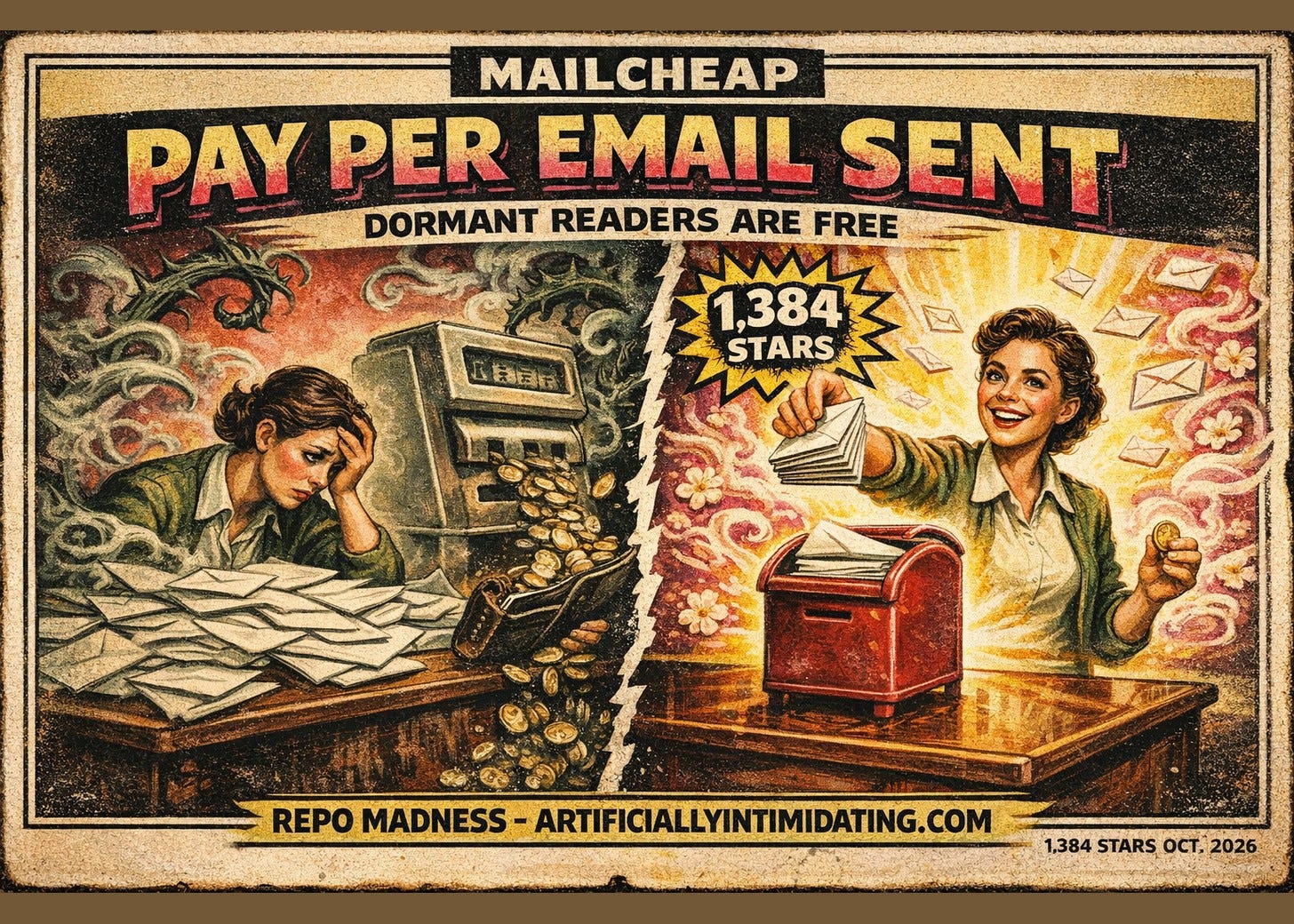
MailCheap — a newsletter app you can host yourself: write an issue, send it to your list, publish it on the web, from a dashboard or from an AI agent. Built by Marc Lou.
Alternative to: beehiiv Lite at 10,000 subscribers, $139/month billed monthly or $119/month billed yearly, unlimited sends. MailCheap's own paid hosting, MailCheap Cloud, starts at $19/month.
Cost to run: sending is about $6.40 per 40,000 emails on Amazon SES's default plan for new accounts, or about $4.20 after switching to a la carte (tenant fees included), plus whatever you pay for MongoDB, Upstash QStash and a Node.js host. Those three were not priced for this entry.
Licence: AGPL-3.0, unmodified. MIT for the first 4 days, until October 14, 2026. Commercial use is allowed; if you run a modified version over a network, you must offer its users your version's source under the same licence.
Runs on: any Node.js 22+ host reachable over HTTPS from the internet, Vercel included.
Requires: MongoDB, Amazon SES or PostShiba, Upstash QStash, your own domain with DKIM, return path and DMARC records. New SES accounts start in a sandbox until Amazon approves production sending.
Traction: 1,384 stars · 361 forks · 146 commits · issues turned off · 17 pull requests, 0 merged
Liveness: very live — 146 commits since October 10, last commit October 24, 2026. One author, and the public repo is synced from a private one.
Maturity: no releases, no tags. The README: "Self-hosting comes without support: issues are off and setup questions go unanswered."
Links: repo · site · Hacker News, 2 points, 0 comments
Figures as of October 24, 2026.
What it does
MailCheap is the whole newsletter stack in one repo. An editor with slash commands. A send button with a pre-flight review that checks your subject line, unsubscribe link and Gmail's 100 KB clip limit. A public website for every issue, with a signup form and a sitemap. Imports from beehiiv, Substack, Mailchimp, Kit and four others.
The pitch is in the name. Hosted newsletter tools mostly charge by how many people are on your list. MailCheap is built to charge mainly for emails sent; its Cloud plans also cap active subscribers, but dormant ones don't count. Self-hosted, that means you pay Amazon SES per email and nothing per subscriber.
It also ships deliverability guardrails most people never think about until they get burned. New contacts get mailed in steps: 2% first, then 5% more, then the rest, 30 minutes apart, as long as bounces and complaints stay low. Readers who ignore several issues get one "do you still want this?" email, then stop getting issues. Past 2% hard bounces or 0.08% complaints, sending pauses on its own.
Everything the dashboard does also works from an AI agent through an MCP server. Sending is marked as an action that can't be undone, so agents ask before they hit it.
What it replaces, and what that costs
beehiiv prices by subscriber count and includes unlimited sends. MailCheap prices by emails sent. That makes the two hard to line up, so here is one fixed list, held constant: 10,000 subscribers, four issues a month, 40,000 emails.
beehiiv Lite, 10,000 subscribers — $139/month billed monthly, $119/month billed yearly
beehiiv Pro, 10,000 subscribers — $239/month billed monthly, $199/month billed yearly
beehiiv Free — capped at 2,500 subscribers, so not available at this size
MailCheap Cloud Growth (75,000 emails, 40,000 active subscribers) — $39/month, or $390/year
MailCheap self-hosted, Amazon SES default plan — 40 × $0.16 = $6.40/month in sending
MailCheap self-hosted, Amazon SES a la carte — 40 × $0.10 = $4.00/month, plus tenant fees of 40 × $0.005 = $0.20 and $0.005 per tenant
beehiiv's prices come from its own pricing page code; the rendered page only shows the 1,000-subscriber defaults. The SES default matters: Amazon's pricing page says new accounts start on its Essentials plan at $0.16 per 1,000 emails, and $0.10 is what you get after switching to a la carte. Whether tenant fees also apply on Essentials is unclear from the page, so the $6.40 line may be slightly low.
The self-hosted lines are sending only. They leave out the database, the job queue, the host and the hour of DNS setup the README tells you to plan for. Those costs are real and were not priced here.
These are costs, not savings. If you already pay beehiiv $139 a month, moving to MailCheap Cloud would stop that bill and start a $39 one. If you have never paid for a newsletter tool, there is nothing to save. Self-hosting is a different trade again: a far smaller sending bill in exchange for running your own email infrastructure with no support.
MailCheap Cloud's own pricing page makes a narrower claim: 4,000 subscribers sending weekly costs $19 on its Starter plan against $109 on beehiiv Lite. That $109 is beehiiv's month-to-month price at its 5,000-subscriber tier. Billed yearly, the same beehiiv tier is $95.
Is it still alive?
Very live, with three caveats that matter more than the commit count.
One author. All 146 commits are Marc Lou's. The first landed October 10 and the latest landed today.
The public repo is a mirror. 144 of the 146 commits are titled "Sync from mailcheap-cloud" followed by a hash. The code is written in a private repository for the paid product and copied out. The README says every change ships to both.
Outside contributions are not landing. Issues are switched off. Seventeen pull requests have been opened, including two that add a Docker setup, one of which also swaps SES for plain SMTP and QStash for a MongoDB job queue. None has been merged. The README says pull requests "may not be reviewed."
There are no releases and no tags. Trendshift shows a peak of #5 among JavaScript repos on October 11, and no ranking after that.
What people say
Almost nothing yet, in public, in a form this column can quote. The one Hacker News submission drew 2 points and no comments. Reddit is blocked from the research sandbox, so no vote counts from it are claimed.
The loudest conversation is on X, and it is Marc Lou's own. His launch posts tell the story: he left beehiiv after a third price rise in two years, rebuilt the parts he used with AI help, and open-sourced it when people asked. A later post pitched the hosted version as 83% cheaper than beehiiv. Those posts were read through search snippets, not fetched directly, so they are summarized here rather than quoted.
beehiiv's CEO posted a list of features you would need to rebuild to replace his product, according to a write-up on X, which notes he never named Marc Lou. That post was not retrieved, so it is not quoted or counted here.
The pull request tracker is the most useful signal. The open Docker and SMTP requests show what self-hosters want: a way to run MailCheap without signing up for SES and QStash first.
The catch
The licence changed as the paid version arrived. MailCheap shipped under MIT on October 10. On October 14 it moved to AGPL-3.0. The same commit pitched MailCheap Cloud, from $19 a month; Marc Lou's post announcing the cloud version is dated October 15 (read via a search snippet, not fetched). The first commit stays MIT, as the README notes. The AGPL text itself is standard and unmodified. What it means in practice: you can run MailCheap for your own newsletter, commercially, but if you run a modified version for other people over the network, you have to offer them the source of your version.
Self-hosting gets less than Cloud. Cloud gets a shared sending address and a free <slug>.mailcheap.ai website, so you need no domain. It also gets a Gmail warm-up that spreads a new domain's first sends over two days, and chat support. Self-hosters bring their own domain and get no support. The DNS helper behind Cloud's shared addresses "isn't part of this repository."
SES is not plug-and-play. New Amazon SES accounts start in a sandbox: 200 emails a day, to verified addresses only, until Amazon approves production access. The README budgets about an hour for setup, most of it waiting.
Every account on one server shares a sending reputation. The project's SECURITY.md lists known gaps in its own words, including that SES account quota and reputation are shared, and that API keys can't yet be limited to read-only or to one newsletter.
It is two weeks old. No releases, one author, no outside code merged. That can change fast in either direction.
My read
Two things are true here.
The idea is right. Paying for subscribers who never open your email is a bad deal. Paying for the emails you actually send is the fix, whoever builds it.
The repo is a storefront. 144 of 146 commits are syncs from a private repo. Issues are off. Not one outside pull request has been merged. The licence went from MIT to AGPL in the same commit that started selling the paid version.
Plenty of companies run that way. Know that you're looking at a storefront as well as an idea.
Credits
Built by Marc Lou (@marclou). No other contributors in the git history. Data: the repo's git history, README, AGENTS.md, SECURITY.md and LICENSE; ungh.cc; Trendshift; the pricing pages of mailcheap.ai, beehiiv and Amazon SES; the GitHub pull request tracker; Hacker News; Marc Lou's posts on X, via search.