

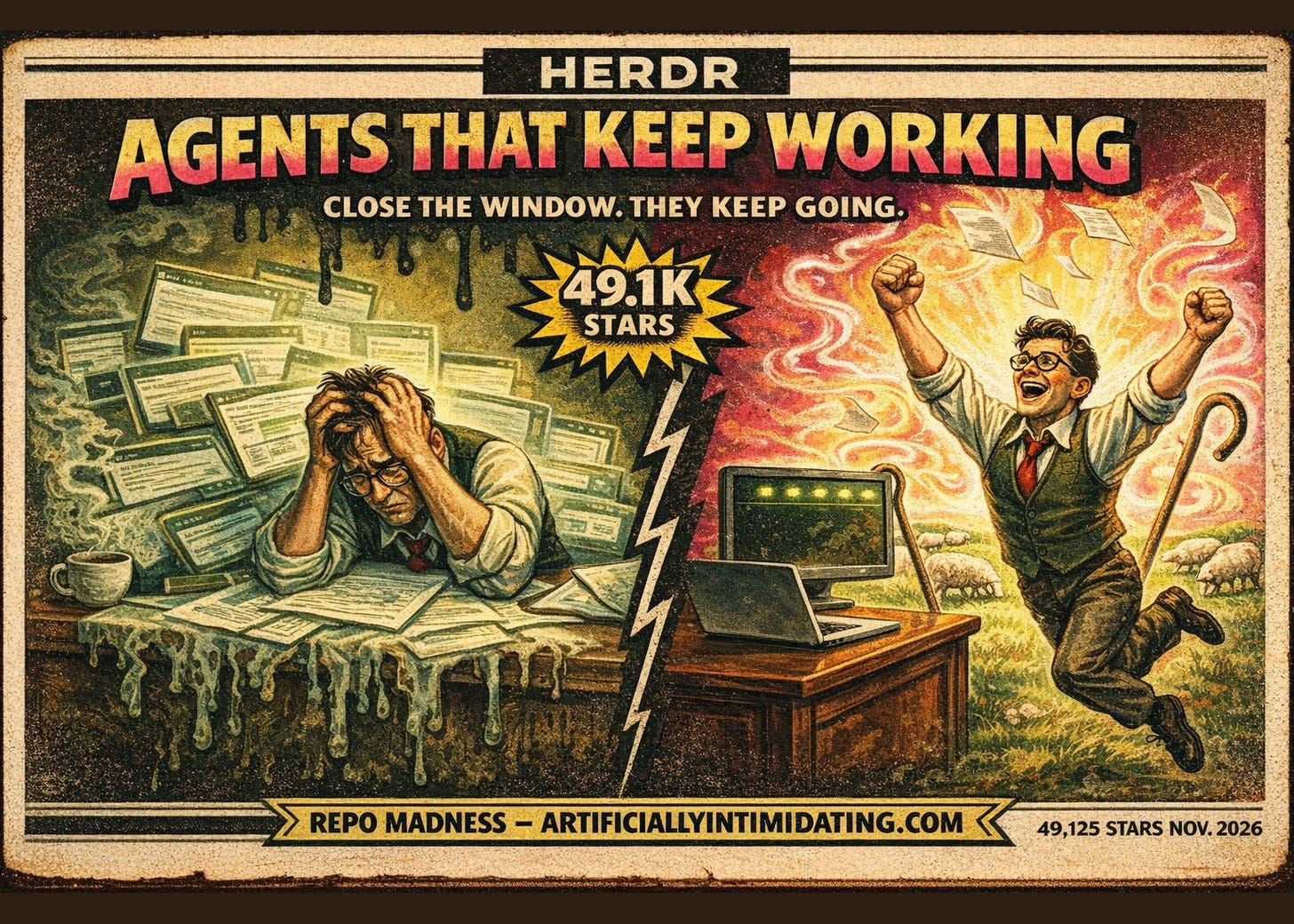
Herdr — a terminal app for running coding agents. It shows which agent needs you, and the agents keep running after you close the window.
Alternative to: Warp. Warp's terminal is free; its paid plans mostly buy AI usage: Build $20/month, Max $200/month, Business $50/user/month (up to 25 seats), monthly list prices. Herdr includes no AI, so the like-for-like price is $0 against $0.
Cost to run: free. You bring your own coding agent, and that agent's subscription or API bill is unchanged.
Licence: Apache 2.0 for all three repos (the TUI, the desktop app and herdr-core). Free for commercial use. The TUI was AGPL-3.0 until July 22, 2026.
Runs on: the desktop app on macOS (Apple silicon), Linux (x86-64 and ARM64) and Windows (x86-64). The TUI on macOS, Linux and Windows. Other machines join over SSH.
Requires: the desktop app needs herdr-core, which its installer adds; Linux needs a desktop session and a working Vulkan driver. The desktop app sends usage telemetry by default; turn it off in Settings → Privacy.
Traction: herdr (TUI) 49,125 stars · 3,959 forks · 1,880 commits. herdr-app 2,250 stars · 347 forks · 311 commits. herdr-core 472 stars · 108 forks · 138 commits. Issue counts unknown; highest PR number seen in the TUI's history, #5585.
Liveness: very live, but the work has moved. herdr-app and herdr-core made 311 and 138 commits since their histories began on October 23, and last committed November 7, 2026. The TUI made 49 in the last 30 days, and its last commit on
masterwas October 29, 2026.Maturity: desktop app v0.1.13 and herdr-core v0.1.18, both tagged November 4, 2026. TUI v0.9.5, October 14, 2026.
Links: herdr repo · herdr-app repo · herdr-core repo · site · Hacker News, 367 points · NetworkChuck video
Figures as of November 7, 2026.
What it does
If you run more than one coding agent, you know the problem. Five terminal windows. Claude Code in one, Codex in another. One of them stopped twenty minutes ago to ask you a question, and you didn't notice.
Herdr puts them in one place. Each repo gets a space. Each task gets a tab. A sidebar lists every agent and marks it working, blocked, done or idle. When one needs you, it says so.
The agents don't run inside the window. They run in a small background server called herdr-core. Quit the app, update it, or let it crash, and the agents keep going. You can also add any machine you reach over SSH, like a server or a cloud box. Its agents show up in the same sidebar and keep running while your laptop sleeps.
It doesn't replace your agent. It runs real terminals, so Claude Code, Codex, OpenCode and the rest work the way they already do. Agents that speak an open status protocol, OSC 7501, also report whether they're busy or waiting.
The newest part is the strangest. The desktop app keeps its layout, sidebar, keys and themes as plain files, with an AGENTS.md that explains them to your agent. You ask your agent to change the app, and it does. Herdr's homepage counts 215 shared layouts and 435 mods from 393 people.
There are two Herdrs, and that matters. Herdr TUI is the original: one Rust binary that runs inside whatever terminal you already use. The Herdr app, which reached Hacker News October 30, is a separate native desktop program built on herdr-core. The site says they don't share agents.
What it replaces, and what that costs
The paid product in this lane is Warp, the AI terminal. From Warp's own pricing page, monthly plans:
Free: $0 a month, with the core terminal and a bring-your-own-AI option
Build: $20 a month, with $20 of agent usage at API rates included
Max: $200 a month, with $200 of agent usage included
Business: $50 per user a month, up to 25 seats, with $20 of agent usage per seat
Read those carefully. Warp's terminal costs nothing. The money mostly buys AI usage, plus team and cloud extras. Herdr ships no AI at all. You bring the agent and pay for it the way you already do.
So the honest comparison is $0 against $0. Herdr doesn't cut an AI bill. If you pay Warp for its agent, Herdr doesn't do that job.
What Herdr does cost: an install, a learning curve, and a background process on every machine you use it on.
The nearest free alternatives are cmux, which already has a row in the directory, and tmux, the decades-old terminal multiplexer that several Herdr fans on Hacker News say they left for it.
Is it still alive?
Yes. Very. But not in the repo with the 49,125 stars.
Herdr started as one person's project. The first commit is dated March 23, 2026, and the repo went up March 27. Can Celik, who commits as Ogulcan Celik, wrote 1,314 of the TUI's 1,880 commits, 69.9%, with his two author names merged here. In August, Herdr joined Y Combinator. In September, it announced a $6 million seed round led by Bessemer Venture Partners.
Then the work moved. Two new repos appeared in late October: herdr-core, the server, and herdr-app, the desktop program. Both histories start with an initial commit on October 23, and the app's first tag is already v0.1.4 (core's is v0.1.10), so earlier work happened somewhere private. Since then:
herdr-app: 311 commits, 10 tags, latest v0.1.13 on November 4
herdr-core: 138 commits, 9 tags, latest v0.1.18 on November 4
herdr (TUI): 49 commits in the last 30 days, none since October 29
The TUI's monthly commit count ran between 216 and 356 from April to September, by author date. October had 90. November has none so far. Its last stable release, v0.9.5, came out October 14.
Herdr's site says the TUI "keeps working," and its YC post said the TUI stays first-class "forever." Nothing here says it's abandoned. Commits thinned after October 16 and stopped October 29, nine days before this was written. But a reader picking the original today should know where the commits are going.
The downloads download. The TUI's macOS binary for v0.9.5 is 22.5 MB from GitHub. The app's Herdr.dmg is 24.7 MB from Herdr's own release server. Neither new repo publishes GitHub releases; the app installs from releases.herdr.dev.
One more thing in the TUI repo: a monthly job closes stale issues "without outside engagement." That's normal housekeeping for a busy repo. It also means an issue nobody else comments on, reacts to or links a pull request to won't stay open forever.
What people say
The app launch hit Hacker News on October 30, eight days ago, with 367 points and 271 comments. Most of it is fans. One commenter wrote that they moved to Herdr "after a decade of using tmux, and I haven't looked back since."
The most useful question in the thread came from a user asking whether the TUI was "going to be sunset by herdr-app backed by herdr-core?" The commit counts above are the best answer this entry can give.
The money worries some people. The August thread on the YC news had 281 points and 189 comments, and a fair share of worry. One user in the October thread said: "ever since they got VC funding I am avoiding it." Another asked what the business model is for VC-backed terminal multiplexers. The replies under it are guesses from other users: cloud, inference, or getting bought.
NetworkChuck, the YouTube channel, made a video titled "you need to use Herdr RIGHT NOW!!" It's linked in Quick Facts.
Reddit is blocked from the research sandbox, so no vote counts from it are claimed. Trendshift blocked the sandbox too, so no peak rank is claimed.
The catch
There is no business model yet, in public. Herdr is a venture-funded company with no paid plan on its site. Can Celik's YC post says the runtime stays free under Apache 2.0, and that he wants to "build on top of the open Herdr runtime like everyone else." What gets sold, and when, isn't said. The licence change runs the friendly way: AGPL-3.0 at launch, a commercial option added in May, then Apache 2.0 on July 22. Apache code that's already out stays Apache. The app's LICENSE file landed October 29, six days into its history; before that its package file said MIT.
Telemetry is on by default in the desktop app. Release builds send a daily report with a random install ID. Herdr's security doc lists what goes in it: app and core versions, OS and architecture, bucketed usage time and counts, known agent names, built-in layout names (custom ones become custom), mod counts, app command names and event counters. It also says terminal text, prompts, file contents, folder paths and free-text names are not sent. You can inspect the report in Settings → Privacy and switch it off there. Turning it off doesn't stop update checks.
Mods have your access. A mod is JavaScript that can run programs, fetch URLs and read files on your machine, and run programs on connected ones. Herdr's own docs say there's no permission prompt, and that the limit on where a mod writes files "is not a security boundary." Read a mod like you'd read a shell script before you run it. With 435 of them in the gallery, that's real homework.
The app and the TUI are separate worlds. Agents started in one don't show up in the other. Pick one per machine.
In the app, reboots stop the agents. Closing the window is safe. A reboot or a herdr-core crash isn't. Your panes come back with fresh shells in the same folders, but the app doesn't restart the agent or resume its work. The TUI's own page says it resumes sessions after a restart.
Status needs your agent's help. The working-or-waiting markers come from agents that speak OSC 7501. An agent that doesn't still runs, just without a status. Herdr warns that agents run inside tmux, and older agent versions, may not report a status.
My read
I already use cmux. It's my terminal for agent work, and the sidebar is the reason. So Herdr isn't replacing nothing for me. It's sitting next to something I like.
What Herdr has that cmux doesn't is the exit door. Close the window and the agents keep working. Put an agent on a server and it keeps going while my laptop sleeps. That's the part I'd actually test.
If it survives that, there's a field report in it.
Credits
Maintainer: Can Celik (commits as Ogulcan Celik), founder of Herdr, @cancelik. Project account @herdrdev. Contributors in the last 30 days across the three repos include JJ Liebig, the akbash account (herdr.dev address), Martin Trifunov, Sundar Shahi Thakuri, Rui Lopes, Eric Yue and the kangal-bot account. Voices quoted: Hacker News users flippant, _bobm, loveparade and tiffanyh. Sources: the herdrdev/herdr, herdr-app and herdr-core repos, their READMEs, LICENSE files, workflows and the app's security doc, cloned November 7, 2026 · herdr.dev and its blog posts on Y Combinator and the seed round · ungh.cc for stars, forks and releases · Warp's pricing page · Hacker News via the Algolia API · NetworkChuck's video page.