

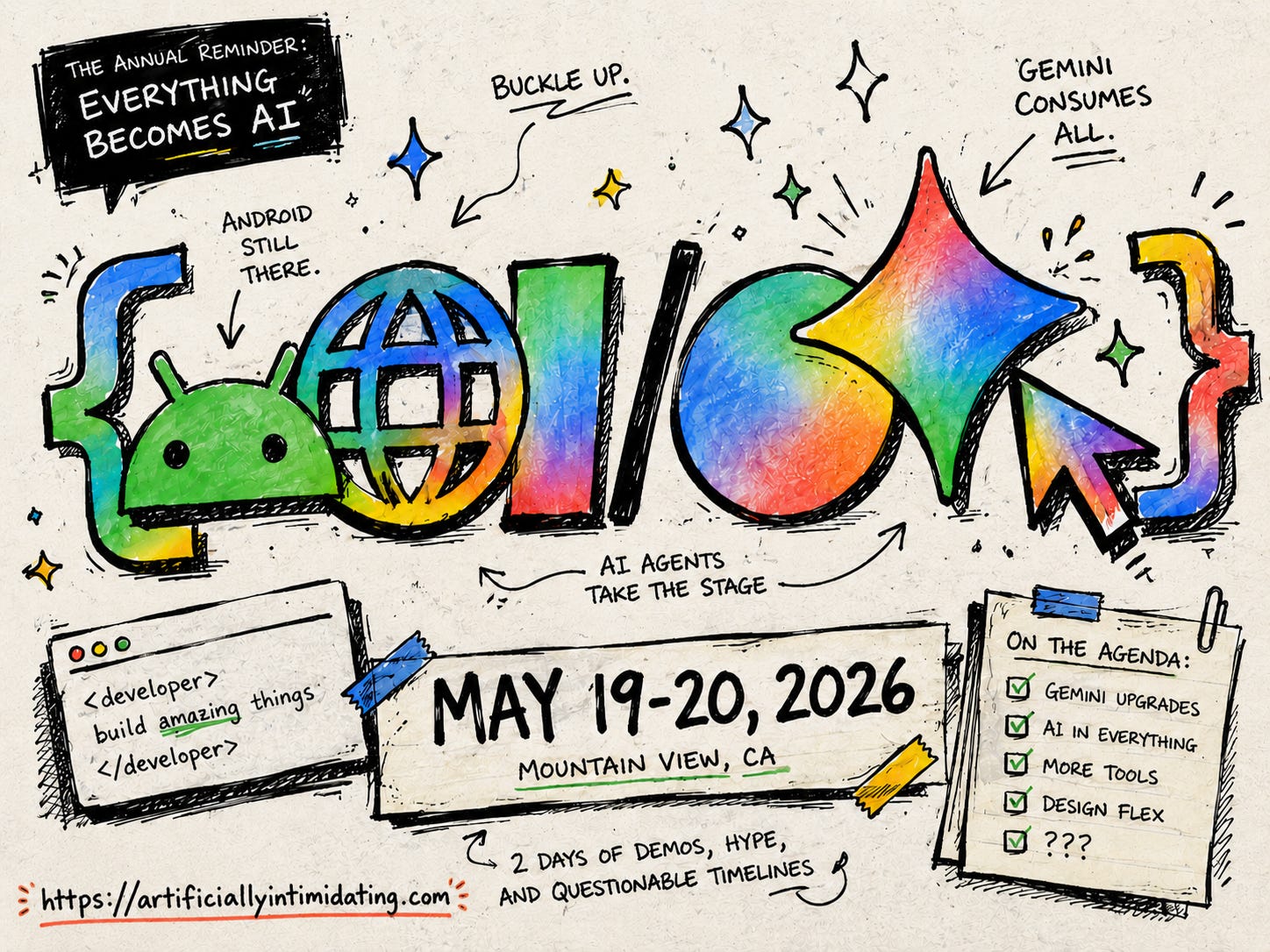
Good evening, humans — Welcome to a special Google I/O Day Edition. Day one wrapped today and it was a genuinely packed keynote. We're going exhaustive: every major announcement, plus the ones that sounded boring on stage but will matter more than anything Sundar Pichai put on the slides. All the details are at io.google/2026. Here's what you actually need to understand.
📬 Before we dive in: The sharpest AI Brief tips come from readers who are actually in the weeds. If you spot a story worth covering, share it in the community chat. The best tips make tomorrow's edition.
Google Search Gets Its Biggest Overhaul in 30 Years — Tom's Guide
What happened: Google replaced the search box with an "intelligent search box" that expands with query complexity, accepts text, images, video, files, and open Chrome tabs, and surfaces AI suggestions in real time. Alongside it: "information agents" that monitor the web continuously on topics you care about — apartment listings, stock conditions, sports scores — and alert you without requiring a search. A third feature, agentic coding in Search, uses Gemini 3.5 Flash to generate interactive visualizations and mini-apps directly inside results. All of it rolls out this week to all users for free.
Why it matters: Gartner predicted a 25% drop in traditional search volume by 2026 as users shift to AI chatbots. This is Google's answer: absorb the chatbot capabilities directly into Search, while adding something chatbots can't offer — persistent background monitoring across the web. The information agents in particular flip the product model entirely. You no longer go to Search. Search comes to you.
What everyone's saying: TechCrunch ran the headline "Google Search as you know it is over." The familiar blue links are being pushed aside for an intelligent, expanding interface that Google is centering its entire consumer product strategy around. Queries recently hit an all-time high for Google — up 19% — which gives the company room to experiment without panic.
My read between the lines: Google has 25 years of search intent data, the best web crawl in the world, and 900 million Gemini users. They just fused all three into one product. AI-native search competitors like Perplexity and OpenAI Search built their moat around being newer. Google just turned newness into a liability.
You spend all week reading about AI. WisprFlow is the one I actually use. It's voice dictation that works across every app on your Mac — speak, and it writes. No switching, no copying, no friction. If you're still typing everything, this is the upgrade. Try WisprFlow free →
Gemini Spark: An AI Agent That Works While You Sleep — CNBC
What happened: Google launched Gemini Spark — a cloud-based personal AI agent that runs on dedicated Google Cloud virtual machines, meaning it keeps working even when your devices are off. Powered by Gemini 3.5 Flash and Antigravity 2.0, Spark handles recurring tasks: scanning credit card statements for hidden fees, summarizing email threads, drafting reports from meeting notes, and chaining workflows across Gmail, Docs, Slides, Canva, OpenTable, and Instacart. Entirely opt-in; asks permission before high-stakes actions like spending money or sending emails. Beta for AI Ultra subscribers in the US next week.
Why it matters: This is the first mainstream consumer product that explicitly runs AI on your behalf in the background — not just when you prompt it. The cloud VM model removes the battery and processor constraint entirely. Google processes 3.2 quadrillion tokens per month across its AI products. Spark is where most of those tokens are about to start going.
What everyone's saying: Mashable compared it directly to OpenAI's OpenClaw agent. Google's integration advantages in Gmail, Docs, and Drive — apps where most knowledge workers already live — give Spark a home-field advantage OpenClaw would need years to replicate. The $100/month AI Ultra plan is where Spark lives at launch, with broader tiers to follow.
My read between the lines: Spark runs on Google's servers, processes your emails, calendar, financial statements, and third-party apps. The privacy surface area is enormous. Google is betting — based on two decades of evidence — that users will trade data access for convenience without much friction. So far, that bet has never been wrong.
Gemini Omni: Google's "World Model" for Video — The Verge
What happened: Google unveiled Gemini Omni, a new family of generative models designed to create and edit video from any input — text, image, audio, or existing footage. Demis Hassabis described it as a step toward "creating anything from any input." The first model, Gemini Omni Flash, generates 10-second clips with audio, allows conversational editing (swap backgrounds, change angles, alter scenes), and draws on Gemini's world knowledge for physics accuracy. Available today to AI subscribers; free on YouTube Shorts and YouTube Create later this week. All Omni videos carry SynthID watermarks.
Why it matters: Unlike Veo (Google's prior video model), Omni uses existing footage as a foundation for new videos — not just text-to-video generation. That's a meaningfully different product. More importantly, Google is distributing this through YouTube Shorts at zero cost before AI video competitors have established a paid habit. Runway, Pika, and Sora should be watching their conversion funnels carefully this week.
What everyone's saying: Google also restructured AI pricing alongside the launch: AI Ultra drops from $250 to $200/month, and a new $100/month tier with 5x higher usage limits launches for Antigravity. Google AI Plus and Pro users get Omni Flash access today. Across the board, pricing moved down.
My read between the lines: "World model" is a term from AI research that implies understanding physics, causality, and how objects move through time — not just pattern-matching pixels. If Omni actually delivers on that, this is a research breakthrough disguised as a YouTube feature. The Verge got hands-on access and didn't report obvious failures. That's a meaningful signal.
Antigravity 2.0: The Developer Story Nobody Is Talking About — Google Developer Blog
What happened: Google launched Antigravity 2.0 — a desktop application for orchestrating multiple AI coding agents in parallel, with dynamic subagents, scheduled background tasks, and integrations across AI Studio, Android, and Firebase. Alongside it: Antigravity CLI (replacing Gemini CLI, which is being retired), the Antigravity SDK for programmatic access, and Managed Agents in the Gemini API — one API call to spin up a fully capable agent with reasoning, tools, and code execution in an isolated Linux environment. Google also launched a $2 million XPRIZE Hackathon, the largest hackathon prize pool ever.
Why it matters: Antigravity is the infrastructure layer that makes every other Google announcement at I/O possible. Spark, Search agents, Gemini for Science — they all run on it. By open-sourcing this platform for developers, Google is doing something significant: inviting the entire developer ecosystem to build on the same agent infrastructure that powers its own products. The Managed Agents API is the sleeper feature — instant agent-with-tools in a single API call, no configuration.
What everyone's saying: Google explicitly told Gemini CLI users to migrate to Antigravity CLI — a rare direct deprecation signal. Gemini 3.5 Flash, which powers the platform, reportedly outperforms Gemini 3.1 Pro across nearly all benchmarks while running 4x faster. The competitive target is clear: Cursor, GitHub Copilot, Claude Code, and every other AI coding tool on the market.
My read between the lines: Sundar Pichai mentioned on stage that 75% of Google's new code is now AI-generated using these same internal systems. Google just handed developers the same platform its own engineers are using. If that's true, Antigravity CLI isn't a consumer product — it's a glimpse at how a trillion-dollar company actually builds software in 2026.
Project Aura Glasses + Googlebook Laptops: Google Bets on Hardware — TechCrunch
What happened: Google confirmed two new hardware categories at I/O. Project Aura: XR smart glasses built with Xreal, featuring a 70-degree FOV optical display, running Android XR, tethered to a pocketable compute puck. Launching this fall alongside glasses from Samsung, Warby Parker, and Gentle Monster. Googlebook: a new premium laptop category running "Aluminum OS" (merged Android + ChromeOS), with an AI-enhanced "Magic Pointer" cursor, Gemini built in, and hardware from Acer, Asus, Dell, HP, and Lenovo — also this fall. Samsung is notably absent from the Googlebook manufacturer list.
Why it matters: Google is fighting a two-front hardware war: glasses against Meta Ray-Ban, laptops against Microsoft Copilot+ PCs. Both products use Gemini as the platform differentiator. The Aluminum OS merger of Android and ChromeOS has been rumored for three years — this is the first official product confirmation, which means ChromeOS is effectively being wound down as a standalone platform.
What everyone's saying: The Warby Parker and Gentle Monster partnerships signal that Google absorbed the lesson of Google Glass: hardware has to be desirable before it can be useful. Audio-first glasses (no display) launch first; display models follow. That sequencing is smart — it builds the distribution and habit before asking users to wear something that looks like an HUD.
My read between the lines: Samsung's absence from the Googlebook lineup is the most interesting data point from the hardware announcements. Samsung is Google's biggest Android partner and they're presumably building their own AI laptops. If Google and Samsung are competing on laptops while collaborating on glasses, that relationship is more complicated than the partnership branding suggests.
Universal Cart: Google Wants to Be Where You Buy — 9to5Google
What happened: Google announced Universal Cart — a Gemini-powered shopping cart that aggregates items you encounter across Search, the Gemini app, YouTube, and Gmail into a single hub. Once in the cart, Gemini tracks price drops, flags incompatibilities, surfaces deals, and applies Google Wallet loyalty perks and payment benefits at checkout. Built on Google's Universal Commerce Protocol, backed by Walmart, Target, Wayfair, and Shopify. Coming to Search and Gemini app in the US this summer.
Why it matters: Universal Cart turns Google into a persistent shopping layer across the entire internet — not just for searches that start on google.com. Find something on YouTube? It goes in the cart. Promo email in Gmail? Cart. The Universal Commerce Protocol backing from major retailers signals this isn't just a Google feature — it's an open standard being adopted by the companies that actually sell things.
What everyone's saying: The Amazon comparison is everywhere in the coverage. Amazon dominates "ready to buy" searches. Google dominates "researching before buying" searches. Universal Cart is Google's attempt to own the moment between those two states — and capture the transaction that used to leave its ecosystem for Amazon.
My read between the lines: This fight will take years. Amazon built its dominance on logistics and habit — Prime members check Amazon first before they search anywhere. Google is betting that Gemini intelligence (finding the right product, tracking price, flagging incompatibilities) can overcome Amazon's distribution moat. That's a product vs. infrastructure bet. Product bets are exciting. Infrastructure bets win.
Gemini for Science: The Most Important Announcement Nobody Covered — Google Research
What happened: Google launched Gemini for Science — a suite combining Co-Scientist (multi-agent hypothesis generation), AlphaEvolve (algorithm discovery and optimization), and ERA (Empirical Research Assistance), all integrated with 30+ major life science databases. ERA, first released as a research preprint in September 2025, autonomously proposes research methodologies, implements them as executable code, and validates results. It's already demonstrated expert-level results across six benchmarks spanning genomics, public health, neuroscience, geospatial analysis, time-series forecasting, and numerical analysis. Available now through Google Labs and as Science Skills in Antigravity.
Why it matters: ERA generated 14 COVID-19 forecasting models that outperformed the CDC's official ensemble. It discovered 40 novel genomics methods that surpassed expert-developed approaches. It solved open problems in cosmology. These aren't demos — they're peer-reviewable results in real scientific domains. For working researchers, this is the first credible AI platform that can propose a hypothesis, build the code to test it, run it against real data, and validate it autonomously.
What everyone's saying: It's getting far less coverage than the Googlebook and smart glasses, which is exactly what happens when something is genuinely hard to explain in a headline. "AI produces 14 COVID forecasting models that beat the CDC" is true and important. It's also less shareable than "Google made AI glasses with Warby Parker."
My read between the lines: The gap between what AI is actually doing in science and what the public understands AI is doing in science is enormous and widening every month. ERA beat the CDC's official COVID forecasting ensemble. That sentence deserves a news cycle of its own. Instead it's a footnote in a keynote about shopping carts and laptop names.
OpenAI Just Agreed to Use Google's Watermark — CNET
What happened: Google announced that OpenAI, Kakao, and ElevenLabs have agreed to embed its SynthID digital watermarking technology in their AI-generated content — joining Nvidia, which signed on last year. SynthID has now been applied to 100 billion images and videos and 60,000 years' worth of audio. The watermark survives editing, compression, and screenshots. Simultaneously, Google is expanding SynthID detection to Chrome and Search via Lens, Circle to Search, and right-click context menus, alongside C2PA Content Credentials — a cryptographic standard that lets users trace whether content came from a camera, was AI-generated, or was AI-edited.
Why it matters: A two-layer provenance system — SynthID for pixel-level persistence, C2PA for cryptographic attribution — means the practical question "did AI make this?" will soon have a technical answer for the first time. With OpenAI on board, the major AI labs are converging on a shared standard for content identification, which is a form of governance coordination that almost never happens voluntarily in this industry.
What everyone's saying: Researchers note that SynthID is not infallible — translation, paraphrasing, and certain image manipulations can strip the watermark. But adoption at this scale is unprecedented. Google sits on the C2PA steering committee with Amazon, Meta, Microsoft, and OpenAI. This is industry self-regulation moving faster than government regulation, which is rare enough to be notable.
My read between the lines: OpenAI agreed to embed a Google-designed watermark in its products. Read that again. In a space where every foundation model lab treats interoperability as a competitive threat, this is cooperation — and probably not entirely altruistic. Both companies benefit from a world where AI content is identifiable and normalized. The real beneficiary of watermarking isn't the consumer detecting fakes. It's the companies whose content they're detecting.
That's your Google I/O 2026 full breakdown. Eight announcements, one keynote, one very busy Tuesday. Full details at io.google/2026. Join the conversation in the Artificially Intimidating community chat.
—Artificially Intimidating