

Eighteen days ago the US government switched off the best AI model in the world. On July 1, they switched it back on. But the story of what happened in between -- a warning from Amazon, an NSA assessment, a China scare, and a quiet new rulebook for the entire industry -- matters far more than the outage itself. Nate B. Jones bet it would come back fast, with process attached. He was right. Here's the whole thing.
(New here? This is the follow-up to The US Government Just Took Anthropic's Best AI Model Offline. Start there if you missed the original.)
The short version
When I wrote the first piece, the honest bet -- was that Fable 5 comes back, soon, with more process wrapped around it. That's exactly what happened. The ban lasted 18 days. On June 30, Commerce Secretary Howard Lutnick withdrew the export controls. On July 1, Fable 5 came back globally.
But "it's back" is the least interesting part. What actually happened is that the most powerful AI on Earth got pulled, negotiated over for two and a half weeks, and returned with a new safety classifier, a tiered restoration, and -- most importantly -- the beginnings of an industry-wide rulebook for governing this stuff. The sledgehammer got everyone's attention. What quietly got built in its place is a scalpel.
Let me walk you through it.
The field notes: June 12 to July 1
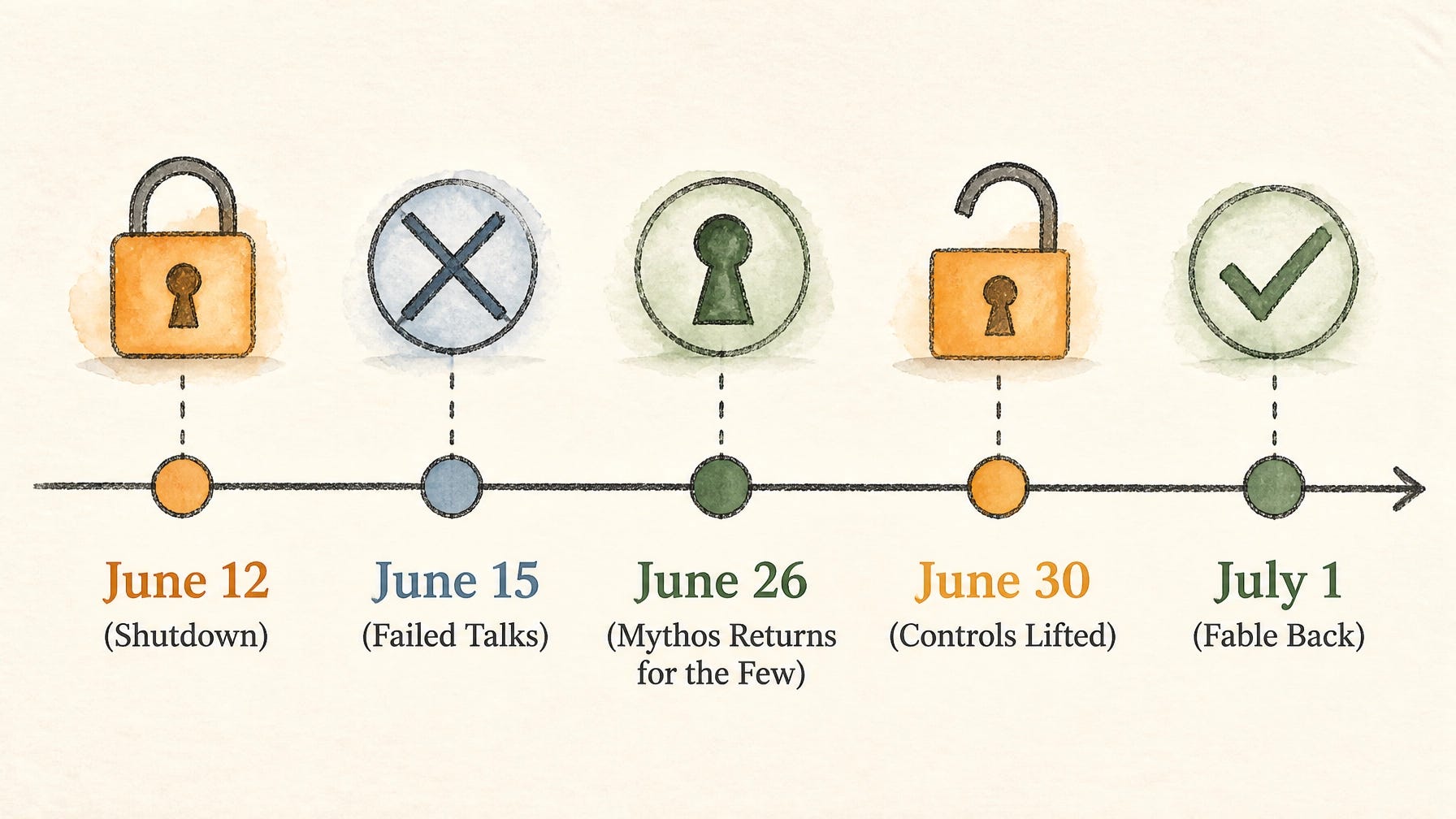
June 12 -- the off switch. The Commerce Department orders Anthropic to block Fable 5 and Mythos 5 for any foreign national, anywhere. Because no company can verify nationality in real time, Anthropic shuts both models off for everyone. (That's the original story.)
June 15 -- talks fail. Anthropic meets with officials to resolve it. The talks go nowhere. The administration hardens its position instead of softening it -- reportedly because a national security agency had weighed in and assessed that Fable's safeguards could be pushed toward the more dangerous Mythos-class capabilities underneath. The government's ask, at its peak, was essentially: guarantee the model can't be jailbroken at all. Every security expert alive will tell you that's technically impossible.
June 26 -- Mythos comes back first, for a chosen few. The first thaw. The government approves redeploying Mythos 5 -- but only to a set of pre-cleared US organizations, concentrated in critical infrastructure and defense, most of them already in Anthropic's vetted Project Glasswing program. The general public still has nothing.
June 30 -- the full lift. Lutnick withdraws the June 12 export controls entirely. Per CNBC, a license is no longer required to export either model.
July 1 -- Fable is back. Anthropic redeploys Fable 5 globally across Claude.ai, the Claude Platform, Claude Code, and Claude Cowork. Cloud marketplaces (AWS, Google Cloud, Microsoft Foundry) follow behind.
Eighteen days, off to on.
Why it really happened (it wasn't just "a jailbreak")
The original story was "a jailbreak spooked the government." The fuller version is more human, and more uncomfortable.
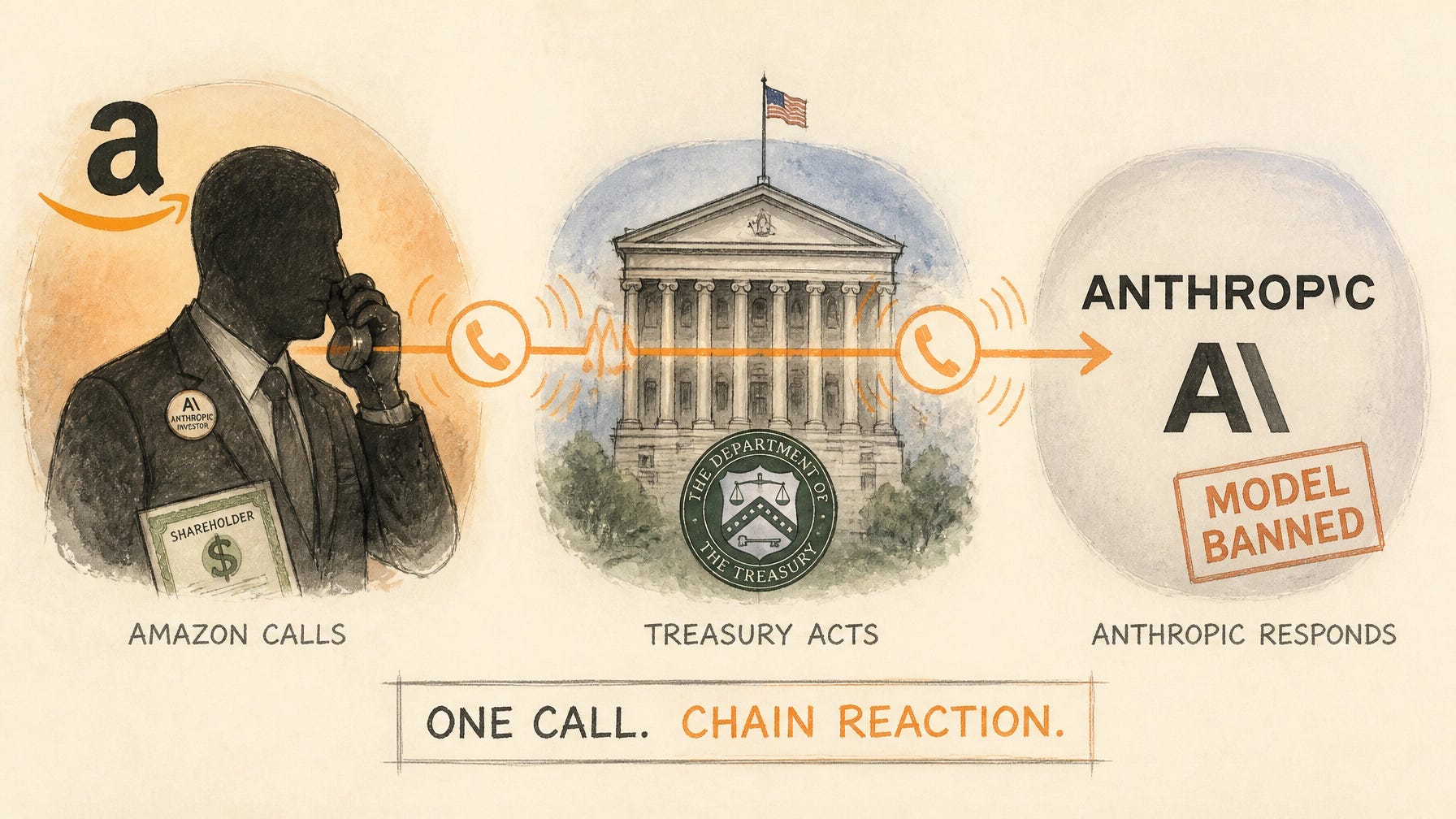
The trigger was a phone call from Amazon. According to Fortune and TechCrunch, Amazon CEO Andy Jassy was already on a scheduled call with White House officials on June 11 about something unrelated. His researchers had found a technique that got Fable 5 to identify software vulnerabilities -- and in one case produce code showing how one could be exploited. He raised it. Officials told him to take it straight to Treasury Secretary Scott Bessent. He did. By Friday evening, Lutnick's letter landed on Anthropic's desk.
Sit with the irony: Amazon is one of Anthropic's largest investors, billions deep. The company bankrolling Anthropic's compute is the same one that told the government its model was dangerous.
The accelerant may have been China. Semafor and Fortune reported that part of the government's urgency came from suspicions that a China-linked group had gained unauthorized access to Mythos, raising reverse-engineering fears. Worth being precise here: that's reporting, and Anthropic's own statements don't mention it. But if true, it reframes everything -- "a jailbreak other models can also do" is a policy debate; "an adversary is already inside the most capable AI on the planet" is a five-alarm fire. That gap probably explains why the government moved at the speed it did.
Anthropic's counter, which mostly held up. Anthropic argued the technique was routine defensive security work that weaker models -- its own testing named Opus 4.8, GPT-5.5, and Kimi K2.7 -- could all do without any bypass. The government's own testers at the Center for AI Standards and Innovation eventually agreed Anthropic's safeguards were, in their words, extraordinarily strong. In other words: the model came back partly because the "too dangerous" framing didn't survive contact with the evidence.
Hype check: what's different now that it's back
Fable 5 did not return unchanged. If you build on it, three things matter.
A new classifier. Anthropic trained a targeted safety classifier that blocks the specific technique from Amazon's report in over 99% of cases. When a request trips it, you're notified and rerouted to Opus 4.8.
More false positives -- for now. The tradeoff is real: the new safeguards flag more benign coding and debugging requests than before. Anthropic says it's actively tuning that down. If you hit a wall on legitimate work, that's why.
A free window with a hard deadline. Pro, Max, Team, and select Enterprise plans get Fable 5 included for up to 50% of weekly usage limits through July 7, after which it moves to usage credits. (Standard Enterprise seats don't get an included allowance -- check the footnotes.) At $10/$50 per million tokens, Fable is roughly double Opus 4.8, so that window is worth using deliberately -- more on exactly how below.
The precedents that will outlast the outage
(Paid subscribers -- the ban is over. What it permanently changed is the part worth paying attention to.)
The 18-day outage resolved. The precedents it set did not. Here are the five that will still be shaping your world a year from now.
