

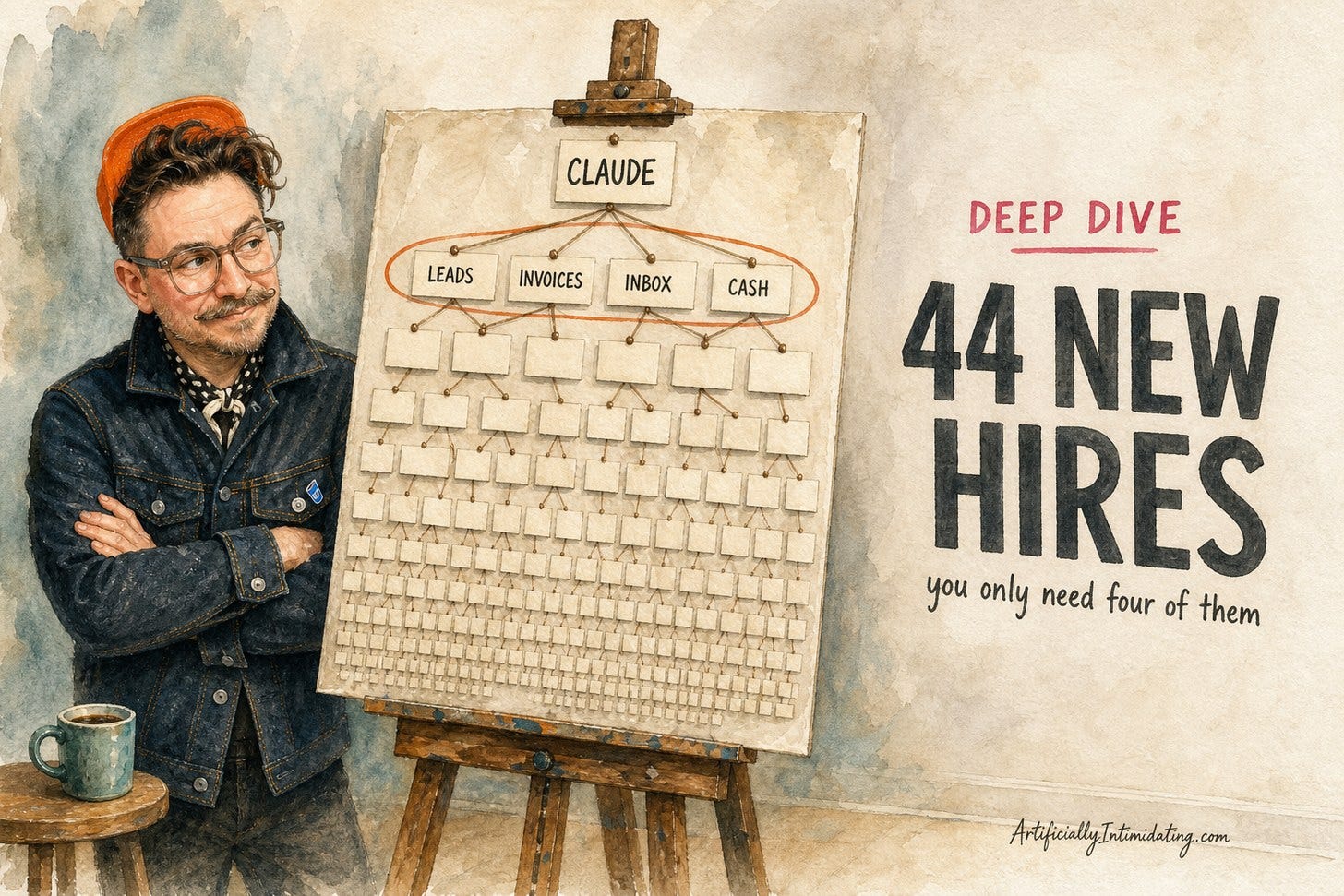
Anthropic didn't build this from scratch -- it already had a small business plugin, and just rolled a BIG update into it. What's live now are 44 pre-built skills and connectors which integrate with roughly three dozen tools (ie. QuickBooks, HubSpot, Shopify, Gusto, Stripe, Google Workspace, Slack, DocuSign, Canva, Zapier, and a long tail of others). While Anthropic's own recap claims 35 connectors; we count 34 live in the catalog as of today. Take "about three dozen" as the honest number -- a plugin this actively maintained will likely have a different count next week anyhow. Once installed, and Claude can draft your month-end close, chase your overdue invoices, screen your inbound resumes, write your ad copy, forecast your cash flow, and answer your leads at 11pm on a Saturday night while you’re out dancing or half asleep on the couch trying to keep at least one eye open for SNL’s cold open.
It's free with a Pro, Max, Team, or Enterprise Claude plans. You install it from inside of Cowork, under Customize, then Plugins, then Discover -- search "small business" and hit install. That part takes about ninety seconds.
Here's the part nobody puts in the announcement: 44 skills is not a starter kit. It's an entire operations department, delivered flat-packed, with no instructions for which piece goes where in your specific business. A four-person landscaping company and a twelve-person marketing agency both get the same 44 skills. Neither of them needs all 44. Neither of them will know which four to start with. And most of you will open this thing, feel the size of it, and close the tab feeling like AI is too overwhelming for you.
That's not a knock on the plugin. It's genuinely one of the more useful things Anthropic has shipped for small business owners … they just didn’t do themselves any favors explaining it. But "useful" and "easy to actually adopt" are different problems, and this piece is about both -- what's actually in here, and what it takes to make it stick in a real business instead of becoming another tool you installed once and forgot.
What you're actually installing
Under the hood, this isn't 44 unrelated tricks. It's a small number of building-block skills, plus a layer of "recipes" that chain those building blocks together into a finished job. Plan Payroll, for example, isn't its own thing -- it runs Cash Flow Snapshot, then Invoice Chase, then Payroll Prep, in that order, so you find out you can't make payroll before the run gets staged, not after. Close Month runs Month-End Prep, then a fresh Cash Flow Snapshot, then Report Builder. Restock runs Inventory Planner, then hands the bill to AP Processor so the purchase order and the invoice actually match up later. Tax Prep won't even start until Month-End Prep confirms your books are reconciled, because a tax estimate built on a messy ledger is a number you'd be sending to the IRS.
That design detail matters more than it looks like. It means the plugin already understands that these jobs depend on each other in your business, in that order. What it doesn't know, yet, is which of these jobs is actually broken in your business as of right now, which ones you've already solved a different way, and which ones would touch something (money, a customer, an employee) that you're not ready to hand to an AI agent without watching it closely first.
The other piece holding all 44 together is memory. Run /SMBOnboard and it interviews you: your industry, your size, your top headaches, even your brand colors. The interview saves your details as as a business-context file Claude keeps permanently. Every other skill reads from that file before it does anything, so a report it builds three weeks from now already knows what you told it on day one. That's genuinely well designed. It's also why skipping onboarding doesn't just cost you the setup questions -- it means every skill after that is working blind.
Every skill that touches money or a customer is built to draft and wait for your eyes and sign off . Nothing pays a bill, sends a refund, or posts to your feed without you approving it first. That's the right default. It also means the plugin doesn't remove the work of deciding -- it just moves all 44 of those decisions to day one, all at once, which is exactly the moment you have the least context to make them well.

The 44 skills, in plain English
Grouped by the job they do, not the order Anthropic listed them in.
Getting started
SMB Onboard -- Walks you through connecting your first two tools, runs one small task to prove it actually works, then asks about your business so every other skill has context from day one. This is where you're supposed to start. Most people won't, and that's the first mistake.
SMB Router -- The front door. Ask it "what can you do" or "help me with my business" and it points you at the right skill instead of making you memorize 44 names.
Brand Style -- Tells Claude what your business looks and sounds like, from a website link or a plain description, and every report or document the plugin produces after that follows it.
Build Connector -- If your point-of-sale or field-service software isn't on the list, this wires it up through Zapier instead of leaving you stuck.
Build Agent -- Watches you do a repetitive task once, then turns it into its own named, reusable skill your team can trigger on demand or on a schedule.
Money -- cash, bills, and the books
AP Processor -- Reads bills out of your inbox or a photo, codes them to the right account, matches them to the PO, and stages a payment run for your approval.
Pay the Bills -- The same job, plus a cash-position check between "here's what's coded" and "here's what we're paying," so you never approve a run you can't cover.
Cash Flow Snapshot -- A 30/60/90-day forecast with confidence ranges and named risks, not just a number. Ask it "will I make payroll" and it answers with a downloadable workbook.
Invoice Chase -- Drafts reminder emails for what people owe you, gentle for good customers and firm for repeat late payers, matched to their actual payment history.
Month-End Prep -- Reconciles your books against every payment processor you've got connected, flags duplicates and missing receipts, and writes the plain-English version of what happened to your margin.
Close Month -- Runs Month-End Prep, refreshes the cash forecast off the newly closed numbers, and packages the whole thing for your accountant.
Payroll Prep -- Totals hours, flags anything off (missed punches, a rate that changed, overtime that spiked) and stages the run line by line before a dollar moves.
Plan Payroll -- Checks you can afford payroll, chases what's owed to close the gap if you can't, then runs Payroll Prep on what's left.
Tax Prep -- Confirms your books are actually closed, then hands off to the skill below. Never advice, never filed -- prep material for your accountant.
Tax Season Organizer -- Calculates the quarterly estimate off your closed numbers, or builds the year-end 1099 list with a flag on every contractor missing a W-9.
Sales and pipeline
Lead Finder -- Works out who your best customers actually look like, then finds companies that resemble them and the right person to contact there.
Lead Triage -- Scores your inbound leads by fit and urgency, tells you who's worth calling today, and drafts the follow-up.
Call List -- Runs Lead Triage, then blocks time on your calendar and hands you talking points pulled from your own email history with each person.
Speed to Lead -- Answers new inquiries with real meeting times, drafted and ready before you wake up, so nothing sits unanswered overnight.
Grow Pipeline -- The whole funnel in one motion: builds a prospect list, writes the outreach in your voice, and logs every touch to your CRM.
Outreach Composer -- Learns your voice from your own sent mail and writes cold outreach and follow-up sequences that don't read like a robot wrote them.
CRM Autopilot -- Updates contacts and deals from your calls, calendar, and email so the CRM stays current without you opening it. Includes a cleanup pass for duplicate and stale records.
Proposal Builder -- Turns a call transcript, jobsite photos, or scrappy notes into a costed, branded proposal on your own templates, and triggers the deposit invoice once it's signed.
Reactivate -- Finds customers who've quietly stopped buying, ranks them by what they were worth, and drafts a win-back message that acknowledges the gap before it pitches anything.
Marketing and content
Content Strategy -- Looks at what's actually selling and what's seasonal, then hands you a 30-day plan for what to push and what to hold. Strategy only, no assets.
Social Content Engine -- Runs your posting calendar as a standing thing: on-brand graphics, captions in your voice, one asset repurposed across every platform, staged for your approval.
Canva Creator -- Takes an approved brief and builds the actual campaign: the calendar, the Canva designs, the captions.
Ad Manager -- Reads what your ads are actually doing, explains what's working in plain English, and recommends budget and targeting changes with the dollar impact attached to each one.
SEO & AI Visibility -- Audits both halves of being found: classic Google ranking, and whether ChatGPT or Claude can actually read and cite your site when someone asks about your industry.
Customers and reputation
Review & Reputation -- Pulls your Google, Yelp, and Facebook reviews into themes with real quotes, drafts a reply to every one, and flags customers who look like they're drifting away.
Ticket Deflector -- Reads a forwarded customer email, checks the order and refund status, and drafts a reply in your voice -- and can issue the refund itself once you say go.
Inventory
Inventory Planner -- Figures out what's about to run out from actual sales velocity, sizes the reorder, and drafts the PO and the vendor email.
Restock -- Runs Inventory Planner, then stages the matching bill entry so the invoice checks out against the PO when it lands six weeks later.
People
Job Post Builder -- Writes the job post, the interview guide with a scoring rubric, and an offer letter template from a hiring brief.
Hiring Screener -- Turns a stack of resumes into a ranked shortlist against that rubric, drafts replies to everyone (yes and no), and schedules the interviews.
Legal and funding
Contract Review -- Reads an NDA or vendor contract, flags anything non-standard, and explains the risk in plain English -- built for businesses with no lawyer on staff.
Grant & RFP Writer -- Filters a flood of grant listings or solicitations down to the ones you'd actually qualify for, then drafts the response from your past submissions.
Know where you stand
Business Pulse -- A one-page snapshot: cash position, sales trend, pipeline movement, what's on the calendar, and the single most important thing that needs you today.
Growth Pulse -- The marketing version: is the growth engine actually working, what's converting, what's not, and the three things worth doing about it this week.
Monday Brief -- Chains Business Pulse with your saved reports and your calendar into one document to start the week.
Marketing Monday -- The growth version of the same idea, merged with a reputation check and a competitor scan.
Report Builder -- Turns "can you track this every week" into an actual recurring report, defined once and rerun on demand or on a schedule.
Report Pack -- Delivers whatever report you defined, wrapped in a Business Pulse snapshot so the numbers have context, on the cadence you set.
Inbox
Inbox Manager -- Sorts a full inbox into what needs you, what's drafted and waiting, and what's already handled, and hands bills, leads, and scheduling requests off to the skills that own them.

Why most people will install this and get nothing out of it
The failure mode here isn't the plugin. It's the sequencing.
Somebody installs Small Business, skips the onboarding, and asks it to do the thing they saw in a screenshot -- usually something ambitious, like the full monthly close or a complete outreach campaign. It half-works, because it was never told what their chart of accounts looks like, or that their "leads" actually come in through a Facebook form nobody checks. They call it a disappointment and never open it again.
The other failure mode is the opposite: somebody connects everything on day one -- the ledger, the CRM, three payment processors, Gmail, Slack -- and now they're approving fifteen drafts a day from a tool they don't trust yet. That's not automation. That's a part-time job reviewing an intern's work, except the intern never gets faster because you never gave it the chance to prove itself on one thing first.

And the thing worth yelling out loud: a lot of the most powerful skills here will only get good once they're sitting on top of your real system and real data . AP Processor is much better with a ledger behind it than a shoebox of PDFs. CRM Autopilot needs an actual CRM. If you're a five-person business running off spreadsheets and a shared inbox, a good chunk of these 44 skills are aspirational until you've made some other decisions first -- decisions about which tools to actually pay for, which is its own project.

None of that is a flaw in the plugin. It's just the truth about any tool this broad: the software is the easy 10%. Figuring out which of the 44 jobs matches something actually broken in your business, in what order, connected to what, with what you're comfortable letting it touch unsupervised -- that's the other 90%, and it's different for every business. Nobody wrote that part down for you , because nobody could. For better or worse, it's specific to how you actually run things.
We're not the only ones who noticed the gap between "44 skills exist" and "an owner can actually use them." One AI consultant who runs an agency and a paid automation community put out a full walkthrough of this same plugin and, out of 44 skills, only recommended 10 -- then built an entire paid course and community around helping small business owners customize and run the rest. That's not a knock on him. It's the same conclusion we came to from a different angle: the plugin is free, but knowing which pieces to turn on, for your specific business, is already something people pay for.
So below the fold: the actual setup order we'd run for our own clients, a starter kit for four different kinds of small business (so you can find yours and skip the guesswork), and a copyable approval-threshold template for deciding what this thing gets to touch on its own versus what always comes to you first.
Behind the paywall, I’ll show you the part Anthropic didn’t: the exact 12-step setup order, the four skills I’d start with for four common kinds of small businesses, and a copyable “draft / review / never delegate” approval template.
If you want a second pair of eyes before you start connecting things, reply and send us two answers:
What does your business do?
What is the one job you’d happily never do again—chasing invoices, answering leads, sorting the inbox, forecasting cash, something else?
We’ll tell you where we’d start—and, just as importantly, what we’d leave off for now.
