

Imagine a world where humans can converse with animals, understanding their thoughts, emotions, and needs as clearly as we do with one another. This isn't the plot of a sci-fi movie but a burgeoning reality thanks to the advancements in artificial intelligence (AI). My interest in this intersection was sparked when my friend Andrew dropped a meme in my Instagram DMs introducing me to Jane Lawton, Director of Impact at Earth Species Project.
Despite thinking big about AI, I realized I had completely missed this use case. I then went into a multi-hour YouTube and scientific journal wormhole, seeing how much work on this topic has already been done. For me, this exploration, although about communicating with animals, humanizes the use cases of AI.
AI in Animal Communication: Current Experiments
Decoding Dolphin Language
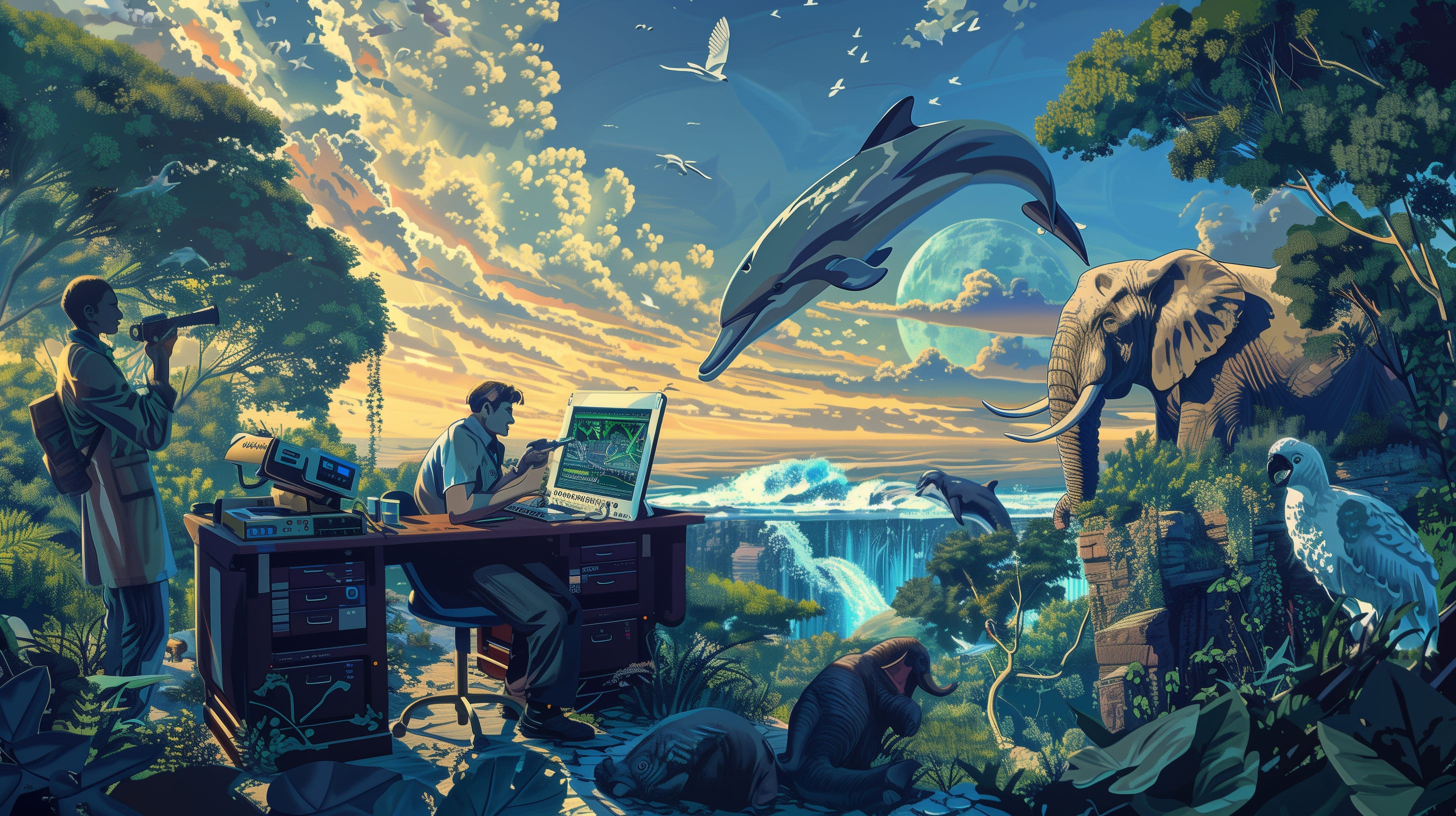
Project CETI (Cetacean Translation Initiative) is one such project where AI is being used to understand the complex communication patterns of dolphins. Using deep learning algorithms, researchers analyze the vast array of clicks, whistles, and body postures to decode potential "words" and "sentences".
Understanding Elephants
At Cornell University, researchers are using AI to study the low-frequency rumbles of elephants, which travel long distances through the ground. By capturing and analyzing these sounds, AI helps in understanding their social interactions and alerts conservationists to poaching activities.
Birdsong Interpretation
AI is also being used to decode birdsongs, such as those of the endangered Hawaiian crow. By understanding their calls, scientists aim to improve breeding programs and better support their reintroduction into the wild.
Breaking Down the AI Translation Process
The idea of an AI translating animal communication might seem like magic, but it’s rooted in complex yet fascinating processes. Here’s a simplified breakdown of how it works:
Data Collection
The first step involves gathering a vast amount of data. For animals, this means recording their sounds, movements, and contextual behaviors. This data serves as the raw material for the AI to learn from.
Feature Extraction
Once the data is collected, AI algorithms sift through it to identify patterns. For instance, in dolphin communication, the AI might identify specific sound frequencies, patterns of clicks, or whistles that correlate with certain behaviors or responses.
Training the Model
The extracted features are used to train the AI model. This involves feeding the AI a labeled dataset (where the meaning of each sound is already known) and letting it learn the associations. The AI uses this information to predict the meaning of new, unlabeled data.
Pattern Recognition
Advanced AI, especially those using deep learning, can recognize complex patterns that are often undetectable by humans. For example, subtle variations in an elephant’s rumble might indicate different types of social interactions.
Contextual Understanding
Understanding communication isn’t just about decoding sounds; it’s also about context. AI systems are trained to consider environmental factors and situational context to provide more accurate interpretations.
Real-Time Translation
The ultimate goal is real-time translation. Imagine a biologist in the field receiving immediate insights into animal behavior through a handheld device powered by AI, much like a universal translator in sci-fi stories.
Ethical Considerations
In most cases, I'm not so scared of AI— but I have to admit, the idea of being able to speak to, confuse, and possibly control more of nature does give me pause. It's crucial to ensure that the AI models we develop are accurate and unbiased. While the specifics of this are over my pay grade when it comes to animals, ensuring fairness and mitigating biases is essential, just as it is with other datasets.
Why This Matters
Understanding animal communication has profound implications:
Conservation: By decoding distress signals, conservationists can intervene more effectively to protect endangered species.
Behavioral Science: Gaining insights into animal social structures and behaviors enriches our knowledge of the natural world.
Human-Animal Interaction: Improved communication can enhance how we coexist with and care for animals, from pets to wildlife. For instance, I would love to know what my dog Ruthie is thinking when she stares me down and cocks her head from one side to the other.
Conclusion
The intersection of AI and animal communication is an awe-inspiring frontier of technology. It opens up possibilities that were once confined to the realm of fantasy, bringing us closer to understanding and connecting with the animal kingdom. As AI continues to evolve, so too will our ability to bridge the communication gap between humans and animals, fostering a deeper, more harmonious relationship with all living beings on our planet.
I’m curious what other use cases for AI I've never thought of. What are some of your most esoteric and least expected use cases for AI? By breaking down these processes and sharing current examples, we can appreciate how AI isn't just a tool for human advancement but a bridge to a more interconnected and empathetic world.