

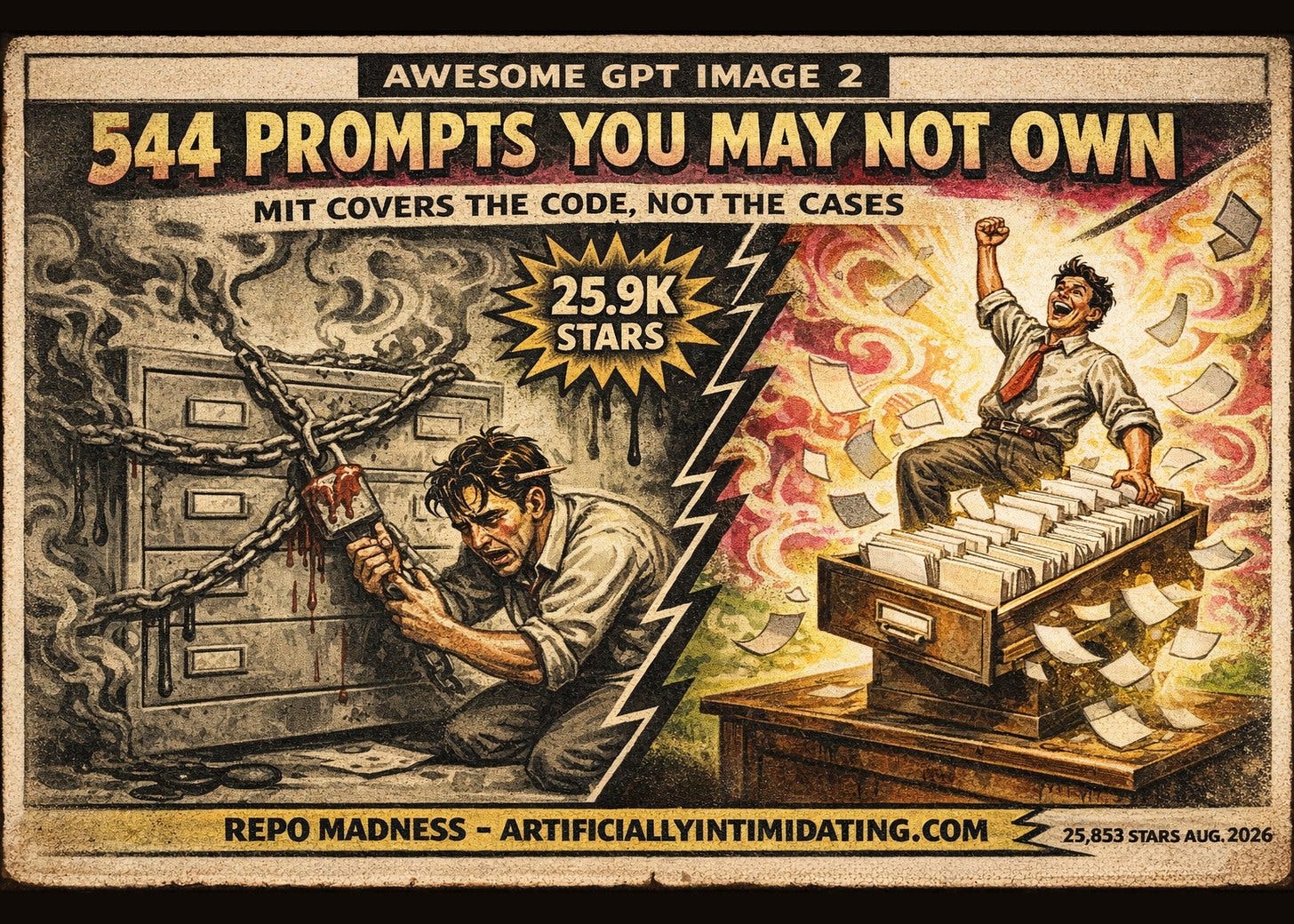
awesome-gpt-image-2 — a library of 544 structured prompt "cases" and 20+ templates for OpenAI's GPT-Image-2, organised as reusable, composable blocks rather than prose.
Alternative to: nothing you can buy. Today you type prompts yourself and iterate. The paid comparisons all fail an honesty test — PromptBase Select is $19/mo for ten prompts, so matching 544 cases would take 4.5 years and about $1,026, and nobody makes that trade. On Gumroad, a 165,000-prompt bundle currently sells for $0.00. The category has no price floor.
Cost to run: the library is free. The images are not: GPT-Image-2 at 1024x1024 costs $0.006 low, $0.053 medium, $0.211 high per image via the API, or a ChatGPT Plus subscription at $20/mo, for which OpenAI publishes no image quota.
Licence: MIT for the repository. The prompt cases are a separate question — see The catch.
Runs on: anything. It is markdown and images.
Requires: access to GPT-Image-2, via the API or a ChatGPT plan.
Traction: 25,853 stars · 2,541 forks · 167 commits · 5 committers in the last year.
Liveness: live for what it is — 13 commits in 30 days, last commit 2026-08-28 adding cases 539 to 544. Commit frequency is the wrong yardstick here; this is a reference library, not software with dependencies to bump.
Maturity: no versioning beyond style-library tags. 544 cases and counting.
Links: repo · gpt-image2.canghe.ai · Trendshift 28623
Figures as of 2026-08-31.
What it does
It turns prompt-writing into something closer to configuration. Rather than 544 paragraphs of prose, each case is split into composable parts — subject, lighting, materials, layout, visual details — so that a prompt can be edited by component and reused across a batch. The project calls this "Prompt as Code," and its stated goal is to "compress prose-style prompts into structured protocols" for agents, scripts and automation workflows.
There are 20-plus templates on top of the cases, a gallery split across three markdown files, and README translations in English, Chinese and Japanese.
There is also a companion website that renders the gallery as a browsable product, with large previews, copy-to-clipboard prompts, and filtering by style or scenario.
What it replaces, and what that costs
Nothing you were paying for, and this entry will not invent an incumbent to make the comparison look better.
PromptBase is the closest structural match and it is the wrong comparison. Individual prompts sell there for $2.99 to $9.99, and PromptBase Select is $19/month for "any 10 Select prompts each month." Reaching 544 cases that way is four and a half years and roughly $1,026, or about $2,700 buying à la carte. Nobody does that. Quoting it as "what this replaces" would be exactly the two-true-numbers-one-false-sentence trap this column tries to avoid.
The prompt-pack market has collapsed toward zero anyway. Alongside a $30 pack of 50 prompts on Gumroad sits a "165,000+ Prompts Bundle" at $0.00, and a "500,000+ AI Prompts Mega Bundle" also free. When 165,000 prompts are free, a 544-prompt library has no priced incumbent. That is the finding, not a gap in the research.
Midjourney, Firefly and Canva are the tool, not the library — you still have to write the prompt. For reference: Midjourney Basic $10/mo, Standard $30, Pro $60, Mega $120. Adobe Firefly Standard $9.99/mo for 2,000 generative credits, Pro $19.99 for 4,000. Canva Pro $180/yr.
What it actually compresses is iteration. There is one citable measurement. A controlled study of 20 participants across 10 target images and 10 iterations each — 2,000 prompts total — found that iterations one through six each scored significantly better than the tenth, and that "by iteration 7 and beyond, the effect is no longer statistically significant." Objective gains flatten around six or seven rounds. Starting from a working structured prompt instead of a blank box is a saving measured in generations, not dollars. At OpenAI's medium tier, seven iterations is about $0.37 per finished image; at high quality, about $1.48.
There is one priced product here, and it belongs to the maintainer. The companion site at gpt-image2.canghe.ai is not a free demo. Its public billing endpoint returns live membership tiers of $9, $19 and $49 per month for 700, 1,800 and 5,200 credits, and credit packs at $5, $15 and $39 for 300, 1,000 and 3,000 credits. The free allowance is one image, once — the interface string reads "Free generation used. Buy credits or start a membership to keep generating." There is also a separate one-time ¥9.90 payment for access to a WeChat community group.
What a paid credit buys is fixed in the site's own source: a single `gpt-image-2` call at `quality: 'low'`, `size: '1024x1024'`, not user-selectable, routed through a third-party relay rather than to OpenAI directly. OpenAI's list price for exactly that call is $0.006. The site's tiers work out to $0.0094 to $0.0167 per generation. That is roughly 1.6x to 2.8x OpenAI's own price for its cheapest quality setting. Both numbers are published; the arithmetic is the reader's to do.
For completeness: the membership pages are currently unlinked from the site's navigation and `/pricing` and `/membership` return 404, though the billing API answers and reports Stripe checkout available. The ¥9.90 community purchase is fully reachable.
Is it still alive?
Yes, on the right yardstick. 13 commits in the last 30 days and 41 in 90, with the most recent on 2026-08-28 adding cases 539 through 544. Cases are still being added weekly.
Commit frequency is the wrong measure for this artifact and this entry says so rather than pretending otherwise. A prompt library has no dependencies to bump and no CVEs to patch. The honest liveness question is whether new cases keep arriving, and they do. The comparison point is this column's own entry on the System Design Primer, judged "slow" at 364,000 stars because its last merge was a link fix — an artifact where the content had genuinely stopped moving. This one has not.
The concentration is worth flagging: five committers in the past year, 135 of 167 commits from one account, plus 20 more under the maintainer's Chinese name from the same email address. This is one person's library.
What people say
Very little, and the reason is structural. There are 28 issues in the repository's entire history. It has no meaningful Hacker News presence — searches return only unrelated 1-and-2-point submissions from other projects. Reddit is blocked from this column's research sandbox, so no Reddit vote counts are claimed here.
This is the "thin signal is a finding" case in its purest form: a file people copy is not a project people join. 2,541 forks against 28 issues is the signature of a resource being taken rather than a codebase being contributed to.
The issues that do exist are mostly requests — Bengali language support, a plea to add search and user-uploaded prompt sharing to the site, a marketplace listing notice. The one substantive piece of dissent is issue #3, reporting that case 326 is "明显和提供的提示词不一致" — plainly inconsistent with the prompt provided. A user checked whether a case reproduces and said it did not.
The catch
The MIT licence does not cover the thing you came for, and the repository says so itself. The README states the project "is open source under the MIT License. You can use, modify, distribute, and build on it freely while preserving the license notice." Eleven lines earlier, the disclaimer says something different:
"This repository does not guarantee that third-party content can be used commercially. Please obtain authorization from the original rights holder before commercial use."
Both sentences are in the same file. MIT explicitly grants the right to sell copies; the disclaimer says the maintainer cannot promise the cases are yours to use commercially. The MIT grant covers the repository's own scaffolding. For the 544 prompt cases, a commercial user cannot rely on it.
The provenance is disclosed, and it does not match the badge. The README carries a badge reading `100% Original AI Rewritten` and a headline describing "500+ Reverse-Engineered Cases." The disclaimer names the source: the project "references public prompt-library content from YouMind and OpenNana for learning, summarization, and methodology research. Copyright belongs to the original authors or platforms," and "all prompt cases and generated images in this repository were initially inspired by public community sources, especially YouMind and OpenNana." It offers a takedown path for rights holders. This entry reports what the repository says about itself; how much of each case is transformed rather than copied is not something it verified, and it does not claim to know.
The sponsors are four API relay services, and three carry undisclosed referral codes. APIMart, hiapi and PackyCode links in the README all include `?aff=` parameters; PPToken's does not. No affiliate disclosure appears anywhere in the README in any of its three languages. All four describe themselves as API aggregation or relay platforms for OpenAI, Anthropic and Google models.
Readers can weigh the pricing themselves. PPToken's own homepage advertises OpenAI capacity billed at "16% of OpenAI's official price," subscription cards such as ¥789 (about $110) for "$10,000 额度/月" of list-price capacity, an architecture it describes as 多账号负载均衡 — multi-account load balancing — and payment by WeChat Pay, Alipay or USDT. Set against that, OpenAI's Services Agreement §3.1 states "Customer may not resell or lease access to its Account or any End User Account," and §3.3(g) prohibits customers from "buy, sell, or transfer API keys from, to, or with a third party." Anthropic's Commercial Terms §D.4 bars using the services "to build a competing product or service... or resell the Services except as expressly approved."
This entry names no company as violating anything. It reports the advertised prices, the advertised architecture, and the vendors' published terms, and leaves the comparison to the reader. One smaller note for accuracy: the README's sponsor blurb claims GPT-Image-2 "from $0.006/image" via APIMart, but that site's own pricing page shows $0.0085, and $0.006 is precisely OpenAI's list price for the same call.
Most of the value is in Chinese. The README is translated three ways, but the community, the WeChat group and much of the surrounding material are not.
It is one person's library, with the same person running the free repository and the paid site.
Credits
Maintained by freestylefly (苍何), Founder at WeSight, based in Wuhan, on X as @canghe — 135 commits under that account and 20 more as 苍何 from the same address. Contributions from canghe (9), 冷雄伟, sscodeai and ImgBotApp.
Source libraries credited by the repository itself: YouMind and OpenNana.
Issue reporters referenced: the filer of issue #3 on case 326, and the requesters on issues #25 and #27.
Prices verified against the live billing endpoints at gpt-image2.canghe.ai, developers.openai.com image-generation and pricing docs, help.openai.com, promptbase.com, the named Gumroad listings, docs.midjourney.com, adobe.com/products/firefly/plans.html, canva.com/pricing, apimart.ai/pricing and pptoken.cc. Iteration study: Trinh et al., "A Picture is Worth a Thousand Prompts?", arXiv:2504.20340. Licence and disclaimer text quoted from the repository's own README and docs/disclaimer.md. Repository figures from a blobless clone and ungh.cc, both read 2026-08-31.