

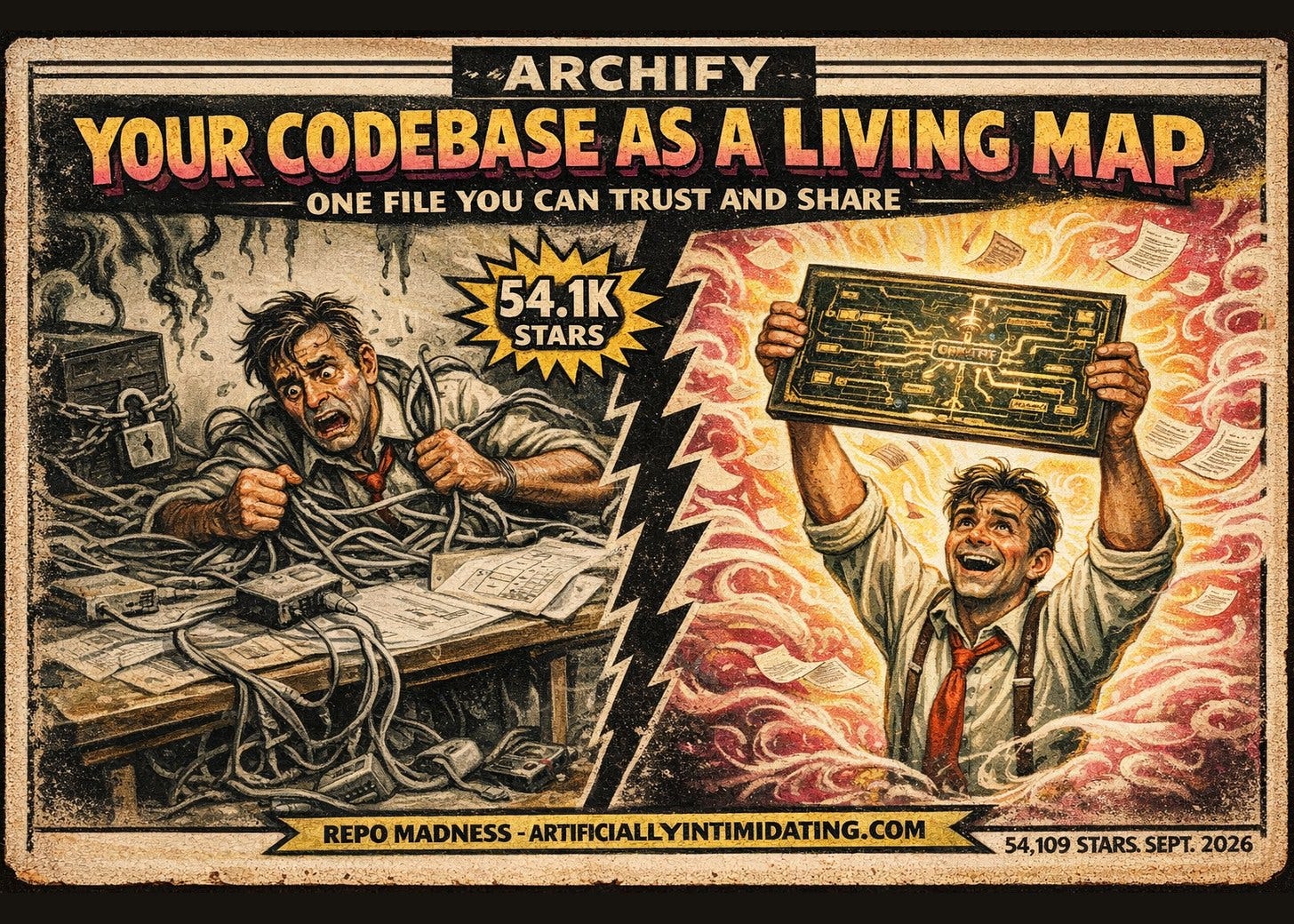
Archify — an agent skill that turns a codebase or a plain description into an interactive architecture, workflow, sequence, data-flow or lifecycle diagram, delivered as one self-contained HTML file.
Alternative to: Ilograph Pro at $18/month billed annually, or $22/month billed monthly, where exporting a self-contained HTML file is itself the paid feature · Eraser Starter at $15/member/month billed annually, or $20/month monthly, metered at 40 AI credits a month · Lucidchart Individual at $9/month billed annually, against a free tier limited to 3 editable documents and 75 shapes per document · Structurizr, the architecture-diagrams-as-code incumbent, whose cloud service is now end of life and whose self-hosted server licence runs GBP 300/month for 1 to 20 users, billed annually.
Cost to run: free. The rendering and validation are local Node. You pay whatever your coding agent already costs you, and nothing else.
Licence: MIT — free for commercial use.
Runs on: anywhere Node runs, driven from Cursor, Claude Code, Codex CLI or OpenCode.
Requires: Node.js and one of those agents. No repository is required — you can describe a system in chat and get a diagram back.
Traction: 54,109 stars · 3,542 forks · 236 commits onmain· open/closed issue counts unknown; issue and PR numbering has reached at least #354.
Liveness: very live — 105 commits in the last 30 days, 201 in the last 90, 25 authors in the last year, last commit 2026-09-08.
Maturity: latest stable release v2.16.0, 2026-08-30, across 19 tags, with v2.17.0-dev.1 named in the README as the current development version. Past 2.0 and cutting releases regularly.
Note on defaults: Archify makes an outbound network request on a roughly 72-hour cycle to check for a newer stable version. Its README states the server receives normal HTTP metadata only — IP and time — and no version, agent, project data, prompts, account or device ID. It never downloads or installs anything. SetARCHIFY_UPDATE_CHECK_DISABLED=1to turn it off.
Links: github.com/tt-a1i/archify · tt-a1i.github.io/archify · Trendshift #31352 · a Hacker News submission on 2026-09-07 scored 1 point and drew a single comment.
Figures as of 2026-09-08.
What it does
You ask your coding agent to map a system. The agent produces typed JSON describing the components and their connections, and Archify compiles that JSON deterministically into HTML and SVG. The output is one file with no external dependencies that you can open, present from, or attach to a pull request.
The design choice underneath is that the agent is not allowed to draw. It emits a typed intermediate representation, and Archify validates and renders it. That is what stops the usual failure where a language model produces a confident diagram of a system that does not exist.
Five diagram types, four visual presets, dark and light themes. The viewer does more than display: you can search nodes, trace upstream and downstream reach along authored edges, compare two validated snapshots as before, delta and after to review an architecture change before merge, and play guided named chapters through a diagram. Export covers PNG, SVG, WebM and a 1200x630 share card.
Install is npx skills add tt-a1i/archify -g.
What it replaces, and what that costs
The headline is not a price. It is that the closest incumbent stopped selling the product.
Structurizr's cloud service is end of life. structurizr.com/pricing returns HTTP 404. The Structurizr homepage carries a site-wide banner reading "Cloud service end of life announcement," and the page at docs.structurizr.com/cloud is now filed under a docs section titled "End of life," containing a migration guide that tells existing users to export their workspaces and move to the playground, to Structurizr Lite, or to a self-hosted server.
What Structurizr still prices is that self-hosted server:
Structurizr server, self-hosted — GBP 300/month for 1 to 20 unique users, rising through GBP 600 (21 to 50), GBP 900 (51 to 100) and on to GBP 2,400 (1001+).
Billed annually and does not auto-renew. Payments are non-refundable. There is no self-serve checkout — purchase is by email quote.
A "unique user" explicitly includes viewers, iframe embeds, image embeds and automated API processes, not just people who edit diagrams.
So the smallest band is GBP 3,600 a year, and the meter counts everyone who so much as looks at a rendered diagram.
The commercial products still selling in this space:
Ilograph Pro — $18/month billed annually, $22/month billed monthly. The relevant detail: Ilograph's own feature list puts "Export your diagrams to 100% self-contained HTML files that can be hosted anywhere" behind Pro. That is precisely Archify's output format, sold as an upgrade.
Eraser Starter — $15/member/month billed annually, $20/month monthly. AI generation is metered in credits: 5 AI diagrams on Free, 40 monthly AI credits on Starter, 250 monthly on Business at $45/member/month annually. Free is separately capped at 3 files.
Lucidchart Individual — $9/month billed annually. Free is capped at 3 editable documents and 75 shapes per document.
Archify's own cost is zero, and that figure is honest rather than hidden, because the compute is local. There is no inference bill hiding behind it: the agent you already run writes the JSON, and Node renders it.
One caution on the comparison. Lucidchart and Miro are general diagramming canvases where people draw org charts and flowcharts by dragging boxes. Archify does not do that, and nobody should cancel a Lucidchart seat expecting to replace it. The overlap is narrow and specific: producing an architecture diagram that reflects a real system. Against Ilograph and Eraser, which sell exactly that, the comparison is direct. Against Lucidchart, it is partial.
Is it still alive?
Aggressively. 105 commits in the last 30 days, 201 in the last 90, from 25 authors over the past year, with the most recent landing 2026-09-08. Nineteen tags, latest stable v2.16.0 on 2026-08-30, and the README naming v2.17.0-dev.1 as the in-flight version.
The release notes for v2.16.0 credit 21 pull requests by number and author, from nine contributors other than the maintainer, plus a New Contributors block naming six first-timers. That is a project taking contributions rather than a solo repo with a comments section. Maintainer concentration is still meaningful: tt-a1i accounts for 170 of the recorded contributions across two addresses, with sunsunsun-java next at 30 across three.
The tracker moves in days. Issues filed on 2026-09-04, 09-05 and 09-06 carry numbers in the 300s and 320s against a project that has reached at least #354.
Star growth is steep enough to be worth dating precisely: this entry recorded 52,220 stars on 2026-09-07 and 54,109 on 2026-09-08.
What people say
Almost nothing, publicly, and that is the finding. The only relevant Hacker News submission is "Archify", posted 2026-09-07 by saikatsg. It scored 1 point. It received one comment, from soltanov, reading in full:
"It is useful architecture tool."
That is the entire public conversation on Hacker News about a repository with 54,109 stars. Reddit is blocked from the research sandbox, so no vote counts from it are claimed.
The issue tracker carries the real signal, and it is unusually high quality. Citing titles rather than threads read in full: macawi-ai opened #301 on 2026-09-04, "repository-evidence: identity binding is hard-coded to github.com, blocking self-hosted Git (Gitea/GitLab/Forgejo)." jmvassoler opened #277 on 2026-09-02 reporting that adaptive reader width depends on reaching Google Fonts, shifting from 960 to 987 offline, and that the pinned desktop-reader test only passes online. julianwirawan-hash opened #310 on 2026-09-04 on a live-preview crash with a native libuv assertion on short-name-aliased Windows paths.
Windows is a recurring theme — a separate issue, #274, reports that --repo-root is rejected as not-top-level when the Windows drive letter is lowercase.
The sharpest one is the dissent, and it is aimed straight at the project's central claim. On 2026-09-05, ronenamr opened #324: "3 of 5 packaged examples fail archify's own visual-check containment gate."
The catch
Take #324 seriously. Archify's entire pitch is deterministic validation — the diagrams are trustworthy because the tool checks them. An outside reporter's issue title says three of five packaged examples fail the tool's own visual-check containment gate. The entry does not restate that as a count of what the repository ships, because the examples directory on the default branch holds more than five files and the issue's scope was not read in full. That is cited here as a filed issue title, not a verified reproduction, and it is the first thing to test before trusting the output on anything that matters.
The update check is a network call the tool makes on its own. The project discloses it clearly, scopes it narrowly, and ships an environment variable to disable it, which is better behaviour than most. It is still an outbound request from a diagramming tool, and it is listed in Quick Facts rather than buried here for that reason.
The README carries paid sponsor placements, including an affiliate link with a discount code for an API reseller and a link to a sponsor's own agent product. That is disclosed on the page and does not touch the licence, but it is worth knowing that the README is partly a commercial surface.
The README on the default branch offers no social handle, only a QQ email address. Outreach and questions therefore go to the GitHub issue tracker rather than to a public mention.
Open and closed issue counts are not obtainable from this research sandbox, so the traction row reports the highest number reached instead of a ratio.
My read
The story here is not that a free tool undercut a paid one. It is that Structurizr, the incumbent for architecture-diagrams-as-code, shut down its hosted service and left GBP 300 a month with an email-only checkout as the on-ramp — where the meter counts anyone who views a diagram, not just the people making them.
That is not a product losing to a better product. That is a vendor walking away from the easy tier and leaving a hole.
Archify sits in that hole. It did not arrive in response — its first commit is dated 2026-04-15 and it was already at version 2.0 — but a free MIT tool that produces a shareable HTML file is standing exactly where a team that just lost its cloud workspace is standing. Ilograph, meanwhile, is over there charging $18 a month with self-contained HTML export as the upgrade trigger.
I would not read the 54,000 stars as 54,000 people using this. But I would read the issue tracker as real — those Windows path bugs and the self-hosted Git request are what people file when they are actually trying to run something, not when they are browsing. That is the more useful signal, and it is the one I would watch.
Before I trusted it on anything that mattered, though, I would run issue #324 down first. A validation tool that cannot validate its own examples is a specific claim, and it is cheap to check.
Credits
tt-a1i maintains Archify and wrote 170 of its recorded contributions. sunsunsun-java, YunyueLi, NgoQuocViet2001, ClaireXi99, smf-h, yunaremaia, simaba and seekskyworld are credited in the v2.16.0 release notes. Issue reporters cited by title: macawi-ai, jmvassoler, julianwirawan-hash, ronenamr. Hacker News commenter soltanov, quoted in full, and submitter saikatsg.
Figures came from the Archify repository and its README, ungh.cc for counts and releases, a blobless clone for commit history, and the published pricing pages of Ilograph, Eraser, Lucidchart and Structurizr, plus Structurizr's own end-of-life documentation. The Hacker News score and comment came from the Algolia HN API.